Dylan Thomas
Author of the day

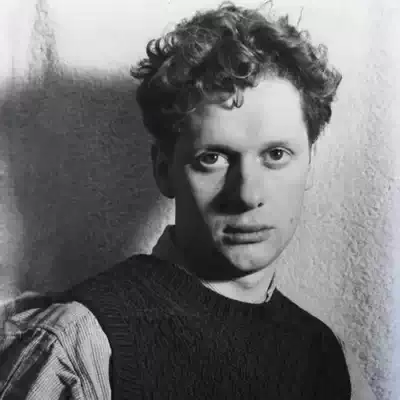
Dylan Thomas

Dylan Thomas was a celebrated Welsh poet whose vivid imagery, lyrical intensity, and unique use of language captivated readers worldwide. His work, often characterized by its passionate exploration of life, death, love, and nature, combined a deep connection to his Welsh heritage with a modernist sensibility. Despite a tragically short and often tumultuous life, his poems possess an enduring power and musicality that have secured his place as one of the 20th century's most important poets.

Poem of the day

Do Not Go Gentle Into That Good Night

Dylan Thomas
Do not go gentle into that good night, 
Old age should burn and rave at close of day; 
Rage, rage against the dying of the light. 

Though wise men at their end know dark is right, 
Because their words had forked no lightning they 
Do not go gentle into that good night. 

Good men, the last wave by, crying how bright 
Their frail deeds might have danced in a green bay, 
Rage, rage against the dying of the light. 

Wild men who caught and sang the sun in flight, 
And learn, too late, they grieved it on its way, 
Do not go gentle into that good night. 

Grave men, near death, who see with blinding sight 
Blind eyes could blaze like meteors and be gay, 
Rage, rage against the dying of the light. 

And you, my father, there on that sad height, 
Curse, bless, me now with your fierce tears, I pray. 
Do not go gentle into that good night. 
Rage, rage against the dying of the light.
Read full poem

Born on this day

14
Sebastião da Gama

Sebastião da Gama was a Portuguese poet, essayist, and professor, known for his deep connection to nature, especially the landscape of Serra da Arrábida, and for his work that celebrates life, beauty, and transcendence. His poetry, marked by a simple lyricism and accessible language, yet rich in meaning, reflects an immanent spirituality and profound gratitude for existence. Despite a life dedicated to teaching and literary creation, his work, which developed far from prominent literary circles, has earned a distinguished place in contemporary Portuguese literature for its authenticity and its ability to evoke the sacred in the everyday.

Daniel Faria

Daniel Faria was a Brazilian poet whose work stands out for its lyrical intensity, exploration of existential and spiritual themes, and for a language that oscillates between the sacred and the profane. His poetry, marked by deep restlessness and a search for transcendence, revealed a singular talent that left an indelible mark on Brazilian literature, despite his short life.

Vladimir Nabokov

Vladimir Nabokov was a prominent Russian-American novelist, short-story writer, translator, and literary critic. Born in St. Petersburg to an aristocratic family, he became known for his intricate literary style, wordplay, and complex themes such as memory, identity, and obsession. His most famous work, 'Lolita,' generated both controversy and acclaim. Following the Russian Revolution, Nabokov emigrated with his family, living in Europe before settling in the United States. He taught literature at American universities and wrote in both Russian and English, demonstrating an exceptional command of both languages. His writing is characterized by lyrical prose, subtle humor, and a deep appreciation for beauty and art.

That trite little whimsy about characters getting
Maria Banus

Maria Banuș was a Romanian poet, known for her lyrical and intimate poetry, often exploring themes such as nature, love, and the passage of time. Her work is distinguished by its musicality and the delicacy of its imagery.

Bella Akhmadúlina

Bella Akhmadulina was a prominent Russian poet, known for her refined lyricism and emotional expressiveness. Her poetic work is marked by formal beauty, the exploration of universal themes such as love, memory, and the passage of time, and a deep aesthetic sensibility. Akhmadulina emerged as an important voice in 20th-century Russian poetry, captivating readers with her elaborate language and her ability to evoke vivid imagery and profound feelings. Her legacy endures as a testament to the power of poetry in expressing the complexities of the human experience.

Vesna Parun

Vesna Parun was one of the most important Croatian poetesses of the 20th century, known for her lyrical, innovative, and profoundly human poetry. Her work, which spanned various phases and styles, explored themes such as love, nature, the human condition, and freedom. With a prolific career marked by originality, Parun left a significant legacy for Croatian literature, being recognized for her contribution to the renewal of poetic language and the expressive force of her verses.

António Matias

António Matias is a poet whose work stands out for its lyrical depth and exploration of themes such as identity, memory, and the human relationship with the surrounding world. His writing is marked by a refined language and a keen sensitivity to capture the subtleties of existence. Throughout his career, he has been building a body of work that reflects on the human condition, the passage of time, and the search for meaning, offering the reader a rich and contemplative poetic experience.

Domitila de Carvalho

Domitila de Carvalho was a pioneer in the fields of physics and mathematics in Portugal, standing out for her academic career and her dedication to teaching and research. She was one of the first women to obtain a doctorate in Physical and Mathematical Sciences in Portugal, paving the way for future generations of women scientists. Her work, although centered on her area of expertise, represents a milestone in the fight for equal opportunities for women in science and higher education.

Norman Dubie

Norman Dubie is an American poet known for his poetry that often delves into historical, mythological, and personal landscapes. His work is characterized by an imaginative approach and an exploration of the complexities of life and consciousness. He teaches at the University of Arizona and has influenced many younger poets with his distinct voice and his ability to weave narratives and images in an engaging way.

Horace Gregory

Horace Gregory was an American poet, literary critic, and translator. His poetic work is known for its introspection, exploration of social and historical themes, and a style that often blends the lyrical with the narrative. He was also a long-time scholar of poetry, contributing critical analyses and important translations. As a critic, Gregory offered insightful reviews of modern and classical poets, while his translations, notably of Catullus, helped make ancient poetry more accessible to the contemporary audience.

Adrian Henri

Adrian Henri was an English poet associated with the Liverpool Poetry Scene, an influential group in the 1960s and 1970s. His poetry is known for its accessibility, vibrant imagination, and themes that often celebrate love, the city, and everyday aspects. Henri was also noted for his versatility, working in various media, including visual arts and music.

Ramón de Almagro

Ramón de Almagro was a poet whose work is inscribed in the Spanish lyric tradition, exploring the depths of human sentiment and the beauty of language. His poetry is characterized by careful meter and a particular sensitivity for capturing emotions and reflections on existence. Although his figure may be less known compared to other great names in poetry, Almagro represents an authentic voice within his time, contributing his talent to the richness of the poetic heritage.

Died on this day

6
Cora Coralina

Cora Coralina was a Brazilian poet, known for her poetry that portrays the daily life of the interior of Goiás and the memories of her life. Her work, marked by simplicity and popular wisdom, addresses themes such as family, work, nature, and the passage of time, with an accessible and profound language. She is considered one of the most authentic and representative voices of Brazilian poetry of the 20th century, having achieved late but consolidated recognition for her literary contribution.

Teixeira de Melo

António de Azevedo Teixeira de Melo was a prominent Portuguese writer, playwright, and journalist. His work spans a variety of genres, but he particularly excelled in theater, where his comedies and dramas acidly and humorously explored the customs of the society of his time. He was an active figure in the literary and political circles of the 19th century, known for his intelligence and critical spirit.

Oscar Cerruto

Oscar Cerruto was a Bolivian poet and diplomat, known for his poetry that explores the dimensions of identity, land, and the human condition with lyrical and introspective language. His work is part of a context of reflection on Latin American reality and the search for meaning in a constantly changing world. His literary journey is marked by a constant search for authentic expression, addressing themes such as memory, time, and spirituality. Cerruto left a body of poems that invite contemplation and appreciation of the beauty and complexity of existence.

Henry Van Dyke

Henry Van Dyke was an American author, educator, and clergyman. He is remembered for his contributions to literature, particularly his short stories and poems. Van Dyke's work often explored themes of nature, faith, and the pursuit of happiness, reflecting his own diverse interests and experiences. He was a prolific writer and also held significant positions in academia and public service.

A Child in the Garden
Khalil Gibran

Khalil Gibran was a Lebanese-American poet, writer, and philosopher. He is best known for his philosophical essays and prose poetry, particularly his iconic work "The Prophet." Gibran's writings explore themes of love, freedom, spirituality, and the human condition with a distinctive blend of Eastern and Western thought. His poetic style is characterized by its lyrical beauty, profound wisdom, and universal appeal, making him one of the most widely read poets of the 20th century.

Are you a politician who says to himself: ‘I will