

Awards
Grand prix national de la poésie
Grand Prix National de Poésie
Description
History and Purpose of the Award
The Grand Prix National de la Poésie, often referred to as the "Grand Prix de Poésie" or simply "Grand Prix National", is a distinction of great importance in the French literary landscape. Established in 1947, this award's main objective is to honor and promote poetry, recognizing the work of poets who, throughout their careers, have demonstrated exceptional talent, depth of thought, and a significant contribution to the poetic art.
Distinctive Features
Unlike many other awards that focus on a specific work published in a given year, the Grand Prix National de la Poésie distinguishes the poet's entire body of work, valuing their trajectory, consistency, and the lasting impact of their work. This approach gives the award the character of a life achievement recognition dedicated to poetry, celebrating artistic maturity and the laureate's influence.
Selection Process and Criteria
The selection of winners is carried out by a jury composed of prominent figures from the literary world, including critics, academics, publishers, and other renowned poets. The jury's composition is rotational and seeks to ensure a rigorous and representative evaluation of the current state of French poetry. The selection criteria, although not explicitly codified in rigid regulations, focus on the aesthetic and literary quality of the work, the originality of the poetic voice, the capacity for language renewal, thematic depth, and the emotional and intellectual resonance that the author's poetry provides.
Scope and Relevance
The award is not limited to a specific genre of poetry, encompassing everything from the most lyrical and intimate poetry to more engaged and experimental poetry. Its relevance lies in its ability to highlight poets who, at times, operate outside the more commercial or media-driven circuits, granting them the recognition they deserve and drawing public attention to the richness and diversity of contemporary poetic production.
Illustrious Laureates
Throughout its history, the Grand Prix National de la Poésie has been awarded to some of the most important names in French poetry of the 20th and 21st centuries, including figures such as Paul Éluard, Louis Aragon, René Char, Yves Bonnefoy, Philippe Jaccottet, André Frénaud, Jacques Roubaud, among many others. The awarding of the prize to these authors solidified their reputation and contributed to their definitive consecration in the French literary canon.
Value and Ceremony
The award is often associated with a monetary component, although its symbolic value and the prestige it confers are, for many, the most significant aspects. The award ceremony, when held, is an important cultural event, bringing together the literary community and celebrating poetry as an essential art form.
Legacy and Reflection of Poetic Evolution
Interestingly, the history of the award also reflects the evolutions and aesthetic currents of French poetry over the decades, with its laureates representing different schools, sensibilities, and approaches to the poetic art. Its longevity and the quality of its winners attest to its continued importance as a beacon for poetry in the French language.
Winners

Franck Venaille


Claude Vigée

Anne Perrier
Anne Perrier is a writer and poet whose work explores the depths of the human condition with sharp sensitivity. Her writing is characterized by a rich and evocative language, often delving into themes of memory, identity, and the ephemerality of existence. She stands out for her ability to weave narratives and verses that resonate with the reader on a deep emotional and intellectual level. With a lyrical and introspective voice, Perrier builds literary universes that invite reflection on the complexities of daily life and human passions. Her contribution to literature lies in how she approaches subjectivity and the perception of the world, creating works that are both personal and universal, enriching the literary landscape with her unique perspective.

Dominique Fourcade
Dominique Fourcade is a contemporary French poet, whose work is marked by intense writing and a deep exploration of language, the body, and lived experience. Her poetry is distinguished by its lyrical strength and its ability to reveal the complexities of being and feeling. She is recognized for her significant contribution to French poetry, with verses that challenge conventions and invite immersion in poetic matter, revealing a sharp sensibility and a particular vision of the world.

Philippe Jaccottet

Philippe Jaccottet was a French-language Swiss poet and essayist, widely recognized for his lyrical and reflective work. His poetry explores the relationship between man and nature, the passage of time, memory, and the search for a more attentive gaze upon the world. Jaccottet also distinguished himself as a translator and literary critic, leaving a significant intellectual legacy.

Loránd Gáspár

Yves Bonnefoy

Bernard Noël
Bernard Noël was a French poet, novelist, and essayist, whose work was characterized by an intense exploration of language and its relationship with the body, desire, and death. His writing is marked by expressive force and a constant search for the radicality of the word. Known for his formal daring and his ability to strip bare human anguish and impulses, Noël built a singular literary universe. His poetry and prose are an invitation to confront the deepest and often darkest aspects of existence, with a sharp sensitivity to the tensions between silence and voice, life and nothingness.
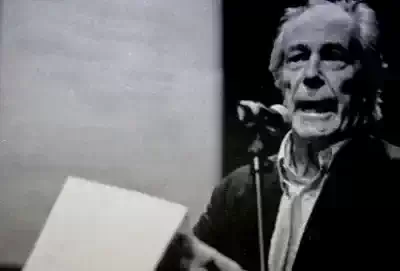
Bernard Heidsieck

Jacques Roubaud

Michel Deguy

Jacques Dupin

Edmond Jabès
Edmond Jabès was a Franco-Egyptian poet, known for his profoundly philosophical work and for exploring themes such as the book, the desert, exile, and the word. His poetry is characterized by dense language and a fragmented structure.

Jean Tortel

André Frénaud

Eugène Guillevic
Eugène Guillevic was a French poet, known for his work exploring the relationship between humanity and the natural world, often with a contemplative and philosophical tone. His poetry is marked by formal simplicity and depth of thought, addressing themes such as the earth, time, and existence with clear and evocative language.

André du Bouchet
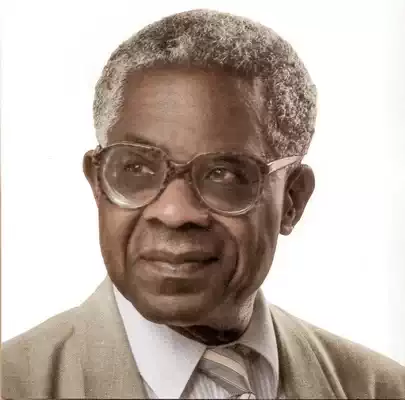
Aimé Césaire
Aimé Césaire was a Martinican poet, writer, and politician, a prominent figure in the literary and political movement of Négritude. His poetic work, marked by expressive force and denunciation of colonialism, deeply explored African and Caribbean identity. He was also an influential political leader, fighting for decolonization and the rights of oppressed peoples.
Francis Ponge
Francis Ponge was a French poet and writer, known for his unique and meditative approach to the material world and language. His work, which defies traditional categorizations, explores everyday objects and natural elements with philosophical depth and meticulous attention to the word. Ponge dedicated himself to deconstructing conventional poetry, focusing on sensory experience and the materiality of existence, which earned him a unique place in 20th-century literature.