
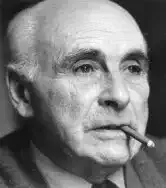
Francis Ponge
1899–1988
· lived 89 years
 FR
FR
FR
Francis Ponge was a French poet and writer, known for his unique and meditative approach to the material world and language. His work, which defies traditional categorizations, explores everyday objects and natural elements with philosophical depth and meticulous attention to the word. Ponge dedicated himself to deconstructing conventional poetry, focusing on sensory experience and the materiality of existence, which earned him a unique place in 20th-century literature.
n. 1899-03-27, Montpellier · m. 1988-08-06, Le Bar-sur-Loup
86
Views
Bio
Identification and basic context
Francis Ponge, full name Francis Jean Gaston Louis Ponge, was born in Boulogne, France. He was a renowned French poet and essayist, whose work is distinguished by its originality and profound meditation on the world and language. He lived during a period of intense social and cultural transformations in Europe, which was subtly reflected in his perspective on reality.Childhood and education
Ponge was born into a bourgeois family, which provided him with access to a relatively privileged education and cultural environment. His intellectual development was marked by diverse readings and a growing sensitivity to the nuances of language and the detailed description of the world. He absorbed influences that shaped his unique vision of poetry and poetic prose.Literary career
Ponge's writing began to develop gradually, culminating in the publication of works that departed from the literary conventions of the time. His evolution over time was marked by a constant exploration of language and an attempt to capture the essence of objects. His major work, "Le Parti pris des choses" (The Things Chosen), published in 1942, is a landmark in his career and in French literature.Work, style, and literary characteristics
Ponge's work, with "Le Parti pris des choses" as its prime example, explores the meticulous and meditative description of everyday objects, such as stones, cigarettes, or bread. His style is characterized by dense poetic prose, with precise vocabulary and extreme attention to the materiality of words and things. Ponge sought to strip objects of their usual symbolic charge to reveal their pure existence. His tone is often reflective and almost scientific, yet imbued with a deep admiration for life and language.Work, style, and literary characteristics
Cultural and historical context Ponge lived in France during a turbulent period, marked by two World Wars and significant political and social changes. Although he was not an overtly political author, his work reflects a certain melancholy and a profound reflection on the human condition in times of uncertainty. His position in French literature is that of an innovator, influencing later generations with his unique approach.Work, style, and literary characteristics
Personal life Specific details about Francis Ponge's personal life are less prominent in his work, which focuses more on external observation and reflection on the world. However, his dedication to writing and literary exploration was a constant throughout his life.Work, style, and literary characteristics
Recognition and reception Francis Ponge is widely recognized as one of the great French poets and prose writers of the 20th century. His work, although sometimes considered hermetic, has been the subject of study and admiration, consolidating his place in the literary canon.Work, style, and literary characteristics
Influences and legacy Ponge influenced many later writers and poets with his originality in exploring language and approaching objects. His ability to see the extraordinary in the ordinary continues to inspire readers and creators.Work, style, and literary characteristics
Interpretation and critical analysis Ponge's work is often interpreted as a meditation on the relationship between man, the world, and language. His search for the essence of things and his attention to poetic form have been the subject of critical analysis, highlighting his originality and his ability to challenge literary conventions.Work, style, and literary characteristics
Curiosities and lesser-known aspects A curiosity about Ponge is his writing methodology, which involved long periods of observation and reflection on a single object before beginning to write about it. This dedication to meticulous detail and sensory investigation is a distinctive aspect of his creative process.Work, style, and literary characteristics
Death and memory Francis Ponge passed away in France. His work continues to be published and studied, keeping his memory and literary legacy alive.Poems
0No poems found
Videos
50
Comments (0)
Log in
to post a comment.
No comments yet. Be the first to comment.