
Ethics and Morality
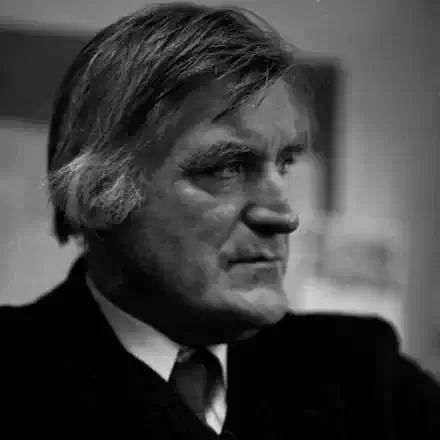
Ted Hughes
Tractor
The tractor stands frozen - an agony
To think of. All night
Snow packed its open entrails. Now a head-pincering gale,
A spill of molten ice, smoking snow,
Pours into its steel.
At white heat of numbness it stands
In the aimed hosing of ground-level fieriness.
It defied flesh and won't start.
Hands are like wounds already
Inside armour gloves, and feet are unbelievable
As if the toe-nails were all just torn off.
I stare at it in hatred. Beyond it
The copse hisses - capitulates miserably
In the fleeing, failing light. Starlings,
A dirtier sleetier snow, blow smokily, unendingly, over
Towards plantations Eastward.
All the time the tractor is sinking
Through the degrees, deepening
Into its hell of ice.
The starting lever
Cracks its action, like a snapping knuckle.
The battery is alive - but like a lamb
Trying to nudge its solid-frozen mother -
While the seat claims my buttock-bones, bites
With the space-cold of earth, which it has joined
In one solid lump.
I squirt commercial sure-fire
Down the black throat - it just coughs.
It ridicules me - a trap of iron stupidity
I've stepped into. I drive the battery
As if I were hammering and hammering
The frozen arrangement to pieces with a hammer
And it jabbers laughing pain-crying mockingly
Into happy life.
And stands
Shuddering itself full of heat, seeming to enlarge slowly
Like a demon demonstrating
A more-than-usually-complete materialization -
Suddenly it jerks from its solidarity
With the concrete, and lurches towards a stanchion
Bursting with superhuman well-being and abandon
Shouting Where Where?
Worse iron is waiting. Power-lift kneels
Levers awake imprisoned deadweight,
Shackle-pins bedded in cast-iron cow-shit.
The blind and vibrating condemned obedience
Of iron to the cruelty of iron,
Wheels screeched out of their night-locks -
Fingers
Among the tormented
Tonnage and burning of iron
Eyes
Weeping in the wind of chloroform
And the tractor, streaming with sweat,
Raging and trembling and rejoicing.
461

Ezra Pound
Salvationists
I
Come, my songs, let us speak of perfection
We shall get ourselves rather disliked.
II
Ah yes, my songs, let us resurrect
The very excellent term Rusticus.
Let us apply it in all its opprobrium
To those to whom it applies.
And you may decline to make them immortal,
For we shall consider them and their state
In delicate
Opulent silence.
III
Come, my songs,
Let us take arms against this sea of stupidities-
Beginning with Mumpodorus;
And against this sea of vulgarities
Beginning with Nimmim;
And against this sea of imbeciles
All the Bulmenian literati.
459

William Butler Yeats
Stream And Sun At Glendalough
THROUGH intricate motions ran
Stream and gliding sun
And all my heart seemed gay:
Some stupid thing that I had done
Made my attention stray.
Repentance keeps my heart impure;
But what am I that dare
Fancy that I can
Better conduct myself or have more
Sense than a common man?
What motion of the sun or stream
Or eyelid shot the gleam
That pierced my body through?
What made me live like these that seem
Self-born, born anew?
459

Rudyard Kipling
Heriot's Ford
"What's that that hirples at my side?"
The foe that you must fight, my lord.
"That rides as fast as I can ride?"
The shadow of your might, my lord.
"Then wheel my horse against the foe!"
He's down and overpast, my lord.
You war against the sunset-glow,
The judgment follows fast, my lord!
"Oh, who will stay the sun's descent?"
King Joshua he is dead, my lord.
"I need an hour to repent!"
'Tis what our sister said, my lord.
"Oh, do not slay me in my sins!"
You're safe awhile with us, my lord.
"Nay, kill me ere my fear begins!"
We would not serve you thus, my lord.
"Where is the doom that I must face?"
Three little leagues away, my lord.
"Then mend the horses' laggard pace!"
We need them for next day, my lord.
"Next day--next day! Unloose my cords!"
Our sister needed none, my lord.
You had no mind to face our swords,
And--where can cowards run, my lord?
"You would not kill the soul alive?"
'Twas thus our sister cried, my lord.
"I dare not die with none to shrive."
But so our sister died, my lord.
"Then wipe the sweat from brow and cheek."
It runnels forth afresh, my lord.
"Uphold me--for the flesh is weak."
You've finished with the Flesh, my lord!
461

Ella Wheeler Wilcox
Contentment
If any line that I ever penned,
Or any word I have spoken,
Has comforted heart of foe or friend In
any way, why my life, I'll say,
Has reaped the reward of labour,
If aught I have said, or written, has made
Gladder the heart o' my neighbour.
If any deed that I ever did
Lightened a sad heart's sorrow,
If I have lifted a drooping lid
Up to the bright to-morrow,
Though the world knows not, nor gives me a thought,
Nor ever can know, nor praise me,
Yet still I shall say, to my heart alway,
That my life and labour repay me.
If in any way I have helped a soul,
Or given a spirit pleasure,
Then my cup of joy, I shall think is full
With an overflowing measure.
Though never an eye, but the one on high
Looks on my kindly action,
Yet, O my heart, we shall think of our part
In the drama, with satisfaction.
460
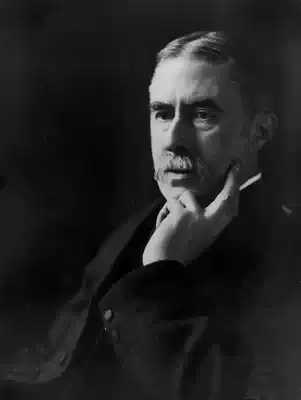
Alfred Edward Housman
The Day of Battle
"Far I hear the bugle blow
To call me where I would not go,
And the guns begin the song,
'Soldier, fly or stay for long.'
"Comrade, if to turn and fly
Made a soldier never die,
Fly I would, for who would not?
'Tis sure no pleasure to be shot.
"But since the man that runs away
Lives to die another day,
And cowards' funerals, when they come,
Are not wept so well at home,
"Therefore, though the best is bad,
Stand and do the best, my lad;
Stand and fight and see your slain,
And take the bullet in your brain."
461

Alfred Lord Tennyson
Balin and Balan
Pellam the King, who held and lost with Lot
In that first war, and had his realm restored
But rendered tributary, failed of late
To send his tribute; wherefore Arthur called
His treasurer, one of many years, and spake,
'Go thou with him and him and bring it to us,
Lest we should set one truer on his throne.
Man's word is God in man.'
His Baron said
'We go but harken: there be two strange knights
Who sit near Camelot at a fountain-side,
A mile beneath the forest, challenging
And overthrowing every knight who comes.
Wilt thou I undertake them as we pass,
And send them to thee?'
Arthur laughed upon him.
'Old friend, too old to be so young, depart,
Delay not thou for aught, but let them sit,
Until they find a lustier than themselves.'
So these departed. Early, one fair dawn,
The light-winged spirit of his youth returned
On Arthur's heart; he armed himself and went,
So coming to the fountain-side beheld
Balin and Balan sitting statuelike,
Brethren, to right and left the spring, that down,
From underneath a plume of lady-fern,
Sang, and the sand danced at the bottom of it.
And on the right of Balin Balin's horse
Was fast beside an alder, on the left
Of Balan Balan's near a poplartree.
'Fair Sirs,' said Arthur, 'wherefore sit ye here?'
Balin and Balan answered 'For the sake
Of glory; we be mightier men than all
In Arthur's court; that also have we proved;
For whatsoever knight against us came
Or I or he have easily overthrown.'
'I too,' said Arthur, 'am of Arthur's hall,
But rather proven in his Paynim wars
Than famous jousts; but see, or proven or not,
Whether me likewise ye can overthrow.'
And Arthur lightly smote the brethren down,
And lightly so returned, and no man knew.
Then Balin rose, and Balan, and beside
The carolling water set themselves again,
And spake no word until the shadow turned;
When from the fringe of coppice round them burst
A spangled pursuivant, and crying 'Sirs,
Rise, follow! ye be sent for by the King,'
They followed; whom when Arthur seeing asked
'Tell me your names; why sat ye by the well?'
Balin the stillness of a minute broke
Saying 'An unmelodious name to thee,
Balin, "the Savage"--that addition thine--
My brother and my better, this man here,
Balan. I smote upon the naked skull
A thrall of thine in open hall, my hand
Was gauntleted, half slew him; for I heard
He had spoken evil of me; thy just wrath
Sent me a three-years' exile from thine eyes.
I have not lived my life delightsomely:
For I that did that violence to thy thrall,
Had often wrought some fury on myself,
Saving for Balan: those three kingless years
Have past--were wormwood-bitter to me. King,
Methought that if we sat beside the well,
And hurled to ground what knight soever spurred
Against us, thou would'st take me gladlier back,
And make, as ten-times worthier to be thine
Than twenty Balins, Balan knight. I have said.
Not so--not all. A man of thine today
Abashed us both, and brake my boast. Thy will?'
Said Arthur 'Thou hast ever spoken truth;
Thy too fierce manhood would not let thee lie.
Rise, my true knight. As children learn, be thou
Wiser for falling! walk with me, and move
To music with thine Order and the King.
Thy chair, a grief to all the brethren, stands
Vacant, but thou retake it, mine again!'
Thereafter, when Sir Balin entered hall,
The Lost one Found was greeted as in Heaven
With joy that blazed itself in woodland wealth
Of leaf, and gayest garlandage of flowers,
Along the walls and down the board; they sat,
And cup clashed cup; they drank and some one sang,
Sweet-voiced, a song of welcome, whereupon
Their common shout in chorus, mounting, made
Those banners of twelve battles overhead
Stir, as they stirred of old, when Arthur's host
Proclaimed him Victor, and the day was won.
Then Balan added to their Order lived
A wealthier life than heretofore with these
And Balin, till their embassage returned.
'Sir King' they brought report 'we hardly found,
So bushed about it is with gloom, the hall
Of him to whom ye sent us, Pellam, once
A Christless foe of thine as ever dashed
Horse against horse; but seeing that thy realm
Hath prospered in the name of Christ, the King
Took, as in rival heat, to holy things;
And finds himself descended from the Saint
Arimathan Joseph; him who first
Brought the great faith to Britain over seas;
He boasts his life as purer than thine own;
Eats scarce enow to keep his pulse abeat;
Hath pushed aside his faithful wife, nor lets
Or dame or damsel enter at his gates
Lest he should be polluted. This gray King
Showed us a shrine wherein were wonders--yea--
Rich arks with priceless bones of martyrdom,
Thorns of the crown and shivers of the cross,
And therewithal (for thus he told us) brought
By holy Joseph thither, that same spear
Wherewith the Roman pierced the side of Christ.
He much amazed us; after, when we sought
The tribute, answered "I have quite foregone
All matters of this world: Garlon, mine heir,
Of him demand it," which this Garlon gave
With much ado, railing at thine and thee.
'But when we left, in those deep woods we found
A knight of thine spear-stricken from behind,
Dead, whom we buried; more than one of us
Cried out on Garlon, but a woodman there
Reported of some demon in the woods
Was once a man, who driven by evil tongues
From all his fellows, lived alone, and came
To learn black magic, and to hate his kind
With such a hate, that when he died, his soul
Became a Fiend, which, as the man in life
Was wounded by blind tongues he saw not whence,
Strikes from behind. This woodman showed the cave
From which he sallies, and wherein he dwelt.
We saw the hoof-print of a horse, no more.'
Then Arthur, 'Let who goes before me, see
He do not fall behind me: foully slain
And villainously! who will hunt for me
This demon of the woods?' Said Balan, 'I'!
So claimed the quest and rode away, but first,
Embracing Balin, 'Good my brother, hear!
Let not thy moods prevail, when I am gone
Who used to lay them! hold them outer fiends,
Who leap at thee to tear thee; shake them aside,
Dreams ruling when wit sleeps! yea, but to dream
That any of these would wrong thee, wrongs thyself.
Witness their flowery welcome. Bound are they
To speak no evil. Truly save for fears,
My fears for thee, so rich a fellowship
Would make me wholly blest: thou one of them,
Be one indeed: consider them, and all
Their bearing in their common bond of love,
No more of hatred than in Heaven itself,
No more of jealousy than in Paradise.'
So Balan warned, and went; Balin remained:
Who--for but three brief moons had glanced away
From being knighted till he smote the thrall,
And faded from the presence into years
Of exile--now would strictlier set himself
To learn what Arthur meant by courtesy,
Manhood, and knighthood; wherefore hovered round
Lancelot, but when he marked his high sweet smile
In passing, and a transitory word
Make knight or churl or child or damsel seem
From being smiled at happier in themselves--
Sighed, as a boy lame-born beneath a height,
That glooms his valley, sighs to see the peak
Sun-flushed, or touch at night the northern star;
For one from out his village lately climed
And brought report of azure lands and fair,
Far seen to left and right; and he himself
Hath hardly scaled with help a hundred feet
Up from the base: so Balin marvelling oft
How far beyond him Lancelot seemed to move,
Groaned, and at times would mutter, 'These be gifts,
Born with the blood, not learnable, divine,
Beyond MY reach. Well had I foughten--well--
In those fierce wars, struck hard--and had I crowned
With my slain self the heaps of whom I slew-So--
better!--But this worship of the Queen,
That honour too wherein she holds him--this,
This was the sunshine that hath given the man
A growth, a name that branches o'er the rest,
And strength against all odds, and what the King
So prizes--overprizes--gentleness.
Her likewise would I worship an I might.
I never can be close with her, as he
That brought her hither. Shall I pray the King
To let me bear some token of his Queen
Whereon to gaze, remembering her--forget
My heats and violences? live afresh?
What, if the Queen disdained to grant it! nay
Being so stately-gentle, would she make
My darkness blackness? and with how sweet grace
She greeted my return! Bold will I be--
Some goodly cognizance of Guinevere,
In lieu of this rough beast upon my shield,
Langued gules, and toothed with grinning savagery.'
And Arthur, when Sir Balin sought him, said
'What wilt thou bear?' Balin was bold, and asked
To bear her own crown-royal upon shield,
Whereat she smiled and turned her to the King,
Who answered 'Thou shalt put the crown to use.
The crown is but the shadow of the King,
And this a shadow's shadow, let him have it,
So this will help him of his violences!'
'No shadow' said Sir Balin 'O my Queen,
But light to me! no shadow, O my King,
But golden earnest of a gentler life!'
So Balin bare the crown, and all the knights
Approved him, and the Queen, and all the world
Made music, and he felt his being move
In music with his Order, and the King.
The nightingale, full-toned in middle May,
Hath ever and anon a note so thin
It seems another voice in other groves;
Thus, after some quick burst of sudden wrath,
The music in him seemed to change, and grow
Faint and far-off.
And once he saw the thrall
His passion half had gauntleted to death,
That causer of his banishment and shame,
Smile at him, as he deemed, presumptuously:
His arm half rose to strike again, but fell:
The memory of that cognizance on shield
Weighted it down, but in himself he moaned:
'Too high this mount of Camelot for me:
These high-set courtesies are not for me.
Shall I not rather prove the worse for these?
Fierier and stormier from restraining, break
Into some madness even before the Queen?'
Thus, as a hearth lit in a mountain home,
And glancing on the window, when the gloom
Of twilight deepens round it, seems a flame
That rages in the woodland far below,
So when his moods were darkened, court and King
And all the kindly warmth of Arthur's hall
Shadowed an angry distance: yet he strove
To learn the graces of their Table, fought
Hard with himself, and seemed at length in peace.
Then chanced, one morning, that Sir Balin sat
Close-bowered in that garden nigh the hall.
A walk of roses ran from door to door;
A walk of lilies crost it to the bower:
And down that range of roses the great Queen
Came with slow steps, the morning on her face;
And all in shadow from the counter door
Sir Lancelot as to meet her, then at once,
As if he saw not, glanced aside, and paced
The long white walk of lilies toward the bower.
Followed the Queen; Sir Balin heard her 'Prince,
Art thou so little loyal to thy Queen,
As pass without good morrow to thy Queen?'
To whom Sir Lancelot with his eyes on earth,
'Fain would I still be loyal to the Queen.'
'Yea so' she said 'but so to pass me by--
So loyal scarce is loyal to thyself,
Whom all men rate the king of courtesy.
Let be: ye stand, fair lord, as in a dream.'
Then Lancelot with his hand among the flowers
'Yea--for a dream. Last night methought I saw
That maiden Saint who stands with lily in hand
In yonder shrine. All round her prest the dark,
And all the light upon her silver face
Flowed from the spiritual lily that she held.
Lo! these her emblems drew mine eyes--away:
For see, how perfect-pure! As light a flush
As hardly tints the blossom of the quince
Would mar their charm of stainless maidenhood.'
'Sweeter to me' she said 'this garden rose
Deep-hued and many-folded! sweeter still
The wild-wood hyacinth and the bloom of May.
Prince, we have ridden before among the flowers
In those fair days--not all as cool as these,
Though season-earlier. Art thou sad? or sick?
Our noble King will send thee his own leech--
Sick? or for any matter angered at me?'
Then Lancelot lifted his large eyes; they dwelt
Deep-tranced on hers, and could not fall: her hue
Changed at his gaze: so turning side by side
They past, and Balin started from his bower.
'Queen? subject? but I see not what I see.
Damsel and lover? hear not what I hear.
My father hath begotten me in his wrath.
I suffer from the things before me, know,
Learn nothing; am not worthy to be knight;
A churl, a clown!' and in him gloom on gloom
Deepened: he sharply caught his lance and shield,
Nor stayed to crave permission of the King,
But, mad for strange adventure, dashed away.
He took the selfsame track as Balan, saw
The fountain where they sat together, sighed
'Was I not better there with him?' and rode
The skyless woods, but under open blue
Came on the hoarhead woodman at a bough
Wearily hewing. 'Churl, thine axe!' he cried,
Descended, and disjointed it at a blow:
To whom the woodman uttered wonderingly
'Lord, thou couldst lay the Devil of these woods
If arm of flesh could lay him.' Balin cried
'Him, or the viler devil who plays his part,
To lay that devil would lay the Devil in me.'
'Nay' said the churl, 'our devil is a truth,
I saw the flash of him but yestereven.
And some DO say that our Sir Garlon too
Hath learned black magic, and to ride unseen.
Look to the cave.' But Balin answered him
'Old fabler, these be fancies of the churl,
Look to thy woodcraft,' and so leaving him,
Now with slack rein and careless of himself,
Now with dug spur and raving at himself,
Now with droopt brow down the long glades he rode;
So marked not on his right a cavern-chasm
Yawn over darkness, where, nor far within,
The whole day died, but, dying, gleamed on rocks
Roof-pendent, sharp; and others from the floor,
Tusklike, arising, made that mouth of night
Whereout the Demon issued up from Hell.
He marked not this, but blind and deaf to all
Save that chained rage, which ever yelpt within,
Past eastward from the falling sun. At once
He felt the hollow-beaten mosses thud
And tremble, and then the shadow of a spear,
Shot from behind him, ran along the ground.
Sideways he started from the path, and saw,
With pointed lance as if to pierce, a shape,
A light of armour by him flash, and pass
And vanish in the woods; and followed this,
But all so blind in rage that unawares
He burst his lance against a forest bough,
Dishorsed himself, and rose again, and fled
Far, till the castle of a King, the hall
Of Pellam, lichen-bearded, grayly draped
With streaming grass, appeared, low-built but strong;
The ruinous donjon as a knoll of moss,
The battlement overtopt with ivytods,
A home of bats, in every tower an owl.
Then spake the men of Pellam crying 'Lord,
Why wear ye this crown-royal upon shield?'
Said Balin 'For the fairest and the best
Of ladies living gave me this to bear.'
So stalled his horse, and strode across the court,
But found the greetings both of knight and King
Faint in the low dark hall of banquet: leaves
Laid their green faces flat against the panes,
Sprays grated, and the cankered boughs without
Whined in the wood; for all was hushed within,
Till when at feast Sir Garlon likewise asked
'Why wear ye that crown-royal?' Balin said
'The Queen we worship, Lancelot, I, and all,
As fairest, best and purest, granted me
To bear it!' Such a sound (for Arthur's knights
Were hated strangers in the hall) as makes
The white swan-mother, sitting, when she hears
A strange knee rustle through her secret reeds,
Made Garlon, hissing; then he sourly smiled.
'Fairest I grant her: I have seen; but best,
Best, purest? THOU from Arthur's hall, and yet
So simple! hast thou eyes, or if, are these
So far besotted that they fail to see
This fair wife-worship cloaks a secret shame?
Truly, ye men of Arthur be but babes.'
A goblet on the board by Balin, bossed
With holy Joseph's legend, on his right
Stood, all of massiest bronze: one side had sea
And ship and sail and angels blowing on it:
And one was rough with wattling, and the walls
Of that low church he built at Glastonbury.
This Balin graspt, but while in act to hurl,
Through memory of that token on the shield
Relaxed his hold: 'I will be gentle' he thought
'And passing gentle' caught his hand away,
Then fiercely to Sir Garlon 'Eyes have I
That saw today the shadow of a spear,
Shot from behind me, run along the ground;
Eyes too that long have watched how Lancelot draws
From homage to the best and purest, might,
Name, manhood, and a grace, but scantly thine,
Who, sitting in thine own hall, canst endure
To mouth so huge a foulness--to thy guest,
Me, me of Arthur's Table. Felon talk!
Let be! no more!'
But not the less by night
The scorn of Garlon, poisoning all his rest,
Stung him in dreams. At length, and dim through leaves
Blinkt the white morn, sprays grated, and old boughs
Whined in the wood. He rose, descended, met
The scorner in the castle court, and fain,
For hate and loathing, would have past him by;
But when Sir Garlon uttered mocking-wise;
'What, wear ye still that same crown-scandalous?'
His countenance blackened, and his forehead veins
Bloated, and branched; and tearing out of sheath
The brand, Sir Balin with a fiery 'Ha!
So thou be shadow, here I make thee ghost,'
Hard upon helm smote him, and the blade flew
Splintering in six, and clinkt upon the stones.
Then Garlon, reeling slowly backward, fell,
And Balin by the banneret of his helm
Dragged him, and struck, but from the castle a cry
Sounded across the court, and--men-at-arms,
A score with pointed lances, making at him--
He dashed the pummel at the foremost face,
Beneath a low door dipt, and made his feet
Wings through a glimmering gallery, till he marked
The portal of King Pellam's chapel wide
And inward to the wall; he stept behind;
Thence in a moment heard them pass like wolves
Howling; but while he stared about the shrine,
In which he scarce could spy the Christ for Saints,
Beheld before a golden altar lie
The longest lance his eyes had ever seen,
Point-painted red; and seizing thereupon
Pushed through an open casement down, leaned on it,
Leapt in a semicircle, and lit on earth;
Then hand at ear, and harkening from what side
The blindfold rummage buried in the walls
Might echo, ran the counter path, and found
His charger, mounted on him and away.
An arrow whizzed to the right, one to the left,
One overhead; and Pellam's feeble cry
'Stay, stay him! he defileth heavenly things
With earthly uses'--made him quickly dive
Beneath the boughs, and race through many a mile
Of dense and open, till his goodly horse,
Arising wearily at a fallen oak,
Stumbled headlong, and cast him face to ground.
Half-wroth he had not ended, but all glad,
Knightlike, to find his charger yet unlamed,
Sir Balin drew the shield from off his neck,
Stared at the priceless cognizance, and thought
'I have shamed thee so that now thou shamest me,
Thee will I bear no more,' high on a branch
Hung it, and turned aside into the woods,
And there in gloom cast himself all along,
Moaning 'My violences, my violences!'
But now the wholesome music of the wood
Was dumbed by one from out the hall of Mark,
A damsel-errant, warbling, as she rode
The woodland alleys, Vivien, with her Squire.
'The fire of Heaven has killed the barren cold,
And kindled all the plain and all the wold.
The new leaf ever pushes off the old.
The fire of Heaven is not the flame of Hell.
'Old priest, who mumble worship in your quire--
Old monk and nun, ye scorn the world's desire,
Yet in your frosty cells ye feel the fire!
The fire of Heaven is not the flame of Hell.
'The fire of Heaven is on the dusty ways.
The wayside blossoms open to the blaze.
The whole wood-world is one full peal of praise.
The fire of Heaven is not the flame of Hell.
'The fire of Heaven is lord of all things good,
And starve not thou this fire within thy blood,
But follow Vivien through the fiery flood!
The fire of Heaven is not the flame of Hell!'
Then turning to her Squire 'This fire of Heaven,
This old sun-worship, boy, will rise again,
And beat the cross to earth, and break the King
And all his Table.'
Then they reached a glade,
Where under one long lane of cloudless air
Before another wood, the royal crown
Sparkled, and swaying upon a restless elm
Drew the vague glance of Vivien, and her Squire;
Amazed were these; 'Lo there' she cried--'a crown--
Borne by some high lord-prince of Arthur's hall,
And there a horse! the rider? where is he?
See, yonder lies one dead within the wood.
Not dead; he stirs!--but sleeping. I will speak.
Hail, royal knight, we break on thy sweet rest,
Not, doubtless, all unearned by noble deeds.
But bounden art thou, if from Arthur's hall,
To help the weak. Behold, I fly from shame,
A lustful King, who sought to win my love
Through evil ways: the knight, with whom I rode,
Hath suffered misadventure, and my squire
Hath in him small defence; but thou, Sir Prince,
Wilt surely guide me to the warrior King,
Arthur the blameless, pure as any maid,
To get me shelter for my maidenhood.
I charge thee by that crown upon thy shield,
And by the great Queen's name, arise and hence.'
And Balin rose, 'Thither no more! nor Prince
Nor knight am I, but one that hath defamed
The cognizance she gave me: here I dwell
Savage among the savage woods, here die--
Die: let the wolves' black maws ensepulchre
Their brother beast, whose anger was his lord.
O me, that such a name as Guinevere's,
Which our high Lancelot hath so lifted up,
And been thereby uplifted, should through me,
My violence, and my villainy, come to shame.'
Thereat she suddenly laughed and shrill, anon
Sighed all as suddenly. Said Balin to her
'Is this thy courtesy--to mock me, ha?
Hence, for I will not with thee.' Again she sighed
'Pardon, sweet lord! we maidens often laugh
When sick at heart, when rather we should weep.
I knew thee wronged. I brake upon thy rest,
And now full loth am I to break thy dream,
But thou art man, and canst abide a truth,
Though bitter. Hither, boy--and mark me well.
Dost thou remember at Caerleon once--
A year ago--nay, then I love thee not--
Ay, thou rememberest well--one summer dawn--
By the great tower--Caerleon upon Usk--
Nay, truly we were hidden: this fair lord,
The flower of all their vestal knighthood, knelt
In amorous homage--knelt--what else?--O ay
Knelt, and drew down from out his night-black hair
And mumbled that white hand whose ringed caress
Had wandered from her own King's golden head,
And lost itself in darkness, till she cried--
I thought the great tower would crash down on both-"
Rise, my sweet King, and kiss me on the lips,
Thou art my King." This lad, whose lightest word
Is mere white truth in simple nakedness,
Saw them embrace: he reddens, cannot speak,
So bashful, he! but all the maiden Saints,
The deathless mother-maidenhood of Heaven,
Cry out upon her. Up then, ride with me!
Talk not of shame! thou canst not, an thou would'st,
Do these more shame than these have done themselves.'
She lied with ease; but horror-stricken he,
Remembering that dark bower at Camelot,
Breathed in a dismal whisper 'It is truth.'
Sunnily she smiled 'And even in this lone wood,
Sweet lord, ye do right well to whisper this.
Fools prate, and perish traitors. Woods have tongues,
As walls have ears: but thou shalt go with me,
And we will speak at first exceeding low.
Meet is it the good King be not deceived.
See now, I set thee high on vantage ground,
From whence to watch the time, and eagle-like
Stoop at thy will on Lancelot and the Queen.'
She ceased; his evil spirit upon him leapt,
He ground his teeth together, sprang with a yell,
Tore from the branch, and cast on earth, the shield,
Drove his mailed heel athwart the royal crown,
Stampt all into defacement, hurled it from him
Among the forest weeds, and cursed the tale,
The told-of, and the teller.
That weird yell,
Unearthlier than all shriek of bird or beast,
Thrilled through the woods; and Balan lurking there
(His quest was unaccomplished) heard and thought
'The scream of that Wood-devil I came to quell!'
Then nearing 'Lo! he hath slain some brother-knight,
And tramples on the goodly shield to show
His loathing of our Order and the Queen.
My quest, meseems, is here. Or devil or man
Guard thou thine head.' Sir Balin spake not word,
But snatched a sudden buckler from the Squire,
And vaulted on his horse, and so they crashed
In onset, and King Pellam's holy spear,
Reputed to be red with sinless blood,
Redded at once with sinful, for the point
Across the maiden shield of Balan pricked
The hauberk to the flesh; and Balin's horse
Was wearied to the death, and, when they clashed,
Rolling back upon Balin, crushed the man
Inward, and either fell, and swooned away.
Then to her Squire muttered the damsel 'Fools!
This fellow hath wrought some foulness with his Queen:
Else never had he borne her crown, nor raved
And thus foamed over at a rival name:
But thou, Sir Chick, that scarce hast broken shell,
Art yet half-yolk, not even come to down--
Who never sawest Caerleon upon Usk--
And yet hast often pleaded for my love--
See what I see, be thou where I have been,
Or else Sir Chick--dismount and loose their casques
I fain would know what manner of men they be.'
And when the Squire had loosed them, 'Goodly!--look!
They might have cropt the myriad flower of May,
And butt each other here, like brainless bulls,
Dead for one heifer!
Then the gentle Squire
'I hold them happy, so they died for love:
And, Vivien, though ye beat me like your dog,
I too could die, as now I live, for thee.'
'Live on, Sir Boy,' she cried. 'I better prize
The living dog than the dead lion: away!
I cannot brook to gaze upon the dead.'
Then leapt her palfrey o'er the fallen oak,
And bounding forward 'Leave them to the wolves.'
But when their foreheads felt the cooling air,
Balin first woke, and seeing that true face,
Familiar up from cradle-time, so wan,
Crawled slowly with low moans to where he lay,
And on his dying brother cast himself
Dying; and HE lifted faint eyes; he felt
One near him; all at once they found the world,
Staring wild-wide; then with a childlike wail
And drawing down the dim disastrous brow
That o'er him hung, he kissed it, moaned and spake;
'O Balin, Balin, I that fain had died
To save thy life, have brought thee to thy death.
Why had ye not the shield I knew? and why
Trampled ye thus on that which bare the Crown?'
Then Balin told him brokenly, and in gasps,
All that had chanced, and Balan moaned again.
'Brother, I dwelt a day in Pellam's hall:
This Garlon mocked me, but I heeded not.
And one said "Eat in peace! a liar is he,
And hates thee for the tribute!" this good knight
Told me, that twice a wanton damsel came,
And sought for Garlon at the castle-gates,
Whom Pellam drove away with holy heat.
I well believe this damsel, and the one
Who stood beside thee even now, the same.
"She dwells among the woods" he said "and meets
And dallies with him in the Mouth of Hell."
Foul are their lives; foul are their lips; they lied.
Pure as our own true Mother is our Queen."
'O brother' answered Balin 'woe is me!
My madness all thy life has been thy doom,
Thy curse, and darkened all thy day; and now
The night has come. I scarce can see thee now.
Goodnight! for we shall never bid again
Goodmorrow--Dark my doom was here, and dark
It will be there. I see thee now no more.
I would not mine again should darken thine,
Goodnight, true brother.
Balan answered low
'Goodnight, true brother here! goodmorrow there!
We two were born together, and we die
Together by one doom:' and while he spoke
Closed his death-drowsing eyes, and slept the sleep
With Balin, either locked in either's arm.
458

Lord Byron
Lines On Hearing That Lady Byron Was Ill
And thou wert sad yet
I was not with thee;
And thou wert sick, and yet I was not near;
Methought that joy and health alone could be
Where I was not and
pain and sorrow here!
And is it thus?it
is as I foretold,
And shall be more so; for the mind recoils
Upon itself, and the wreck'd heart lies cold,
While heaviness collects the shatter'd spoils.
It is not in the storm nor in the strife
We feel benumb'd, and wish to be no more,
But in the after silence
on the shore.
When all is lost, except a little life.
I am too well avenged! but
'twas my right ;
Whate'er my sins might be, thou wert not sent
To be the Nemesis who should requite Nor
did Heaven choose so near an instrument.
Mercy is for the merciful! thou
Hast been of such, 'twill be accorded now.
Thy nights are banish'd from the realms of sleep! Yes!
they may flatter thee, but thou shalt feel
A hollow agony which will not heal,
For thou art pillow'd on a curse too deep;
Thou hast sown in my sorrow, and must reap
The bitter harvest in a woe as real!
I have had many foes, but none like thee;
For 'gainst the rest myself I could defend,
And be avenged, or turn them into friend;
But thou in safe implacability
Hadst nought to dread in
thy own weakness shielded,
And in my love, which hath but too much yielded,
And spared, for thy sake, some I should not spare;
And thus upon the world trust
in thy truth,
And the wild fame of my ungovern'd youth On
things that were not, and on things that are Even
upon such a basis hast thou built
A monument, whose cement hath been guilt!
The moral Clytemnestra of thy lord,
And hew'd down, with an unsuspected sword,
Fame, peace, and hope and
all the better life,
Which, but for this cold treason of thy heart,
Might still have risen from out the grave of strife,
And found a nobler duty than to part.
But of thy virtues didst thou make a vice,
Trafficking with them in a purpose cold,
For present anger, and for future gold And
buying others' grief at any price.
And thus once enter 'd into crooked ways,
The earthly truth, which was thy proper praise,
Did not still walk beside thee but
at times,
And with a breast unknowing its own crimes,
Deceit, averments incompatible,
Equivocations, and the thoughts which dwell
In Janusspirits
the
significant eye
Which learns to lie with silence the
pretext
Of prudence, with advantages annex'd The
acquiescence in all things which tend,
No matter how, to the desired end
All found a place in thy philosophy.
The means were worthy, and the end is won
I would not do by thee as thou hast done!
September 1816.
458
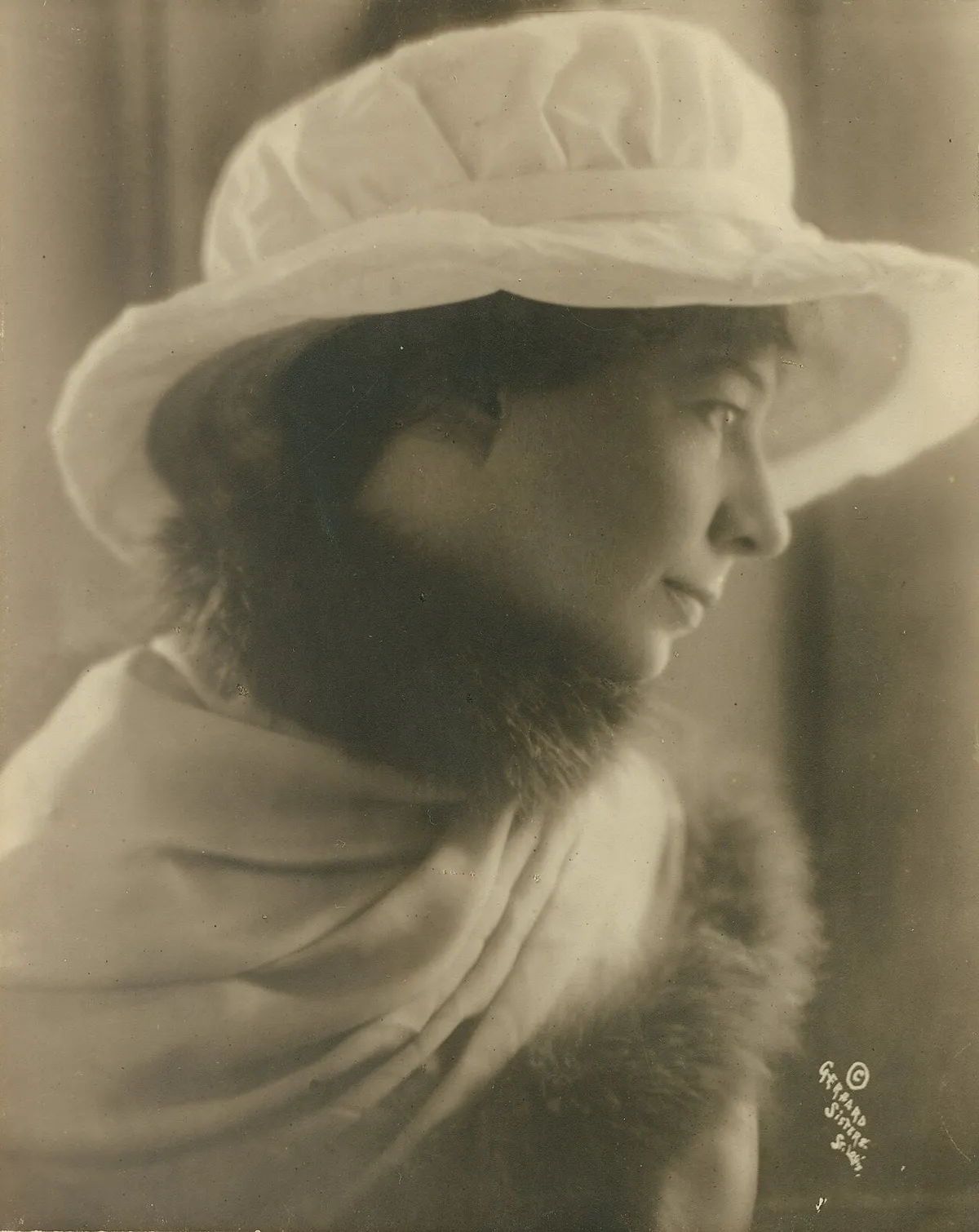
Sara Teasdale
Four Winds
"Four winds blowing through the sky,
You have seen poor maidens die,
Tell me then what I shall do
That my lover may be true."
Said the wind from out the south,
"Lay no kiss upon his mouth,"
And the wind from out the west,
"Wound the heart within his breast,"
And the wind from out the east,
"Send him empty from the feast,"
And the wind from out the north,
"In the tempest thrust him forth;
When thou art more cruel than he,
Then will Love be kind to thee."
458
Ezra Pound
The Encounter
All the while they were talking the new morality
Her eyes explored me.
And when I rose to go
Her fingers were like the tissue
Of a Japanese paper napkin.
Her eyes explored me.
And when I rose to go
Her fingers were like the tissue
Of a Japanese paper napkin.
455

Robert Louis Stevenson
Hail! Childish Slave Of Social Rules
HAIL! Childish slaves of social rules
You had yourselves a hand in making!
How I could shake your faith, ye fools,
If but I thought it worth the shaking.
I see, and pity you; and then
Go, casting off the idle pity,
In search of better, braver men,
My own way freely through the city.
My own way freely, and not yours;
And, careless of a town's abusing,
Seek real friendship that endures
Among the friends of my own choosing.
I'll choose my friends myself, do you hear?
And won't let Mrs. Grundy do it,
Tho' all I honour and hold dear
And all I hope should move me to it.
I take my old coat from the shelf -
I am a man of little breeding.
And only dress to please myself -
I own, a very strange proceeding.
I smoke a pipe abroad, because
To all cigars I much prefer it,
And as I scorn your social laws
My choice has nothing to deter it.
Gladly I trudge the footpath way,
While you and yours roll by in coaches
In all the pride of fine array,
Through all the city's thronged approaches.
O fine religious, decent folk,
In Virtue's flaunting gold and scarlet,
I sneer between two puffs of smoke, -
Give me the publican and harlot.
Ye dainty-spoken, stiff, severe
Seed of the migrated Philistian,
One whispered question in your ear -
Pray, what was Christ, if you be Christian?
If Christ were only here just now,
Among the city's wynds and gables
Teaching the life he taught us, how
Would he be welcome to your tables?
I go and leave your logic-straws,
Your former-friends with face averted,
Your petty ways and narrow laws,
Your Grundy and your God, deserted.
From your frail ark of lies, I flee
I know not where, like Noah's raven.
Full to the broad, unsounded sea
I swim from your dishonest haven.
Alone on that unsounded deep,
Poor waif, it may be I shall perish,
Far from the course I thought to keep,
Far from the friends I hoped to cherish.
It may be that I shall sink, and yet
Hear, thro' all taunt and scornful laughter,
Through all defeat and all regret,
The stronger swimmers coming after.
458
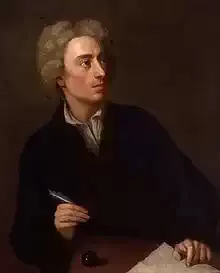
Alexander Pope
An Essay on Man in Four Epistles: Epistle 1
To Henry St. John, Lord Bolingbroke
Awake, my St. John! leave all meaner things
To low ambition, and the pride of kings.
Let us (since life can little more supply
Than just to look about us and to die)
Expatiate free o'er all this scene of man;
A mighty maze! but not without a plan;
A wild, where weeds and flow'rs promiscuous shoot;
Or garden, tempting with forbidden fruit.
Together let us beat this ample field,
Try what the open, what the covert yield;
The latent tracts, the giddy heights explore
Of all who blindly creep, or sightless soar;
Eye Nature's walks, shoot folly as it flies,
And catch the manners living as they rise;
Laugh where we must, be candid where we can;
But vindicate the ways of God to man.I.
Say first, of God above, or man below,
What can we reason, but from what we know?
Of man what see we, but his station here,
From which to reason, or to which refer?
Through worlds unnumber'd though the God be known,
'Tis ours to trace him only in our own.
He, who through vast immensity can pierce,
See worlds on worlds compose one universe,
Observe how system into system runs,
What other planets circle other suns,
What varied being peoples ev'ry star,
May tell why Heav'n has made us as we are.
But of this frame the bearings, and the ties,
The strong connections, nice dependencies,
Gradations just, has thy pervading soul
Look'd through? or can a part contain the whole?
Is the great chain, that draws all to agree,
And drawn supports, upheld by God, or thee?II.
Presumptuous man! the reason wouldst thou find,
Why form'd so weak, so little, and so blind?
First, if thou canst, the harder reason guess,
Why form'd no weaker, blinder, and no less?
Ask of thy mother earth, why oaks are made
Taller or stronger than the weeds they shade?
Or ask of yonder argent fields above,
Why Jove's satellites are less than Jove?
Of systems possible, if 'tis confest
That Wisdom infinite must form the best,
Where all must full or not coherent be,
And all that rises, rise in due degree;
Then, in the scale of reas'ning life, 'tis plain
There must be somewhere, such a rank as man:
And all the question (wrangle e'er so long)
Is only this, if God has plac'd him wrong?
Respecting man, whatever wrong we call,
May, must be right, as relative to all.
In human works, though labour'd on with pain,
A thousand movements scarce one purpose gain;
In God's, one single can its end produce;
Yet serves to second too some other use.
So man, who here seems principal alone,
Perhaps acts second to some sphere unknown,
Touches some wheel, or verges to some goal;
'Tis but a part we see, and not a whole.
When the proud steed shall know why man restrains
His fiery course, or drives him o'er the plains:
When the dull ox, why now he breaks the clod,
Is now a victim, and now Egypt's God:
Then shall man's pride and dulness comprehend
His actions', passions', being's, use and end;
Why doing, suff'ring, check'd, impell'd; and why
This hour a slave, the next a deity.
Then say not man's imperfect, Heav'n in fault;
Say rather, man's as perfect as he ought:
His knowledge measur'd to his state and place;
His time a moment, and a point his space.
If to be perfect in a certain sphere,
What matter, soon or late, or here or there?
The blest today is as completely so,
As who began a thousand years ago.III.
Heav'n from all creatures hides the book of fate,
All but the page prescrib'd, their present state:
From brutes what men, from men what spirits know:
Or who could suffer being here below?
The lamb thy riot dooms to bleed today,
Had he thy reason, would he skip and play?
Pleas'd to the last, he crops the flow'ry food,
And licks the hand just rais'd to shed his blood.
Oh blindness to the future! kindly giv'n,
That each may fill the circle mark'd by Heav'n:
Who sees with equal eye, as God of all,
A hero perish, or a sparrow fall,
Atoms or systems into ruin hurl'd,
And now a bubble burst, and now a world.
Hope humbly then; with trembling pinions soar;
Wait the great teacher Death; and God adore.
What future bliss, he gives not thee to know,
But gives that hope to be thy blessing now.
Hope springs eternal in the human breast:
Man never is, but always to be blest:
The soul, uneasy and confin'd from home,
Rests and expatiates in a life to come.
Lo! the poor Indian, whose untutor'd mind
Sees God in clouds, or hears him in the wind;
His soul, proud science never taught to stray
Far as the solar walk, or milky way;
Yet simple nature to his hope has giv'n,
Behind the cloud topp'd hill, an humbler heav'n;
Some safer world in depth of woods embrac'd,
Some happier island in the wat'ry waste,
Where slaves once more their native land behold,
No fiends torment, no Christians thirst for gold.
To be, contents his natural desire,
He asks no angel's wing, no seraph's fire;
But thinks, admitted to that equal sky,
His faithful dog shall bear him company.IV.
Go, wiser thou! and, in thy scale of sense
Weigh thy opinion against Providence;
Call imperfection what thou fanciest such,
Say, here he gives too little, there too much:
Destroy all creatures for thy sport or gust,
Yet cry, if man's unhappy, God's unjust;
If man alone engross not Heav'n's high care,
Alone made perfect here, immortal there:
Snatch from his hand the balance and the rod,
Rejudge his justice, be the God of God.
In pride, in reas'ning pride, our error lies;
All quit their sphere, and rush into the skies.
Pride still is aiming at the blest abodes,
Men would be angels, angels would be gods.
Aspiring to be gods, if angels fell,
Aspiring to be angels, men rebel:
And who but wishes to invert the laws
Of order, sins against th' Eternal Cause.V.
Ask for what end the heav'nly bodies shine,
Earth for whose use? Pride answers, " 'Tis for mine:
For me kind Nature wakes her genial pow'r,
Suckles each herb, and spreads out ev'ry flow'r;
Annual for me, the grape, the rose renew,
The juice nectareous, and the balmy dew;
For me, the mine a thousand treasures brings;
For me, health gushes from a thousand springs;
Seas roll to waft me, suns to light me rise;
My foot-stool earth, my canopy the skies."
But errs not Nature from this gracious end,
From burning suns when livid deaths descend,
When earthquakes swallow, or when tempests sweep
Towns to one grave, whole nations to the deep?
"No, ('tis replied) the first Almighty Cause
Acts not by partial, but by gen'ral laws;
Th' exceptions few; some change since all began:
And what created perfect?"--Why then man?
If the great end be human happiness,
Then Nature deviates; and can man do less?
As much that end a constant course requires
Of show'rs and sunshine, as of man's desires;
As much eternal springs and cloudless skies,
As men for ever temp'rate, calm, and wise.
If plagues or earthquakes break not Heav'n's design,
Why then a Borgia, or a Catiline?
Who knows but he, whose hand the lightning forms,
Who heaves old ocean, and who wings the storms;
Pours fierce ambition in a Cæsar's mind,
Or turns young Ammon loose to scourge mankind?
From pride, from pride, our very reas'ning springs;
Account for moral, as for nat'ral things:
Why charge we Heav'n in those, in these acquit?
In both, to reason right is to submit.
Better for us, perhaps, it might appear,
Were there all harmony, all virtue here;
That never air or ocean felt the wind;
That never passion discompos'd the mind.
But ALL subsists by elemental strife;
And passions are the elements of life.
The gen'ral order, since the whole began,
Is kept in nature, and is kept in man.VI.
What would this man? Now upward will he soar,
And little less than angel, would be more;
Now looking downwards, just as griev'd appears
To want the strength of bulls, the fur of bears.
Made for his use all creatures if he call,
Say what their use, had he the pow'rs of all?
Nature to these, without profusion, kind,
The proper organs, proper pow'rs assign'd;
Each seeming want compensated of course,
Here with degrees of swiftness, there of force;
All in exact proportion to the state;
Nothing to add, and nothing to abate.
Each beast, each insect, happy in its own:
Is Heav'n unkind to man, and man alone?
Shall he alone, whom rational we call,
Be pleas'd with nothing, if not bless'd with all?
The bliss of man (could pride that blessing find)
Is not to act or think beyond mankind;
No pow'rs of body or of soul to share,
But what his nature and his state can bear.
Why has not man a microscopic eye?
For this plain reason, man is not a fly.
Say what the use, were finer optics giv'n,
T' inspect a mite, not comprehend the heav'n?
Or touch, if tremblingly alive all o'er,
To smart and agonize at ev'ry pore?
Or quick effluvia darting through the brain,
Die of a rose in aromatic pain?
If nature thunder'd in his op'ning ears,
And stunn'd him with the music of the spheres,
How would he wish that Heav'n had left him still
The whisp'ring zephyr, and the purling rill?
Who finds not Providence all good and wise,
Alike in what it gives, and what denies?VII.
Far as creation's ample range extends,
The scale of sensual, mental pow'rs ascends:
Mark how it mounts, to man's imperial race,
From the green myriads in the peopled grass:
What modes of sight betwixt each wide extreme,
The mole's dim curtain, and the lynx's beam:
Of smell, the headlong lioness between,
And hound sagacious on the tainted green:
Of hearing, from the life that fills the flood,
To that which warbles through the vernal wood:
The spider's touch, how exquisitely fine!
Feels at each thread, and lives along the line:
In the nice bee, what sense so subtly true
From pois'nous herbs extracts the healing dew?
How instinct varies in the grov'lling swine,
Compar'd, half-reas'ning elephant, with thine!
'Twixt that, and reason, what a nice barrier;
For ever sep'rate, yet for ever near!
Remembrance and reflection how allied;
What thin partitions sense from thought divide:
And middle natures, how they long to join,
Yet never pass th' insuperable line!
Without this just gradation, could they be
Subjected, these to those, or all to thee?
The pow'rs of all subdu'd by thee alone,
Is not thy reason all these pow'rs in one?VIII.
See, through this air, this ocean, and this earth,
All matter quick, and bursting into birth.
Above, how high, progressive life may go!
Around, how wide! how deep extend below!
Vast chain of being, which from God began,
Natures ethereal, human, angel, man,
Beast, bird, fish, insect! what no eye can see,
No glass can reach! from infinite to thee,
From thee to nothing!--On superior pow'rs
Were we to press, inferior might on ours:
Or in the full creation leave a void,
Where, one step broken, the great scale's destroy'd:
From nature's chain whatever link you strike,
Tenth or ten thousandth, breaks the chain alike.
And, if each system in gradation roll
Alike essential to th' amazing whole,
The least confusion but in one, not all
That system only, but the whole must fall.
Let earth unbalanc'd from her orbit fly,
Planets and suns run lawless through the sky;
Let ruling angels from their spheres be hurl'd,
Being on being wreck'd, and world on world;
Heav'n's whole foundations to their centre nod,
And nature trembles to the throne of God.
All this dread order break--for whom? for thee?
Vile worm!--Oh madness, pride, impiety!IX.
What if the foot ordain'd the dust to tread,
Or hand, to toil, aspir'd to be the head?
What if the head, the eye, or ear repin'd
To serve mere engines to the ruling mind?
Just as absurd for any part to claim
To be another, in this gen'ral frame:
Just as absurd, to mourn the tasks or pains,
The great directing Mind of All ordains.
All are but parts of one stupendous whole,
Whose body Nature is, and God the soul;
That, chang'd through all, and yet in all the same,
Great in the earth, as in th' ethereal frame,
Warms in the sun, refreshes in the breeze,
Glows in the stars, and blossoms in the trees,
Lives through all life, extends through all extent,
Spreads undivided, operates unspent,
Breathes in our soul, informs our mortal part,
As full, as perfect, in a hair as heart;
As full, as perfect, in vile man that mourns,
As the rapt seraph that adores and burns;
To him no high, no low, no great, no small;
He fills, he bounds, connects, and equals all.X.
Cease then, nor order imperfection name:
Our proper bliss depends on what we blame.
Know thy own point: This kind, this due degree
Of blindness, weakness, Heav'n bestows on thee.
Submit.--In this, or any other sphere,
Secure to be as blest as thou canst bear:
Safe in the hand of one disposing pow'r,
Or in the natal, or the mortal hour.
All nature is but art, unknown to thee;
All chance, direction, which thou canst not see;
All discord, harmony, not understood;
All partial evil, universal good:
And, spite of pride, in erring reason's spite,
One truth is clear, Whatever is, is right.
454
Hilaire Belloc
Ballade to Our Lady of Czestochowa
I
Lady and Queen and Mystery manifold
And very Regent of the untroubled sky,
Whom in a dream St. Hilda did behold
And heard a woodland music passing by:
You shall receive me when the clouds are high
With evening and the sheep attain the fold.
This is the faith that I have held and hold,
And this is that in which I mean to die.
II
Steep are the seas and savaging and cold
In broken waters terrible to try;
And vast against the winter night the wold,
And harbourless for any sail to lie.
But you shall lead me to the lights, and I
Shall hymn you in a harbour story told.
This is the faith that I have held and hold,
And this is that in which I mean to die.
III
Help of the half-defeated, House of gold,
Shrine of the Sword, and Tower of Ivory;
Splendour apart, supreme and aureoled,
The Battler's vision and the World's reply.
You shall restore me, O my last Ally,
To vengence and the glories of the bold.
This is the faith that I have held and hold,
And this is that in which I mean to die.
Envoi
Prince of the degradations, bought and sold,
These verses, written in your crumbling sty,
Proclaim the faith that I have held and hold
And publish that in which I mean to die.
459

William Wordsworth
It is not to be Thought of
. It is not to be thought of that the Flood
Of British freedom, which, to the open sea
Of the world's praise, from dark antiquity
Hath flowed, "with pomp of waters, unwithstood,"
Roused though it be full often to a mood
Which spurns the check of salutary bands,
That this most famous Stream in bogs and sands
Should perish; and to evil and to good
Be lost for ever. In our halls is hung
Armoury of the invincible Knights of old:
We must be free or die, who speak the tongue
That Shakespeare spake; the faith and morals hold
Which Milton held.--In every thing we are sprung
Of Earth's first blood, have titles manifold.
457
Rudyard Kipling
The Penalty
Once in life I watched a Star;
But I whistled, "Let her go!
There are others, fairer far,
Which my favouring skies shall show
Here I lied, and herein I
Stood to pay the penalty.
Marvellous the Planets shone
As I ranged from coast to coast--
But beyond comparison
Rode the Star that I had lost.
I had lied, and only I
Did not guess the penalty! . . .
When my Heavens were turned to blood,
When the dark had filled my day,
Furthest, but most faithful, stood
That lone Star I cast away.
I had loved myself, and I
Have not lived and dare not die!
458
Lord Byron
Lines To A Lady Weeping
Weep, daughter of a royal line,
A Sire's disgrace, a realm's decay;
Ah! happy if each tear of thine
Could wash a father's fault away!
Weepfor
thy tears are Virtue's tears
Auspicious
to these suffering isles;
And be each drop in future years
Repaid thee by thy people's smiles!
A Sire's disgrace, a realm's decay;
Ah! happy if each tear of thine
Could wash a father's fault away!
Weepfor
thy tears are Virtue's tears
Auspicious
to these suffering isles;
And be each drop in future years
Repaid thee by thy people's smiles!
455
Ella Wheeler Wilcox
Only A Sad Mistake
Only a blunder-a sad mistake;
All my own fault and mine alone.
The saddest error a heart can make;
I was so young, or I would have known.
Only his rare, sweet, tender smile;
Only a lingering touch of his hand.
I think I was dreaming all the while,
The reason I did not understand.
Yet, somewhere, I've read men woo this way;
That eyes speak, sometimes, before the tongue.
And I was sure he would speak some day;
Pardon the folly-I was so young.
Was I, say-for now I am old!
So old, it seems like a hundred years
Since I felt my heart growing hard and cold
With a pain too bitter and deep for tears.
I saw him lean over the stranger's chair,
With a warm, new light in his beautiful eyes;
And I woke from my dreaming, then and there,
And went out of my self-made Paradise.
He never loved me-I know, I see!
Such sad, sad blunders as young hearts make.
She did not win him away from me,
For he was not mine. It was my mistake.
A woman should wait for a man to speak
Before she dreams of his love, I own;
But I was a girl-girls' hearts are weak;
And the pain, like the fault, is mine alone.
458
Hilaire Belloc
The Pelagian Drinking Song
Pelagius lived at Kardanoel
And taught a doctrine there
How, whether you went to heaven or to hell
It was your own affair.
It had nothing to do with the Church, my boy,
But was your own affair.
No, he didn't believe
In Adam and Eve
He put no faith therein!
His doubts began
With the Fall of Man
And he laughed at Original Sin.
With my row-ti-tow
Ti-oodly-ow
He laughed at original sin.
Then came the bishop of old Auxerre
Germanus was his name
He tore great handfuls out of his hair
And he called Pelagius shame.
And with his stout Episcopal staff
So thoroughly whacked and banged
The heretics all, both short and tall --
They rather had been hanged.
Oh he whacked them hard, and he banged them long
Upon each and all occasions
Till they bellowed in chorus, loud and strong
Their orthodox persuasions.
With my row-ti-tow
Ti-oodly-ow
Their orthodox persuasions.
Now the faith is old and the Devil bold
Exceedingly bold indeed.
And the masses of doubt that are floating about
Would smother a mortal creed.
But we that sit in a sturdy youth
And still can drink strong ale
Let us put it away to infallible truth
That always shall prevail.
And thank the Lord
For the temporal sword
And howling heretics too.
And all good things
Our Christendom brings
But especially barley brew!
With my row-ti-tow
Ti-oodly-ow
Especially barley brew!
458
Alfred Lord Tennyson
The Letters
Still on the tower stood the vane,
A black yew gloomed the stagnant air,
I peered athwart the chancel pane
And saw the altar cold and bare.
A clog of lead was round my feet,
A band of pain across my brow;
"Cold altar, Heaven and earth shall meet
Before you hear my marriage vow."
I turned and hummed a bitter song
That mocked the wholesome human heart,
And then we met in wrath and wrong,
We met, but only met to part.
Full cold my greeting was and dry;
She faintly smiled, she hardly moved;
I saw with half-unconscious eye
She wore the colours I approved.
She took the little ivory chest,
With half a sigh she turned the key,
Then raised her head with lips comprest,
And gave my letters back to me.
And gave the trinkets and the rings,
My gifts, when gifts of mine could please;
As looks a father on the things
Of his dead son, I looked on these.
She told me all her friends had said;
I raged against the public liar;
She talked as if her love were dead,
But in my words were seeds of fire.
"No more of love; your sex is known:
I never will be twice deceived.
Henceforth I trust the man alone,
The woman cannot be believed.
Through slander, meanest spawn of Hell -
And woman's slander is the worst,
And you, whom once I loved so well,
Through you, my life will be accurst."
I spoke with heart, and heat and force,
I shook her breast with vague alarms -
Like torrents from a mountain's source
We rushed into each other's arms.
We parted: sweetly gleamed the stars,
And sweet the vapour-braided blue,
Low breezes fanned the belfry bars,
As homeward by the church I drew.
The very graves appeared to smile,
So fresh they rose in shadowed swells;
"Dark porch," I said, "and silent aisle,
There comes a sound of marriage bells."
455

Johann Wolfgang von Goethe
Legend
THERE lived in the desert a holy man
To whom a goat-footed Faun one day
Paid a visit, and thus began
To his surprise: 'I entreat thee to pray
That grace to me and my friends may be given,
That we may be able to mount to Heaven,
For great is our thirst for heav'nly bliss.'
The holy man made answer to this:
'Much danger is lurking in thy petition,
Nor will it be easy to gain admission;
Thou dost not come with an angel's salute;
For I see thou wearest a cloven foot.'
The wild man paused, and then answer'd he:
'What doth my goat's foot matter to thee?
Full many I've known into heaven to pass
Straight and with ease, with the head of an ass!'
457
Rudyard Kipling
Hadramauti
Who knows the heart of the Christian? How does he reason?
What are his measures and balances? Which is his season
For laughter, forbearance or bloodshed, and what devils move him
When he arises to smite us? I do not love him.
He invites the derision of strangers—he enters all places.
Booted, bareheaded he enters. With shouts and embraces
He asks of us news of the household whom we reckon nameless.
Certainly Allah created him forty-fold shameless!
So it is not in the Desert. One came to me weeping—
The Avenger of Blood on his track—I took him in keeping.
Demanding not whom he had slain, I refreshed him, I fed him
As he were even a brother. But Eblis had bred him.
He was the son of an ape, ill at ease in his clothing.
He talked with his head, hands and feet. I endured him with loathing.
Whatever his spirit conceived his countenance showed it
As a frog shows in a mud-puddle. Yet I abode it!
I fingered my beard and was dumb, in silence confronting him.
His soul was too shallow for silence, e'en with Death hunting him.
I said: "'Tis his weariness speaks," but, when he had rested,
He chirped in my face like some sparrow, and, presently, jested!
Wherefore slew I that stranger? He brought me dishonour.
I saddled my mare, Bijli, I set him upon her.
I gave him rice and goat's flesh. He bared me to laughter.
When he was gone from my tent, swift I followed after,
Taking my sword in my hand. The hot wine had filled him.
Under the stars he mocked me—therefore I killed him!
456
Ella Wheeler Wilcox
As You Go Through Life
Don’t look for the flaws as you go through life;
And even when you find them,
It is wise and kind to be somewhat blind
And look for the virtue behind them.
For the cloudiest night has a hint of light
Somewhere in its shadows hiding;
It is better by far to hunt for a star,
Than the spots on the sun abiding.
The current of life runs ever away
To the bosom of God’s great ocean.
Don’t set your force ‘gainst the river’s course
And think to alter its motion.
Don’t waste a curse on the universe –
Remember it lived before you.
Don’t butt at the storm with your puny form,
But bend and let it go o’er you.
The world will never adjust itself
To suit your whims to the letter.
Some things must go wrong your whole life long,
And the sooner you know it the better.
It is folly to fight with the Infinite,
And go under at last in the wrestle;
The wiser man shapes into God’s plan
As water shapes into a vessel.
456

Robert Browning
The Bishop Orders His Tomb At Saint Praxed's Church
Vanity, saith the preacher, vanity!
Draw round my bed: is Anselm keeping back?
Nephews -- sons mine -- ah God, I know not! Well --
She, men would have to be your mother once,
Old Gandolf envied me, so fair she was!
What's done is done, and she is dead beside,
Dead long ago, and I am Bishop since,
And as she died so must we die ourselves,
And thence ye may perceive the world's a dream.
Life, how and what is it? As here I lie
In this state-chamber, dying by degrees,
Hours and long hours in the dead night, I ask
"Do I live, am I dead?" Peace, peace seems all.
Saint Praxed's ever was the church for peace;
And so, about this tomb of mine. I fought
With tooth and nail to save my niche, ye know:
-- Old Gandolf cozened me, despite my care;
Shrewd was that snatch from out the corner South
He graced his carrion with, God curse the same!
Yet still my niche is not so cramped but thence
One sees the pulpit o' the epistle-side,
And somewhat of the choir, those silent seats,
And up into the very dome where live
The angels, and a sunbeam's sure to lurk:
And I shall fill my slab of basalt there,
And 'neath my tabernacle take my rest,
With those nine columns round me, two and two,
The odd one at my feet where Anselm stands:
Peach-blossom marble all, the rare, the ripe
As fresh poured red wine of a mighty pulse
-- Old Gandolf with his paltry onion-stone,
Put me where I may look at him! True peach,
Rosy and flawless: how I earned the prize!
Draw close: that conflagration of my church
-- What then? So much was saved if aught were missed!
My sons, ye would not be my death? Go dig
The white-grape vineyard where the oil-press stood,
Drop water gently till the surface sink,
And if ye find -- Ah God, I know not, I! --
Bedded in store of rotten fig-leaves soft,
And corded up in a tight olive-frail,
Some lump, ah God, of lapis lazuli,
Big as a Jew's head cut off at the nape,
Blue as a vein o'er the Madonna's breast
Sons, all have I bequeathed you, villas, all,
That brave Frascati villa with its bath,
So, let the blue lump poise between my knees,
Like God the Father's globe on both his hands
Ye worship in the Jesu Church so gay,
For Gandolf shall not choose but see and burst!
Swift as a weaver's shuttle fleet our years:
Man goeth to the grave, and where is he?
Did I say basalt for my slab, sons? Black --
'Twas ever antique-black I meant! How else
Shall ye contrast my frieze to come beneath?
The bas-relief in bronze ye promised me.
Those Pans and Nymphs ye wot of, and perchance
Some tripod, thyrsus, with a vase or so,
The Saviour at his sermon on the mount,
Saint Praxed in a glory, and one Pan
Ready to twitch the Nymph's last garment off,
And Moses with the tables -- but I know
Ye mark me not! What do they whisper thee,
Child of my bowels, Anselm? Ah, ye hope
To revel down my villas while I gasp
Bricked o'er with beggar's mouldy travertine
Which Gandolf from his tomb-top chuckles at!
Nay, boys, ye love me -- all of jasper, then!
'Tis jasper ye stand pledged to, lest I grieve.
My bath must needs be left behind, alas!
One block, pure green as a pistachio-nut,
There's plenty jasper somewhere in the world --
And have I not Saint Praxed's ear to pray
Horses for ye, and brown Greek manuscripts,
And mistresses with great smooth marbly limbs?
-- That's if ye carve my epitaph aright,
Choice Latin, picked phrase, Tully's every word,
No gaudy ware like Gandolf's second line --
Tully, my masters? Ulpian serves his need!
And then how I shall lie through centuries,
And hear the blessed mutter of the mass,
And see God made and eaten all day long,
And feel the steady candle-flame, and taste
Good strong thick stupefying incense-smoke!
For as I lie here, hours of the dead night,
Dying in state and by such slow degrees,
I fold my arms as if they clasped a crook,
And stretch my feet forth straight as stone can point,
And let the bedclothes, for a mortcloth, drop
Into great laps and folds of sculptor's work:
And as yon tapers dwindle, and strange thoughts
Grow, with a certain humming in my ears,
About the life before I lived this life,
And this life too, popes, cardinals and priests,
Saint Praxed at his sermon on the mount,
Your tall pale mother with her talking eyes,
And new-found agate urns as fresh as day,
And marble's language, Latin pure, discreet,
-- Aha, ELUCESCEBAT quoth our friend?
No Tully, said I, Ulpian at the best!
Evil and brief hath been my pilgrimage.
All lapis, all, sons! Else I give the Pope
My villas! Will ye ever eat my heart?
Ever your eyes were as a lizard's quick,
They glitter like your mother's for my soul,
Or ye would heighten my impoverished frieze,
Piece out its starved design, and fill my vase
With grapes, and add a visor and a Term,
And to the tripod ye would tie a lynx
That in his struggle throws the thyrsus down,
To comfort me on my entablature
Whereon I am to lie till I must ask
"Do I live, am I dead?" There, leave me, there!
For ye have stabbed me with ingratitude
To death -- ye wish it -- God, ye wish it! Stone --
Gritstone, a crumble! Clammy squares which sweat
As if the corpse they keep were oozing through --
And no more lapis to delight the world!
Well, go! I bless ye. Fewer tapers there,
But in a row: and, going, turn your backs
-- Ay, like departing altar-ministrants,
And leave me in my church, the church for peace,
That I may watch at leisure if he leers --
Old Gandolf -- at me, from his onion-stone,
As still he envied me, so fair she was!
456
William Butler Yeats
Tom O'Roughley
'THOUGH logic-choppers rule the town,
And every man and maid and boy
Has marked a distant object down,
An aimless joy is a pure joy,'
Or so did Tom O'Roughley say
That saw the surges running by.
'And wisdom is a butterfly
And not a gloomy bird of prey.
'If little planned is little sinned
But little need the grave distress.
What's dying but a second wind?
How but in zig-zag wantonness
Could trumpeter Michael be so brave?'
Or something of that sort he said,
'And if my dearest friend were dead
I'd dance a measure on his grave.'
454