Identification and basic context
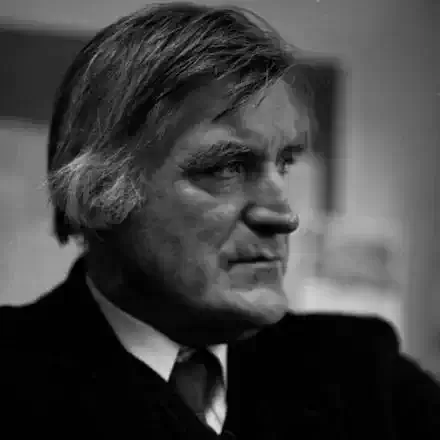
Edward James "Ted" Hughes was a highly influential English poet, translator, and playwright. He is widely regarded as one of the most significant poets of the post-war era, known for his intense engagement with nature, myth, and the animal world. His major collections include The Hawk in the Rain (1957), Crow (1970), Moortown (1979), and Birthday Letters (1998). Born on August 17, 1930, in Mytholmroyd, West Riding of Yorkshire, England, he died on October 28, 1998, in North Tawton, Devon, England. His family background was working-class, with strong ties to the Yorkshire landscape, which profoundly shaped his poetic vision. He wrote exclusively in English.
Childhood and education
Hughes's childhood was spent in the rugged landscape of Yorkshire, an environment that deeply influenced his early perceptions and later poetry. His family ran a small shop, and his father had served in the trenches of World War I, experiences that he later incorporated into his work. He attended Mirfield Grammar School, where he discovered his passion for poetry. After completing his National Service, he studied English at Pembroke College, Cambridge, though he later transferred to study archaeology and anthropology, interests that would continue to inform his work. He was an avid reader, absorbing influences from classical mythology, folklore, and early English literature.
Literary trajectory
Hughes's poetic career began to gain momentum in the early 1950s. His first major collection, The Hawk in the Rain (1957), published by Faber and Faber, announced his arrival with its powerful, often violent, imagery and uncompromising engagement with the natural world. This collection established his reputation for a rugged, elemental style. He continued to develop this distinctive voice through subsequent works like Lupercal (1960) and Wodwo (1967). The Crow sequence (1970) marked a significant shift, employing a more mythic and philosophical approach, often using the trickster figure of Crow to explore themes of creation, destruction, and survival. His later works, such as Moortown and Birthday Letters, continued to explore personal experiences, myth, and the natural world with profound insight.
Works, style, and literary characteristics
Hughes's major works include The Hawk in the Rain, Lupercal, Crow, Moortown, and Birthday Letters. His dominant themes are the power and brutality of nature, the interconnectedness of life and death, the presence of myth and ritual in contemporary life, and the struggle for survival. Hughes's style is characterized by its directness, its potent imagery drawn from the animal kingdom and the natural landscape, and its often startling violence. He employed strong rhythms and a muscular diction, frequently using Anglo-Saxon influences. His poems often feature animals—hawks, wolves, otters, badgers—as protagonists, exploring their instincts and their place in the larger cosmic order. He sought to return poetry to a more primal, elemental state, moving away from what he saw as the overly intellectualized or personal poetry of his predecessors. His innovations included a bold re-engagement with myth and a visceral portrayal of the animal psyche.
Cultural and historical context
Hughes lived through the latter half of the 20th century, a period marked by significant social and political change, including the Cold War, decolonization, and evolving attitudes towards the environment. His work, while often rooted in ancient myths and the natural world, resonated with contemporary anxieties about humanity's place in a rapidly changing and often violent world. He was associated with the "Movement" poets but forged a distinct path, often seen as more primal and less overtly political than some of his contemporaries. His marriage to the American poet Sylvia Plath and their subsequent, highly publicized, personal tragedies also placed him in the public eye, sometimes overshadowing his literary achievements.
Personal life
Hughes's personal life was marked by both profound love and intense tragedy. His marriage to Sylvia Plath, another highly regarded poet, was a central event in his life and the subject of his later collection Birthday Letters. Their relationship was passionate but also tumultuous, and Plath's suicide in 1963 cast a long shadow over his life and work. He later married Carol Orchard. Hughes was known for his deep connection to the land and his often solitary existence, dedicating much of his life to his writing and his love for animals and nature. He held strong beliefs about the spiritual and restorative power of the natural world.
Recognition and reception
Hughes achieved considerable recognition during his lifetime. He was appointed Poet Laureate in 1984, a position he held until his death, succeeding Sir John Betjeman. His work was consistently praised for its power, originality, and depth. While some critics found his work too violent or obscure, his reputation grew steadily, and he is now considered a central figure in 20th-century British poetry. His poems are widely anthologized and studied in schools and universities.
Influences and legacy
Hughes was influenced by classical poets, Shakespeare, the Romantics, and modernists, as well as by folklore, mythology, and anthropology. His legacy is immense; he revitalized the English poetic tradition by reintroducing a sense of mythic depth, elemental power, and visceral engagement with the natural world. He inspired generations of poets to explore the primal forces within nature and the human psyche, and to write with a bolder, more muscular language. His influence is evident in the work of many contemporary poets who continue to grapple with similar themes.
Interpretation and critical analysis
Hughes's poetry invites analysis of its relationship to myth, its exploration of the animal psyche, and its commentary on human violence and survival. Critics often discuss the balance between the beautiful and the brutal in his work, the role of myth in understanding contemporary experience, and the complex personal resonances within his poems, particularly concerning his relationship with Sylvia Plath. His poems continue to provoke discussion about humanity's relationship with nature and its own darker impulses.
Curiosities and lesser-known aspects
Beyond his poetry, Hughes was also a significant children's author, writing books such as The Iron Man. He had a deep respect for animals and often found solace and inspiration in observing them. His dedication to his craft was unwavering, and he was known for his meticulous attention to language and form. His life, particularly his relationship with Sylvia Plath, has been the subject of considerable biographical and critical attention.
Death and memory
Ted Hughes died in London in 1998. His death was widely mourned, and his status as a major poet was firmly established. His final collection, Birthday Letters, published shortly before his death, offered a poignant and deeply personal reflection on his life and relationships. His legacy continues to be celebrated through ongoing critical study, new editions of his work, and the enduring influence of his powerful and elemental verse.