
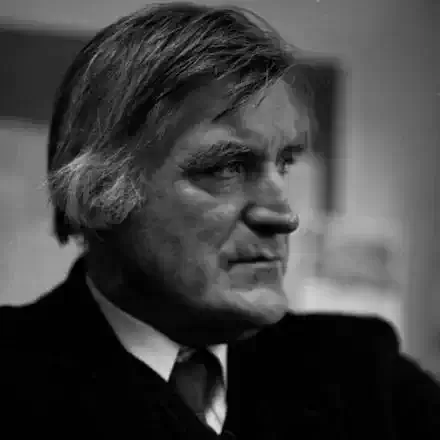
Ted Hughes

Ted Hughes

1930–1998 · lived 68 years

Ted Hughes was a prominent English poet, translator, and children's writer, celebrated for his powerful and visceral depictions of the natural world and its raw, primal forces. His poetry is characterized by its intensity, rugged language, and exploration of myth, the animal kingdom, and the darker aspects of human nature. Hughes's work often draws upon mythologies and folk traditions, imbuing his verse with a profound sense of elemental power and ancient wisdom.

n. 1930-08-17, Mytholmroyd · m. 1998-10-28, Southwark

7,389 Views

Work and Play

Work and Play

The swallow of summer, she toils all the summer,
A blue-dark knot of glittering voltage,
A whiplash swimmer, a fish of the air.


But the serpent of cars that crawls through the dust

In shimmering exhaust

Searching to slake

Its fever in ocean

Will play and be idle or else it will bust.


The swallow of summer, the barbed harpoon,
She flings from the furnace, a rainbow of purples,
Dips her glow in the pond and is perfect.

But the serpent of cars that collapsed on the beach

Disgorges its organs

A scamper of colours

Which roll like tomatoes

Nude as tomatoes

With sand in their creases

To cringe in the sparkle of rollers and screech.


The swallow of summer, the seamstress of summer,
She scissors the blue into shapes and she sews it,
She draws a long thread and she knots it at the corners.


But the holiday people

Are laid out like wounded

Flat as in ovens

Roasting and basting

With faces of torment as space burns them blue

Their heads are transistors

Their teeth grit on sand grains

Their lost kids are squalling

While man-eating flies

Jab electric shock needles but what can they do?


They can climb in their cars with raw bodies, raw faces

And start up the serpent

And headache it homeward

A car full of squabbles

And sobbing and stickiness

With sand in their crannies

Inhaling petroleum

That pours from the foxgloves

While the evening swallow
The swallow of summer, cartwheeling through crimson,
Touches the honey-slow river and turning
Returns to the hand stretched from under the eaves -
A boomerang of rejoicing shadow.
Read full poem
Bio

Identification and basic context

Edward James "Ted" Hughes was a highly influential English poet, translator, and playwright. He is widely regarded as one of the most significant poets of the post-war era, known for his intense engagement with nature, myth, and the animal world. His major collections include The Hawk in the Rain (1957), Crow (1970), Moortown (1979), and Birthday Letters (1998). Born on August 17, 1930, in Mytholmroyd, West Riding of Yorkshire, England, he died on October 28, 1998, in North Tawton, Devon, England. His family background was working-class, with strong ties to the Yorkshire landscape, which profoundly shaped his poetic vision. He wrote exclusively in English.

Childhood and education

Hughes's childhood was spent in the rugged landscape of Yorkshire, an environment that deeply influenced his early perceptions and later poetry. His family ran a small shop, and his father had served in the trenches of World War I, experiences that he later incorporated into his work. He attended Mirfield Grammar School, where he discovered his passion for poetry. After completing his National Service, he studied English at Pembroke College, Cambridge, though he later transferred to study archaeology and anthropology, interests that would continue to inform his work. He was an avid reader, absorbing influences from classical mythology, folklore, and early English literature.

Literary trajectory

Hughes's poetic career began to gain momentum in the early 1950s. His first major collection, The Hawk in the Rain (1957), published by Faber and Faber, announced his arrival with its powerful, often violent, imagery and uncompromising engagement with the natural world. This collection established his reputation for a rugged, elemental style. He continued to develop this distinctive voice through subsequent works like Lupercal (1960) and Wodwo (1967). The Crow sequence (1970) marked a significant shift, employing a more mythic and philosophical approach, often using the trickster figure of Crow to explore themes of creation, destruction, and survival. His later works, such as Moortown and Birthday Letters, continued to explore personal experiences, myth, and the natural world with profound insight.

Works, style, and literary characteristics

Hughes's major works include The Hawk in the Rain, Lupercal, Crow, Moortown, and Birthday Letters. His dominant themes are the power and brutality of nature, the interconnectedness of life and death, the presence of myth and ritual in contemporary life, and the struggle for survival. Hughes's style is characterized by its directness, its potent imagery drawn from the animal kingdom and the natural landscape, and its often startling violence. He employed strong rhythms and a muscular diction, frequently using Anglo-Saxon influences. His poems often feature animals—hawks, wolves, otters, badgers—as protagonists, exploring their instincts and their place in the larger cosmic order. He sought to return poetry to a more primal, elemental state, moving away from what he saw as the overly intellectualized or personal poetry of his predecessors. His innovations included a bold re-engagement with myth and a visceral portrayal of the animal psyche.

Cultural and historical context

Hughes lived through the latter half of the 20th century, a period marked by significant social and political change, including the Cold War, decolonization, and evolving attitudes towards the environment. His work, while often rooted in ancient myths and the natural world, resonated with contemporary anxieties about humanity's place in a rapidly changing and often violent world. He was associated with the "Movement" poets but forged a distinct path, often seen as more primal and less overtly political than some of his contemporaries. His marriage to the American poet Sylvia Plath and their subsequent, highly publicized, personal tragedies also placed him in the public eye, sometimes overshadowing his literary achievements.

Personal life

Hughes's personal life was marked by both profound love and intense tragedy. His marriage to Sylvia Plath, another highly regarded poet, was a central event in his life and the subject of his later collection Birthday Letters. Their relationship was passionate but also tumultuous, and Plath's suicide in 1963 cast a long shadow over his life and work. He later married Carol Orchard. Hughes was known for his deep connection to the land and his often solitary existence, dedicating much of his life to his writing and his love for animals and nature. He held strong beliefs about the spiritual and restorative power of the natural world.

Recognition and reception

Hughes achieved considerable recognition during his lifetime. He was appointed Poet Laureate in 1984, a position he held until his death, succeeding Sir John Betjeman. His work was consistently praised for its power, originality, and depth. While some critics found his work too violent or obscure, his reputation grew steadily, and he is now considered a central figure in 20th-century British poetry. His poems are widely anthologized and studied in schools and universities.

Influences and legacy

Hughes was influenced by classical poets, Shakespeare, the Romantics, and modernists, as well as by folklore, mythology, and anthropology. His legacy is immense; he revitalized the English poetic tradition by reintroducing a sense of mythic depth, elemental power, and visceral engagement with the natural world. He inspired generations of poets to explore the primal forces within nature and the human psyche, and to write with a bolder, more muscular language. His influence is evident in the work of many contemporary poets who continue to grapple with similar themes.

Interpretation and critical analysis

Hughes's poetry invites analysis of its relationship to myth, its exploration of the animal psyche, and its commentary on human violence and survival. Critics often discuss the balance between the beautiful and the brutal in his work, the role of myth in understanding contemporary experience, and the complex personal resonances within his poems, particularly concerning his relationship with Sylvia Plath. His poems continue to provoke discussion about humanity's relationship with nature and its own darker impulses.

Curiosities and lesser-known aspects

Beyond his poetry, Hughes was also a significant children's author, writing books such as The Iron Man. He had a deep respect for animals and often found solace and inspiration in observing them. His dedication to his craft was unwavering, and he was known for his meticulous attention to language and form. His life, particularly his relationship with Sylvia Plath, has been the subject of considerable biographical and critical attention.

Death and memory

Ted Hughes died in London in 1998. His death was widely mourned, and his status as a major poet was firmly established. His final collection, Birthday Letters, published shortly before his death, offered a poignant and deeply personal reflection on his life and relationships. His legacy continues to be celebrated through ongoing critical study, new editions of his work, and the enduring influence of his powerful and elemental verse.

Poems

15

Work and Play

Work and Play

The swallow of summer, she toils all the summer,
A blue-dark knot of glittering voltage,
A whiplash swimmer, a fish of the air.


But the serpent of cars that crawls through the dust

In shimmering exhaust

Searching to slake

Its fever in ocean

Will play and be idle or else it will bust.


The swallow of summer, the barbed harpoon,
She flings from the furnace, a rainbow of purples,
Dips her glow in the pond and is perfect.

But the serpent of cars that collapsed on the beach

Disgorges its organs

A scamper of colours

Which roll like tomatoes

Nude as tomatoes

With sand in their creases

To cringe in the sparkle of rollers and screech.


The swallow of summer, the seamstress of summer,
She scissors the blue into shapes and she sews it,
She draws a long thread and she knots it at the corners.


But the holiday people

Are laid out like wounded

Flat as in ovens

Roasting and basting

With faces of torment as space burns them blue

Their heads are transistors

Their teeth grit on sand grains

Their lost kids are squalling

While man-eating flies

Jab electric shock needles but what can they do?


They can climb in their cars with raw bodies, raw faces

And start up the serpent

And headache it homeward

A car full of squabbles

And sobbing and stickiness

With sand in their crannies

Inhaling petroleum

That pours from the foxgloves

While the evening swallow
The swallow of summer, cartwheeling through crimson,
Touches the honey-slow river and turning
Returns to the hand stretched from under the eaves -
A boomerang of rejoicing shadow.
362

Thistles

Thistles


Against the rubber tongues of cows and the hoeing hands of men
Thistles spike the summer air
And crackle open under a blue-black pressure.


Every one a revengeful burst
Of resurrection, a grasped fistful
Of splintered weapons and Icelandic frost thrust up


From the underground stain of a decayed Viking.
They are like pale hair and the gutturals of dialects.
Every one manages a plume of blood.


Then they grow grey like men.
Mown down, it is a feud. Their sons appear
Stiff with weapons, fighting back over the same ground.
552

Tractor

Tractor


The tractor stands frozen - an agony
To think of. All night
Snow packed its open entrails. Now a head-pincering gale,
A spill of molten ice, smoking snow,
Pours into its steel.
At white heat of numbness it stands
In the aimed hosing of ground-level fieriness.


It defied flesh and won't start.
Hands are like wounds already
Inside armour gloves, and feet are unbelievable
As if the toe-nails were all just torn off.
I stare at it in hatred. Beyond it
The copse hisses - capitulates miserably
In the fleeing, failing light. Starlings,
A dirtier sleetier snow, blow smokily, unendingly, over
Towards plantations Eastward.
All the time the tractor is sinking
Through the degrees, deepening
Into its hell of ice.


The starting lever
Cracks its action, like a snapping knuckle.
The battery is alive - but like a lamb
Trying to nudge its solid-frozen mother -
While the seat claims my buttock-bones, bites
With the space-cold of earth, which it has joined
In one solid lump.


I squirt commercial sure-fire
Down the black throat - it just coughs.
It ridicules me - a trap of iron stupidity
I've stepped into. I drive the battery
As if I were hammering and hammering
The frozen arrangement to pieces with a hammer
And it jabbers laughing pain-crying mockingly
Into happy life.


And stands
Shuddering itself full of heat, seeming to enlarge slowly
Like a demon demonstrating
A more-than-usually-complete materialization -
Suddenly it jerks from its solidarity
With the concrete, and lurches towards a stanchion
Bursting with superhuman well-being and abandon
Shouting Where Where?


Worse iron is waiting. Power-lift kneels
Levers awake imprisoned deadweight,
Shackle-pins bedded in cast-iron cow-shit.
The blind and vibrating condemned obedience
Of iron to the cruelty of iron,


Wheels screeched out of their night-locks -

Fingers
Among the tormented
Tonnage and burning of iron


Eyes
Weeping in the wind of chloroform


And the tractor, streaming with sweat,
Raging and trembling and rejoicing.
444

The Warm and the Cold

The Warm and the Cold

Freezing dusk is closing
Like a slow trap of steel
On trees and roads and hills and all
That can no longer feel.
But the carp is in its depth
Like a planet in its heaven.
And the badger in its bedding
Like a loaf in the oven.
And the butterfly in its mummy
Like a viol in its case.
And the owl in its feathers
Like a doll in its lace.


Freezing dusk has tightened
Like a nut screwed tight
On the starry aeroplane
Of the soaring night.
But the trout is in its hole
Like a chuckle in a sleeper.
The hare strays down the highway
Like a root going deeper.
The snail is dry in the outhouse
Like a seed in a sunflower.
The owl is pale on the gatepost
Like a clock on its tower.


Moonlight freezes the shaggy world
Like a mammoth of ice -
The past and the future
Are the jaws of a steel vice.
But the cod is in the tide-rip
Like a key in a purse.
The deer are on the bare-blown hill
Like smiles on a nurse.
The flies are behind the plaster
Like the lost score of a jig.
Sparrows are in the ivy-clump
Like money in a pig.


Such a frost
The flimsy moon
Has lost her wits.

A star falls.


The sweating farmers
Turn in their sleep
Like oxen on spits.
705

The Seven Sorrows

The Seven Sorrows

The first sorrow of autumn
Is the slow goodbye
Of the garden who stands so long in the evening-
A brown poppy head,
The stalk of a lily,
And still cannot go.


The second sorrow
Is the empty feet
Of a pheasant who hangs from a hook with his brothers.
The woodland of gold
Is folded in feathers
With its head in a bag.


And the third sorrow
Is the slow goodbye
Of the sun who has gathered the birds and who gathers
The minutes of evening,
The golden and holy
Ground of the picture.


The fourth sorrow
Is the pond gone black
Ruined and sunken the city of water-
The beetle's palace,
The catacombs
Of the dragonfly.


And the fifth sorrow
Is the slow goodbye
Of the woodland that quietly breaks up its camp.
One day it's gone.
It has only left litter-
Firewood, tentpoles.


And the sixth sorrow
Is the fox's sorrow
The joy of the huntsman, the joy of the hounds,
The hooves that pound
Till earth closes her ear
To the fox's prayer.


And the seventh sorrow
Is the slow goodbye
Of the face with its wrinkles that looks through the window
As the year packs up
Like a tatty fairground
That came for the children.
708

September

September


We sit late, watching the dark slowly unfold:
No clock counts this.
When kisses are repeated and the arms hold
There is no telling where time is.


It is midsummer: the leaves hang big and still:
Behind the eye a star,
Under the silk of the wrist a sea, tell
Time is nowhere.


We stand; leaves have not timed the summer.
No clock now needs
Tell we have only what we remember:
Minutes uproaring with our heads


Like an unfortunate King's and his Queen's
When the senseless mob rules;
And quietly the trees casting their crowns
Into the pools.
431

The Minotaur

The Minotaur

The mahogany table-top you smashed
Had been the broad plank top
Of my mother's heirloom sideboard-
Mapped with the scars of my whole life.


That came under the hammer.
That high stool you swung that day
Demented by my being
Twenty minutes late for baby-minding.


'Marvellous!' I shouted, 'Go on,
Smash it into kindling.
That's the stuff you're keeping out of your poems!'
And later, considered and calmer,


'Get that shoulder under your stanzas
And we'll be away.' Deep in the cave of your ear
The goblin snapped his fingers.
So what had I given him?


The bloody end of the skein
That unravelled your marriage,
Left your children echoing
Like tunnels in a labyrinth.


Left your mother a dead-end,
Brought you to the horned, bellowing
Grave of your risen father
And your own corpse in it.
378

Pike

Pike


Pike, three inches long, perfect
Pike in all parts, green tigering the gold.
Killers from the egg: the malevolent aged grin.
They dance on the surface among the flies.


Or move, stunned by their own grandeur,
Over a bed of emerald, silhouette
Of submarine delicacy and horror.
A hundred feet long in their world.


In ponds, under the heat-struck lily pads-
Gloom of their stillness:
Logged on last year's black leaves, watching upwards.
Or hung in an amber cavern of weeds


The jaws' hooked clamp and fangs
Not to be changed at this date:
A life subdued to its instrument;
The gills kneading quietly, and the pectorals.


Three we kept behind glass,
Jungled in weed: three inches, four,
And four and a half: red fry to them-
Suddenly there were two. Finally one


With a sag belly and the grin it was born with.
And indeed they spare nobody.
Two, six pounds each, over two feet long
High and dry and dead in the willow-herb-


One jammed past its gills down the other's gullet:
The outside eye stared: as a vice locks-
The same iron in this eye
Though its film shrank in death.


A pond I fished, fifty yards across,
Whose lilies and muscular tench
Had outlasted every visible stone
Of the monastery that planted them-


Stilled legendary depth:
It was as deep as England. It held
Pike too immense to stir, so immense and old
That past nightfall I dared not cast


But silently cast and fished
With the hair frozen on my head
For what might move, for what eye might move.
The still splashes on the dark pond,


Owls hushing the floating woods
Frail on my ear against the dream


Darkness beneath night's darkness had freed,
That rose slowly toward me, watching.
808

Macaw and Little Miss

Macaw and Little Miss

In a cage of wire-ribs
The size of a man's head, the macaw bristles in a staring
Combustion, suffers the stoking devils of his eyes.
In the old lady's parlour, where an aspidistra succumbs
To the musk of faded velvet, he hangs in clear flames,

Like a torturer's iron instrument preparing
With dense slow shudderings of greens, yellows, blues,
Crimsoning into the barbs:


Or like the smouldering head that hung
In Killdevil's brass kitchen, in irons, who had been
Volcano swearing to vomit the world away in black ash,
And would, one day; or a fugitive aristocrat
From some thunderous mythological hierarchy, caught

By a little boy with a crust and a bent pin,
Or snare of horsehair set for a song-thrush,
And put in a cage to sing.


The old lady who feeds him seeds
Has a grand-daughter. The girl calls him 'Poor Polly', pokes fun.
'Jolly Mop.' But lies under every full moon,
The spun glass of her body bared and so gleam-still
Her brimming eyes do not tremble or spill

The dream where the warrior comes, lightning and iron,
Smashing and burning and rending towards her loin:
Deep into her pillow her silence pleads.

All day he stares at his furnace
With eyes red-raw, but when she comes they close.
'Polly. Pretty Poll', she cajoles, and rocks him gently.
She caresses, whispers kisses. The blue lids stay shut.
She strikes the cage in a tantrum and swirls out:

Instantly beak, wings, talons crash
The bars in conflagration and frenzy,
And his shriek shakes the house.
399

Lineage

Lineage


In the beginning was Scream
Who begat Blood
Who begat Eye
Who begat Fear
Who begat Wing
Who begat Bone
Who begat Granite
Who begat Violet
Who begat Guitar
Who begat Sweat
Who begat Adam
Who begat Mary
Who begat God
Who begat Nothing
Who begat Never
Never Never Never


Who begat Crow


Screaming for Blood
Grubs, crusts


Anything


Trembling featherless elbows in the nest's filth
298

Quotes

13

Videos

50

Comments (0)

Share
Log in to post a comment.

No comments yet. Be the first to comment.