
Art

John Keats
Written on a Blank Space
This pleasant tale is like a little copse:
The honied lines so freshly interlace,
To keep the reader in so sweet a place,
So that he here and there full-hearted stops;
And oftentimes he feels the dewy drops
Come cool and suddenly against his face,
And, by the wandering melody, may trace
Which way the tender-legged linnet hops.
Oh! what a power has white Simplicity!
What mighty power has this gentle story!
I, that do ever feel athirst for glory,
Could at this moment be content to lie
Meekly upon the grass, as those whose sobbings
Were heard of none beside the mournful robins.
411

Lord Byron
Epistle From Mr. Murray To Dr. Polidori
Dear Doctor, I have read your play,
Which is a good one in its way,
Purges
the eyes and moves the bowels,
And drenches handkerchiefs like towels
With tears, that, in a flux of grief,
Afford hysterical relief
To shatter'd nerves and quicken'd pulses,
Which your catastrophe convulses.
I like your moral and machinery;
Your plot, too, has such scope for scenery:
Your dialogue is apt and smart:
The play's concoction full of art;
Your hero raves, your heroine cries,
All stab, and everybody dies.
In short, your tragedy would be
The very thing to hear and see:
And for a piece of publication,
If I decline on this occasion,
It is not that I am not sensible
To merits in themselves ostensible,
But and
I grieve to speak itplays
Are drugs mere
drugs, sirnowadays.
I had a heavy loss by 'Manual'Too
lucky if it prove not annual,
And
Sotheby, with his 'Orestes,'
(Which, by the by, the author's best is),
Has lain so very long on hand,
That I despair of all demand.
I've advertised, but see my books,
Or only watch my shopman's looks;
Still
Ivan, Ina, and such lumber,
My backshop
glut, my shelves encumber.
There's Byron too, who once did better,
Has sent me, folded in a letter,
A sort ofit's
no more a drama
Than Darnley, Ivan, or Kehama:
So alter'd since last year his pen is,
I think he's lost his wits at Venice.
In short, sir, what with one and t'other,
I dare not venture on another.
I write in haste; excuse each blunder;
The coaches through the street so thunder!
My room's so fullwe've
Gifford here
Reading MS., with Hookham Frere
Pronouncing on the nouns and particles
Of some of our forthcoming Articles.
The QuarterlyAh,
sir, if you
Had but the genius to review!
A
smart critique upon St. Helena,
Or if you only would but tell in a
Short compass whatbut
to resume:
As I was saying, sir, the room
The
room's so full of wits and bards,
Crabbes, Campbells, Crokers, Freres, and Wards,
And others, neither bards nor wits:
My humble tenement admits
All persons in the dress of gent,
From Mr. Hammond to Dog Dent.
A party dines with me today,
All clever men, who make their way;
Crabbe, Malcolm, Hamilton, and Chantrey
Are all partakers of my pantry.
They're at this moment in discussion
On poor De Staël's late dissolution.
Her book, they say, was in advance
Pray
Heaven, she tell the truth of France!
Thus run our time and tongues away;
But, to return, sir, to your play:
Sorry, sir, but I cannot deal,
Unless 'twere acted by O'Neill;
My hands so full, my head so busy,
I'm almost dead, and always dizzy;
And so, with endless truth and hurry,
Dear Doctor, I am yours
JOHN MURRAY.
410

Ezra Pound
Grace Before Song
Lord God of heaven that with mercy dight
Th'alternate prayer wheel of the night and light
Eternal hath to thee, and in whose sight
Our days as rain drops in the sea surge fall,
As bright white drops upon a leaden sea
Grant so my songs to this grey folk may be:
As drops that dream and gleam and falling catch the sun
Evan'scent mirrors every opal one
Of such his splendor as their compass is,
So, bold My Songs, seek ye such death as this.
412

William Butler Yeats
The Municipal Gallery Revisited
AROUND me the images of thirty years:
An ambush; pilgrims at the water-side;
Casement upon trial, half hidden by the bars,
Guarded; Griffith staring in hysterical pride;
Kevin O'Higgins' countenance that wears
A gentle questioning look that cannot hide
A soul incapable of remorse or rest;
A revolutionary soldier kneeling to be blessed;
An Abbot or Archbishop with an upraised hand
Blessing the Tricolour. 'This is not,' I say,
'The dead Ireland of my youth, but an Ireland
The poets have imagined, terrible and gay.'
Before a woman's portrait suddenly I stand,
Beautiful and gentle in her Venetian way.
I met her all but fifty years ago
For twenty minutes in some studio.
III
Heart-smitten with emotion I Sink down,
My heart recovering with covered eyes;
Wherever I had looked I had looked upon
My permanent or impermanent images:
Augusta Gregory's son; her sister's son,
Hugh Lane, 'onlie begetter' of all these;
Hazel Lavery living and dying, that tale
As though some ballad-singer had sung it all;
Mancini's portrait of Augusta Gregory,
'Greatest since Rembrandt,' according to John Synge;
A great ebullient portrait certainly;
But where is the brush that could show anything
Of all that pride and that humility?
And I am in despair that time may bring
Approved patterns of women or of men
But not that selfsame excellence again.
My mediaeval knees lack health until they bend,
But in that woman, in that household where
Honour had lived so long, all lacking found.
Childless I thought, 'My children may find here
Deep-rooted things,' but never foresaw its end,
And now that end has come I have not wept;
No fox can foul the lair the badger swept --
VI
(An image out of Spenser and the common tongue).
John Synge, I and Augusta Gregory, thought
All that we did, all that we said or sang
Must come from contact with the soil, from that
Contact everything Antaeus-like grew strong.
We three alone in modern times had brought
Everything down to that sole test again,
Dream of the noble and the beggar-man.
VII
And here's John Synge himself, that rooted man,
'Forgetting human words,' a grave deep face.
You that would judge me, do not judge alone
This book or that, come to this hallowed place
Where my friends' portraits hang and look thereon;
Ireland's history in their lineaments trace;
Think where man's glory most begins and ends,
And say my glory was I had such friends.
407

John Greenleaf Whittier
Wordsworth
WRITTEN ON A BLANK LEAF OF HIS MEMOIRS.
Dear friends, who read the world aright,
And in its common forms discern
A beauty and a harmony
The many never learn!
Kindred in soul of him who found
In simple flower and leaf and stone
The impulse of the sweetest lays
Our Saxon tongue has known,-
Accept this record of a life
As sweet and pure, as calm and good,
As a long day of blandest June
In green field and in wood.
How welcome to our ears, long pained
By strife of sect and party noise,
The brook-like murmur of his song
Of nature's simple joys!
The violet' by its mossy stone,
The primrose by the river's brim,
And chance-sown daffodil, have found
Immortal life through him.
The sunrise on his breezy lake,
The rosy tints his sunset brought,
World-seen, are gladdening all the vales
And mountain-peaks of thought.
Art builds on sand; the works of pride
And human passion change and fall;
But that which shares the life of God
With Him surviveth all.
409

Claude Mckay
Poetry
Sometimes I tremble like a storm-swept flower,
And seek to hide my tortured soul from thee.
Bowing my head in deep humility
Before the silent thunder of thy power.
Sometimes I flee before thy blazing light,
As from the specter of pursuing death;
Intimidated lest thy mighty breath,
Windways, will sweep me into utter night.
For oh, I fear they will be swallowed up--
The loves which are to me of vital worth,
My passion and my pleasure in the earth--
And lost forever in thy magic cup!
I fear, I fear my truly human heart
Will perish on the altar-stone of art!
405

Alexander Pope
Sound and Sense
True ease in writing comes from art, not chance,
As those move easiest who have learned to dance.
'Tis not enough no harshness gives offense,
The sound must seem an echo to the sense:
Soft is the strain when Zephyr gently blows,
And the smooth stream in smoother numbers flows;
But when loud surges lash the sounding shore,
The hoarse, rough verse should like the torrent roar;
When Ajax strives some rock's vast weight to throw,
The line too labors, and the words move slow;
Not so, when swift Camilla scours the plain,
Flies o'er the unbending corn, and skims along the main.
Hear how Timotheus' varied lays surprise,
And bid alternate passions fall and rise!
403

Carl Sandburg
They All Want to Play Hamlet
They all want to play Hamlet.
They have not exactly seen their fathers killed
Nor their mothers in a frame-up to kill,
Nor an Ophelia lying with dust gagging the heart,
Not exactly the spinning circles of singing golden spiders,
Not exactly this have they got at nor the meaning of flowers--O flowers, flowers slung
by a dancing girl--in the saddest play the inkfish, Shakespeare ever wrote;
Yet they all want to play Hamlet because it is sad like all actors are sad and to stand by
an open grave with a joker's skull in the hand and then to say over slow and over slow
wise, keen, beautiful words asking the heart that's breaking, breaking,
This is something that calls and calls to their blood.
They are acting when they talk about it and they know it is acting to be particular
about it and yet: They all want to play Hamlet.
403

Robert Louis Stevenson
Tall as a guardsman, pale as the east at dawn
Tall as a guardsman, pale as the east at dawn,
Who strides in strange apparel on the lawn?
Rails for his breakfast? routs his vassals out
(Like boys escaped from school) with song and shout?
Kind and unkind, his Maker's final freak,
Part we deride the child, part dread the antique!
See where his gang, like frogs, among the dew
Crouch at their duty, an unquiet crew;
Adjust their staring kilts; and their swift eyes
Turn still to him who sits to supervise.
He in the midst, perched on a fallen tree,
Eyes them at labour; and, guitar on knee,
Now ministers alarm, now scatters joy,
Now twangs a halting chord, now tweaks a boy.
Thorough in all, my resolute vizier
Plays both the despot and the volunteer,
Exacts with fines obedience to my laws,
And for his music, too, exacts applause.
402
John Keats
Fragment of an Ode to Maia
MOTHER of Hermes! and still youthful Maia!
May I sing to thee
As thou wast hymned on the shores of Baiae?
Or may I woo thee
In earlier Sicilian? or thy smiles
Seek as they once were sought, in Grecian isles,
By bards who died content on pleasant sward,
Leaving great verse unto a little clan?
O give me their old vigour! and unheard
Save of the quiet primrose, and the span
Of heaven, and few ears,
Rounded by thee, my song should die away
Content as theirs,
Rich in the simple worship of a day.
400
Ezra Pound
The Three Poets
Candidia has taken a new lover
And three poets are gone into mourning.
The first has written a long elegy to 'Chloris',
To 'Chloris chaste and cold,' his 'only Chloris'.
The second has written a sonnet
upon the mutability of woman,
And the third writes an epigram to Candidia.
And three poets are gone into mourning.
The first has written a long elegy to 'Chloris',
To 'Chloris chaste and cold,' his 'only Chloris'.
The second has written a sonnet
upon the mutability of woman,
And the third writes an epigram to Candidia.
402

William Shakespeare
Sonnet 79: Whilst I alone did call upon thy aid
Whilst I alone did call upon thy aid,
My verse alone had all thy gentle grace,
But now my gracious numbers are decay'd
And my sick Muse doth give another place.
I grant, sweet love, thy lovely argument
Deserves the travail of a worthier pen,
Yet what of thee thy poet doth invent
He robs thee of and pays it thee again.
He lends thee virtue and he stole that word
From thy behavior; beauty doth he give
And found it in thy cheek; he can afford
No praise to thee but what in thee doth live.
Then thank him not for that which he doth say,
Since what he owes thee thou thyself dost pay.
403

Edna St. Vincent Millay
The Concert
No, I will go alone.
I will come back when it's over.
Yes, of course I love you.
No, it will not be long.
Why may you not come with me?—
You are too much my lover.
You would put yourself
Between me and song.
If I go alone,
Quiet and suavely clothed,
My body will die in its chair,
And over my head a flame,
A mind that is twice my own,
Will mark with icy mirth
The wise advance and retreat
Of armies without a country,
Storming a nameless gate,
Hurling terrible javelins down
From the shouting walls of a singing town
Where no women wait!
Armies clean of love and hate,
Marching lines of pitiless sound
Climbing hills to the sun and hurling
Golden spears to the ground!
Up the lines a silver runner
Bearing a banner whereon is scored
The milk and steel of a bloodless wound
Healed at length by the sword!
You and I have nothing to do with music.
We may not make of music a filigree frame,
Within which you and I,
Tenderly glad we came,
Sit smiling, hand in hand.
Come now, be content.
I will come back to you, I swear I will;
And you will know me still.
I shall be only a little taller
Than when I went.
402
Carl Sandburg
Salvage
Guns on the battle lines have pounded now a year
between Brussels and Paris.
And, William Morris, when I read your old chapter on
the great arches and naves and little whimsical
corners of the Churches of Northern France--Brr-rr!
I'm glad you're a dead man, William Morris, I'm glad
you're down in the damp and mouldy, only a memory
instead of a living man--I'm glad you're gone.
You never lied to us, William Morris, you loved the
shape of those stones piled and carved for you to
dream over and wonder because workmen got joy
of life into them,
Workmen in aprons singing while they hammered, and
praying, and putting their songs and prayers into
the walls and roofs, the bastions and cornerstones
and gargoyles--all their children and kisses of
women and wheat and roses growing.
I say, William Morris, I'm glad you're gone, I'm glad
you're a dead man.
Guns on the battle lines have pounded a year now between
Brussels and Paris.
402
William Butler Yeats
To A Wealthy Man Who Promised A Second Subscription To The Dublin
You gave, but will not give again
Until enough of paudeen's pence
By Biddy's halfpennies have lain
To be 'some sort of evidence',
Before you'll put your guineas down,
That things it were a pride to give
Are what the blind and ignorant town
Imagines best to make it thrive.
What cared Duke Ercole, that bid
His mummers to the market-place,
What th' onion-sellers thought or did
So that his plautus set the pace
For the Italian comedies?
And Guidobaldo, when he made
That grammar school of courtesies
Where wit and beauty learned their trade
Upon Urbino's windy hill,
Had sent no runners to and fro
That he might learn the shepherds' will
And when they drove out Cosimo,
Indifferent how the rancour ran,
He gave the hours they had set free
To Michelozzo's latest plan
For the San Marco Library,
Whence turbulent Italy should draw
Delight in Art who
Se end is peace,
In logic and in natural law
By sucking at the dugs of Greece.
Your open hand but shows our loss,
For he knew better how to live.
Let paudeens play at pitch and toss,
Look up in the sun's eye and give
What the exultant heart calls good
That some new day may breed the best
Because you gave, not what they would,
But the right twigs for an eagle's nest!
399

Henry Wadsworth Longfellow
Milton
I pace the sounding sea-beach and behold
How the voluminous billows roll and run,
Upheaving and subsiding, while the sun
Shines through their sheeted emerald far unrolled,
And the ninth wave, slow gathering fold by fold
All its loose-flowing garments into one,
Plunges upon the shore, and floods the dun
Pale reach of sands, and changes them to gold.
So in majestic cadence rise and fall
The mighty undulations of thy song,
O sightless bard, England's Mæonides!
And ever and anon, high over all
Uplifted, a ninth wave superb and strong,
Floods all the soul with its melodious seas.
397
Lord Byron
Lines In The Travellers' Book At Orchomenus
In this book a traveller had written:'
Fair Albion, smiling, sees her son depart
To trace the birth and nursery of art:
Noble his object, glorious is his aim;
He comes to Athens, and he writes his name.'
BENEATH WHICH LORD BYRON INSERTED THE FOLLOWING.
The modest bard, like many a bard unknown,
Rhymes on our names, but wisely hides his own;
But yet, whoe'er he be, to say no worse,
His name would bring more credit than his verse.
396

Safo
I took my lyre and said
I took my lyre and said:
Come now, my heavenly
tortoise shell: become
a speaking instrument
Come now, my heavenly
tortoise shell: become
a speaking instrument
399
Safo
I have no complaint
I have no complaint
prosperity that
the golden Muses
gave me was no
delusion: dead, I
won't be forgotten
prosperity that
the golden Muses
gave me was no
delusion: dead, I
won't be forgotten
395

Emily Dickinson
Autumn-overlooked my Knitting
Autumn-overlooked my KnittingDyes-
said He-have I-
Could disparage a Flamingo-
Show Me them-said I
Cochineal-I chose-for deeming
It resemble Thee-
And the little Border-Dusker-
For resembling Me-
said He-have I-
Could disparage a Flamingo-
Show Me them-said I
Cochineal-I chose-for deeming
It resemble Thee-
And the little Border-Dusker-
For resembling Me-
394

Ella Wheeler Wilcox
The Unattained
A vision beauteous as the morn,
With heavenly eyes and tresses streaming,
Slow glided o'er a field late shorn
Where walked a poet idly dreaming.
He saw her, and joy lit his face.
"Oh, vanish not at human speaking,"
He cried, "thou form of magic grace,
Thou art the poem I am seeking.
"I've sought thee long! I claim thee now---
My thought embodied, living, real."
She shook the tresses from her brow.
"Nay, nay!" she said, "I am ideal.
I am the phantom of desire---
The spirit of all great endeavour,
I am the voice that says, 'Come higher.'
That calls men up and up for ever.
"'Tis not alone the thought supreme
That here upon thy path has risen;
I am the artist's highest dream,
The ray of light he cannot prison.
I am the sweet ecstatic note
Than all glad music gladder, clearer,
That trembles in the singer's throat,
And dies without a human hearer.
"I am the greater, better yield,
That leads and cheers thy farmer neighbour,
For me he bravely tills the field
And whistles gaily at his labour.
Not thou alone, O poet soul,
Dost seek me through an endless morrow,
But to the toiling, hoping whole
I am at once the hope and sorrow.
The spirit of the unattained,
I am to those who seek to name me,
A good desired but never gained.
All shall pursue, but none shall claim me."
391
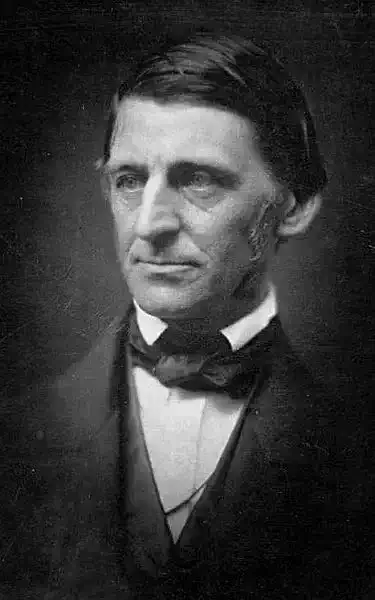
Ralph Waldo Emerson
Merlin I
Thy trivial harp will never please
Or fill my craving ear;
Its chords should ring as blows the breeze,
Free, peremptory, clear.
No jingling serenader's art,
Nor tinkle of piano strings,
Can make the wild blood start
In its mystic springs.
The kingly bard
Must smite the chords rudely and hard,
As with hammer or with mace,
That they may render back
Artful thunder that conveys
Secrets of the solar track,
Sparks of the supersolar blaze.
Merlin's blows are strokes of fate,
Chiming with the forest-tone,
When boughs buffet boughs in the wood;
Chiming with the gasp and moan
Of the ice-imprisoned flood;
With the pulse of manly hearts,
With the voice of orators,
With the din of city arts,
With the cannonade of wars.
With the marches of the brave,
And prayers of might from martyrs' cave.
Great is the art,
Great be the manners of the bard!
He shall not his brain encumber
With the coil of rhythm and number,
But, leaving rule and pale forethought,
He shall aye climb
For his rhyme:
Pass in, pass in, the angels say,
In to the upper doors;
Nor count compartments of the floors,
But mount to Paradise
By the stairway of surprise.
Blameless master of the games,
King of sport that never shames;
He shall daily joy dispense
Hid in song's sweet influence.
Things more cheerly live and go,
What time the subtle mind
Plays aloud the tune whereto
Their pulses beat,
And march their feet,
And their members are combined.
By Sybarites beguiled
He shall no task decline;
Merlin's mighty line,
Extremes of nature reconciled,
Bereaved a tyrant of his will,
And made the lion mild.
Songs can the tempest still,
Scattered on the stormy air,
Mould the year to fair increase,
And bring in poetic peace.
He shall not seek to weave,
In weak unhappy times,
Efficacious rhymes;
Wait his returning strength,
Bird, that from the nadir's floor,
To the zenith's top could soar,
The soaring orbit of the muse exceeds that journey's length!
Nor, profane, affect to hit
Or compass that by meddling wit,
Which only the propitious mind
Publishes when 'tis inclined.
There are open hours
When the god's will sallies free,
And the dull idiot might see
The flowing fortunes of a thousand years;
Sudden, at unawares,
Self-moved fly-to the doors,
Nor sword of angels could reveal
What they conceal.
392
William Butler Yeats
A Coat
I MADE my song a coat
Covered with embroideries
Out of old mythologies
From heel to throat;
But the fools caught it,
Wore it in the world's eyes
As though they'd wrought it.
Song, let them take it,
For there's more enterprise
In walking naked.
Covered with embroideries
Out of old mythologies
From heel to throat;
But the fools caught it,
Wore it in the world's eyes
As though they'd wrought it.
Song, let them take it,
For there's more enterprise
In walking naked.
390
Carl Sandburg
Bronzes
I
The bronze General Grant riding a bronze horse in Lincoln
Park
Shrivels in the sun by day when the motor cars whirr
by in long processions going somewhere to keep appointment
for dinner and matineés and buying and
selling
Though in the dusk and nightfall when high waves are
piling
On the slabs of the promenade along the lake shore near
by
I have seen the general dare the combers come closer
And make to ride his bronze horse out into the hoofs
and guns of the storm.
II
I cross Lincoln Park on a winter night when the snow
is falling.
Lincoln in bronze stands among the white lines of snow,
his bronze forehead meeting soft echoes of the newsies
crying forty thousand men are dead along the
Yser, his bronze ears listening to the mumbled roar
of the city at his bronze feet.
A lithe Indian on a bronze pony, Shakespeare seated with
long legs in bronze, Garibaldi in a bronze cape, they
hold places in the cold, lonely snow to-night on their
pedestals and so they will hold them past midnight
and into the dawn.
388