
Happiness and Joy

James Whitcomb Riley
On The Sunny Side
Hi and whoop-hooray, boys!
Sing a song of cheer!
Here's a holiday, boys,
Lasting half a year!
Round the world, and half is
Shadow we have tried;
Now we're where the laugh is,--
On the sunny side!
Pigeons coo and mutter,
Strutting high aloof
Where the sunbeans flutter
Through the stable roof.
Hear the chickens cheep, boys,
And the hen with pride
Clucking them to sleep, boys,
On the sunny side!
Hear the clacking guinea;
Hear the cattle moo;
Hear the horses whinny,
Looking out at you!
On the hitching-block, boys,
Grandly satisfied,
See the old peacock, boys,
On the sunny side!
Robins in the peach-tree;
Bluebirds in the pear;
Blossoms over each tree
In the orchard there!
All the world's in joy, boys,
Glad and glorified
As a romping boy, boys,
On the sunny side!
Where's a heart as mellow?
Where's a soul as free?
Where is any fellow
We would rather be?
Just ourselves or none, boys,
World around and wide,
Laughing in the sun, boys,
On the sunny side!
306

Billy Collins
The Best Cigarette
There are many that I miss
having sent my last one out a car window
sparking along the road one night, years ago.
The heralded one, of course:
after sex, the two glowing tips
now the lights of a single ship;
at the end of a long dinner
with more wine to come
and a smoke ring coasting into the chandelier;
or on a white beach,
holding one with fingers still wet from a swim.
How bittersweet these punctuations
of flame and gesture;
but the best were on those mornings
when I would have a little something going
in the typewriter,
the sun bright in the windows,
maybe some Berlioz on in the background.
I would go into the kitchen for coffee
and on the way back to the page,
curled in its roller,
I would light one up and feel
its dry rush mix with the dark taste of coffee.
Then I would be my own locomotive,
trailing behind me as I returned to work
little puffs of smoke,
indicators of progress,
signs of industry and thought,
the signal that told the nineteenth century
it was moving forward.
That was the best cigarette,
when I would steam into the study
full of vaporous hope
and stand there,
the big headlamp of my face
pointed down at all the words in parallel lines.
303
James Whitcomb Riley
The Katydids
Sometimes I keep
From going to sleep,
To hear the katydids 'cheep-cheep!'
And think they say
Their prayers that way;
But _katydids_ don't have to _pray_!
I listen when
They cheep again
And so, I think, they're _singing_ then!
But, no; I'm wrong,--
The sound's too long
And all-alike to be a song!
I think, 'Well, there!
I do declare,
If it is neither song nor prayer,
It's _talk_--and quite
Too vain and light
For me to listen to all night!'
And so, I smile,
And think,--'Now I'll
Not listen for a little while!'--
Then, sweet and clear,
Next '_cheep_' I hear
'S a _kiss_.... Good morning, Mommy dear!
302

Anonymous
I Saw Three Ships
I saw three ships come sailing in
On Christmas day, on Christmas day;
I saw three ships come sailing in
On Christmas day in the morning.
And what was in those ships all three,
On Christmas day, on Christmas day?
And what was in those ships all three,
On Christmas day in the morning?
Our Saviour Christ and his lady,
On Christmas day, on Christmas day;
Our Saviour Christ and his lady,
On Christmas day in the morning.
Pray whither sailed those ships all three,
On Christmas day, on Christmas day?
Pray whither sailed those ships all three,
On Christmas day in the morning?
O they sailed into Bethlehem,
On Christmas day, on Christmas day;
O they sailed into Bethlehem,
On Christmas day in the morning.
And all the bells on earth shall ring,
On Christmas day, on Christmas day;
And all the bells on earth shall ring,
On Christmas day in the morning.
And all the Angels in Heaven shall sing,
On Christmas day, on Christmas day;
And all the Angels in Heaven shall sing,
On Christmas day in the morning.
And all the Souls on Earth shall sing,
On Christmas day, on Christmas day;
And all the Souls on Earth shall sing,
On Christmas day in the morning.
Then let us all rejoice amain,
On Christmas day, on Christmas day;
Then let us all rejoice amain,
On Christmas day in the morning.
On Christmas day, on Christmas day;
I saw three ships come sailing in
On Christmas day in the morning.
And what was in those ships all three,
On Christmas day, on Christmas day?
And what was in those ships all three,
On Christmas day in the morning?
Our Saviour Christ and his lady,
On Christmas day, on Christmas day;
Our Saviour Christ and his lady,
On Christmas day in the morning.
Pray whither sailed those ships all three,
On Christmas day, on Christmas day?
Pray whither sailed those ships all three,
On Christmas day in the morning?
O they sailed into Bethlehem,
On Christmas day, on Christmas day;
O they sailed into Bethlehem,
On Christmas day in the morning.
And all the bells on earth shall ring,
On Christmas day, on Christmas day;
And all the bells on earth shall ring,
On Christmas day in the morning.
And all the Angels in Heaven shall sing,
On Christmas day, on Christmas day;
And all the Angels in Heaven shall sing,
On Christmas day in the morning.
And all the Souls on Earth shall sing,
On Christmas day, on Christmas day;
And all the Souls on Earth shall sing,
On Christmas day in the morning.
Then let us all rejoice amain,
On Christmas day, on Christmas day;
Then let us all rejoice amain,
On Christmas day in the morning.
299
James Whitcomb Riley
The Town Karnteel
The Town Karnteel--! It's who'll reveal
Its praises jushtifiable?
For who can sing av anything
So lovely and reliable?
Whin Summer, Spring, or Winter lies
From Malin's Head to Tipperary,
There's no such town for interprise
Bechuxt Youghal and Londonderry!
There's not its likes in Ireland--
For twic't the week, be gorries!
They're playing jigs upon the band,
And joomping there in sacks-- and-- and--
And racing, wid wheelborries!
Kanteel-- it's there, like any fair,
The purty gurrls is plinty, sure--!
And man-alive! At forty-five
The leg's av me air twinty, sure!
I lave me cares, and hoein' too,
Behint me, as is sinsible,
And it's Karnteel I'm goin' to,
To cilebrate in principle!
For there's the town av all the land!
And twic't the week, be-gorries!
They're playing jigs upon the band,
And joomping there in sacks-- and-- and--
And racing, wid wheelborries!
And whilst I feel for owld Karnteel
That I've no phrases glorious,
It stands above the need av love
That boasts in voice uproarious--!
Lave that for Cork, and Dublin too,
And Armagh and Killarney thin--,
And Karnteel won't be troublin' you
Wid any jilous blarney, thin!
For there's the town av all the land
Where twic't the week, be-gorries!
They're playing jigs upon the band,
And joomping there in sacks-- and-- and--
And racing, wid wheelborries!
299
James Whitcomb Riley
Sister Jones's Confession
I thought the deacon liked me, yit
I warn't adzackly shore of it--
Fer, mind ye, time and time agin,
When jiners 'ud be comin' in,
I'd seed him shakin' hands as free
With all the sistern as with me!
But jurin' last Revival, where
He called on _me_ to lead in prayer,
An' kneeled there with me, side by side,
A-whisper'n' 'he felt sanctified
Jes' tetchin of my gyarment's hem,'--
That settled things as fur as them-
Thare other wimmin was concerned!-And--
well!--I know I must a-turned
A dozen colors!--_Flurried_?--_la_!--
No mortal sinner never saw
A gladder widder than the one
A-kneelin' there and wonderun'
Who'd pray'--So glad, upon my word,
I railly could n't thank the Lord!
299

Emily Dickinson
We—Bee and I—live by the quaffing
We—Bee and I—live by the quaffing—
'Tisn't all Hock—with us—
Life has its Ale—
But it's many a lay of the Dim Burgundy—
We chant—for cheer—when the Wines—fail—
Do we "get drunk"?
Ask the jolly Clovers!
Do we "beat" our "Wife"?
I—never wed—
Bee—pledges his—in minute flagons—
Dainty—as the trees—on our deft Head—
While runs the Rhine—
He and I—revel—
First—at the vat—and latest at the Vine—
Noon—our last Cup—
"Found dead"—"of Nectar"—
By a humming Coroner—
In a By-Thyme!
299

William Wordsworth
The Mother's Return
A MONTH, sweet Little-ones, is past
Since your dear Mother went away,---
And she tomorrow will return;
Tomorrow is the happy day.
O blessed tidings! thought of joy!
The eldest heard with steady glee;
Silent he stood; then laughed amain,---
And shouted, ' Mother, come to me!'
Louder and louder did he shout,
With witless hope to bring her near;
'Nay, patience! patience, little boy!
Your tender mother cannot hear.'
I told of hills, and far-off town,
And long, long vale to travel through;---
He listens, puzzled, sore perplexed,
But he submits; what can he do ?
No strife disturbs his sister's breast;
She wars not with the mystery
Of time and distance, night and day;
The bonds of our humanity.
Her joy is like an instinct, joy
Of kitten, bird, or summer fly;
She dances, runs without an aim,
She chatters in her ecstasy.
Her brother now takes up the note,
And echoes back his sister's glee;
They hug the infant in my arms,
As if to force his sympathy.
Then, settling into fond discourse,
We rested in the garden bower;
While sweetly shone the evening sun
In his departing hour.
We told o'er all that we had done,---
Our rambles by the swift brook's side
Far as the willow-skirted pool,
Where two fair swans together glide.
We talked of change, of winter gone,
Of green leaves on the hawthorn spray,
Of birds that build their nests and sing
And all 'since Mother went away!'
To her these tales they will repeat,
To her our new-born tribes will show,
The goslings green, the ass's colt,
The lambs that in the meadow go.
---But, see, the evening star comes forth!
To bed the children must depart;
A moment's heaviness they feel,
A sadness at the heart;
'Tis gone---and in a merry fit
They run up stairs in gamesome race;
I, too, infected by their mood,
I could have joined the wanton chase.
Five minutes past---and, O the change!
Asleep upon their beds they lie;
Their buy limbs in perfect rest,
And closed the sparkling eye.
301
James Whitcomb Riley
A Cup Of Tea
I have sipped, with drooping lashes,
Dreamy draughts of Verzenay;
I have flourished brandy-smashes
In the wildest sort of way;
I have joked with 'Tom and Jerry'
Till wee hours ayont the twal'--
But I've found my tea the very
Safest tipple of them all!
'Tis a mystical potation
That exceeds in warmth of glow
And divine exhilaration
All the drugs of long ago--
All of old magicians' potions--
Of Medea's filtered spells--
Or of fabled isles and oceans
Where the Lotos-eater dwells!
Though I've reveled o'er late lunches
With _blase_ dramatic stars,
And absorbed their wit and punches
And the fumes of their cigars--
Drank in the latest story,
With a cock-tail either end,--
I have drained a deeper glory
In a cup of tea, my friend.
Green, Black, Moyune, Formosa,
Congou, Amboy, Pingsuey--
No odds the name it knows--ah!
Fill a cup of it for me!
And, as I clink my china
Against your goblet's brim,
My tea in steam shall twine a
Fragrant laurel round its rim.
296
Anonymous
Cradle Song
O MY deir hert, young Jesus sweit,
Prepare thy creddil in my spreit,
And I sall rock thee in my hert
And never mair from thee depart.
But I sall praise thee evermoir
With sangis sweit unto thy gloir;
The knees of my hert sall I bow,
And sing that richt Balulalow!
Prepare thy creddil in my spreit,
And I sall rock thee in my hert
And never mair from thee depart.
But I sall praise thee evermoir
With sangis sweit unto thy gloir;
The knees of my hert sall I bow,
And sing that richt Balulalow!
294
Emily Dickinson
Did Our Best Moment last
Did Our Best Moment last'
Twould supersede the Heaven-
A few-and they by Risk-procure-
So this Sort-are not given-
Except as stimulants-in
Cases of Despair-
Or Stupor-The Reserve-
These Heavenly Moments are-
A Grant of the Divine-
That Certain as it ComesWithdraws-
and leaves the dazzled Soul
In her unfurnished Rooms
Twould supersede the Heaven-
A few-and they by Risk-procure-
So this Sort-are not given-
Except as stimulants-in
Cases of Despair-
Or Stupor-The Reserve-
These Heavenly Moments are-
A Grant of the Divine-
That Certain as it ComesWithdraws-
and leaves the dazzled Soul
In her unfurnished Rooms
295

John Greenleaf Whittier
The Pumpkin
Oh, greenly and fair in the lands of the sun,
The vines of the gourd and the rich melon run,
And the rock and the tree and the cottage enfold,
With broad leaves all greenness and blossoms all gold,
Like that which o'er Nineveh's prophet once grew,
While he waited to know that his warning was true,
And longed for the storm-cloud, and listened in vain
For the rush of the whirlwind and red fire-rain.
On the banks of the Xenil the dark Spanish maiden
Comes up with the fruit of the tangled vine laden;
And the Creole of Cuba laughs out to behold
Through orange-leaves shining the broad spheres of gold;
Yet with dearer delight from his home in the North,
On the fields of his harvest the Yankee looks forth,
Where crook-necks are coiling and yellow fruit shines,
And the sun of September melts down on his vines.
Ah! on Thanksgiving day, when from East and from West,
From North and from South comes the pilgrim and guest;
When the gray-haired New Englander sees round his board
The old broken links of affection restored;
When the care-wearied man seeks his mother once more,
And the worn matron smiles where the girl smiled before;
What moistens the lip and what brightens the eye,
What calls back the past, like the rich Pumpkin pie?
Oh, fruit loved of boyhood! the old days recalling,
When wood-grapes were purpling and brown nuts were falling!
When wild, ugly faces we carved in its skin,
Glaring out through the dark with a candle within!
When we laughed round the corn-heap, with hearts all in tune,
Our chair a broad pumpkin, -- our lantern the moon,
Telling tales of the fairy who travelled like steam
In a pumpkin-shell coach, with two rats for her team!
Then thanks for thy present! none sweeter or better
E'er smoked from an oven or circled a platter!
Fairer hands never wrought at a pastry more fine,
Brighter eyes never watched o'er its baking, than thine!
And the prayer, which my mouth is too full to express,
Swells my heart that thy shadow may never be less,
That the days of thy lot may be lengthened below,
And the fame of thy worth like a pumpkin-vine grow,
And thy life be as sweet, and its last sunset sky
Golden-tinted and fair as thy own Pumpkin pie!
291

Robert W. Service
Wonder
For failure I was well equipped
And should have come to grief,
By atavism grimly gripped,
A fool beyond belief.
But lo! the Lord was good to me,
And with a heart to sing,
He gave me to a rare degree
The Gift of Wondering.
I could not play a stalwart part
My shoddy soul to save,
And should have gone with broken heart
A begger to the grave;
But praise to my anointed sight
As wandering I went,
I sang of living with delight
In terms of Wonderment.
Aye, starry-eyed did I rejoice
With marvel of a child,
And there were those who heard my voice
Although my words were wild:
So as I go my wistful way,
With worship let me sing,
A treasure to my farewell day
God's Gift of Wondering.
292
Emily Dickinson
It was given to me by the Gods
It was given to me by the Gods-
When I was a little Girl-
They given us Presents most-you know-
When we are new-and small.
I kept it in my Hand-
I never put it down-
I did not dare to eat-or sleep-
For fear it would be gone-
I heard such words as "Rich"-
When hurrying to school-
From lips at Corners of the Streets-
And wrestled with a smile.
Rich! 'Twas Myself-was rich-
To take the name of Gold-
And Gold to own-in solid Bars-
The Difference-made me bold-
290
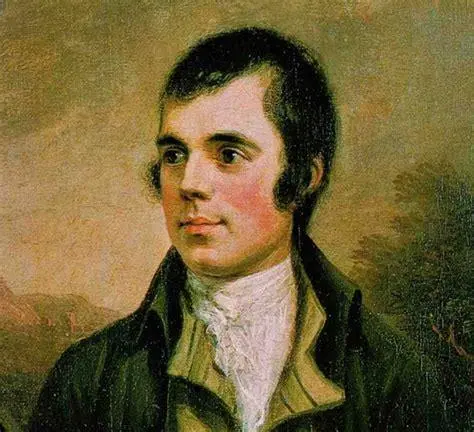
Robert Burns
Scotch Drink
Let other poets raise a fracas
Bout vines, and wines, an drucken Bacchus,
An crabbit names an stories wrack us,
An grate our lug:
I sing the juice Scotch bear can mak us,
In glass or Jug.
O thou, my Muse! guid auld Scotch drink!
Whether thro' wimplin worms thou jink,
Or, richly brown, ream owre the brink,
In glorious faem
Inspire me, till I lisp an wink,
To sing thy name!
Let husky wheat the haughs adorn,
An aits set up their awnie horn,
An Pease and beans, at e'en or morn,
Perfume the plain:
Leeze me on thee, John Barleycorn,
Thou king o' grain!
On thee aft Scotland chows her cood,
In souple scones, the wale o' food!
Or tumbling in the boiling flood
Wi' kail an beef;
But when thou pours thy strong heart's blood
There thou shines chief.
Food fills the wame, an keeps us livin;
Tho life's a gift no worth receivin
When heavy-dragg'd wi pine an grievin;
But oil'd by thee
The wheels o' life gae down-hill, scrievin,
Wi' rattlin glee.
Thou clears the head o' doited Lear,
Thou cheers the heart o' drooping Care;
Thou strings the nerves o' Labour sair,
At 's weary toil;
Thou ev'n brightens dark Despair
Wi' gloomy smile.
Aft, clad in massy siller weed,
Wi gentles thou erscts thy head;
Yet humbly kind in time o' need,
The poor man's wine:
His wee drap parritch, or his bread,
Thou kitchens fine.
Thou art the life o' public haunts;
But thee, what were our fairs and rants?
Ev'n godly meetings o' the saunts,
By thee inspir'd,
When, gaping, they besiege the tents,
Are doubly fir'd.
That merry night we get the corn in,
O sweetly, then, thou reams the horn
Or reekin on a New-Year mornin
In cog or bicker,
An just a wee drap sp'ritual burn in,
An gusty sucker!
When Vulcan gies his bellows breath,
An ploughmen gather wi their graith,
O rare! to see thee fizz an freath
I' th' lugget caup!
Then Burnewin comes on like death
At every chaup.
Nae mercy, then, for airn or steel:
The brawnie, bainie, ploughman chiel,
Brings hard owrehip, wi sturdy wheel,
The strong forehammer,
Till block an studdie ring an reel,
Wi dinsome clamour.
When skirlin' weanies see the light,
Thou maks the gossips clatter bright,
How fumblin coofs their dearies slight;
Wae worth the name!
Nae howdie gets a social night,
Or plack frae them.
When neebors anger at a plea,
An just as wud as wud can be,
How easy can the barley-brie
Cement the quarrel!
It's aye the cheapest lawyer's fee,
To taste the barrel.
Alake! that e'er my Muse has reason,
To wyte her countrymen wi' treason!
But monie daily weet their weason
Wi' liquors nice,
An hardly, in a winter season,
E'er spier her price.
Wae worth that brandy, burnin trash!
Fell source o' monie a pain an brash!
Twins monie a poor, doylt, drucken hash
O' half his days;
An sends, beside, auld Scotland's cash
To her warst faes.
Ye Scots, wha wish auld Scotland well!
Ye chief, to you my tale I tell,
Poor, plackless devils like mysel!
It sets you ill
Wi' bitter, dearthfu' wines to mell,
Or foreign gill.
May gravels round his blather wrench,
An gouts torment him, inch by inch,
Wha twists his gruntle wi' a glunch
O' sour disdain
Out owre a glass o' whisky-punch
Wi honest men!
O Whisky! soul o' plays an pranks!
Accept a Bardie's gratefu thanks!
When wanting thee, what tuneless cranks
Are my poor verses!
Thou comes---they rattle i' their ranks,
At ither's arses!
Thee, Ferintosh! O sadly lost!
Scotland lament frae coast to coast!
Now colic grips, an barkin hoast
May kill us a';
For loyal Eorbes' charter'd boast
Is taen awa!
They curst horse-leeches o' th' Excise,
Wha mak the whisky stells their prize!
Haud up thy han', Deil! ance, twice, thrice!
There, seize the blinkers!
An bake them up in brunstane pies
For poor damn'd drinkers.
Fortune! if thou'll but gie me still
Hale breeks, a scone, an whisky gill,
An rowth o' rhyme to rave at will,
Tak a' the rest,
An deal't about as thy blind skill
Directs thee best.
292
James Whitcomb Riley
The Little Town O' Tailholt
You kin boast about yer cities, and their stiddy growth and size,
And brag about yer County-seats, and business enterprise,
And railroads, and factories, and all sich foolery--
But the little Town o' Tailholt is big enough fer me!
You kin harp about yer churches, with their steeples in the clouds,
And gas about yer graded streets, and blow about yer crowds;
You kin talk about yer 'theaters,' and all you've got to see--
But the little Town o' Tailholt is show enough fer me!
They hain't no style in our town-- hit's little-like and small--
They hain't no 'churches,' nuther--, jes' the meetin' house is all;
They's no sidewalks, to speak of-- but the highway's allus free,
And the little Town o' Tailholt is wide enough fer me!
Some find it discommodin'-like, I'm willin' to admit,
To hev but one post-office, and a womern keepin' hit,
And the drug-store, and shoe-shop, and grocery, all three--
But the little Town o' Tailholt is handy 'nough fer me!
You kin smile and turn yer nose up, and joke and hev yer fun,
And laugh and holler 'Tail-holts is better holts'n none!
Ef the city suits you better w'y, hit's where you'd ort'o be--
But the little Town o' Tailholt's good enough fer me!
286
Robert W. Service
A Lyric Day
I deem that there are lyric days
So ripe with radiance and cheer,
So rich with gratitude and praise
That they enrapture all the year.
And if there is a God b\above,
(As they would tell me in the Kirk,)
How he must look with pride and love
Upon his perfect handiwork!
To-day has been a lyric day
I hope I shall remember long,
Of meadow dance and roundelay,
Of woodland glee, of glow and song.
Such joy I saw in maidens eyes,
In mother gaze such tender bliss . . .
How earth would rival paradise
If every day could be like this!
Why die, say I? Let us live on
In lyric world of song and shine,
With ecstasy from dawn to dawn,
Until we greet the dawn Devine.
For I believe, with star and sun,
With peak and plain, with sea and sod,
Inextricably we are one,
Bound in the Wholeness - God.
286
Emily Dickinson
I think the longest Hour of all
I think the longest Hour of all
Is when the Cars have come-
And we are waiting for the Coach-
It seems as though the Time
Indignant-that the Joy was come-
Did block the Gilded Hands-
And would not let the Seconds by-
But slowest instant-ends-
The Pendulum begins to count-
Like little Scholars-loud-
The steps grow thicker-in the Hall-
The Heart begins to crowd-
Then I-my timid service done-
Tho' service 'twas, of Love-
Take up my little Violin-
And further North-remove.
285
Emily Dickinson
The Bee is not afraid of me
The Bee is not afraid of me.
I know the Butterfly.
The pretty people in the Woods
Receive me cordially-
The Brooks laugh louder when I come-
The Breezes madder play;
Wherefore mine eye thy silver mists,
Wherefore, Oh Summer's Day?
I know the Butterfly.
The pretty people in the Woods
Receive me cordially-
The Brooks laugh louder when I come-
The Breezes madder play;
Wherefore mine eye thy silver mists,
Wherefore, Oh Summer's Day?
281
Robert W. Service
Finistere
Hurrah! I'm off to Finistere, to Finistere, to Finistere;
My satchel's swinging on my back, my staff is in my hand;
I've twenty louis in my purse, I know the sun and sea are there,
And so I'm starting out to-day to tramp the golden land.
I'll go alone and glorying, with on my lips a song of joy;
I'll leave behind the city with its canker and its care;
I'll swing along so sturdily -- oh, won't I be the happy boy!
A-singing on the rocky roads, the roads of Finistere.
Oh, have you been to Finistere, and do you know a whin-gray town
That echoes to the clatter of a thousand wooden shoes?
And have you seen the fisher-girls go gallivantin' up and down,
And watched the tawny boats go out, and heard the roaring crews?
Oh, would you sit with pipe and bowl, and dream upon some sunny quay,
Or would you walk the windy heath and drink the cooler air;
Oh, would you seek a cradled cove and tussle with the topaz sea! --
Pack up your kit to-morrow, lad, and haste to Finistere.
Oh, I will go to Finistere, there's nothing that can hold me back.
I'll laugh with Yves and Le/on, and I'll chaff with Rose and Jeanne;
I'll seek the little, quaint buvette that's kept by Mother Merdrinac,
Who wears a cap of many frills, and swears just like a man.
I'll yarn with hearty, hairy chaps who dance and leap and crack their heels;
Who swallow cupfuls of cognac and never turn a hair;
I'll watch the nut-brown boats come in with mullet, plaice and conger eels,
The jeweled harvest of the sea they reap in Finistere.
Yes, I'll come back from Finistere with memories of shining days,
Of scaly nets and salty men in overalls of brown;
Of ancient women knitting as they watch the tethered cattle graze
By little nestling beaches where the gorse goes blazing down;
Of headlands silvering the sea, of Calvarys against the sky,
Of scorn of angry sunsets, and of Carnac grim and bare;
Oh, won't I have the leaping veins, and tawny cheek and sparkling eye,
When I come back to Montparnasse and dream of Finistere.
281

Alice Walker
What Makes The Dalai Lama Lovable?
His posture
From so many years
Holding his robe with one hand
Is odd.
His gait
Also.
One's own body
Aches
Witnessing
The sloping
Shoulders
& Angled
Neck;
One hopes
He
Attends
Yoga class
Or does Yoga
On his own
As part
Of prayer.
He smiles
As he bows
To Everything:
Accepting
The heavy
Burdens
Of
This earth;
It's
Toxic
Evils
& Prolific
Insults.
Even so,
He sleeps
Through
The night
Like a child
Because
Thank goodness
That is something
Else
Daylong
Meditation
Assures.
You could cry
Yourself to sleep
On his behalf
& He
Has done that
Too.
Life
Has been
A great
Endless
Tearing away
For
Him.
From
Mother, Father, Siblings, Country, Home.
And yet
Clearly
His mother
Loved him;
His brother & sister
Too:
Even his
Not so constant father,
Who
When Tenzin was
A boy
Shared
With him
Delicious
Scraps
Of
Succulent
Pork.
He laughs
Telling this
Story
Over half a century
Later
&
To who knows
How many
Puzzled
Vegetarians:
About
The way he sat
Behind
His father's chair
Like a dog,
Relishing
Each juicy
Greasy
Bite.
Whenever I see
The Dalai Lama
My first impulse
Is to laugh
I am so happy
To
Lay eyes
On
One
So effortlessly
Beautiful.
That balding head
That holds
A shine;
Those wire framed
Glasses
That might
Have come
From
Anywhere.
His look of having given
All he has.
He is my teacher;
Just staying alive.
Other teachers
I have had
Resemble him
In some way;
They too
Were
&
Are
Smart
And Humble;
Fascinated
By Science & things like
Time,
Eternity,
Cause & Effect;
The Evolution
Of the Soul.
A soul
That
Might
Or might not
Exist.
They too
See all of us
-Banker, murderer, gardener, thief -
When they look
Out across
The world:
But that is not all
They see.
They see our suffering;
Our striving
To find
The right path;
The one with heart
We may only
Have heard
About.
The Dalai Lama is Cool
A modern word
For
"Divine"
Because he wants
Only
Our collective
Health
& Happiness.
That's it!
What makes
Him
Lovable
Is
His holiness.
280
Emily Dickinson
To my small Hearth His fire came
To my small Hearth His fire came-
And all my House aglow
Did fan and rock, with sudden light'
Twas Sunrise-'twas the Sky-
Impanelled from no Summer brief-
With limit of Decay'
Twas Noon-without the News of Night-
Nay, Nature, it was Day-
And all my House aglow
Did fan and rock, with sudden light'
Twas Sunrise-'twas the Sky-
Impanelled from no Summer brief-
With limit of Decay'
Twas Noon-without the News of Night-
Nay, Nature, it was Day-
280

Ogden Nash
Soliloquy in Circles
Being a father
Is quite a bother.
You are as free as air
With time to spare,
You're a fiscal rocket
With change in your pocket,
And then one morn
A child is born.
Your life has been runcible,
Irresponsible,
Like an arrow or javelin
You've been constantly travelin'.
But mostly, I daresay,
Without a chaise percée,
To which by comparison
Nothing's embarison.
But all children matures,
Maybe even yours.
You improve them mentally
And straighten them dentally,
They grow tall as a lancer
And ask questions you can't answer,
And supply you with data
About how everybody else wears lipstick sooner and stays up later,
And if they are popular,
The phone they monopular.
They scorn the dominion
Of their parent's opinion,
They're no longer corralable
Once they find that you're fallible
But after you've raised them and educated them and gowned them,
They just take their little fingers and wrap you around them.
Being a father Is quite a bother,
But I like it, rather.
282

Robert Louis Stevenson
Before This Little Gift Was Come
BEFORE this little gift was come
The little owner had made haste for home;
And from the door of where the eternal dwell,
Looked back on human things and smiled farewell.
O may this grief remain the only one!
O may our house be still a garrison
Of smiling children, and for evermore
The tune of little feet be heard along the floor!
The little owner had made haste for home;
And from the door of where the eternal dwell,
Looked back on human things and smiled farewell.
O may this grief remain the only one!
O may our house be still a garrison
Of smiling children, and for evermore
The tune of little feet be heard along the floor!
279