
Humanity and Solidarity

Carl Sandburg
Threes
I was a boy when I heard three red words
a thousand Frenchmen died in the streets
for: Liberty, Equality, Fraternity--I asked
why men die for words.
I was older; men with mustaches, sideburns,
lilacs, told me the high golden words are:
Mother, Home, and Heaven--other older men with
face decorations said: God, Duty, Immortality
--they sang these threes slow from deep lungs.
Years ticked off their say-so on the great clocks
of doom and damnation, soup, and nuts: meteors flashed
their say-so: and out of great Russia came three
dusky syllables workmen took guns and went out to die
for: Bread, Peace, Land.
And I met a marine of the U.S.A., a leatherneck with a girl on his knee
for a memory in ports circling the earth and he said: Tell me how to say
three things and I always get by--gimme a plate of ham and eggs--how
much--and--do you love me, kid?
350

Alice Walker
To Change The World Enough
To change the world enough
you must cease to be afraid
of the poor.
We experience your fear as the least pardonable of
humiliations; in the past
it has sent us scurrying off
daunted and ashamed
into the shadows.
Now,
the world ending
the only one all of us have known
we seek the same
fresh light
you do:
the same high place
and ample table.
The poor always believe
there is room enough
for all of us;
the very rich never seem to have heard
of this.
In us there is wisdom of how to share
loaves and fishes
however few;
we do this everyday.
Learn from us,
we ask you.
We enter now
the dreaded location
of Earth's reckoning;
no longer far
off
or hidden in books
that claim to disclose
revelations;
it is here.
We must walk together without fear.
There is no path without us
350

Ella Wheeler Wilcox
Voice of the Voiceless
I am the Voice of the Voiceless
Through me the dumb shall speak
Till the world's deaf ear be made to hear
The wrongs of the wordless weak.
Oh shame on the mothers of mortals
Who do not stoop to teach
The sorrow that lies in dear dumb eyes
The sorrow that has no speech.
From street, from cage, from kennel
From stable and from zoo
The wall of my tortured kin proclaims the sin
Of the mighty against the frail.
But I am my brother's keeper
And I shall fight their fight
And speak the word for beast and bird
Till the world shall set things right.
350

John Greenleaf Whittier
George L. Stearns
He has done the work of a true man,-Crown
him, honor him, love him.
Weep, over him, tears of woman,
Stoop manliest brows above him!
O dusky mothers and daughters,
Vigils of mourning keep for him!
Up in the mountains, and down by the waters,
Lift up your voices and weep for him,
For the warmest of hearts is frozen,
The freest of hands is still;
And the gap in our picked and chosen
The long years may not fill.
No duty could overtask him,
No need his will outrun;
Or ever our lips could ask him,
His hands the work had done.
He forgot his own soul for others,
Himself to his neighbor lending;
He found the Lord in his suffering brothers,
And not in the clouds descending.
So the bed was sweet to die on,
Whence he saw the doors wide swung
Against whose bolted iron
The strength of his life was flung.
And he saw ere his eye was darkened
The sheaves of the harvest-bringing,
And knew while his ear yet hearkened
The voice of the reapers singing.
Ah, well! The world is discreet;
There are plenty to pause and wait;
But here was a man who set his feet
Sometimes in advance of fate;
Plucked off the old bark when the inner
Was slow to renew it,
And put to the Lord's work the sinner
When saints failed to do it.
Never rode to the wrong's redressing
A worthier paladin.
Shall he not hear the blessing,
'Good and faithful, enter in!'
348
Ella Wheeler Wilcox
God's Work
To J. J. H., Of Kentucky
Gathering brands from the burning,
Plucking them out of the fire,
Lifting the sheep that have wandered,
Out of the dust and the mire,
Bringing home sheaves from the harvest
To lay at the Master's feet-
Lord! all thy hosts of angels
Must smile on a life so sweet.
Speaking with fear of no man,
Speaking with love for all,
Warning the young and the thoughtless
From the wild beast-'Alcohol.'
Showing the snares that the tempter
Weaveth on every hand.
Lord! all thy dear, dear angels
Must smile on a life so grand.
Fighting the bloodless battle
With a heart that is true and bold;
Fighting it not for glory,
Fighting it not for gold,
But out of love for his neighbor,
And out of love for his Lord.
And I know that the hands of the angels
Will crown him with his reward.
For whoso works for the Master,
And whoso fights his fight,
The angels crown with a star-wreath,
And it glows with gems most bright.
They wear them for ever and ever,
The saints in that land of bliss,
And I know that heaven's best jewel
Is kept for a soul like this.
345
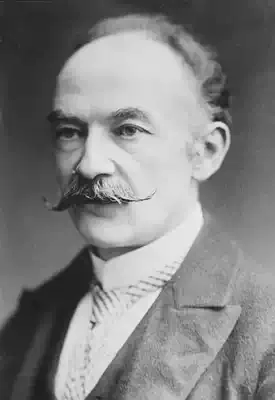
Thomas Hardy
God-Forgotten
I towered far, and lo! I stood within
The presence of the Lord Most High,
Sent thither by the sons of earth, to win
Some answer to their cry.
--"The Earth, say'st thou? The Human race?
By Me created? Sad its lot?
Nay: I have no remembrance of such place:
Such world I fashioned not." -
--"O Lord, forgive me when I say
Thou spak'st the word, and mad'st it all." -
"The Earth of men--let me bethink me . . . Yea!
I dimly do recall
"Some tiny sphere I built long back
(Mid millions of such shapes of mine)
So named . . . It perished, surely--not a wrack
Remaining, or a sign?
"It lost my interest from the first,
My aims therefor succeeding ill;
Haply it died of doing as it durst?" -
"Lord, it existeth still." -
"Dark, then, its life! For not a cry
Of aught it bears do I now hear;
Of its own act the threads were snapt whereby
Its plaints had reached mine ear.
"It used to ask for gifts of good,
Till came its severance self-entailed,
When sudden silence on that side ensued,
And has till now prevailed.
"All other orbs have kept in touch;
Their voicings reach me speedily:
Thy people took upon them overmuch
In sundering them from me!
"And it is strange--though sad enough -
Earth's race should think that one whose call
Frames, daily, shining spheres of flawless stuff
Must heed their tainted ball! . . .
"But say'st thou 'tis by pangs distraught,
And strife, and silent suffering? -
Deep grieved am I that injury should be wrought
Even on so poor a thing!
"Thou should'st have learnt that Not to Mend
For Me could mean but Not to Know:
Hence, Messengers! and straightway put an end
To what men undergo." . . .
Homing at dawn, I thought to see
One of the Messengers standing by.
- Oh, childish thought! . . . Yet oft it comes to me
When trouble hovers nigh.
346
John Greenleaf Whittier
Divine Compassion
Long since, a dream of heaven I had,
And still the vision haunts me oft;
I see the saints in white robes clad,
The martyrs with their palms aloft;
But hearing still, in middle song,
The ceaseless dissonance of wrong;
And shrinking, with hid faces, from the strain
Of sad, beseeching eyes, full of remorse and pain.
The glad song falters to a wail,
The harping sinks to low lament;
Before the still unlifted veil
I see the crowned foreheads bent,
Making more sweet the heavenly air,
With breathings of unselfish prayer;
And a Voice saith: 'O Pity which is pain,
O Love that weeps, fill up my sufferings which remain!
'Shall souls redeemed by me refuse
To share my sorrow in their turn?
Or, sin-forgiven, my gift abuse
Of peace with selfish unconcern?
Has saintly ease no pitying care?
Has faith no work, and love no prayer?
While sin remains, and souls in darkness dwell,
Can heaven itself be heaven, and look unmoved on hell?'
Then through the Gates of Pain, I dream,
A wind of heaven blows coolly in;
Fainter the awful discords seem,
The smoke of torment grows more thin,
Tears quench the burning soil, and thence
Spring sweet, pale flowers of penitence
And through the dreary realm of man's despair,
Star-crowned an angel walks, and to! God's hope is there!
Is it a dream? Is heaven so high
That pity cannot breathe its air?
Its happy eyes forever dry,
Its holy lips without a prayer!
My God! my God! if thither led
By Thy free grace unmerited,
No crown nor palm be mine, but let me keep
A heart that still can feel, and eyes that still can weep.
342

Khalil Gibran
Good and Evil XXII
And one of the elders of the city said, "Speak to us of Good and Evil."
And he answered:
Of the good in you I can speak, but not of the evil.
For what is evil but good tortured by its own hunger and thirst?
Verily when good is hungry it seeks food even in dark caves, and when it thirsts, it
drinks even of dead waters.
You are good when you are one with yourself.
Yet when you are not one with yourself you are not evil.
For a divided house is not a den of thieves; it is only a divided house.
And a ship without rudder may wander aimlessly among perilous isles yet sink not to
the bottom.
You are good when you strive to give of yourself.
Yet you are not evil when you seek gain for yourself.
For when you strive for gain you are but a root that clings to the earth and sucks at her
breast.
Surely the fruit cannot say to the root, "Be like me, ripe and full and ever giving of
your abundance."
For to the fruit giving is a need, as receiving is a need to the root.
You are good when you are fully awake in your speech,
Yet you are not evil when you sleep while your tongue staggers without purpose.
And even stumbling speech may strengthen a weak tongue.
You are good when you walk to your goal firmly and with bold steps.
Yet you are not evil when you go thither limping.
Even those who limp go not backward.
But you who are strong and swift, see that you do not limp before the lame, deeming it
kindness.
You are good in countless ways, and you are not evil when you are not good,
You are only loitering and sluggard.
Pity that the stags cannot teach swiftness to the turtles.
In your longing for your giant self lies your goodness: and that longing is in all of you.
But in some of you that longing is a torrent rushing with might to the sea, carrying the
secrets of the hillsides and the songs of the forest.
And in others it is a flat stream that loses itself in angles and bends and lingers before
it reaches the shore.
But let not him who longs much say to him who longs little, "Wherefore are you slow
and halting?"
For the truly good ask not the naked, "Where is your garment?" nor the houseless,
"What has befallen your house?"
342

Walt Whitman
One's Self I Sing
ONE'S-SELF I sing--a simple, separate Person;
Yet utter the word Democratic, the word En-masse.
Of Physiology from top to toe I sing;
Not physiognomy alone, nor brain alone, is worthy for the muse--I say
the Form complete is worthier far;
The Female equally with the male I sing.
Of Life immense in passion, pulse, and power,
Cheerful--for freest action form'd, under the laws divine,
The Modern Man I sing.
339
Ella Wheeler Wilcox
True Charity
I gave a beggar from my little store
Of well-earned gold. He spent the shining ore
And came again, and yet again, still cold
And hungry, as before.
I gave a thought, and through that thought of mine
He found himself, the man, supreme, divine!
Fed, clothed, and crowned with blessings manifold.
And now he begs no more.
Of well-earned gold. He spent the shining ore
And came again, and yet again, still cold
And hungry, as before.
I gave a thought, and through that thought of mine
He found himself, the man, supreme, divine!
Fed, clothed, and crowned with blessings manifold.
And now he begs no more.
333

Emily Dickinson
Drama's Vitallest Expression is the Common Day
Drama's Vitallest Expression is the Common Day
That arise and set about Us-
Other Tragedy
Perish in the RecitationThis-
the best enact
When the Audience is scattered
And the Boxes shut
"Hamlet" to Himself were Hamlet-
Had not Shakespeare wrote-
Though the "Romeo" left no Record
Of his Juliet,
It were infinite enacted
In the Human Heart-
Only Theatre recorded
Owner cannot shut-
332
John Greenleaf Whittier
Astraea
'Jove means to settle
Astraea in her seat again,
And let down his golden chain
An age of better metal.'
Ben Johnson 1615
O POET rare and old!
Thy words are prophecies;
Forward the age of gold,
The new Saturnian lies.
The universal prayer
And hope are not in vain;
Rise, brothers! and prepare
The way for Saturn's reign.
Perish shall all which takes
From labor's board and can;
Perish shall all which makes
A spaniel of the man!
Free from its bonds the mind,
The body from the rod;
Broken all chains that bind
The image of our God.
Just men no longer pine
Behind their prison-bars;
Through the rent dungeon shine
The free sun and the stars.
Earth own, at last, untrod
By sect, or caste, or clan,
The fatherhood of God,
The brotherhood of man!
Fraud fail, craft perish, forth
The money-changers driven,
And God's will done on earth,
As now in heaven;
334

Robert Burns
Address to the Unco Guid
My Son, these maxims make a rule,
An' lump them aye thegither;
The Rigid Righteous is a fool,
The Rigid Wise anither:
The cleanest corn that ere was dight
May hae some pyles o' caff in;
So ne'er a fellow creature slight
For random fits o' daffin.
Solomon.--Eccles. ch. vii. verse
O ye wha are sae guid yoursel',
Sae pious and sae holy,
Ye've nought to do but mark and tell
Your neibours' fauts and folly!
Whase life is like a weel-gaun mill,
Supplied wi' store o' water;
The heapèd happer's ebbing still,
An' still the clap plays clatter.
Hear me, ye venerable core,
As counsel for poor mortals
That frequent pass douce Wisdom's door
For glaikit Folly's portals:
I, for their thoughtless, careless sakes,
Would here propone defences--
Their donsie tricks, their black mistakes,
Their failings and mischances.
Ye see your state wi' theirs compared,
And shudder at the niffer;
But cast a moment's fair regard,
What makes the mighty differ?
Discount what scant occassion gave,
That purity ye pride in;
And (what's aft mair than a' the lave)
Your better art o' hidin.
Think, when your castigated pulse
Gies now and then a wallop,
What ragings must his veins convulse,
That still eternal gallop!
Wi' wind and tide fair i' your tail,
Right on ye scud your sea-way;
But in the teeth o' baith to sail,
It maks a unco lee-way.
See Social Life and Glee sit down,
All joyous and unthinking,
Till, quite transmugrified, they're grown
Debauchery and Drinking:
O would they stay to calculate
Th' external consequences;
Or your more dreaded hell to state
Damnation of expenses!
Ye high, exalted, virtuous dames,
Tied up in godly laces,
Before ye gie poor Frailty names,
Suppose a change o' cases;
A dear-lov'd lad, convenience snug,
A treach'rous inclination--
But let me whisper i' your lug,
Ye're aiblins nae temptation.
Then gently scan your brother man,
Still gentler sister woman;
Tho' they may gang a kennin wrang,
To step aside is human;
One point must still be greatly dark,--
The moving Why they do it;
And just as lamely can ye mark,
How far perhaps they rue it.
Who made the heart, 'tis He alone
Decidedly can try us;
He knows each chord, its various tone,
Each spring, its various bias:
Then at the balance let's be mute,
We never can adjust it;
What's done we partly may compute,
But know not what's resisted.
332
John Greenleaf Whittier
The Prayer-Seeker
Along the aisle where prayer was made,
A woman, all in black arrayed,
Close-veiled, between the kneeling host,
With gliding motion of a ghost,
Passed to the desk, and laid thereon
A scroll which bore these words alone,
_Pray for me_!
Back from the place of worshipping
She glided like a guilty thing
The rustle of her draperies, stirred
By hurrying feet, alone was heard;
While, full of awe, the preacher read,
As out into the dark she sped:
'_Pray for me_!'
Back to the night from whence she came,
To unimagined grief or shame!
Across the threshold of that door
None knew the burden that she bore;
Alone she left the written scroll,
The legend of a troubled soul,-_
Pray for me_!
Glide on, poor ghost of woe or sin!
Thou leav'st a common need within;
Each bears, like thee, some nameless weight,
Some misery inarticulate,
Some secret sin, some shrouded dread,
Some household sorrow all unsaid.
_Pray for us_!
Pass on! The type of all thou art,
Sad witness to the common heart!
With face in veil and seal on lip,
In mute and strange companionship,
Like thee we wander to and fro,
Dumbly imploring as we go
_Pray for us_!
Ah, who shall pray, since he who pleads
Our want perchance hath greater needs?
Yet they who make their loss the gain
Of others shall not ask in vain,
And Heaven bends low to hear the prayer
Of love from lips of self-despair
_Pray for us_!
In vain remorse and fear and hate
Beat with bruised bands against a fate
Whose walls of iron only move
And open to the touch of love.
He only feels his burdens fall
Who, taught by suffering, pities all.
_Pray for us_!
He prayeth best who leaves unguessed
The mystery of another's breast.
Why cheeks grow pale, why eyes o'erflow,
Or heads are white, thou need'st not know.
Enough to note by many a sign
That every heart hath needs like thine.
_Pray for us_!
330
Carl Sandburg
Skyscraper
By day the skyscraper looms in the smoke and sun and
has a soul.
Prairie and valley, streets of the city, pour people into
it and they mingle among its twenty floors and are
poured out again back to the streets, prairies and
valleys.
It is the men and women, boys and girls so poured in and
out all day that give the building a soul of dreams
and thoughts and memories.
(Dumped in the sea or fixed in a desert, who would care
for the building or speak its name or ask a policeman
the way to it?)
Elevators slide on their cables and tubes catch letters and
parcels and iron pipes carry gas and water in and
sewage out.
Wires climb with secrets, carry light and carry words,
and tell terrors and profits and loves--curses of men
grappling plans of business and questions of women
in plots of love.
Hour by hour the caissons reach down to the rock of the
earth and hold the building to a turning planet.
Hour by hour the girders play as ribs and reach out and
hold together the stone walls and floors.
Hour by hour the hand of the mason and the stuff of the
mortar clinch the pieces and parts to the shape an
architect voted.
Hour by hour the sun and the rain, the air and the rust,
and the press of time running into centuries, play
on the building inside and out and use it.
Men who sunk the pilings and mixed the mortar are laid
in graves where the wind whistles a wild song
without words
And so are men who strung the wires and fixed the pipes
and tubes and those who saw it rise floor by floor.
Souls of them all are here, even the hod carrier begging
at back doors hundreds of miles away and the bricklayer
who went to state's prison for shooting another
man while drunk.
(One man fell from a girder and broke his neck at the
end of a straight plunge--he is here--his soul has
gone into the stones of the building.)
On the office doors from tier to tier--hundreds of names
and each name standing for a face written across
with a dead child, a passionate lover, a driving
ambition for a million dollar business or a lobster's
ease of life.
Behind the signs on the doors they work and the walls
tell nothing from room to room.
Ten-dollar-a-week stenographers take letters from
corporation officers, lawyers, efficiency engineers,
and tons of letters go bundled from the building to all
ends of the earth.
Smiles and tears of each office girl go into the soul of
the building just the same as the master-men who
rule the building.
Hands of clocks turn to noon hours and each floor
empties its men and women who go away and eat
and come back to work.
Toward the end of the afternoon all work slackens and
all jobs go slower as the people feel day closing on
them.
One by one the floors are emptied. . . The uniformed
elevator men are gone. Pails clang. . . Scrubbers
work, talking in foreign tongues. Broom and water
and mop clean from the floors human dust and spit,
and machine grime of the day.
Spelled in electric fire on the roof are words telling
miles of houses and people where to buy a thing for
money. The sign speaks till midnight.
Darkness on the hallways. Voices echo. Silence
holds. . . Watchmen walk slow from floor to floor
and try the doors. Revolvers bulge from their hip
pockets. . . Steel safes stand in corners. Money
is stacked in them.
A young watchman leans at a window and sees the lights
of barges butting their way across a harbor, nets of
red and white lanterns in a railroad yard, and a span
of glooms splashed with lines of white and blurs of
crosses and clusters over the sleeping city.
By night the skyscraper looms in the smoke and the stars
and has a soul.
329

James Whitcomb Riley
Told By
Coming, clean from the Maryland-end
Of this great National Road of ours,
Through your vast West; with the time to spend,
Stopping for days in the main towns, where
Every citizen seemed a friend,
And friends grew thick as the wayside flowers,--
I found no thing that I might narrate
More singularly strange or queer
Than a thing I found in your sister-state
Ohio,--at a river-town--down here
In my notebook: _Zanesville--situate
On the stream Muskingum--broad and clear,
And navigable, through half the year,
North, to Coshocton; south, as far
As Marietta._--But these facts are
Not of the _story_, but the _scene_
Of the simple little tale I mean
To tell _directly_--from this, straight through
To the _end_ that is best worth listening to:
Eastward of Zanesville, two or three
Miles from the town, as our stage drove in,
I on the driver's seat, and he
Pointing out this and that to me,--
On beyond us--among the rest--
A grovey slope, and a fluttering throng
Of little children, which he 'guessed'
Was a picnic, as we caught their thin
High laughter, as we drove along,
Clearer and clearer. Then suddenly
He turned and asked, with a curious grin,
What were my views on _Slavery? 'Why?'_
I asked, in return, with a wary eye.
'Because,' he answered, pointing his whip
At a little, whitewashed house and shed
On the edge of the road by the grove ahead,-'
Because there are two slaves _there_,' he said-'
Two Black slaves that I've passed each trip
For eighteen years.--Though they've been set free,
They have been slaves ever since!' said he.
And, as our horses slowly drew
Nearer the little house in view,
All briefly I heard the history
Of this little old Negro woman and
Her husband, house and scrap of land;
How they were slaves and had been made free
By their dying master, years ago
In old Virginia; and then had come
North here into a _free_ state--so,
Safe forever, to found a home--
For themselves alone?--for they left South there
Five strong sons, who had, alas!
All been sold ere it came to pass
This first old master with his last breath
Had freed the _parents_.--(He went to death
Agonized and in dire despair
That the poor slave _children_ might not share
Their parents' freedom. And wildly then
He moaned for pardon and died. Amen!)
Thus, with their freedom, and little sum
Of money left them, these two had come
North, full twenty long years ago;
And, settling there, they had hopefully
Gone to work, in their simple way,
Hauling--gardening--raising sweet
Corn, and popcorn.--Bird and bee
In the garden-blooms and the apple-tree
Singing with them throughout the slow
Summer's day, with its dust and heat--
The crops that thirst and the rains that fail;
Or in Autumn chill, when the clouds hung low,
And hand-made hominy might find sale
In the near town-market; or baking pies
And cakes, to range in alluring show
At the little window, where the eyes
Of the Movers' children, driving past,
Grew fixed, till the big white wagons drew
Into a halt that would sometimes last
Even the space of an hour or two--
As the dusty, thirsty travelers made
Their noonings there in the beeches' shade
By the old black Aunty's spring-house, where,
Along with its cooling draughts, were found
Jugs of her famous sweet spruce-beer,
Served with her gingerbread-horses there,
While Aunty's snow-white cap bobbed 'round
Till the children's rapture knew no bound,
As she sang and danced for them, quavering clear
And high the chant of her old slave-days-
'Oh, Lo'd, Jinny! my toes is so',
Dancin' on yo' sandy flo'!'
Even so had they wrought all ways
To earn the pennies, and hoard them, too,--
And with what ultimate end in view?--
They were saving up money enough to be
Able, in time, to buy their own
Five children back.
Ah! the toil gone through!
And the long delays and the heartaches, too,
And self-denials that they had known!
But the pride and glory that was theirs
When they first hitched up their shackly cart
For the long, long journey South.--The start
In the first drear light of the chilly dawn,
With no friends gathered in grieving throng,--
With no farewells and favoring prayers;
But, as they creaked and jolted on,
Their chiming voices broke in song-
''Hail, all hail! don't you see the stars a-fallin'?
Hail, all hail! I'm on my way.
Gideon[1] am
A healin' ba'm--
I belong to the blood-washed army.
Gideon am
A healin' ba'm--
On my way!''
And their _return!_--with their oldest boy
Along with them! Why, their happiness
Spread abroad till it grew a joy
_Universal_--It even reached
And thrilled the town till the _Church_ was stirred
Into suspecting that wrong was wrong!--
And it stayed awake as the preacher preached
A _Real_ 'Love'-text that he had not long
To ransack for in the Holy Word.
And the son, restored, and welcomed so,
Found service readily in the town;
And, with the parents, sure and slow,
_He_ went 'saltin' de cole cash down.'
So with the _next_ boy--and each one
In turn, till _four_ of the five at last
Had been bought back; and, in each case,
With steady work and good homes not
Far from the parents, _they_ chipped in
To the family fund, with an equal grace.
Thus they managed and planned and wrought,
And the old folks throve--Till the night before
They were to start for the lone last son
In the rainy dawn--their money fast
Hid away in the house,--two mean,
Murderous robbers burst the door.
...Then, in the dark, was a scuffle--a fall--
An old man's gasping cry--and then
A woman's fife-like shriek.
...Three men
Splashing by on horseback heard
The summons: And in an instant all
Sprung to their duty, with scarce a word.
And they were _in time_--not only to save
The lives of the old folks, but to bag
Both the robbers, and buck-and-gag
And land them safe in the county-jail--
Or, as Aunty said, with a blended awe
And subtlety,--'Safe in de calaboose whah
De dawgs caint bite 'em!'
--So prevail
The faithful!--So had the Lord upheld
His servants of both deed and prayer,--
HIS the glory unparalleled-_
Theirs_ the reward,--their every son
Free, at last, as the parents were!
And, as the driver ended there
In front of the little house, I said,
All fervently, 'Well done! well done!'
At which he smiled, and turned his head
And pulled on the leaders' lines and--'See!'
He said,--''you can read old Aunty's sign?'
And, peering down through these specs of mine
On a little, square board-sign, I read:
'Stop, traveler, if you think it fit,
And quench your thirst for a-fip-and-a-bit.
The rocky spring is very clear,
And soon converted into beer.'
And, though I read aloud, I could
Scarce hear myself for laugh and shout
Of children--a glad multitude
Of little people, swarming out
Of the picnic-grounds I spoke about.--
And in their rapturous midst, I see
Again--through mists of memory--
A black old Negress laughing up
At the driver, with her broad lips rolled
Back from her teeth, chalk-white, and gums
Redder than reddest red-ripe plums.
He took from her hand the lifted cup
Of clear spring-water, pure and cold,
And passed it to me: And I raised my hat
And drank to her with a reverence that
My conscience knew was justly due
The old black face, and the old eyes, too--
The old black head, with its mossy mat
Of hair, set under its cap and frills
White as the snows on Alpine hills;
Drank to the old _black_ smile, but yet
Bright as the sun on the violet,--
Drank to the gnarled and knuckled old
Black hands whose palms had ached and bled
And pitilessly been worn pale
And white almost as the palms that hold
Slavery's lash while the victim's wail
Fails as a crippled prayer might fail.--
Aye, with a reverence infinite,
I drank to the old black face and head--
The old black breast with its life of light--
The old black hide with its heart of gold.
332
John Greenleaf Whittier
Song Of The Negro Boatman
Oh, praise an' tanks! De Lord he come
To set de people free;
An' massa tink it day ob doom,
An' we ob jubilee.
De Lord dat heap de Red Sea waves
He jus' as 'trong as den;
He say de word: we las' night slaves;
To-day, de Lord's freemen.
De yam will grow, de cotton blow,
We'll hab de rice an' corn;
Oh nebber you fear, if nebber you hear
De driver blow his horn!
Ole massa on he trabbels gone;
He leaf de land behind:
De Lord's breff blow him furder on,
Like corn-shuck in de wind.
We own de hoe, we own de plough,
We own de hands dat hold;
We sell de pig, we sell de cow,
But nebber chile be sold.
De yam will grow, de cotton blow,
We'll hab de rice an' corn;
Oh nebber you fear, if nebber you hear
De driver blow his horn!
We pray de Lord: he gib us signs
Dat some clay we be free;
De norf-wind tell it to de pines,
De wild-duck to de sea;
We tink it when de church-bell ring,
We dream it in de dream;
De rice-bird mean it when he sing,
De eagle when he scream.
De yam will grow, de cotton blow,
We'll hab de rice an' corn:
Oh nebber you fear, if nebber you hear
De driver blow his horn!
We know de promise nebber fail,
An' nebber lie de word;
So like de 'postles in de jail,
We waited for de Lord
An' now he open ebery door,
An' trow away de key;
He tink we lub him so before,
We lub him better free.
De yam will grow, de cotton blow,
He'll gib de rice an' corn;
Oh nebber you fear, if nebber you hear
De driver blow his horn!
So sing our dusky gondoliers;
And with a secret pain,
And smiles that seem akin to tears,
We hear the wild refrain.
We dare not share the negro's trust,
Nor yet his hope deny;
We only know that God is just,
And every wrong shall die.
Rude seems the song; each swarthy face,
Flame-lighted, ruder still:
We start to think that hapless race
Must shape our good or ill;
That laws of changeless justice bind
Oppressor with oppressed;
And, close as sin and suffering joined,
We march to Fate abreast.
Sing on, poor hearts! your chant shall be
Our sign of blight or bloom,
The Vala-song of Liberty,
Or death-rune of our doom!
328
James Whitcomb Riley
Jim
He was jes a plain ever'-day, all-round kind of a jour.,
Consumpted-Iookin'-- but la!
The jokeiest, wittiest, story-tellin', song-singin', laughin'est, jolliest
Feller you ever saw!
Worked at jes coarse work, but you kin bet he was fine enough in his talk,
And his feelin's too!
Lordy! Ef he was on'y back on his bench ag'in to-day, a- carryin' on
Like he ust to do!
Any shopmate'll tell you there never was, on top o' dirt,
A better feller'n Jim!
You want a favor, and couldn't git it anywheres else--
You could git it o' him!
Most free-heartedest man thataway in the world, I guess!
Give up ever' nickel he's worth--
And ef you'd a-wanted it, and named it to him, and it was his,
He'd a-give you the earth!
Allus a reachin' out, Jim was, and a-he'ppin' some
Pore feller onto his feet-He'd
a-never a-keered how hungry he was hisse'f,
So's the feller got somepin' to eat!
Didn't make no differ'nce at all to him how he was dressed,
He ust to say to me--,
'You togg out a tramp purty comfortable in winter-time, a huntin' a job,
And he'll git along!' says he.
Jim didn't have, ner never could git ahead, so overly much
O' this world's goods at a time--.
'Fore now I've saw him, more'n onc't, lend a dollar, and haf to, more'n
likely,
Turn round and borry a dime!
Mebby laugh and joke about it hisse'f fer awhile-- then jerk his coat,
And kindo' square his chin,
Tie on his apern, and squat hisse'f on his old shoe-bench,
And go to peggin' ag'in!
Patientest feller too, I reckon, 'at ever jes natchurly
Coughed hisse'f to death!
Long enough after his voice was lost he'd laugh in a whisper and say
He could git ever'thing but his breath-'
You fellers,' he'd sorto' twinkle his eyes and say,
'Is a-pilin' onto me
A mighty big debt fer that-air little weak-chested ghost o' mine to pack
Through all Eternity!'
Now there was a man 'at jes 'peared-like, to me,
'At ortn't a-never a-died!
'But death hain't a-showin' no favors,' the old boss said-'
On'y to Jim!' and cried:
And Wigger, who puts up the best sewed-work in the shop--
Er the whole blame neighborhood--,
He says, 'When God made Jim, I bet you He didn't do anything else that day
But jes set around and feel good!'
326
Khalil Gibran
Buying and Selling chapter XI
And a merchant said, "Speak to us of Buying and Selling."
And he answered and said:
To you the earth yields her fruit, and you shall not want if you but know how to fill your
hands.
It is in exchanging the gifts of the earth that you shall find abundance and be satisfied.
Yet unless the exchange be in love and kindly justice, it will but lead some to greed
and others to hunger.
When in the market place you toilers of the sea and fields and vineyards meet the
weavers and the potters and the gatherers of spices, -
Invoke then the master spirit of the earth, to come into your midst and sanctify the
scales and the reckoning that weighs value against value.
And suffer not the barren-handed to take part in your transactions, who would sell
their words for your labour.
To such men you should say,
"Come with us to the field, or go with our brothers to the sea and cast your net;
For the land and the sea shall be bountiful to you even as to us."
And if there come the singers and the dancers and the flute players, - buy of their gifts
also.
For they too are gatherers of fruit and frankincense, and that which they bring, though
fashioned of dreams, is raiment and food for your soul.
And before you leave the marketplace, see that no one has gone his way with empty
hands.
For the master spirit of the earth shall not sleep peacefully upon the wind till the needs
of the least of you are satisfied.
325
John Greenleaf Whittier
Expostulation
OUR fellow-countrymen in chains!
Slaves, in a land of light and law!
Slaves, crouching on the very plains
Where rolled the storm of Freedom's war!
A groan from Eutaw's haunted wood,
A. wail where Camden's martyrs fell,
By every shrine of patriot blood,
From Moultrie's wall and Jasper's well!
By storied hill and hallowed grot,
By mossy wood and marshy glen,
Whence rang of old the rifle-shot,
And hurrying shout of Marion's men!
The groan of breaking hearts is there,
The falling lash, the fetter's clank!
Slaves, slaves are breathing in that air
Which old De Kalb and Sumter drank!
What, ho! our countrymen in chains!
The whip on woman's shrinking flesh!
Our soil yet reddening with the stains
Caught from her scourging, warm and fresh!
What! mothers from their children riven!
What! God's own image bought and sold!
Americans to market driven,
And bartered as the brute for gold!
Speak! shall their agony of prayer
Come thrilling to our hearts in vain?
To us whose fathers scorned to bear
The paltry menace of a chain;
To us, whose boast is loud and long
Of holy Liberty and Light;
Say, shall these writhing slaves of Wrong
Plead vainly for their plundered Right?
What! shall we send, with lavish breath,
Our sympathies across the wave,
Where Manhood, on the field of death,
Strikes for his freedom or a grave?
Shall prayers go up, and hymns be sung
For Greece, the Moslem fetter spurning,
And millions hail with pen and tongue
Our light on all her altars burning?
Shall Belgium feel, and gallant France,
By Vendome's pile and Schoenbrun's wall,
And Poland, gasping on her lance,
The impulse of our cheering call?
And shall the slave, beneath our eye,
Clank o'er our fields his hateful chain?
And toss his fettered arms on high,
And groan for Freedom's gift, in vain?
Oh, say, shall Prussia's banner be
A refuge for the stricken slave?
And shall the Russian serf go free
By Baikal's lake and Neva's wave?
And shall the wintry-bosomed Dane
Relax the iron hand of pride,
And bid his bondmen cast the chain
From fettered soul and limb aside?
Shall every flap of England's flag
Proclaim that all around are free,
From farthest Ind to each blue crag
That beetles o'er the Western Sea?
And shall we scoff at Europe's kings,
When Freedom's fire is dim with us,
And round our country's altar clings
The damning shade of Slavery's curse?
Go, let us ask of Constantine
To loose his grasp on Poland's throat;
And beg the lord of Mahmoud's line
To spare the struggling Suliote;
Will not the scorching answer come
From turbaned Turk, and scornful Russ
'Go, loose your fettered slaves at home,
Then turn, and ask the like of us!'
Just God! and shall we calmly rest,
The Christian's scorn, the heathen's mirth,
Content to live the lingering jest
And by-word of a mocking Earth?
Shall our own glorious land retain
That curse which Europe scorns to bear?
Shall our own brethren drag the chain
Which not even Russia's menials wear?
Up, then, in Freedom's manly part,
From graybeard eld to fiery youth,
And on the nation's naked heart
Scatter the living coals of Truth!
Up! while ye slumber, deeper yet
The shadow of our fame is growing!
Up! while ye pause, our sun may set
In blood, around our altars flowing!
Oh! rouse ye, ere the storm comes forth,
The gathered wrath of God and man,
Like that which wasted Egypt's earth,
When hail and fire above it ran.
Hear ye no warnings in the air?
Feel ye no earthquake underneath?
Up, up! why will ye slumber where
The sleeper only wakes in death?
Rise now for Freedom! not in strife
Like that your sterner fathers saw,
The awful waste of human life,
The glory and the guilt of war:'
But break the chain, the yoke remove,
And smite to earth Oppression's rod,
With those mild arms of Truth and Love,
Made mighty through the living God!
Down let the shrine of Moloch sink,
And leave no traces where it stood;
Nor longer let its idol drink
His daily cup of human blood;
But rear another altar there,
To Truth and Love and Mercy given,
And Freedom's gift, and Freedom's prayer,
Shall call an answer down from Heaven!
326
John Greenleaf Whittier
Inscription On A Fountain
FOR DOROTHEA L. DIX.
Stranger and traveller,
Drink freely and bestow
A kindly thought on her
Who bade this fountain flow,
Yet hath no other claim
Than as the minister
Of blessing in God's name.
Drink, and in His peace go
Stranger and traveller,
Drink freely and bestow
A kindly thought on her
Who bade this fountain flow,
Yet hath no other claim
Than as the minister
Of blessing in God's name.
Drink, and in His peace go
326
Ella Wheeler Wilcox
The World's Need
So many gods, so many creeds,
So many paths that wind and wind,
While just the art of being kind,
Is all the sad world needs.
So many paths that wind and wind,
While just the art of being kind,
Is all the sad world needs.
324
Khalil Gibran
Crime and Punishment chapter XII
Then one of the judges of the city stood forth and said, "Speak to us of Crime and
Punishment."
And he answered saying:
It is when your spirit goes wandering upon the wind,
That you, alone and unguarded, commit a wrong unto others and therefore unto
yourself.
And for that wrong committed must you knock and wait a while unheeded at the gate
of the blessed.
Like the ocean is your god-self;
It remains for ever undefiled.
And like the ether it lifts but the winged.
Even like the sun is your god-self;
It knows not the ways of the mole nor seeks it the holes of the serpent.
But your god-self does not dwell alone in your being.
Much in you is still man, and much in you is not yet man,
But a shapeless pigmy that walks asleep in the mist searching for its own awakening.
And of the man in you would I now speak.
For it is he and not your god-self nor the pigmy in the mist, that knows crime and the
punishment of crime.
Oftentimes have I heard you speak of one who commits a wrong as though he were
not one of you, but a stranger unto you and an intruder upon your world.
But I say that even as the holy and the righteous cannot rise beyond the highest which
is in each one of you,
So the wicked and the weak cannot fall lower than the lowest which is in you also.
And as a single leaf turns not yellow but with the silent knowledge of the whole tree,
So the wrong-doer cannot do wrong without the hidden will of you all.
Like a procession you walk together towards your god-self.
You are the way and the wayfarers.
And when one of you falls down he falls for those behind him, a caution against the
stumbling stone.
Ay, and he falls for those ahead of him, who though faster and surer of foot, yet
removed not the stumbling stone.
And this also, though the word lie heavy upon your hearts:
The murdered is not unaccountable for his own murder,
And the robbed is not blameless in being robbed.
The righteous is not innocent of the deeds of the wicked,
And the white-handed is not clean in the doings of the felon.
Yea, the guilty is oftentimes the victim of the injured,
And still more often the condemned is the burden-bearer for the guiltless and
unblamed.
You cannot separate the just from the unjust and the good from the wicked;
For they stand together before the face of the sun even as the black thread and the
white are woven together.
And when the black thread breaks, the weaver shall look into the whole cloth, and he
shall examine the loom also.
If any of you would bring judgment the unfaithful wife,
Let him also weight the heart of her husband in scales, and measure his soul with
measurements.
And let him who would lash the offender look unto the spirit of the offended.
And if any of you would punish in the name of righteousness and lay the ax unto the
evil tree, let him see to its roots;
And verily he will find the roots of the good and the bad, the fruitful and the fruitless,
all entwined together in the silent heart of the earth.
And you judges who would be just,
What judgment pronounce you upon him who though honest in the flesh yet is a thief
in spirit?
What penalty lay you upon him who slays in the flesh yet is himself slain in the spirit?
And how prosecute you him who in action is a deceiver and an oppressor,
Yet who also is aggrieved and outraged?
And how shall you punish those whose remorse is already greater than their misdeeds?
Is not remorse the justice which is administered by that very law which you would fain
serve?
Yet you cannot lay remorse upon the innocent nor lift it from the heart of the guilty.
Unbidden shall it call in the night, that men may wake and gaze upon themselves.
And you who would understand justice, how shall you unless you look upon all deeds in
the fullness of light?
Only then shall you know that the erect and the fallen are but one man standing in
twilight between the night of his pigmy-self and the day of his god-self,
And that the corner-stone of the temple is not higher than the lowest stone in its
foundation.
322
John Greenleaf Whittier
The Christian Slave
A CHRISTIAN! going, gone!
Who bids for God's own image? for his grace,
Which that poor victim of the market-place
Hath in her suffering won?
My God! can such things be?
Hast Thou not said that whatsoe'er is done
Unto Thy weakest and Thy humblest one
Is even done to Thee?
In that sad victim, then,
Child of Thy pitying love, I see Thee stand;
Once more the jest-word of a mocking band,
Bound, sold, and scourged again!
A Christian up for sale!
Wet with her blood your whips, o'ertask her frame,
Make her life loathsome with your wrong and shame, Her patience shall not fail!
A heathen hand might deal
Back on your heads the gathered wrong of years:
But her low, broken prayer and nightly tears,
Ye neither heed nor feel.
Con well thy lesson o'er,
Thou prudent teacher, tell the toiling slave
No dangerous tale of Him who came to save
The outcast and the poor.
But wisely shut the ray
Of God's free Gospel from her simple heart,
And to her darkened mind alone impart
One stern command, Obey!3
So shalt thou deftly raise
The market price of human flesh; and while
On thee, their pampered guest, the planters smile,
Thy church shall praise.
Grave, reverend men shall tell
From Northern pulpits how thy work was blest,
While in that vile South Sodom first and best,
Thy poor disciples. sell.
Oh, shame! the Moslem thrall,
Who, with his master, to the Prophet kneels,
While turning to the sacred Kebla feels
His fetters break and fall.
Cheers for the turbaned Bey
Of robber-peopled Tunis! he hath torn
The dark slave-dungeons open, and hath borne
Their inmates into day:
But our poor slave in vain.
Turns to the Christian shrine his aching eyes;
Its rites will only swell his market price,
And rivet on his chain.
God of all right! how long
Shall priestly robbers at Thine altar stand,
Lifting in prayer to Thee, the bloody hand
And haughty brow of wrong?
Oh, from the fields of cane,
From the low rice-swamp, from the trader's cell;
From the black slave-ship's foul and loathsome hell,
And coffle's weary chain;
Hoarse, horrible, and strong,
Rises to Heaven that agonizing cry,
Filling the arches of the hollow sky,
How long, O God, how long?
317