
Humanity and Solidarity

John Greenleaf Whittier
The Two Angels
God called the nearest angels who dwell with Him above:
The tenderest one was Pity, the dearest one was Love.
'Arise,' He said, 'my angels! a wail of woe and sin
Steals through the gates of heaven, and saddens all within.
'My harps take up the mournful strain that from a lost world swells,
The smoke of torment clouds the light and blights the asphodels.
'Fly downward to that under world, and on its souls of pain,
Let Love drop smiles like sunshine, and Pity tears like rain!'
Two faces bowed before the Throne, veiled in their golden hair;
Four white wings lessened swiftly down the dark abyss of air.
The way was strange, the flight was long; at last the angels came
Where swung the lost and nether world, red-wrapped in rayless flame.
There Pity, shuddering, wept; but Love, with faith too strong for fear,
Took heart from God's almightiness and smiled a smile of cheer.
And lo! that tear of Pity quenched the flame whereon it fell,
And, with the sunshine of that smile, hope entered into hell!
Two unveiled faces full of joy looked upward to the Throne,
Four white wings folded at the feet of Him who sat thereon!
And deeper than the sound of seas, more soft than falling flake,
Amidst the hush of wing and song the Voice Eternal spake:
'Welcome, my angels! ye have brought a holier joy to heaven;
Henceforth its sweetest song shall be the song of sin forgiven!'
319

Ella Wheeler Wilcox
Does It Pay?
If one poor burdened toiler o’er life’s road,
Who meets us by the way,
Goes on less conscious of his galling load,
Then life, indeed, does pay.
If we can show the troubled heart the gain
That lies always in loss,
Why, then, we too are paid for all the pain
Of bearing life’s hard cross.
If some despondent soul to hope is stirred,
Some sad lip made to smile,
By any act of ours, or any word,
Then, life has been worth while.
315
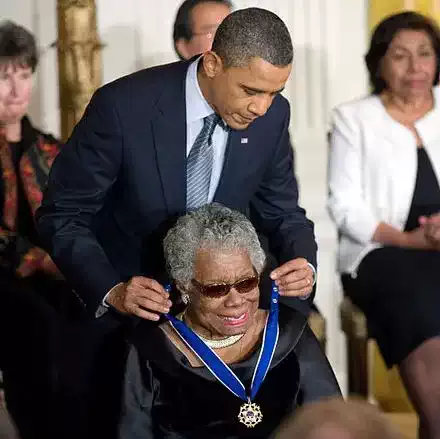
Maya Angelou
Alone
Lying, thinking
Last night
How to find my soul a home
Where water is not thirsty
And bread loaf is not stone
I came up with one thing
And I don't believe I'm wrong
That nobody,
But nobody
Can make it out here alone.
Alone, all alone
Nobody, but nobody
Can make it out here alone.
There are some millionaires
With money they can't use
Their wives run round like banshees
Their children sing the blues
They've got expensive doctors
To cure their hearts of stone.
But nobody
No, nobody
Can make it out here alone.
Alone, all alone
Nobody, but nobody
Can make it out here alone.
Now if you listen closely
I'll tell you what I know
Storm clouds are gathering
The wind is gonna blow
The race of man is suffering
And I can hear the moan,
'Cause nobody,
But nobody
Can make it out here alone.
Alone, all alone
Nobody, but nobody
Can make it out here alone.
317
John Greenleaf Whittier
The Exiles. 1660
The goodman sat beside his door
One sultry afternoon,
With his young wife singing at his side
An old and goodly tune.
A glimmer of heat was in the air,
The
dark green woods were still;
And the skirts of a heavy thunder-cloud
Hung over the western hill.
Black, thick, and vast arose that cloud
Above the wilderness,
As some dark world from upper air
Were stooping over this.
At times the solemn thunder pealed,
And all was still again,
Save a low murmur in the air
Of coming wind and rain.
Just as the first big rain-drop fell,
A weary stranger came,
And stood before the farmer's door,
With travel soiled and lame.
Sad seemed he, yet sustaining hope
Was in his quiet glance,
And peace, like autumn's moonlight, clothed
His tranquil countenance,
A look, like that his Master wore
In Pilate's council-hall:
It told of wrongs, but of a love
Meekly forgiving all.
'Friend! wilt thou give me shelter here?'
The stranger meekly said;
And, leaning on his oaken staff,
The goodman's features read.
'My life is hunted,-evil men
Are following in my track;
The traces of the torturer's whip
Are on my aged back;
'And much, I fear, 't will peril thee
Within thy doors to take
A hunted seeker of the Truth,
Oppressed for conscience' sake.'
Oh, kindly spoke the goodman's wife,
'Come in, old man!' quoth she,
'We will not leave thee to the storm,
Whoever thou mayst be.'
Then came the aged wanderer in,
And silent sat him down;
While all within grew dark as night
Beneath the storm-cloud's frown.
But while the sudden lightning's blaze
Filled every cottage nook,
And with the jarring thunder-roll
The loosened casements shook,
A heavy tramp of horses' feet
Came sounding up the lane,
And half a score of horse, or more,
Came plunging through the rain.
'Now, Goodman Macy, ope thy door,
We
would not be house-breakers;
A rueful deed thou'st done this day,
In harboring banished Quakers.'
Out looked the cautious goodman then,
With much of fear and awe,
For there, with broad wig drenched with rain
The parish priest he saw.
Open thy door, thou wicked man,
And let thy pastor in,
And give God thanks, if forty stripes
Repay thy deadly sin.'
'What seek ye?' quoth the goodman;
'The stranger is my guest;
He is worn with toil and grievous wrong,
Pray
let the old man rest.'
'Now, out upon thee, canting knave!'
And strong hands shook the door.
'Believe me, Macy,' quoth the priest,
'Thou 'lt rue thy conduct sore.'
Then kindled Macy's eye of fire
'No priest who walks the earth,
Shall pluck away the stranger-guest
Made welcome to my hearth.'
Down from his cottage wall he caught
The matchlock, hotly tried
At Preston-pans and Marston-moor,
By fiery Ireton's side;
Where Puritan, and Cavalier,
With shout and psalm contended;
And Rupert's oath, and Cromwell's prayer,
With battle-thunder blended.
Up rose the ancient stranger then
'My spirit is not free
To bring the wrath and violence
Of evil men on thee;
'And for thyself, I pray forbear,
Bethink thee of thy Lord,
Who healed again the smitten ear,
And sheathed His follower's sword.
'I go, as to the slaughter led.
Friends of the poor, farewell!'
Beneath his hand the oaken door
Back on its hinges fell.
'Come forth, old graybeard, yea and nay,'
The reckless scoffers cried,
As to a horseman's saddle-bow
The old man's arms were tied.
And of his bondage hard and long
In Boston's crowded jail,
Where suffering woman's prayer was heard,
With sickening childhood's wail,
It suits not with our tale to tell;
Those scenes have passed away;
Let the dim shadows of the past
Brood o'er that evil day.
'Ho, sheriff!' quoth the ardent priest,
'Take Goodman Macy too;
The sin of this day's heresy
His back or purse shall rue.'
'Now, goodwife, haste thee!' Macy cried.
She caught his manly arm;
Behind, the parson urged pursuit,
With outcry and alarm.
Ho! speed the Macys, neck or naught,
The
river-course was near;
The plashing on its pebbled shore
Was music to their ear.
A gray rock, tasselled o'er with birch,
Above the waters hung,
And at its base, with every wave,
A small light wherry swung.
A leap-they gain the boat-and there
The goodman wields his oar;
'Ill luck betide them all,' he cried,
'The laggards on the shore.'
Down through the crashing underwood,
The burly sheriff came:'
Stand, Goodman Macy, yield thyself;
Yield in the King's own name.'
'Now out upon thy hangman's face!'
Bold Macy answered then,'
Whip women, on the village green,
But meddle not with men.'
The priest came panting to the shore,
His grave cocked hat was gone;
Behind him, like some owl's nest, hung
His wig upon a thorn.
'Come back,-come back!' the parson cried,
'The church's curse beware.'
'Curse, an' thou wilt,' said Macy, 'but
Thy blessing prithee spare.'
'Vile scoffer!' cried the baffled priest,
'Thou 'lt yet the gallows see.'
'Who's born to be hanged will not be drowned,'
Quoth Macy, merrily;
'And so, sir sheriff and priest, good-by!'
He bent him to his oar,
And the small boat glided quietly
From the twain upon the shore.
Now in the west, the heavy clouds
Scattered and fell asunder,
While feebler came the rush of rain,
And fainter growled the thunder.
And through the broken clouds, the sun
Looked out serene and warm,
Painting its holy symbol-light
Upon the passing storm.
Oh, beautiful! that rainbow span,
O'er dim Crane-neck was bended;
One bright foot touched the eastern hills,
And one with ocean blended.
By green Pentucket's southern'slope
The small boat glided fast;
The watchers of the Block-house saw
The strangers as they passed.
That night a stalwart garrison
Sat shaking in their shoes,
To hear the dip of Indian oars,
The glide of birch canoes.
The fisher-wives of SalisburyThe
men were all away
Looked
out to see the stranger oar
Upon their waters play.
Deer-Island's rocks and fir-trees threw
Their sunset-shadows o'er them,
And Newbury's spire and weathercock
Peered o'er the pines before them.
Around the Black Rocks, on their left,
The marsh lay broad and green;
And on their right, with dwarf shrubs crowned,
Plum Island's hills were seen.
With skilful hand and wary eye
The harbor-bar was crossed;
A plaything of the restless wave,
The boat on ocean tossed.
The glory of the sunset heaven
On land and water lay;
On the steep hills of Agawam,
On cape, and bluff, and bay.
They passed the gray rocks of Cape Ann,
And Gloucester's harbor-bar;
The watch-fire of the garrison
Shone like a setting star.
How brightly broke the morning
On Massachusetts Bay!
Blue wave, and bright green island,
Rejoicing in the day.
On passed the bark in safety
Round isle and headland steep;
No tempest broke above them,
No fog-cloud veiled the deep.
Far round the bleak and stormy Cape
The venturous Macy passed,
And on Nantucket's naked isle
Drew up his boat at last.
And how, in log-built cabin,
They braved the rough sea-weather;
And there, in peace and quietness,
Went down life's vale together;
How others drew around them,
And how their fishing sped,
Until to every wind of heaven
Nantucket's sails were spread;
How pale Want alternated
With Plenty's golden smile;
Behold, is it not written
In the annals of the isle?
And yet that isle remaineth
A refuge of the free,
As when true-hearted Macy
Beheld it from the sea.
Free as the winds that winnow
Her shrubless hills of sand,
Free as the waves that batter
Along her yielding land.
Than hers, at duty's summons,
No loftier spirit stirs,
Nor falls o'er human suffering
A readier tear then hers.
God bless the sea-beat island!
And grant forevermore,
That charity and freedom dwell
As now upon her shore!
316

Henry Wadsworth Longfellow
Tales Of A Wayside Inn : Part 2. Interlude I.
'Yes, well your story pleads the cause
Of those dumb mouths that have no speech,
Only a cry from each to each
In its own kind, with its own laws;
Something that is beyond the reach
Of human power to learn or teach,--
An inarticulate moan of pain,
Like the immeasurable main
Breaking upon an unknown beach.'
Thus spake the Poet with a sigh;
Then added, with impassioned cry,
As one who feels the words he speaks,
The color flushing in his cheeks,
The fervor burning in his eye:
'Among the noblest in the land,
Though he may count himself the least,
That man I honor and revere
Who without favor, without fear,
In the great city dares to stand
The friend of every friendless beast,
And tames with his unflinching hand
The brutes that wear our form and face,
The were-wolves of the human race!'
Then paused, and waited with a frown,
Like some old champion of romance,
Who, having thrown his gauntlet down,
Expectant leans upon his lance;
But neither Knight nor Squire is found
To raise the gauntlet from the ground,
And try with him the battle's chance.
'Wake from your dreams, O Edrehi!
Or dreaming speak to us, and make
A feint of being half awake,
And tell us what your dreams may be.
Out of the hazy atmosphere
Of cloud-land deign to reappear
Among us in this Wayside Inn;
Tell us what visions and what scenes
Illuminate the dark ravines
In which you grope your way. Begin!'
Thus the Sicilian spake. The Jew
Made no reply, but only smiled,
As men unto a wayward child,
Not knowing what to answer, do.
As from a cavern's mouth, o'ergrown
With moss and intertangled vines,
A streamlet leaps into the light
And murmurs over root and stone
In a melodious undertone;
Or as amid the noonday night
Of sombre and wind-haunted pines,
There runs a sound as of the sea;
So from his bearded lips there came
A melody without a name,
A song, a tale, a history,
Or whatsoever it may be,
Writ and recorded in these lines.
313

Henry Lawson
The Ghost
Down the street as I was drifting with the city's human tide,
Came a ghost, and for a moment walked in silence by my side --
Now my heart was hard and bitter, and a bitter spirit he,
So I felt no great aversion to his ghostly company.
Said the Shade: `At finer feelings let your lip in scorn be curled,
`Self and Pelf', my friend, has ever been the motto for the world.'
And he said: `If you'd be happy, you must clip your fancy's wings,
Stretch your conscience at the edges to the size of earthly things;
Never fight another's battle, for a friend can never know
When he'll gladly fly for succour to the bosom of the foe.
At the power of truth and friendship let your lip in scorn be curled -`
Self and Pelf', my friend, remember, is the motto of the world.
`Where Society is mighty, always truckle to her rule;
Never send an `i' undotted to the teacher of a school;
Only fight a wrong or falsehood when the crowd is at your back,
And, till Charity repay you, shut the purse, and let her pack;
At the fools who would do other let your lip in scorn be curled,
`Self and Pelf', my friend, remember, that's the motto of the world.
`Ne'er assail the shaky ladders Fame has from her niches hung,
Lest unfriendly heels above you grind your fingers from the rung;
Or the fools who idle under, envious of your fair renown,
Heedless of the pain you suffer, do their worst to shake you down.
At the praise of men, or censure, let your lip in scorn be curled,
`Self and Pelf', my friend, remember, is the motto of the world.
`Flowing founts of inspiration leave their sources parched and dry,
Scalding tears of indignation sear the hearts that beat too high;
Chilly waters thrown upon it drown the fire that's in the bard;
And the banter of the critic hurts his heart till it grows hard.
At the fame your muse may offer let your lip in scorn be curled,
`Self and Pelf', my friend, remember, that's the motto of the world.
`Shun the fields of love, where lightly, to a low and mocking tune,
Strong and useful lives are ruined, and the broken hearts are strewn.
Not a farthing is the value of the honest love you hold;
Call it lust, and make it serve you! Set your heart on nought but gold.
At the bliss of purer passions let your lip in scorn be curled -`
Self and Pelf', my friend, shall ever be the motto of the world.'
Then he ceased and looked intently in my face, and nearer drew;
But a sudden deep repugnance to his presence thrilled me through;
Then I saw his face was cruel, by the look that o'er it stole,
Then I felt his breath was poison, by the shuddering of my soul,
Then I guessed his purpose evil, by his lip in sneering curled,
And I knew he slandered mankind, by my knowledge of the world.
But he vanished as a purer brighter presence gained my side -`
Heed him not! there's truth and friendship
in this wondrous world,' she cried,
And of those who cleave to virtue in their climbing for renown,
Only they who faint or falter from the height are shaken down.
At a cynic's baneful teaching let your lip in scorn be curled!
`Brotherhood and Love and Honour!' is the motto for the world.'
311
John Greenleaf Whittier
The Over-Heart
Above, below, in sky and sod,
In leaf and spar, in star and man,
Well might the wise Athenian scan
The geometric signs of God,
The measured order of His plan.
And India's mystics sang aright
Of the One Life pervading all,-One
Being's tidal rise and fall
In soul and form, in sound and sight,-Eternal
outflow and recall.
God is: and man in guilt and fear
The central fact of Nature owns;
Kneels, trembling, by his altar-stones,
And darkly dreams the ghastly smear
Of blood appeases and atones.
Guilt shapes the Terror: deep within
The human heart the secret lies
Of all the hideous deities;
And, painted on a ground of sin,
The fabled gods of torment rise!
And what is He? The ripe grain nods,
The sweet dews fall, the sweet flowers blow;
But darker signs His presence show
The earthquake and the storm are God's,
And good and evil interflow.
O hearts of love! O souls that turn
Like sunflowers to the pure and best!
To you the truth is manifest:
For they the mind of Christ discern
Who lean like John upon His breast!
In him of whom the sibyl told,
For whom the prophet's harp was toned,
Whose need the sage and magian owned,
The loving heart of God behold,
The hope for which the ages groaned!
Fade, pomp of dreadful imagery
Wherewith mankind have deified
Their hate, and selfishness, and pride!
Let the scared dreamer wake to see
The Christ of Nazareth at his side!
What doth that holy Guide require?
No rite of pain, nor gift of blood,
But man a kindly brotherhood,
Looking, where duty is desire,
To Him, the beautiful and good.
Gone be the faithlessness of fear,
And let the pitying heaven's sweet rain
Wash out the altar's bloody stain;
The law of Hatred disappear,
The law of Love alone remain.
How fall the idols false and grim!
And to! their hideous wreck above
The emblems of the Lamb and Dove!
Man turns from God, not God from him;
And guilt, in suffering, whispers Love!
The world sits at the feet of Christ,
Unknowing, blind, and unconsoled;
It yet shall touch His garment's fold,
And feel the heavenly Alchemist
Transform its very dust to gold.
The theme befitting angel tongues
Beyond a mortal's scope has grown.
O heart of mine! with reverence own
The fulness which to it belongs,
And trust the unknown for the known.
309
Ella Wheeler Wilcox
Mockery
Why do we grudge our sweets so to the living
Who, God knows, find at best too much of gall,
And then with generous, open hands kneel, giving
Unto the dead our all?
Why do we pierce the warm hearts, sin or sorrow,
With idle jests, or scorn, or cruel sneers,
And when it cannot know, on some to-morrow,
Speak of its woe through tears?
What do the dead care, for the tender token—
The love, the praise, the floral offerings?
But palpitating, living hearts are broken
For want of just these things.
306

Henry Van Dyke
Longfellow
In a great land, a new land, a land full of labour
and riches and confusion,
Where there were many running to and fro, and
shouting, and striving together,
In the midst of the hurry and the troubled noise,
I heard the voice of one singing.
"What are you doing there, O man, singing
quietly amid all this tumult?
This is the time for new inventions, mighty
shoutings, and blowings of the trumpet."
But he answered, "I am only shepherding my
sheep with music."
So he went along his chosen way, keeping his
little flock around him;
And he paused to listen, now and then, beside
the antique fountains,
Where the faces of forgotten gods were refreshed
with musically falling waters;
Or he sat for a while at the blacksmith's door,
and heard the cling-clang of the anvils;
Or he rested beneath old steeples full of bells,
that showered their chimes upon him;
Or he walked along the border of the sea,
drinking in the long roar of the billows;
Or he sunned himself in the pine-scented shipyard,
amid the tattoo of the mallets;
Or he leaned on the rail of the bridge, letting
his thoughts flow with the whispering river;
He hearkened also to ancient tales, and made
them young again with his singing.
Then a flaming arrow of death fell on his flock,
and pierced the heart of his dearest!
Silent the music now, as the shepherd entered
the mystical temple of sorrow:
Long he tarried in darkness there: but when he
came out he was singing.
And I saw the faces of men and women and
children silently turning toward him;
The youth setting out on the journey of life, and
the old man waiting beside the last mile-stone;
The toiler sweating beneath his load; and the
happy mother rocking her cradle;
The lonely sailor on far-off seas; and the greyminded
scholar in his book-room;
The mill-hand bound to a clacking machine; and
the hunter in the forest;
And the solitary soul hiding friendless in the
wilderness of the city;
Many human faces, full of care and longing, were
drawn irresistibly toward him,
By the charm of something known to every heart,
yet very strange and lovely,
And at the sound of that singing wonderfully
all their faces were lightened.
"Why do you listen, O you people, to this old
and world-worn music?
This is not for you, in the splendour of a new
age, in the democratic triumph!
Listen to the clashing cymbals, the big drums, the
brazen trumpets of your poets."
But the people made no answer, following in
their hearts the simpler music:
For it seemed to them, noise-weary, nothing
could be better worth the hearing
Than the melodies which brought sweet order
into life's confusion.
So the shepherd sang his way along, until he
came unto a mountain:
And I know not surely whether it was called
Parnassus,
But he climbed it out of sight, and still I heard
the voice of one singing.
303
Henry Lawson
A Song of Brave Men
Man, is the Sea your master? Sea, and is man your slave? –
This is the song of brave men who never know they are brave:
Ceaselessly watching to save you, stranger from foreign lands,
Soundly asleep in your state room, full sail for the Goodwin Sands!
Life is a dream, they tell us, but life seems very real,
When the lifeboat puts out from Ramsgate, and the buggers put out from Deal!
A gun from the lightship! – a rocket! – a cry of, "Turn out, me lad!"
"Ship on the Sands!" they're shouting, and a rush of the oilskin-clad.
The lifeboat leaping and swooping, in the wake of the fighting tug,
And the luggers afloat in Hell's water – Oh, "tourist", with cushion and rug! –
Think of the freezing fury, without one minute's relief,
When they stood all night in the blackness by the wreck of the Indian Chief!
Lashed to their seats, and crouching, to the spray that froze as it flew,
Twenty-six hours in midwinter! That was the lifeboat's crew.
Twice she was swamped, and she righted, in the rush of the heavy seas,
And her tug was mostly buried; but these were common things, these.
And the luggers go out whenever there's a hope to get them afloat,
And these things they do for nothing, and those fishermen say, "Oh! it's nowt!"
(Enemy, Friend or Stranger! In every sea or land,
And across the lives of most men run stretches of Goodwin Sand;
And across the life of a nation, as across the track of a ship,
Lies the hidden rock, or the iceberg, within the horizon dip.
And wise men know them, and warn us, with lightship, or voice, or pen;
But we strike, and the fool survivors sail on to strike again.)
But this is a song of brave men, wherever is aught to save,
Christian or Jew or Wowser – and I knew one who was brave;
British or French or German, Dane or Latin or Dutch:
"Scandies" that ignorant British reckon with "Dagoes and such" –
(Where'er, on a wreck titanic, in a scene of wild despair,
The officers call for assistance, a Swede or a Norse is there.)
Tale of a wreck titanic, with the last boat over the side,
And a brave young husband fighting his clinging, hysterical bride;
He strikes her fair on the temple, while the decks are scarce afloat,
And he kisses her once on the forehead, and he drops her into the boat.
So he goes to his death to save her; and she lives to remember and lie –
Or be true to his love and courage. But that's how brave men die.
(I hate the slander: "Be British" – and I don't believe it, that's flat:
No British sailor and captain would stoop to such cant as that.
What – in the rush of cowards – of the help from before the mast –
Of the two big Swedes and the Norse, who stood by the mate to the last? –
In every mining disaster, in a New-World mining town,
In one of the rescue parties an Olsen or Hans goes down.)
Men who fought for their village, away on their country's edge:
The priest with his cross – and a musket, and the blacksmith with his sledge;
The butcher with cleaver and pistols, and the notary with his pike.
And the clerk with what he laid hands on; but all were ready to strike.
And – Tennyson notwithstanding – when the hour of danger was come,
The shopman has struck full often with his "cheating yard-wand" home!
This is a song of brave men, ever, the wide world o'er –
Starved and crippled and murdered by the land they are fighting for.
Left to freeze in the trenches, sent to drown by the Cape,
Throttled by army contractors, and strangled bv old red-tape.
Fighting for "Home" and "Country", or "Glory", or what you choose –
Sacrificed for the Syndicates, and a monarch "in" with the Jews.
Australia! your trial is coming! Down with the party strife:
Send Your cackling, lying women back to the old Home Life.
Brush trom your Parliament benches the legal chaff and dust:
Make Federation perfect, as sooner or later you must.
Scatter your crowded cities, cut up your States – and so
Give your brave sons of the future the ghost of a White Man's show.
304
Henry Wadsworth Longfellow
The Slave's Dream
Beside the ungathered rice he lay,
His sickle in his hand;
His breast was bare, his matted hair
Was buried in the sand.
Again, in the mist and shadow of sleep,
He saw his Native Land.
Wide through the landscape of his dreams
The lordly Niger flowed;
Beneath the palm-trees on the plain
Once more a king he strode;
And heard the tinkling caravans
Descend the mountain-road.
He saw once more his dark-eyed queen
Among her children stand;
They clasped his neck, they kissed his cheeks,
They held him by the hand!--
A tear burst from the sleeper's lids
And fell into the sand.
And then at furious speed he rode
Along the Niger's bank;
His bridle-reins were golden chains,
And, with a martial clank,
At each leap he could feel his scabbard of steel
Smiting his stallion's flank.
Before him, like a blood-red flag,
The bright flamingoes flew;
>From morn till night he followed their flight,
O'er plains where the tamarind grew,
Till he saw the roofs of Caffre huts,
And the ocean rose to view.
At night he heard the lion roar,
And the hyena scream,
And the river-horse, as he crushed the reeds
Beside some hidden stream;
And it passed, like a glorious roll of drums,
Through the triumph of his dream.
The forests, with their myriad tongues,
Shouted of liberty;
And the Blast of the Desert cried aloud,
With a voice so wild and free,
That he started in his sleep and smiled
At their tempestuous glee.
He did not feel the driver's whip,
Nor the burning heat of day;
For Death had illumined the Land of Sleep,
And his lifeless body lay
A worn-out fetter, that the soul
Had broken and thrown away!
302
John Greenleaf Whittier
Howard At Atlanta
RIGHT in the track where Sherman
Ploughed his red furrow,
Out of the narrow cabin,
Up from the cellar's burrow,
Gathered the little black people,
With freedom newly dowered,
Where, beside their Northern teacher,
Stood the soldier, Howard.
He listened and heard the children
Of the poor and long-enslavëd
Reading the words of Jesus,
Singing the songs of David.
Behold! —the dumb lips speaking,
The blind eyes seeing!
Bones of the Prophet's vision
Warmed into being!
Transformed he saw them passing
Their new life's portal!
Almost it seemed the mortal
Put on the immortal.
No more with the beasts of burden,
No more with stone and clod,
But crowned with glory and honor
In the image of God!
There was the human chattel
Its manhood taking;
There, in each dark, brown statue,
A soul was waking!
The man of many battles,
With tears his eyelids pressing,
Stretched over those dusky foreheads
His one-armed blessing.
And he said: 'Who hears can never
Fear for or doubt you;
What shall I tell the children
Up North about you?'
Then ran round a whisper, a murmur,
Some answer devising;
And a little boy stood up: 'General,
Tell'em we're rising!'
O black boy of Atlanta!
But half was spoken:
The slave's chain and the master's
Alike are broken.
The one curse of the races
Held both in tether:
They are rising, — all are rising,
The black and white together!
O brave men and fair women!
Ill comes of hate and scorning:
Shall the dark faces only
Be turned to morning? —
Make Time your sole avenger,
All-healing, all-redressing;
Meet Fate half-way, and make it
A joy and blessing!
303
Henry Lawson
The Gathering of the Brown-Eyed
The brown eyes came from Asia, where all mystery is true,
Ere the masters of Soul Secrets dreamed of hazel, grey, and blue;
And the Brown Eyes came to Egypt, which is called the gypsies’ home,
And the Brown Eyes went from Egypt and Jerusalem to Rome.
There was strife amongst the Brown Eyes for the false things and the true;
There was war amongst the Brown Eyes for the old gods and the new;
But the old gods live for ever, and their goddesses are bright
In the temples of Old Passions with the Brown Eyes of the White.
The Brown Eyes east, by Africa, they saw and conquered Spain,
And the Brown Eyes marched as Christians till a Brown Eye met a Dane,
The Dane had Brown-Eyed children who in blue eyes took delight—
And a son of blue-eyed sailors, brown-eyed, reads the stars to-night.
Oh, Knowledge from Old Deserts, where the great stars rocked the world!
Oh, courage from grim seaboards, where the Viking ships were hurled!
The clear skin of the Norseman, and the desert strength and sight,
The power to fathom mankind, and the glorious gift to write!
We can look in souls of women, aye! and let them know we do;
We can fix the false eyes earthward; we can meet and match the true;
We can startle Voice from Silence, and from Darkness flash the Light—
And the eyes to fathom Asia are the Brown Eyes of the White.
There’s a legend in the nations that all Brown Eyes once were true,
But were taught in love and warfare by the sinful shades of blue;
There’s a story amongst sinners that all Brown Eyes once were kind,
Till the Steel-Blue struck the Red-Fire in a hatred that was blind.
But the Brown Eyes are the saddest at the death of Love and Truth.
And the Brown Eyes are the grandest and the dreamiest of Youth.
They have risen in rebellion unto leadership sublime—
And the grey-eyed queens of women loved, and love them for all time!
Brown Eyes never married Brown Eyes but unhappiness held sway,
For the real mates of the Brown Eyes have for ever been the grey.
But though Brown Eyes quarrel hotly, though their very souls be wrenched,
Never Blue-Eye wronged a Brown-Eye but the Brown-Eye was avenged!
Through the breadth of wide Australia, waiting desert-like and vast,
We have sent our Brown-Eyed children, who are multiplying fast.
Patriots, picture-writers, sages, fill the Brown-Eyed rolls to-night—
’Tis the gathering from all ages of the Brown-Eyed of the White.
301
John Greenleaf Whittier
Daniel Neall
I.
FRIENDof the Slave, and yet the friend of all;
Lover of peace, yet ever foremost when
The need of battling Freedom called for men
To plant the banner on the outer wall;
Gentle and kindly, ever at distress
Melted to more than woman's tenderness,
Yet firm and steadfast, at his duty's post
Fronting the violence of a maddened host,
Like some-gray rock from which the waves are tossed!
Knowing his deeds of love, men questioned not
The faith of one whose walk and word were right;
Who tranquilly in Life's great task-field wrought,
And, side by side with evil, scarcely caught
A stain upon his pilgrim garb of white:
Prompt to redress another's wrong, his own
Leaving to Time and Truth and Penitence alone.
II.
Such was our friend. Formed on the good old plan,
A true and brave and downright honest man!
He blew no trumpet in the market-place,
Nor in the church with hypocritic face
Supplied with cant the lack of Christian grace;
Loathing pretence, he did with cheerful will
What others talked of while their hands were still;
And, while 'Lord, Lord!' the pious tyrants cried,
Who, in the poor, their Master crucified,
His daily prayer, far better understood.
In acts than words, was simply doing good.
So calm, so constant was his rectitude,
That by his loss alone we know its worth,
And feel how true a man has walked with us on earth.
301
John Greenleaf Whittier
The Golden Wedding Of Longwood
With fifty years between you and your well-kept wedding vow,
The Golden Age, old friends of mine, is not a fable now.
And, sweet as has life's vintage been through all your pleasant past,
Still, as at Cana's marriage-feast, the best wine is the last!
Again before me, with your names, fair Chester's landscape comes,
Its meadows, woods, and ample barns, and quaint, stone-builded homes.
The smooth-shorn vales, the wheaten slopes, the boscage green and soft,
Of which their poet sings so well from towered Cedarcroft.
And lo! from all the country-side come neighbors, kith and kin;
From city, hamlet, farm-house old, the wedding guests come in.
And they who, without scrip or purse, mob-hunted, travel-worn,
In Freedom's age of martyrs came, as victors now return.
Older and slower, yet the same, files in the long array,
And hearts are light and eyes are glad, though heads are badger-gray.
The fire-tried men of Thirty-eight who saw with me the fall,
Midst roaring flames and shouting mob, of Pennsylvania Hall;
And they of Lancaster who turned the cheeks of tyrants pale,
Singing of freedom through the grates of Moyamensing jail!
And haply with them, all unseen, old comrades, gone before,
Pass, silently as shadows pass, within your open door,-
The eagle face of Lindley Coates, brave Garrett's daring zeal,
Christian grace of Pennock, the steadfast heart of Neal.
Ah me! beyond all power to name, the worthies tried and true,
Grave men, fair women, youth and maid, pass by in hushed review.
Of varying faiths, a common cause fused all their hearts in one.
God give them now, whate'er their names, the peace of duty done!
How gladly would I tread again the old-remembered places,
Sit down beside your hearth once more and look in the dear old faces!
And thank you for the lessons your fifty years are teaching,
For honest lives that louder speak than half our noisy preaching;
For your steady faith and courage in that dark and evil time,
When the Golden Rule was treason, and to feed the hungry, crime;
For the poor slave's house of refuge when the hounds were on his track,
And saint and sinner, church and state, joined hands to send him back.
Blessings upon you!--What you did for each sad, suffering one,
So homeless, faint, and naked, unto our Lord was done!
Fair fall on Kennett's pleasant vales and Longwood's bowery ways
The mellow sunset of your lives, friends of my early days.
May many more of quiet years be added to your sum,
And, late at last, in tenderest love, the beckoning angel come.
Dear hearts are here, dear hearts are there, alike below, above;
Our friends are now in either world, and love is sure of love.
296

Robert W. Service
Abandoned Dog
They dumped it on the lonely road,
Then like a streak they sped;
And as along the way I strode
I thought that it was dead:
And then I saw that yelping pup
Rise, race to catch them up.
You know how silly wee dogs are.
It thought they were in fun.
Trying to overtake their car
I saw it run and run:
But as they faster, faster went,
It stumbled, sore and spent.
I found it prone upon the way;
Of life was little token.
As limply in the dust it lay
I thought its heart was broken:
Then one dim eye it opened and
It sought to like my hand.
Of course I took it gently up
And brought it to my wife
Who loves all dogs, and now that pup
Shares in our happy life:
Yet how I curse the bastards who
Its good luck never knew!
296
Henry Lawson
Send Round the Hat
Now this is the creed from the Book of the Bush –
Should be simple and plain to a dunce:
"If a man’s in a hole you must pass round the hat –
Were he jail-bird or gentleman once."
Should be simple and plain to a dunce:
"If a man’s in a hole you must pass round the hat –
Were he jail-bird or gentleman once."
294

Ogden Nash
À Bas Ben Adhem
My fellow man I do not care for.
I often ask me, What's he there for?
The only answer I can find
Is, Reproduction of his kind.
If I'm supposed to swallow that,
Winnetka is my habitat.
Isn't it time to carve Hic Jacet
Above that Reproduction racket?
To make the matter more succint:
Suppose my fellow man extinct.
Why, who would not approve the plan
Save possibly my fellow man?
Yet with a politician's voice
He names himself as Nature's choice.
The finest of the human race
Are bad in figure, worse in face.
Yet just because they have two legs
And come from storks instead of eggs
They count the spacious firmament
As something to be charged and sent.
Though man created cross-town traffic,
The Daily Mirror, News and Graphic,
The pastoral fight and fighting pastor,
And Queen Marie and Lady Astor,
He hails himself with drum and fife
And bullies lower forms of life.
Not that I think much depends
On how we treat our feathered friends,
Or hold the wrinkled elephant
A nobler creature than my aunt.
It's simply that I'm sure I can
Get on without my fellow man.
294

Alice Walker
Blessed Are The Poor In Spirit
Did you ever understand this?
If my spirit was poor, how could I enter heaven?
Was I depressed?
Understanding editing,
I see how a comma, removed or inserted
with careful plan,
can change everything.
I was reminded of this
when a poor young man
in Tunisia
desperate to live
and humiliated for trying
set himself ablaze;
I felt uncomfortably warm
as if scalded by his shame.
I do not have to sell vegetables from a cart as he did
or live in narrow rooms too small for spacious thought;
and, at this late date,
I do not worry that someone will
remove every single opportunity
for me to thrive.
Still, I am connected to, inseparable from,
this young man.
Blessed are the poor, in spirit, for theirs is the kingdom of heaven.
Jesus. (Commas restored) .
Jesus was as usual talking about solidarity: about how we join with others
and, in spirit, feel the world, and suffering, the same as them.
This is the kingdom of owning the other as self, the self as other;
that transforms grief into
peace and delight.
I, and you, might enter the heaven
of right here
through this door.
In this spirit, knowing we are blessed,
we might remain poor
294

Carl Sandburg
I Am The People, The Mob
I Am the people--the mob--the crowd--the mass.
Do you know that all the great work of the world is
done through me?
I am the workingman, the inventor, the maker of the
world's food and clothes.
I am the audience that witnesses history. The Napoleons
come from me and the Lincolns. They die. And
then I send forth more Napoleons and Lincolns.
I am the seed ground. I am a prairie that will stand
for much plowing. Terrible storms pass over me.
I forget. The best of me is sucked out and wasted.
I forget. Everything but Death comes to me and
makes me work and give up what I have. And I
forget.
Sometimes I growl, shake myself and spatter a few red
drops for history to remember. Then--I forget.
When I, the People, learn to remember, when I, the
People, use the lessons of yesterday and no longer
forget who robbed me last year, who played me for
a fool--then there will be no speaker in all the world
say the name: 'The People,' with any fleck of a
sneer in his voice or any far-off smile of derision.
The mob--the crowd--the mass--will arrive then.
295
John Greenleaf Whittier
The Men Of Old
WELL speed thy mission, bold Iconoclast!
Yet all unworthy of its trust thou art,
If, with dry eye, and cold, unloving heart,
Thou tread'st the solemn Pantheon of the Past,
By the great Future's dazzling hope made blind
To all the beauty, power, and truth behind.
Not without reverent awe shouldst thou put by
The cypress branches and the amaranth blooms,
Where, with clasped hands of prayer, upon their tombs
The effigies of old confessors lie,
God's witnesses; the voices of His will,
Heard in the slow march of the centuries still!
Such were the men at whose rebuking frown,
Dark with God's wrath, the tyrant's knee went down;
Such from the terrors of the guilty drew
The vassal's freedom and the poor man's due.
St. Anselm (may he rest forevermore
In Heaven's sweet peace!) forbade, of old, the sale
Of men as slaves, and from the sacred pale
Hurled the Northumbrian buyers of the poor.
To ransom souls from bonds and evil fate
St. Ambrose melted down the sacred plate, —
Image of saint, the chalice, and the pix,
Crosses of gold, and silver candlesticks.
'Man is worth more than temples!' he replied
To such as came his holy work to chide.
And brave Cesarius, stripping altars bare,
And coining from the Abbey's golden hoard
The captive's freedom, answered to the prayer
Or threat of those whose fierce zeal for the Lord
Stifled their love of man, — 'An earthen dish
The last sad supper of the Master bore:
Most miserable sinners! do ye wish
More than your Lord, and grudge His dying poor
What your own pride and not His need requires?
Souls, than these shining gauds, He values more;
Mercy, not sacrifice, His heart desires!'
O faithful worthies! resting far behind
In your dark ages, since ye fell asleep,
Much has been done for truth and human-kind;
Shadows are scattered wherein ye groped blind;
Man claims his birthright, freer pulses leap
Through peoples driven in your day like sheep;
Yet, like your own, our age's sphere of light,
Though widening still, is walled around by night;
With slow, reluctant eye, the Church has read,
Skeptic at heart, the lessons of its Head;
Counting, too oft, its living members less
Than the wall's garnish and the pulpit's dress;
World-moving zeal with power to bless and feed
Life's fainting pilgrims, to their utter need,
Instead of bread, holds out the stone of creed;
Sect builds and worships where its wealth and pride
And vanity stand shrined and deified,
Careless that in the shadow of its walls
God's living temple into ruin falls.
We need, methinks, the prophet-hero still,
Saints true of life, and martyrs strong of will,
To tread the land, even now, as Xavier trod
The streets of God, barefoot, with his bell,
Proclaiming freedom in the name of God,
And startling tyrants with the fear of hell!
Soft words, smooth prophecies, are doubtless well;
But to rebuke the age's popular crime,
We need the souls of fire, the hearts of that old time!
291
Henry Lawson
A Fantasy of War
From Australia
.
OH, tell me, God of Battles! Oh, say what is to come!
The King is in his trenches, the millionaire at home;
The Kaiser with his toiling troops, the Czar is at the front.
Oh! Tell me, God of Battles! Who bears the battle’s brunt?
The Queen knits socks for soldiers, the Empress does the same,
And know no more than peasant girls which nation is to blame.
The wounded live to fight again, or live to slave for bread;
The Slain have graves above the Slain—the Dead are with the Dead.
The widowed young shall wed or not, the widowed old remain—
And all the nations of the world prepare for war again!
But ere that time shall be, O God, say what shall here befall!
Ten millions at the battle fronts, and we’re five millions all!
The world You made was wide, O God, the world we made is small.
We toiled not as our fathers toiled, for
Sport was all our boast;
And so we built our cities, Lord, like warts, upon the coast.
From Europe
.
The seer stood on the mountain side, the witch was in her cave;
The gipsy with his caravan, the sailor on the wave;
The sophist in his easy chair, with ne’er a soul to save,
The factory slaves went forth to slave, the peasant to the field;
The women worked in winter there for one-tenth of the yield;
The village Granny nursed their babes to give them time to slave;
The child was in the cradle, and the grandsire in his grave.
The rich man slumbered in his chair, full fed with wine and meat;
The lady in her carriage sat, the harlot walked the street
With paint upon her cheek and neck, through winter’s snow and sleet.
We saw the pride of Wealth go mad, and Misery increase—
And still the God of Gods was dumb and all the world was Peace!
The wizard on the mountain side, he drew a rasping breath,
For he was old and near to life, as he was near to death;
And he looked out and saw the star they saw at Nazareth.
“Two thousand years have passed,” he said. “A thousand years,” he said.
“A hundred years have passed,” he said, “and, lo! the star is red!
The time has come at last,” he said, and bowed his hoary head.
He laid him on the mountain-side—and so the seer was dead.
And so the Eastern Star was red, and it was red indeed—
We saw the Red Star in the South, but we took little heed.
(The Prophet in his garret starved or drank himself to death.)
The witch was mumbling in her hole before the dawn was grey;
The witch she took a crooked stick and prodded in the clay;
She doddered round and mumbled round as is the beldame’s way.
“Four children shall be born,” she said, “four children at a birth;
Four children of a peasant brood—and what shall come on earth?
Four of the poorest peasantry that Europe knows,” she said,
“And all the nations of the world shall count their gory dead!”
The babes are born in Italy—and all the world is red!
The Ship
The world You gave was wide, O Lord, and wars were far away!
The goal was just as near, O Lord, to-morrow or to-day!
The tree You grew was stout and sound to carve the plank and keel.
(And when the darkness hid the sky Your hand was on the wheel.)
The pine You grew was straight and tall to fashion spar and mast.
Our sails and gear from flax and hemp were stout and firm and fast.
You gave the metal from the mine and taught the carpenter
To fasten plank and rib and beam, and sheath and iron her.
The world You made was wide, O Lord, with signs on sea and sky;
And all the stars were true, O Lord, you gave to steer her by.
More graceful than the albatross upon the morning breeze.
Ah me! she was the fairest thing that ever sailed the seas;
And when the madness of mankind burns out at last in war,
The world may yet behold the day she’ll sail the seas once more.
We were not satisfied, O Lord, we were not satisfied;
We stole Your electricity to fortify our pride!
You gave the horse to draw our loads, You gave the horse to ride;
But we must fly above the Alps and race beneath the tide.
We searched in sacred places for the things we did not need;
Your anger shook our cities down—and yet we took no heed.
We robbed the water and the air to give us “energy,”
As we’d exhaust Thy secret store of electricity.
The day may come—and such a day!—when we shall need all three.
And lest Thou shouldst not understand our various ways and whys,
We cut Thy trees for paper, Lord, where-on to print our lies.
We sent the grand Titanic forth, for pleasure, gold and show;
And all her skeletons of wealth and jewels lie below.
For fame or curiosity, for pride, and greed, or trade,
We sought to know all things and make all things that Thou hast made!
From Pole to Pole we sought to speak, and Heaven’s powers employ—
Our cruisers feverishly seek such language to destroy.
We shaped all things for war, and now the Sister Nations wade
Knee-deep in white man’s blood to wreck all things that we have made!
For in the rottenness of Peace—worse than this bitter strife!—
We murdered the Humanity and Poetry of Life.
The Bells and the Child
.
The gongs are in the temple—the bells are in the tower;
The “tom-tom” in the jungle and the town clock tells the hour;
And all Thy feathered kind at morn have testified Thy power.
Did ever statesman save a land or science save a soul?—
Did ever Tower of Babel stand or war-drums cease to roll?—
Or wedding-bells to ring, O Lord—or requiems to toll?
Did ever child in cradle laid—born of a healthy race—
Cease for an hour, all unafraid, to testify Thy grace?
That shook its rattle from its bed in its proud father’s face?
Cathedral bells must cease awhile, because of Pride and Sin,
That never failed a wedding-morn that hailed a king and queen,
Or failed to peal for victory that brave men died to win.
(Or failed to ring the Old Year out and ring the New Year in.)
The world You made was wide, O God!—O God, ’tis narrow now—
And all its ways must run with blood, for we knew more than Thou!
And millions perish at the guns or rot beside the plough,
For we knew more than Thou.
.
OH, tell me, God of Battles! Oh, say what is to come!
The King is in his trenches, the millionaire at home;
The Kaiser with his toiling troops, the Czar is at the front.
Oh! Tell me, God of Battles! Who bears the battle’s brunt?
The Queen knits socks for soldiers, the Empress does the same,
And know no more than peasant girls which nation is to blame.
The wounded live to fight again, or live to slave for bread;
The Slain have graves above the Slain—the Dead are with the Dead.
The widowed young shall wed or not, the widowed old remain—
And all the nations of the world prepare for war again!
But ere that time shall be, O God, say what shall here befall!
Ten millions at the battle fronts, and we’re five millions all!
The world You made was wide, O God, the world we made is small.
We toiled not as our fathers toiled, for
Sport was all our boast;
And so we built our cities, Lord, like warts, upon the coast.
From Europe
.
The seer stood on the mountain side, the witch was in her cave;
The gipsy with his caravan, the sailor on the wave;
The sophist in his easy chair, with ne’er a soul to save,
The factory slaves went forth to slave, the peasant to the field;
The women worked in winter there for one-tenth of the yield;
The village Granny nursed their babes to give them time to slave;
The child was in the cradle, and the grandsire in his grave.
The rich man slumbered in his chair, full fed with wine and meat;
The lady in her carriage sat, the harlot walked the street
With paint upon her cheek and neck, through winter’s snow and sleet.
We saw the pride of Wealth go mad, and Misery increase—
And still the God of Gods was dumb and all the world was Peace!
The wizard on the mountain side, he drew a rasping breath,
For he was old and near to life, as he was near to death;
And he looked out and saw the star they saw at Nazareth.
“Two thousand years have passed,” he said. “A thousand years,” he said.
“A hundred years have passed,” he said, “and, lo! the star is red!
The time has come at last,” he said, and bowed his hoary head.
He laid him on the mountain-side—and so the seer was dead.
And so the Eastern Star was red, and it was red indeed—
We saw the Red Star in the South, but we took little heed.
(The Prophet in his garret starved or drank himself to death.)
The witch was mumbling in her hole before the dawn was grey;
The witch she took a crooked stick and prodded in the clay;
She doddered round and mumbled round as is the beldame’s way.
“Four children shall be born,” she said, “four children at a birth;
Four children of a peasant brood—and what shall come on earth?
Four of the poorest peasantry that Europe knows,” she said,
“And all the nations of the world shall count their gory dead!”
The babes are born in Italy—and all the world is red!
The Ship
The world You gave was wide, O Lord, and wars were far away!
The goal was just as near, O Lord, to-morrow or to-day!
The tree You grew was stout and sound to carve the plank and keel.
(And when the darkness hid the sky Your hand was on the wheel.)
The pine You grew was straight and tall to fashion spar and mast.
Our sails and gear from flax and hemp were stout and firm and fast.
You gave the metal from the mine and taught the carpenter
To fasten plank and rib and beam, and sheath and iron her.
The world You made was wide, O Lord, with signs on sea and sky;
And all the stars were true, O Lord, you gave to steer her by.
More graceful than the albatross upon the morning breeze.
Ah me! she was the fairest thing that ever sailed the seas;
And when the madness of mankind burns out at last in war,
The world may yet behold the day she’ll sail the seas once more.
We were not satisfied, O Lord, we were not satisfied;
We stole Your electricity to fortify our pride!
You gave the horse to draw our loads, You gave the horse to ride;
But we must fly above the Alps and race beneath the tide.
We searched in sacred places for the things we did not need;
Your anger shook our cities down—and yet we took no heed.
We robbed the water and the air to give us “energy,”
As we’d exhaust Thy secret store of electricity.
The day may come—and such a day!—when we shall need all three.
And lest Thou shouldst not understand our various ways and whys,
We cut Thy trees for paper, Lord, where-on to print our lies.
We sent the grand Titanic forth, for pleasure, gold and show;
And all her skeletons of wealth and jewels lie below.
For fame or curiosity, for pride, and greed, or trade,
We sought to know all things and make all things that Thou hast made!
From Pole to Pole we sought to speak, and Heaven’s powers employ—
Our cruisers feverishly seek such language to destroy.
We shaped all things for war, and now the Sister Nations wade
Knee-deep in white man’s blood to wreck all things that we have made!
For in the rottenness of Peace—worse than this bitter strife!—
We murdered the Humanity and Poetry of Life.
The Bells and the Child
.
The gongs are in the temple—the bells are in the tower;
The “tom-tom” in the jungle and the town clock tells the hour;
And all Thy feathered kind at morn have testified Thy power.
Did ever statesman save a land or science save a soul?—
Did ever Tower of Babel stand or war-drums cease to roll?—
Or wedding-bells to ring, O Lord—or requiems to toll?
Did ever child in cradle laid—born of a healthy race—
Cease for an hour, all unafraid, to testify Thy grace?
That shook its rattle from its bed in its proud father’s face?
Cathedral bells must cease awhile, because of Pride and Sin,
That never failed a wedding-morn that hailed a king and queen,
Or failed to peal for victory that brave men died to win.
(Or failed to ring the Old Year out and ring the New Year in.)
The world You made was wide, O God!—O God, ’tis narrow now—
And all its ways must run with blood, for we knew more than Thou!
And millions perish at the guns or rot beside the plough,
For we knew more than Thou.
289
Henry Lawson
The Alleys
I was welcome in a palace when the ball was at my feet,
I was petted in a garden and my triumph was complete.
But for me above the alleys there forever shone a star,
Where the third-rate public houses and the dens of Venus are.
Where the third-rate public houses
And the fourth-rate lodging houses,
And the rag-shops and the pawn-shops and the dens of Venus are.
I was born among the alleys, bred in darkness and in doubt,
And I wrote the truth in blindness and I struggled up and out;
And the world was fair before me and the way was wide and plain,
But the spirit of the alleys ever dragged me back again.
’Tis a madness I inherit
And a blind and reckless spirit.
Oh! the spirit of the alleys ever drags me down again!
There were fair girls in the garden where the spring came in a day,
But the barmaids in the alleys know a wider world than they.
There were wise men in the palace who were born to rule the earth,
But the wrecks amongst the alleys know the world for what it’s worth.
To the pewter from the chalice,
To the slum from the palace,
Aye! the wrecks sunk in the alleys know the world for what it’s worth!
Poets who have done with puzzling—men who talk but dare not think—
Men who might have moulded nations had it not been for the drink!
Wicked stories full of humour—shafts of wit that seldom miss,
Shot from blighted lips of women that the bravest dare not kiss?
Let the worst girl lead the revels
Of the reckless alley devils!—
Pure and virtuous women often, often drive men down to this.
In the days of mental torture when my life was all a hell,
It was down amongst the alleys that I learnt the tales I tell,
From the black-sheep out from England, from the boozer in from Bourke,
From the tired haggard women bending over needle-work:
Tales of wrongs, that fire the spirit,
Tales of more than human merit,
Told in quiet tones and measured, bending over needle-work.
Oh! the pathos and the humour of the shifts of poverty,
Oh! the sympathy of drunkards, wit and truth and charity,
Oh! the worn-out working women and the lives that they endure,
And the hard and callous kindness of the poor unto the poor!
(Where they blame not—those who labour—
And the prostitute’s a neighbour)
Ah! the humour and the courage and the kindness of the poor!
There is fire down in the alleys that has smouldered very long;
There is hatred in the alleys born of centuries of wrong;
And no prayer wins to heaven like a prayer from the slums,
And the thrones of empire totter when the alleys beat their drums.
(Ah! the world is very rotten!
But my sins shall be forgotten
And my work shall be remembered when the alleys beat their drums.)
It is down amongst the alleys, in the alleys dull and damp,
They find kindness in a scoundrel, they find good points in a scamp.
It is down amongst the alleys, now my star has ceased to shine,
I find sympathy with sinners and can hide what shame is mine,
For we trust and shield each other
And a sinner is a brother—
There are souls amongst the alleys who were lost the same as mine.
And if you should some day miss me, and should care to wonder why,
Ask for me amongst the alleys by the name they knew me by:
Mind your head and pick your footsteps for you’ll grope in alley gloom,
And the stairs are steep and narrow where they’ll lead you to a room.
What if floors are foul and dusty
And the air is close and musty?
In the days when I was noble then I wrote in such a room.
You will see a chair and table dimly shown by candle light,
And the pen I dropped for ever from the last line I shall write;
And some poor attempts at comfort, and a bottle—and maybe
You will find a bad girl crying over what is left of me:
Call no friends—I shall not need them;
Call no priests—I shall not heed them—
Let the bad girl do the praying over what is left of me.
287
John Greenleaf Whittier
Chicago
Men said at vespers: 'All is well!'
In one wild night the city fell;
Fell shrines of prayer and marts of gain
Before the fiery hurricane.
On threescore spires had sunset shone,
Where ghastly sunrise looked on none.
Men clasped each other's hands, and said
'The City of the West is dead!'
Brave hearts who fought, in slow retreat,
The fiends of fire from street to street,
Turned, powerless, to the blinding glare,
The dumb defiance of despair.
A sudden impulse thrilled each wire
That signalled round that sea of fire;
Swift words of cheer, warm heart-throbs came;
In tears of pity died the flame!
From East, from West, from South and North,
The messages of hope shot forth,
And, underneath the severing wave,
The world, full-handed, reached to save.
Fair seemed the old; but fairer still
The new, the dreary void shall fill
With dearer homes than those o'erthrown,
For love shall lay each corner-stone.
Rise, stricken city! from thee throw
The ashen sackcloth of thy woe;
And build, as to Amphion's strain,
To songs of cheer thy walls again!
How shrivelled in thy hot distress
The primal sin of selfishness!
How instant rose, to take thy part,
The angel in the human heart!
Ah! not in vain the flames that tossed
Above thy dreadful holocaust;
The Christ again has preached through thee
The Gospel of Humanity!
Then lift once more thy towers on high,
And fret with spires the western sky,
To tell that God is yet with us,
And love is still miraculous!
285