
Death and Mourning

Emily Dickinson
Would you like summer? Taste of ours
Would you like summer? Taste of ours.
Spices? Buy here!
Ill! We have berries, for the parching!
Weary! Furloughs of down!
Perplexed! Estates of violet trouble ne'er looked on!
Captive! We bring reprieve of roses!
Fainting! Flasks of air!
Even for Death, a fairy medicine.
But, which is it, sir?
Read more →
204
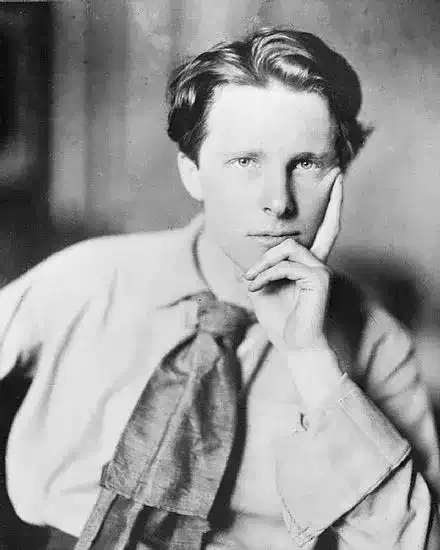
Rupert Brooke
Sonnet
(Suggested by some of the Proceedings of the Society for Psychical Research)
Not with vain tears, when we’re beyond the sun,
We’ll beat on the substantial doors, nor tread
Those dusty high-roads of the aimless dead
Plaintive for Earth; but rather turn and run
Down some close-covered by-way of the air,
Some low sweet alley between wind and wind,
Stoop under faint gleams, thread the shadows, find
Some whispering ghost-forgotten nook, and there
Spend in pure converse our eternal day;
Think each in each, immediately wise;
Learn all we lacked before; hear, know, and say
What this tumultuous body now denies;
And feel, who have laid our groping hands away;
And see, no longer blinded by our eyes.
Read more →
203
Rupert Brooke
Lines Written In The Belief That The Ancient Roman Festival Of The Dead Was Called Ambarvalia
Swings the way still by hollow and hill,
And all the world's a song;
"She's far," it sings me, "but fair," it rings me,
"Quiet," it laughs, "and strong!"
Oh! spite of the miles and years between us,
Spite of your chosen part,
I do remember; and I go
With laughter in my heart.
So above the little folk that know not,
Out of the white hill-town,
High up I clamber; and I remember;
And watch the day go down.
Gold is my heart, and the world's golden,
And one peak tipped with light;
And the air lies still about the hill
With the first fear of night;
Till mystery down the soundless valley
Thunders, and dark is here;
And the wind blows, and the light goes,
And the night is full of fear,
And I know, one night, on some far height,
In the tongue I never knew,
I yet shall hear the tidings clear
From them that were friends of you.
They'll call the news from hill to hill,
Dark and uncomforted,
Earth and sky and the winds; and I
Shall know that you are dead.
I shall not hear your trentals,
Nor eat your arval bread;
For the kin of you will surely do
Their duty by the dead.
Their little dull greasy eyes will water;
They'll paw you, and gulp afresh.
They'll sniffle and weep, and their thoughts will creep
Like flies on the cold flesh.
They will put pence on your grey eyes,
Bind up your fallen chin,
And lay you straight, the fools that loved you
Because they were your kin.
They will praise all the bad about you,
And hush the good away,
And wonder how they'll do without you,
And then they'll go away.
But quieter than one sleeping,
And stranger than of old,
You will not stir for weeping,
You will not mind the cold;
But through the night the lips will laugh not,
The hands will be in place,
And at length the hair be lying still
About the quiet face.
With snuffle and sniff and handkerchief,
And dim and decorous mirth,
With ham and sherry, they'll meet to bury
The lordliest lass of earth.
The little dead hearts will tramp ungrieving
Behind lone-riding you,
The heart so high, the heart so living,
Heart that they never knew.
I shall not hear your trentals,
Nor eat your arval bread,
Nor with smug breath tell lies of death
To the unanswering dead.
With snuffle and sniff and handkerchief,
The folk who loved you not
Will bury you, and go wondering
Back home. And you will rot.
But laughing and half-way up to heaven,
With wind and hill and star,
I yet shall keep, before I sleep,
Your Ambarvalia.
Read more →
205

Henry Lawson
The Wreck Of The `Derry Castle'
Day of ending for beginnings!
Ocean hath another innings,
Ocean hath another score;
And the surges sing his winnings,
And the surges shout his winnings,
And the surges shriek his winnings,
All along the sullen shore.
Sing another dirge in wailing,
For another vessel sailing
With the shadow-ships at sea;
Shadow-ships for ever sinking -Shadow-
ships whose pumps are clinking,
And whose thirsty holds are drinking
Pledges to Eternity.
Pray for souls of ghastly, sodden
Corpses, floating round untrodden
Cliffs, where nought but sea-drift strays;
Souls of dead men, in whose faces
Of humanity no trace is --
Not a mark to show their races -
Floating round for days and days.
. . . . .
Ocean's salty tongues are licking
Round the faces of the drowned,
And a cruel blade seems sticking
Through my heart and turning round.
Heaven! shall HIS ghastly, sodden
Corpse float round for days and days?
Shall it dash 'neath cliffs untrodden,
Rocks where nought but sea-drift strays?
God in heaven! hide the floating,
Falling, rising, face from me;
God in heaven! stay the gloating,
Mocking singing of the sea!
Read more →
204
Henry Lawson
He Mourned His Master
INTRODUCTION
The theme is ancient as the hills,
With all their prehistoric glory;
But yet of Corney and his friend,
We’ve often longed to tell the story;
And should we jar the reader’s ear,
Or fail to please his eye observant,
We only trust that he’ll forgive
The bush muse and—your humble servant.
THE STORY
Old Corney built in Deadman’s Gap
A hut, where mountain shades grow denser,
And there he lived for many years,
A timber-getter and a fencer.
And no one knew if he’d a soul
Above long sprees, or split-rail fences,
Unless, indeed, it was his friend,
Who always kept his confidences.
There was a saw-pit in the range;
’Twas owned by three, and they were brothers,
And visitors to Corney’s hut—
’Twas seldom visited by others.
They came because, as they averred,
“Old Corney licked—a gent infernal.”
“His yarns,” if I might trust their word,
“Would made the fortune of a journal.”
In short, the splitter was a “cure”,
Who brightened up their lives’ dull courses;
And so on Sunday afternoons,
At Corney’s hut they’d hang their horses.
They’d have a game of cards and smoke,
And sometimes sing, which was a rum thing—
Unless, in spite of legal folk,
The splitter kept a “drop of something”.
If, as ’twas said, he was “a swell”
Before he sought these sombre ranges,
’Twixt mother’s arms and coffin gear
He must have seen a world of changes.
But from his lips would never fall
A hint of home, or friends, or brothers;
And if he told his tale at all,
He must have told it as another’s.
Though he was good at telling yarns,
At listening he excelled not less so,
And greatly helped the bushman’s tales
With “yes”, “exactly so”, or “jes’ so”.
In short, the hut became a club
Like our Assembly Legislative,
Combining smokeroom, hall, and “pub”,
Political and recreative.
Old Corney lived and Corney died,
As we will, too, on some to-morrow,
But not as Corney died, we hope,
Of heart disease, and rum, and sorrow.
(We hope to lead a married life,
At times the cup of comfort quaffing;
And when we leave this world of strife
We trust that we may die of laughing.)
One New Year’s Eve they found him dead—
For rum had made his life unstable—
They found him stretched upon his bed,
And also found, upon the table,
The coloured portrait of a girl—
Blue eyes of course. The hair was golden,
A faded letter and a curl,
And—well, we said the theme was olden.
The splitter had for days been dead
And cold before the sawyers found him,
And none had witnessed how he died
Except the friend who whimpered round him;
A noble friend, and of a kind
Who stay when other friends forsake us;
And he at last was left behind
To greet the rough bush undertakers.
This was a season when the bush
Was somewhat ruled by time and distance,
And bushmen came and tried the world,
And “gave it best” without assistance.
Then one might die of heart disease,
And still be spared the inquest horrors.
And when the splitter lay at ease,
So, also, did his sins and sorrows.
“Ole Corey’s dead,” the bushmen said;
“He’s gone at last, an’ ne’er a blunder.”
And so they brought a horse and dray,
And tools to “tuck the old cove under.”
The funeral wended through the range,
And slowly round its rugged corners;
The reader will not think it strange
That Corney’s friend was chief of mourners.
He must have thought the bushmen hard,
And of his misery unheeding,
Because they shunned his anxious eyes,
That seemed for explanation pleading.
At intervals his tongue would wipe
The jaws that seemed with anguish quaking;
As some strong hand impatiently
Might chide the tears for prison breaking.
They reached by rugged ways at last,
A desolate bush cemetery,
Where now (our tale is of the past),
A thriving town its dead doth bury.
And where the bones of pioneers
Are found and thrown aside unheeded—
For later sleepers, blessed with tears
Of many friends, the graves are needed.
The funeral reached the bushmen’s graves,
Where these old pioneers were sleeping,
And now while down the granite ridge
The shadow of the peak was creeping,
They dug a grave beneath a gum
And lowered the dead as gently may be
As Corney’s mother long before
Had laid him down to “hush-a-baby”.
A bushman read the words to which
The others reverently listened,
Some bearded lips were seen to twitch,
Some shaded eyes with moisture glistened.
Perhaps this weakness was because
Their work reminded them in sorrow
Of other burials long ago,
When friends “turned in to wait the morrow.”
The boys had brought the splitter’s tools,
And now they split and put together
Four panels such as Corney made,
To stand the stress of western weather.
Perhaps this second weakness rose,
From some good reason undetected;
They may have thought of other graves
Of dearer friends they left neglected.
“Old Corney’s dead, he paid his bills”
(These words upon the tree were graven)
“And oft a swagman down in luck,
At Corey’s mansion found a haven.”
If this an explanation needs,
We greatly fear we can’t afford it;
Unless they thought of other dead,
Whose virtues they had not recorded.
The day had crossed the homeward track,
And as the bushmen turned to tread it,
They thought and spoke of many things,
Remembered now to Corney’s credit;
And strange to say, above their heads
The kookaburra burst with laughter.
(Perhaps he thought of other friends
Whose virtues they remembered—after.)
But now the bushmen hurried on
Lest darkness in the range should find them;
And strange to say they never saw
That Corney’s friend had stayed behind them.
If one had thrown a backward glance
Along the rugged path they wended,
He might have seen a darker form
Upon the damp cold mound extended.
But soon their forms had vanished all,
And night came down the ranges faster,
And no one saw the shadows fall
Upon the dog that mourned his master.
Read more →
204

John Greenleaf Whittier
The River Path
No bird-song floated down the hill,
The tangled bank below was still;
No rustle from the birchen stem,
No ripple from the water's hem.
The dusk of twilight round us grew,
We felt the falling of the dew;
For, from us, ere the day was done,
The wooded hills shut out the sun.
But on the river's farther side
We saw the hill-tops glorified,-
A tender glow, exceeding fair,
A dream of day without its glare.
With us the damp, the chill, the gloom
With them the sunset's rosy bloom;
While dark, through willowy vistas seen,
The river rolled in shade between.
From out the darkness where we trod,
We gazed upon those bills of God,
Whose light seemed not of moon or sun.
We spake not, but our thought was one.
We paused, as if from that bright shore
Beckoned our dear ones gone before;
And stilled our beating hearts to hear
The voices lost to mortal ear!
Sudden our pathway turned from night;
The hills swung open to the light;
Through their green gates the sunshine showed,
A long, slant splendor downward flowed.
Down glade and glen and bank it rolled;
It bridged the shaded stream with gold;
And, borne on piers of mist, allied
The shadowy with the sunlit side!
'So,' prayed we, 'when our feet draw near
The river dark, with mortal fear,
'And the night cometh chill with dew,
O Father! let Thy light break through!
'So let the hills of doubt divide,
So bridge with faith the sunless tide!
'So let the eyes that fail on earth
On Thy eternal hills look forth;
'And in Thy beckoning angels know
The dear ones whom we loved below!'
Read more →
203
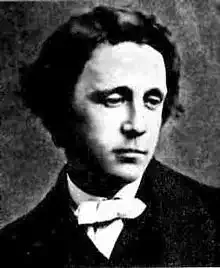
Lewis Carroll
Lays of Sorrow
The day was wet, the rain fell souse
Like jars of strawberry jam, [1] a
sound was heard in the old henhouse,
A beating of a hammer.
Of stalwart form, and visage warm,
Two youths were seen within it,
Splitting up an old tree into perches for their poultry
At a hundred strokes [2] a minute.
The work is done, the hen has taken
Possession of her nest and eggs,
Without a thought of eggs and bacon, [3]
(Or I am very much mistaken happy)
She turns over each shell,
To be sure that all's well,
Looks into the straw
To see there's no flaw,
Goes once round the house, [4]
Half afraid of a mouse,
Then sinks calmly to rest
On the top of her nest,
First doubling up each of her legs.
Time rolled away, and so did every shell,
"Small by degrees and beautifully less,"
As the large mother with a powerful spell [5]
Forced each in turn its contents to express, [6]
But ah! "imperfect is expression,"
Some poet said, I don't care who,
If you want to know you must go elsewhere,
One fact I can tell, if you're willing to hear,
He never attended a Parliament Session,
For I'm certain that if he had ever been there,
Full quickly would he have changed his ideas,
With the hissings, the hootings, the groans and the cheers.
And as to his name it is pretty clear
That it wasn't me and it wasn't you!
And so it fell upon a day,
(That is, it never rose again)
A chick was found upon the hay,
Its little life had ebbed away.
No longer frolicsome and gay,
No longer could it run or play.
"And must we, chicken, must we part?"
Its master [7] cried with bursting heart,
And voice of agony and pain.
So one, whose ticket's marked "Return", [8]
When to the lonely roadside station
He flies in fear and perturbation,
Thinks of his homethe
hissing urn
Then
runs with flying hat and hair,
And, entering, finds to his despair
He's missed the very last train. [9]
Too long it were to tell of each conjecture
Of chicken suicide, and poultry victim,
The deadly frown, the stern and dreary lecture,
The timid guess, "perhaps some needle pricked him!"
The din of voice, the words both loud and many,
The sob, the tear, the sigh that none could smother,
Till all agreed "a shilling to a penny
It killed itself, and we acquit the mother!"
Scarce was the verdict spoken,
When that still calm was broken,
A childish form hath burst into the throng;
With tears and looks of sadness,
That bring no news of gladness,
But tell too surely something hath gone wrong!
"The sight I have come upon
The stoutest heart [10] would sicken,
That nasty hen has been and gone
And killed another chicken!"
Read more →
203
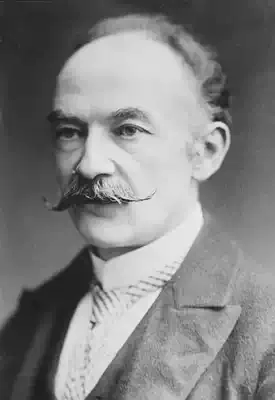
Thomas Hardy
The Supplanter: A Tale
I
He bends his travel-tarnished feet
To where she wastes in clay:
From day-dawn until eve he fares
Along the wintry way;
From day-dawn until eve repairs
Unto her mound to pray.
II
"Are these the gravestone shapes that meet
My forward-straining view?
Or forms that cross a window-blind
In circle, knot, and queue:
Gay forms, that cross and whirl and wind
To music throbbing through?" -
III
"The Keeper of the Field of Tombs
Dwells by its gateway-pier;
He celebrates with feast and dance
His daughter's twentieth year:
He celebrates with wine of France
The birthday of his dear." -
IV
"The gates are shut when evening glooms:
Lay down your wreath, sad wight;
To-morrow is a time more fit
For placing flowers aright:
The morning is the time for it;
Come, wake with us to-night!" -
V
He grounds his wreath, and enters in,
And sits, and shares their cheer. -
"I fain would foot with you, young man,
Before all others here;
I fain would foot it for a span
With such a cavalier!"
VI
She coaxes, clasps, nor fails to win
His first-unwilling hand:
The merry music strikes its staves,
The dancers quickly band;
And with the damsel of the graves
He duly takes his stand.
VII
"You dance divinely, stranger swain,
Such grace I've never known.
O longer stay! Breathe not adieu
And leave me here alone!
O longer stay: to her be true
Whose heart is all your own!" -
VIII
"I mark a phantom through the pane,
That beckons in despair,
Its mouth all drawn with heavy moan -
Her to whom once I sware!" -
"Nay; 'tis the lately carven stone
Of some strange girl laid there!" -
IX
"I see white flowers upon the floor
Betrodden to a clot;
My wreath were they?"--"Nay; love me much,
Swear you'll forget me not!
'Twas but a wreath! Full many such
Are brought here and forgot."
* * *
X
The watches of the night grow hoar,
He rises ere the sun;
"Now could I kill thee here!" he says,
"For winning me from one
Who ever in her living days
Was pure as cloistered nun!"
XI
She cowers, and he takes his track
Afar for many a mile,
For evermore to be apart
From her who could beguile
His senses by her burning heart,
And win his love awhile.
XII
A year: and he is travelling back
To her who wastes in clay;
From day-dawn until eve he fares
Along the wintry way,
From day-dawn until eve repairs
Unto her mound to pray.
XIII
And there he sets him to fulfil
His frustrate first intent:
And lay upon her bed, at last,
The offering earlier meant:
When, on his stooping figure, ghast
And haggard eyes are bent.
XIV
"O surely for a little while
You can be kind to me!
For do you love her, do you hate,
She knows not--cares not she:
Only the living feel the weight
Of loveless misery!
XV
"I own my sin; I've paid its cost,
Being outcast, shamed, and bare:
I give you daily my whole heart,
Your babe my tender care,
I pour you prayers; and aye to part
Is more than I can bear!"
XVI
He turns--unpitying, passion-tossed;
"I know you not!" he cries,
"Nor know your child. I knew this maid,
But she's in Paradise!"
And swiftly in the winter shade
He breaks from her and flies.
Read more →
202

Robert W. Service
My Tails
I haven't worn my evening dress
For nearly twenty years;
Oh I'm unsocial, I confess,
A hermit, it appears.
So much moth-balled it's but away,
And though wee wifie wails,
Never unto my dimmest day
I'll don my tails.
How slim and trim I looked in them,
Though I was sixty old;
And now their sleekness I condemn
To lie in rigid fold.
I have a portrait of myself
Proud-printed in the Press,
In garb now doomed to wardrobe shelf,-My
evening dress.
So let this be my last request,
That when I come to die,
In tails I may be deftly drest,
With white waistcoat and tie.
No, not for me a vulgar shroud
My carcass to caress;--
Oh let me do my coffin proud
In evening dress!
Read more →
195
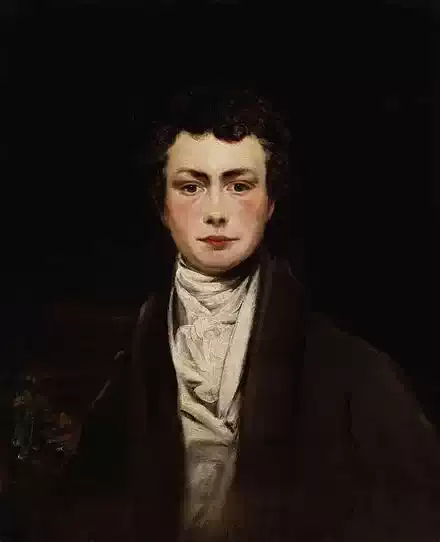
Thomas Moore
Oh, Ye Dead!
Oh, ye Dead! oh, ye Dead! whom we know by the light you give
From your cold gleaming eyes, though you move like men who live,
Why leave you thus your graves,
In far off fields and waves,
Where the worm and the sea-bird only know your bed,
To haunt this spot where all
Those eyes that wept your fall,
And the hearts that wail'd you, like your own, lie dead?
It is true, it is true, we are shadows cold and wan;
And the fair and the brave whom we loved on earth are gone;
But still thus even in death,
So sweet the living breath
Of the fields and the flowers in our youth we wander'd o'er,
That ere, condemn'd, we go
To freeze 'mid Hecla's snow,
We would taste it a while, and think we live once more!
Read more →
195

Wilfred Owen
Hospital Barge
Budging the sluggard ripples of the Somme,
A barge round old Cérisy slowly slewed.
Softly her engines down the current screwed,
And chuckled softly with contented hum,
Till fairy tinklings struck their croonings dumb.
The waters rumpling at the stern subdued;
The lock-gate took her bulging amplitude;
Gently from out the gurgling lock she swum.
One reading by that calm bank shaded eyes
To watch her lessening westward quietly.
Then, as she neared the bend, her funnel screamed.
And that long lamentation made him wise
How unto Avalon, in agony,
Kings passed in the dark barge, which Merlin dreamed.
Read more →
196

Christina Rossetti
Marvel of Marvels
MARVEL of marvels, if I myself shall behold
With mine own eyes my King in His city of gold;
Where the least of lambs is spotless white in the fold,
Where the least and last of saints in spotless white is stoled,
Where the dimmest head beyond a moon is aureoled.
O saints, my beloved, now mouldering to mould in the mould,
Shall I see you lift your heads, see your cerements unroll'd,
See with these very eyes? who now in darkness and cold
Tremble for the midnight cry, the rapture, the tale untold,--
The Bridegroom cometh, cometh, His Bride to enfold!
Cold it is, my beloved, since your funeral bell was toll'd:
Cold it is, O my King, how cold alone on the wold!
Read more →
195
Christina Rossetti
A Baby's Cradle With No Baby In It
A baby's cradle with no baby in it,
A baby's grave where autumn leaves drop sere;
The sweet soul gathered home to Paradise,
The body waiting here.
Read more →
196
Rupert Brooke
On The Death Of Smet-Smet, The Hippopotamus- Goddess
Song of a tribe of the ancient Egyptians
(The Priests within the Temple)
She was wrinkled and huge and hideous? She was our Mother.
She was lustful and lewd? -- but a God; we had none other.
In the day She was hidden and dumb, but at nightfall moaned in the shade;
We shuddered and gave Her Her will in the darkness; we were afraid.
(The People without)
She sent us pain,
And we bowed before Her;
She smiled again
And bade us adore Her.
She solaced our woe
And soothed our sighing;
And what shall we do
Now God is dying?
(The Priests within)
She was hungry and ate our children; -- how should we stay Her?
She took our young men and our maidens; -- ours to obey Her.
We were loathed and mocked and reviled of all nations; that was our pride.
She fed us, protected us, loved us, and killed us; now She has died.
(The People without)
She was so strong;
But death is stronger.
She ruled us long;
But Time is longer.
She solaced our woe
And soothed our sighing;
And what shall we do
Now God is dying?
Read more →
197
Emily Dickinson
The Months have ends—the Years—a knot
The Months have ends—the Years—a knot—
No Power can untie
To stretch a little further
A Skein of Misery—
The Earth lays back these tired lives
In her mysterious Drawers—
Too tenderly, that any doubt
An ultimate Repose—
The manner of the Children—
Who weary of the Day—
Themself—the noisy Plaything
They cannot put away—
Read more →
190
Robert W. Service
Dolls
She said: "I am too old to play
With dolls," and put them all away,
Into a box, one rainy day.
I think she must have felt some pain,
She looked so long into the rain,
Then sighed: "I'll bring you out again;
"For I'll have little children too,
With sunny hair and eyes of blue
And they will play and play with you.
"And now good-bye, my pretty dears;
There in the dark for years and years,
Dream of your little mother's tears."
Eglantine, Pierrot and Marie Claire,
Topsy and Tiny and Teddy Bear,
Side by side in the coffer there.
Time went by; one day she kneeled
By a wooden Cross in Flanders Field,
And wept for the One the earth concealed;
And made a vow she would never wed,
But always be true to the deathless dead,
Until the span of her life be sped.
* *
* * *
* *
More years went on and they made her wise
By sickness and pain and sacrifice,
With greying tresses and tired eyes.
And then one evening of weary rain,
She opened the old oak box again,
And her heart was clutched with an ancient pain
For there in the quiet dark they lay,
Just as they were when she put them away...
O but it seemed like yesterday!
Topsy and Tiny and Teddy Bear,
Eglantine, Pierrot and Marie Claire,
Ever so hopefully waiting there.
But she looked at them through her blinding tears,
And she said: "You've been patient, my pretty dears;
You've waited and waited all these years.
"I've broken a promise I made so true;
But my heart, my darlings, is broken too:
No little Mothers have I for you.
"My hands are withered, my hair is grey;
Yet just for a moment I'll try to play
With you as I did that long dead day...
"Ah no, I cannot. I try in vain . . .
I stare and I stare into the rain . . .
I'll put you back in your box again.
"Bless you, darlings, perhaps one day,
Some little Mother will find you and play,
And once again you'll be glad and gay.
"But when in the friendly dark I lie,
No one will ever love you as I . . . .
My little children . . . good-bye . . . good-bye."
Read more →
190
Wilfred Owen
A Terre
(Being the philosophy of many Soldiers.)
Sit on the bed; I'm blind, and three parts shell,
Be careful; can't shake hands now; never shall.
Both arms have mutinied against me -- brutes.
My fingers fidget like ten idle brats.
I tried to peg out soldierly -- no use!
One dies of war like any old disease.
This bandage feels like pennies on my eyes.
I have my medals? -- Discs to make eyes close.
My glorious ribbons? -- Ripped from my own back
In scarlet shreds. (That's for your poetry book.)
A short life and a merry one, my brick!
We used to say we'd hate to live dead old, --
Yet now . . . I'd willingly be puffy, bald,
And patriotic. Buffers catch from boys
At least the jokes hurled at them. I suppose
Little I'd ever teach a son, but hitting,
Shooting, war, hunting, all the arts of hurting.
Well, that's what I learnt, -- that, and making money.
Your fifty years ahead seem none too many?
Tell me how long I've got? God! For one year
To help myself to nothing more than air!
One Spring! Is one too good to spare, too long?
Spring wind would work its own way to my lung,
And grow me legs as quick as lilac-shoots.
My servant's lamed, but listen how he shouts!
When I'm lugged out, he'll still be good for that.
Here in this mummy-case, you know, I've thought
How well I might have swept his floors for ever,
I'd ask no night off when the bustle's over,
Enjoying so the dirt. Who's prejudiced
Against a grimed hand when his own's quite dust,
Less live than specks that in the sun-shafts turn,
Less warm than dust that mixes with arms' tan?
I'd love to be a sweep, now, black as Town,
Yes, or a muckman. Must I be his load?
O Life, Life, let me breathe, -- a dug-out rat!
Not worse than ours the existences rats lead --
Nosing along at night down some safe vat,
They find a shell-proof home before they rot.
Dead men may envy living mites in cheese,
Or good germs even. Microbes have their joys,
And subdivide, and never come to death,
Certainly flowers have the easiest time on earth.
"I shall be one with nature, herb, and stone."
Shelley would tell me. Shelley would be stunned;
The dullest Tommy hugs that fancy now.
"Pushing up daisies," is their creed, you know.
To grain, then, go my fat, to buds my sap,
For all the usefulness there is in soap.
D'you think the Boche will ever stew man-soup?
Some day, no doubt, if . . .
Friend, be very sure
I shall be better off with plants that share
More peaceably the meadow and the shower.
Soft rains will touch me, -- as they could touch once,
And nothing but the sun shall make me ware.
Your guns may crash around me. I'll not hear;
Or, if I wince, I shall not know I wince.
Don't take my soul's poor comfort for your jest.
Soldiers may grow a soul when turned to fronds,
But here the thing's best left at home with friends.
My soul's a little grief, grappling your chest,
To climb your throat on sobs; easily chased
On other sighs and wiped by fresher winds.
Carry my crying spirit till it's weaned
To do without what blood remained these wounds.
Read more →
187
Wilfred Owen
[I Saw His Round Mouth's Crimson]
[I saw his round mouth's crimson deepen as it fell],
Like a Sun, in his last deep hour;
Watched the magnificent recession of farewell,
Clouding, half gleam, half glower,
And a last splendour burn the heavens of his cheek.
And in his eyes
The cold stars lighting, very old and bleak,
In different skies.
Read more →
183
Christina Rossetti
Christian And Jew
A Dialogue
'Oh happy happy land!
Angels like rushes stand
About the wells of light.'—
'Alas, I have not eyes for this fair sight:
Hold fast my hand.'—
'As in a soft wind, they
Bend all one blessed way,
Each bowed in his own glory, star with star.'—
'I cannot see so far,
Here shadows are.'—
'White-winged the cherubim,
Yet whiter seraphim,
Glow white with intense fire of love.'—
'Mine eyes are dim:
I look in vain above,
And miss their hymn.'—
'Angels, Archangels cry
One to other ceaselessly
(I hear them sing)
One 'Holy, Holy, Holy' to their King.'—
'I do not hear them, I.'—
'At one side Paradise
Is curtained from the rest,
Made green for wearied eyes;
Much softer than the breast
Of mother-dove clad in a rainbow's dyes.
'All precious souls are there
Most safe, elect by grace,
All tears are wiped for ever from their face:
Untired in prayer
They wait and praise
Hidden for a little space.
'Boughs of the Living Vine
They spread in summer shine
Green leaf with leaf:
Sap of the Royal Vine it stirs like wine
In all both less and chief.
'Sing to the Lord,
All spirits of all flesh, sing;
For He hath not abhorred
Our low estate nor scorn'd our offering:
Shout to our King.'—
'But Zion said:
My Lord forgetteth me.
Lo, she hath made her bed
In dust; forsaken weepeth she
Where alien rivers swell the sea.
'She laid her body as the ground,
Her tender body as the ground to those
Who passed; her harpstrings cannot sound
In a strange land; discrowned
She sits, and drunk with woes.'—
'O drunken not with wine,
Whose sins and sorrows have fulfilled the sum,—
Be not afraid, arise, be no more dumb;
Arise, shine,
For thy light is come.'—
'Can these bones live?'—
'God knows:
The prophet saw such clothed with flesh and skin;
A wind blew on them and life entered in;
They shook and rose.
Hasten the time, O Lord, blot out their sin,
Let life begin.'
Read more →
185
Wilfred Owen
Elegy in April and September
Hush, thrush! Hush, missen-thrush, I listen...
I heard the flush of footsteps through the loose leaves,
And a low whistle by the water's brim.
Still! Daffodil! Nay, hail me not so gaily,-
Your gay gold lily daunts me and deceives,
Who follow gleams more golden and more slim.
Look, brook! O run and look, O run!
The vain reeds shook? - Yet search till gray sea heaves,
And I will stray among these fields for him.
Gaze, daisy! Stare through haze and glare,
And mark the hazardous stars all dawns and eves,
For my eye withers, and his star wanes dim.
Close, rose, and droop, heliotrope,
And shudder, hope! The shattering winter blows.
Drop, heliotrope, and close, rose...
Mourn, corn, and sigh, rye.
Men garner you, but youth's head lies forlorn.
Sigh, rye, and mourn, corn...
Brood, wood, and muse, yews,
The ways gods use we have not understood.
Muse, yews, and brood, wood...
Read more →
188
Thomas Moore
It Is Not the Tear At This Moment Shed
It is not the tear at this moment shed,
When the cold turf has just been laid o'er him,
That can tell how beloved was the friend that's fled,
Or how deep in our hearts we deplore him.
'Tis the tear, through many a long day wept,
'Tis life's whole path o'ershaded;
'Tis the one remembrance, fondly kept,
When all lighter griefs have faded.
Thus his memory, like some holy light,
Kept alive in our hearts, will improve them,
For worth shall look fairer, and truth more bright,
When we think how he lived but to love them.
And as fresher flowers the sod perfume
Where buried saints are lying,
So our hearts shall borrow a sweetening bloom
From the image he left there in dying!
Read more →
187

Homero
The Iliad: Book 24
The assembly now broke up and the people went their ways each to his
own ship. There they made ready their supper, and then bethought
them of the blessed boon of sleep; but Achilles still wept for
thinking of his dear comrade, and sleep, before whom all things bow,
could take no hold upon him. This way and that did he turn as he
yearned after the might and manfulness of Patroclus; he thought of all
they had done together, and all they had gone through both on the
field of battle and on the waves of the weary sea. As he dwelt on
these things he wept bitterly and lay now on his side, now on his
back, and now face downwards, till at last he rose and went out as one
distraught to wander upon the seashore. Then, when he saw dawn
breaking over beach and sea, he yoked his horses to his chariot, and
bound the body of Hector behind it that he might drag it about. Thrice
did he drag it round the tomb of the son of Menoetius, and then went
back into his tent, leaving the body on the ground full length and
with its face downwards. But Apollo would not suffer it to be
disfigured, for he pitied the man, dead though he now was; therefore
he shielded him with his golden aegis continually, that he might
take no hurt while Achilles was dragging him.
Thus shamefully did Achilles in his fury dishonour Hector; but the
blessed gods looked down in pity from heaven, and urged Mercury,
slayer of Argus, to steal the body. All were of this mind save only
Juno, Neptune, and Jove's grey-eyed daughter, who persisted in the
hate which they had ever borne towards Ilius with Priam and his
people; for they forgave not the wrong done them by Alexandrus in
disdaining the goddesses who came to him when he was in his
sheepyards, and preferring her who had offered him a wanton to his
ruin.
When, therefore, the morning of the twelfth day had now come,
Phoebus Apollo spoke among the immortals saying, "You gods ought to be
ashamed of yourselves; you are cruel and hard-hearted. Did not
Hector burn you thigh-bones of heifers and of unblemished goats? And
now dare you not rescue even his dead body, for his wife to look upon,
with his mother and child, his father Priam, and his people, who would
forthwith commit him to the flames, and give him his due funeral
rites? So, then, you would all be on the side of mad Achilles, who
knows neither right nor ruth? He is like some savage lion that in
the pride of his great strength and daring springs upon men's flocks
and gorges on them. Even so has Achilles flung aside all pity, and all
that conscience which at once so greatly banes yet greatly boons him
that will heed it. man may lose one far dearer than Achilles has losta
son, it may be, or a brother born from his own mother's womb; yet
when he has mourned him and wept over him he will let him bide, for it
takes much sorrow to kill a man; whereas Achilles, now that he has
slain noble Hector, drags him behind his chariot round the tomb of his
comrade. It were better of him, and for him, that he should not do so,
for brave though he be we gods may take it ill that he should vent his
fury upon dead clay."
Juno spoke up in a rage. "This were well," she cried, "O lord of the
silver bow, if you would give like honour to Hector and to Achilles;
but Hector was mortal and suckled at a woman's breast, whereas
Achilles is the offspring of a goddess whom I myself reared and
brought up. I married her to Peleus, who is above measure dear to
the immortals; you gods came all of you to her wedding; you feasted
along with them yourself and brought your lyre- false, and fond of low
company, that you have ever been."
Then said Jove, "Juno, be not so bitter. Their honour shall not be
equal, but of all that dwell in Ilius, Hector was dearest to the gods,
as also to myself, for his offerings never failed me. Never was my
altar stinted of its dues, nor of the drink-offerings and savour of
sacrifice which we claim of right. I shall therefore permit the body
of mighty Hector to be stolen; and yet this may hardly be without
Achilles coming to know it, for his mother keeps night and day
beside him. Let some one of you, therefore, send Thetis to me, and I
will impart my counsel to her, namely that Achilles is to accept a
ransom from Priam, and give up the body."
On this Iris fleet as the wind went forth to carry his message. Down
she plunged into the dark sea midway between Samos and rocky Imbrus;
the waters hissed as they closed over her, and she sank into the
bottom as the lead at the end of an ox-horn, that is sped to carry
death to fishes. She found Thetis sitting in a great cave with the
other sea-goddesses gathered round her; there she sat in the midst
of them weeping for her noble son who was to fall far from his own
land, on the rich plains of Troy. Iris went up to her and said,
"Rise Thetis; Jove, whose counsels fail not, bids you come to him."
And Thetis answered, "Why does the mighty god so bid me? I am in great
grief, and shrink from going in and out among the immortals. Still,
I will go, and the word that he may speak shall not be spoken in
vain."
The goddess took her dark veil, than which there can be no robe more
sombre, and went forth with fleet Iris leading the way before her. The
waves of the sea opened them a path, and when they reached the shore
they flew up into the heavens, where they found the all-seeing son
of Saturn with the blessed gods that live for ever assembled near him.
Minerva gave up her seat to her, and she sat down by the side of
father Jove. Juno then placed a fair golden cup in her hand, and spoke
to her in words of comfort, whereon Thetis drank and gave her back the
cup; and the sire of gods and men was the first to speak.
"So, goddess," said he, "for all your sorrow, and the grief that I
well know reigns ever in your heart, you have come hither to
Olympus, and I will tell you why I have sent for you. This nine days
past the immortals have been quarrelling about Achilles waster of
cities and the body of Hector. The gods would have Mercury slayer of
Argus steal the body, but in furtherance of our peace and amity
henceforward, I will concede such honour to your son as I will now
tell you. Go, then, to the host and lay these commands upon him; say
that the gods are angry with him, and that I am myself more angry than
them all, in that he keeps Hector at the ships and will not give him
up. He may thus fear me and let the body go. At the same time I will
send Iris to great Priam to bid him go to the ships of the Achaeans,
and ransom his son, taking with him such gifts for Achilles as may
give him satisfaction.
Silver-footed Thetis did as the god had told her, and forthwith down
she darted from the topmost summits of Olympus. She went to her
son's tents where she found him grieving bitterly, while his trusty
comrades round him were busy preparing their morning meal, for which
they had killed a great woolly sheep. His mother sat down beside him
and caressed him with her hand saying, "My son, how long will you keep
on thus grieving and making moan? You are gnawing at your own heart,
and think neither of food nor of woman's embraces; and yet these too
were well, for you have no long time to live, and death with the
strong hand of fate are already close beside you. Now, therefore, heed
what I say, for I come as a messenger from Jove; he says that the gods
are angry with you, and himself more angry than them all, in that
you keep Hector at the ships and will not give him up. Therefore let
him go, and accept a ransom for his body."
And Achilles answered, "So be it. If Olympian Jove of his own motion
thus commands me, let him that brings the ransom bear the body away."
Thus did mother and son talk together at the ships in long discourse
with one another. Meanwhile the son of Saturn sent Iris to the
strong city of Ilius. "Go," said he, "fleet Iris, from the mansions of
Olympus, and tell King Priam in Ilius, that he is to go to the ships
of the Achaeans and free the body of his dear son. He is to take
such gifts with him as shall give satisfaction to Achilles, and he
is to go alone, with no other Trojan, save only some honoured
servant who may drive his mules and waggon, and bring back the body of
him whom noble Achilles has slain. Let him have no thought nor fear of
death in his heart, for we will send the slayer of Argus to escort
him, and bring him within the tent of Achilles. Achilles will not kill
him nor let another do so, for he will take heed to his ways and sin
not, and he will entreat a suppliant with all honourable courtesy."
On this Iris, fleet as the wind, sped forth to deliver her
message. She went to Priam's house, and found weeping and
lamentation therein. His sons were seated round their father in the
outer courtyard, and their raiment was wet with tears: the old man sat
in the midst of them with his mantle wrapped close about his body, and
his head and neck all covered with the filth which he had clutched
as he lay grovelling in the mire. His daughters and his sons' wives
went wailing about the house, as they thought of the many and brave
men who lay dead, slain by the Argives. The messenger of Jove stood by
Priam and spoke softly to him, but fear fell upon him as she did so.
"Take heart," she said, "Priam offspring of Dardanus, take heart and
fear not. I bring no evil tidings, but am minded well towards you. I
come as a messenger from Jove, who though he be not near, takes
thought for you and pities you. The lord of Olympus bids you go and
ransom noble Hector, and take with you such gifts as shall give
satisfaction to Achilles. You are to go alone, with no Trojan, save
only some honoured servant who may drive your mules and waggon, and
bring back to the city the body of him whom noble Achilles has
slain. You are to have no thought, nor fear of death, for Jove will
send the slayer of Argus to escort you. When he has brought you within
Achilles' tent, Achilles will not kill you nor let another do so,
for he will take heed to his ways and sin not, and he will entreat a
suppliant with all honourable courtesy."
Iris went her way when she had thus spoken, and Priam told his
sons to get a mule-waggon ready, and to make the body of the waggon
fast upon the top of its bed. Then he went down into his fragrant
store-room, high-vaulted, and made of cedar-wood, where his many
treasures were kept, and he called Hecuba his wife. "Wife," said he,
"a messenger has come to me from Olympus, and has told me to go to the
ships of the Achaeans to ransom my dear son, taking with me such gifts
as shall give satisfaction to Achilles. What think you of this matter?
for my own part I am greatly moved to pass through the of the Achaeans
and go to their ships."
His wife cried aloud as she heard him, and said, "Alas, what has
become of that judgement for which you have been ever famous both
among strangers and your own people? How can you venture alone to
the ships of the Achaeans, and look into the face of him who has slain
so many of your brave sons? You must have iron courage, for if the
cruel savage sees you and lays hold on you, he will know neither
respect nor pity. Let us then weep Hector from afar here in our own
house, for when I gave him birth the threads of overruling fate were
spun for him that dogs should eat his flesh far from his parents, in
the house of that terrible man on whose liver I would fain fasten
and devour it. Thus would I avenge my son, who showed no cowardice
when Achilles slew him, and thought neither of Right nor of avoiding
battle as he stood in defence of Trojan men and Trojan women."
Then Priam said, "I would go, do not therefore stay me nor be as a
bird of ill omen in my house, for you will not move me. Had it been
some mortal man who had sent me some prophet or priest who divines
from sacrifice- I should have deemed him false and have given him no
heed; but now I have heard the goddess and seen her face to face,
therefore I will go and her saying shall not be in vain. If it be my
fate to die at the ships of the Achaeans even so would I have it;
let Achilles slay me, if I may but first have taken my son in my
arms and mourned him to my heart's comforting."
So saying he lifted the lids of his chests, and took out twelve
goodly vestments. He took also twelve cloaks of single fold, twelve
rugs, twelve fair mantles, and an equal number of shirts. He weighed
out ten talents of gold, and brought moreover two burnished tripods,
four cauldrons, and a very beautiful cup which the Thracians had given
him when he had gone to them on an embassy; it was very precious,
but he grudged not even this, so eager was he to ransom the body of
his son. Then he chased all the Trojans from the court and rebuked
them with words of anger. "Out," he cried, "shame and disgrace to me
that you are. Have you no grief in your own homes that you are come to
plague me here? Is it a small thing, think you, that the son of Saturn
has sent this sorrow upon me, to lose the bravest of my sons? Nay, you
shall prove it in person, for now he is gone the Achaeans will have
easier work in killing you. As for me, let me go down within the house
of Hades, ere mine eyes behold the sacking and wasting of the city."
He drove the men away with his staff, and they went forth as the old
man sped them. Then he called to his sons, upbraiding Helenus,
Paris, noble Agathon, Pammon, Antiphonus, Polites of the loud
battle-cry, Deiphobus, Hippothous, and Dius. These nine did the old
man call near him. "Come to me at once," he cried, "worthless sons who
do me shame; would that you had all been killed at the ships rather
than Hector. Miserable man that I am, I have had the bravest sons in
all Troy- noble Nestor, Troilus the dauntless charioteer, and Hector
who was a god among men, so that one would have thought he was son
to an immortal- yet there is not one of them left. Mars has slain them
and those of whom I am ashamed are alone left me. Liars, and light
of foot, heroes of the dance, robbers of lambs and kids from your
own people, why do you not get a waggon ready for me at once, and
put all these things upon it that I may set out on my way?"
Thus did he speak, and they feared the rebuke of their father.
They brought out a strong mule-waggon, newly made, and set the body of
the waggon fast on its bed. They took the mule-yoke from the peg on
which it hung, a yoke of boxwood with a knob on the top of it and
rings for the reins to go through. Then they brought a yoke-band
eleven cubits long, to bind the yoke to the pole; they bound it on
at the far end of the pole, and put the ring over the upright pin
making it fast with three turns of the band on either side the knob,
and bending the thong of the yoke beneath it. This done, they
brought from the store-chamber the rich ransom that was to purchase
the body of Hector, and they set it all orderly on the waggon; then
they yoked the strong harness-mules which the Mysians had on a time
given as a goodly present to Priam; but for Priam himself they yoked
horses which the old king had bred, and kept for own use.
Thus heedfully did Priam and his servant see to the yolking of their
cars at the palace. Then Hecuba came to them all sorrowful, with a
golden goblet of wine in her right hand, that they might make a
drink-offering before they set out. She stood in front of the horses
and said, "Take this, make a drink-offering to father Jove, and
since you are minded to go to the ships in spite of me, pray that
you may come safely back from the hands of your enemies. Pray to the
son of Saturn lord of the whirlwind, who sits on Ida and looks down
over all Troy, pray him to send his swift messenger on your right
hand, the bird of omen which is strongest and most dear to him of
all birds, that you may see it with your own eyes and trust it as
you go forth to the ships of the Danaans. If all-seeing Jove will
not send you this messenger, however set upon it you may be, I would
not have you go to the ships of the Argives."
And Priam answered, "Wife, I will do as you desire me; it is well to
lift hands in prayer to Jove, if so be he may have mercy upon me."
With this the old man bade the serving-woman pour pure water over
his hands, and the woman came, bearing the water in a bowl. He
washed his hands and took the cup from his wife; then he made the
drink-offering and prayed, standing in the middle of the courtyard and
turning his eyes to heaven. "Father Jove," he said, "that rulest
from Ida, most glorious and most great, grant that I may be received
kindly and compassionately in the tents of Achilles; and send your
swift messenger upon my right hand, the bird of omen which is
strongest and most dear to you of all birds, that I may see it with my
own eyes and trust it as I go forth to the ships of the Danaans."
So did he pray, and Jove the lord of counsel heard his prayer.
Forthwith he sent an eagle, the most unerring portent of all birds
that fly, the dusky hunter that men also call the Black Eagle. His
wings were spread abroad on either side as wide as the well-made and
well-bolted door of a rich man's chamber. He came to them flying
over the city upon their right hands, and when they saw him they
were glad and their hearts took comfort within them. The old man
made haste to mount his chariot, and drove out through the inner
gateway and under the echoing gatehouse of the outer court. Before him
went the mules drawing the four-wheeled waggon, and driven by wise
Idaeus; behind these were the horses, which the old man lashed with
his whip and drove swiftly through the city, while his friends
followed after, wailing and lamenting for him as though he were on his
road to death. As soon as they had come down from the city and had
reached the plain, his sons and sons-in-law who had followed him
went back to Ilius.
But Priam and Idaeus as they showed out upon the plain did not
escape the ken of all-seeing Jove, who looked down upon the old man
and pitied him; then he spoke to his son Mercury and said, "Mercury,
for it is you who are the most disposed to escort men on their way,
and to hear those whom you will hear, go, and so conduct Priam to
the ships of the Achaeans that no other of the Danaans shall see him
nor take note of him until he reach the son of Peleus."
Thus he spoke and Mercury, guide and guardian, slayer of Argus,
did as he was told. Forthwith he bound on his glittering golden
sandals with which he could fly like the wind over land and sea; he
took the wand with which he seals men's eyes in sleep, or wakes them
just as he pleases, and flew holding it in his hand till he came to
Troy and to the Hellespont. To look at, he was like a young man of
noble birth in the hey-day of his youth and beauty with the down
just coming upon his face.
Now when Priam and Idaeus had driven past the great tomb of Ilius,
they stayed their mules and horses that they might drink in the river,
for the shades of night were falling, when, therefore, Idaeus saw
Mercury standing near them he said to Priam, "Take heed, descendant of
Dardanus; here is matter which demands consideration. I see a man
who I think will presently fall upon us; let us fly with our horses,
or at least embrace his knees and implore him to take compassion
upon us?
When he heard this the old man's heart failed him, and he was in
great fear; he stayed where he was as one dazed, and the hair stood on
end over his whole body; but the bringer of good luck came up to him
and took him by the hand, saying, "Whither, father, are you thus
driving your mules and horses in the dead of night when other men
are asleep? Are you not afraid of the fierce Achaeans who are hard
by you, so cruel and relentless? Should some one of them see you
bearing so much treasure through the darkness of the flying night,
what would not your state then be? You are no longer young, and he who
is with you is too old to protect you from those who would attack you.
For myself, I will do you no harm, and I will defend you from any
one else, for you remind me of my own father."
And Priam answered, "It is indeed as you say, my dear son;
nevertheless some god has held his hand over me, in that he has sent
such a wayfarer as yourself to meet me so Opportunely; you are so
comely in mien and figure, and your judgement is so excellent that you
must come of blessed parents."
Then said the slayer of Argus, guide and guardian, "Sir, all that
you have said is right; but tell me and tell me true, are you taking
this rich treasure to send it to a foreign people where it may be
safe, or are you all leaving strong Ilius in dismay now that your
son has fallen who was the bravest man among you and was never lacking
in battle with the Achaeans?"
And Priam said, "Wo are you, my friend, and who are your parents,
that you speak so truly about the fate of my unhappy son?"
The slayer of Argus, guide and guardian, answered him, "Sir, you
would prove me, that you question me about noble Hector. Many a time
have I set eyes upon him in battle when he was driving the Argives
to their ships and putting them to the sword. We stood still and
marvelled, for Achilles in his anger with the son of Atreus suffered
us not to fight. I am his squire, and came with him in the same
ship. I am a Myrmidon, and my father's name is Polyctor: he is a
rich man and about as old as you are; he has six sons besides
myself, and I am the seventh. We cast lots, and it fell upon me to
sail hither with Achilles. I am now come from the ships on to the
plain, for with daybreak the Achaeans will set battle in array about
the city. They chafe at doing nothing, and are so eager that their
princes cannot hold them back."
Then answered Priam, "If you are indeed the squire of Achilles son
of Peleus, tell me now the Whole truth. Is my son still at the
ships, or has Achilles hewn him limb from limb, and given him to his
hounds?"
"Sir," replied the slayer of Argus, guide and guardian, "neither
hounds nor vultures have yet devoured him; he is still just lying at
the tents by the ship of Achilles, and though it is now twelve days
that he has lain there, his flesh is not wasted nor have the worms
eaten him although they feed on warriors. At daybreak Achilles drags
him cruelly round the sepulchre of his dear comrade, but it does him
no hurt. You should come yourself and see how he lies fresh as dew,
with the blood all washed away, and his wounds every one of them
closed though many pierced him with their spears. Such care have the
blessed gods taken of your brave son, for he was dear to them beyond
all measure."
The old man was comforted as he heard him and said, "My son, see
what a good thing it is to have made due offerings to the immortals;
for as sure as that he was born my son never forgot the gods that hold
Olympus, and now they requite it to him even in death. Accept
therefore at my hands this goodly chalice; guard me and with
heaven's help guide me till I come to the tent of the son of Peleus."
Then answered the slayer of Argus, guide and guardian, "Sir, you are
tempting me and playing upon my youth, but you shall not move me,
for you are offering me presents without the knowledge of Achilles
whom I fear and hold it great guiltless to defraud, lest some evil
presently befall me; but as your guide I would go with you even to
Argos itself, and would guard you so carefully whether by sea or land,
that no one should attack you through making light of him who was with
you."
The bringer of good luck then sprang on to the chariot, and
seizing the whip and reins he breathed fresh spirit into the mules and
horses. When they reached the trench and the wall that was before
the ships, those who were on guard had just been getting their
suppers, and the slayer of Argus threw them all into a deep sleep.
Then he drew back the bolts to open the gates, and took Priam inside
with the treasure he had upon his waggon. Ere long they came to the
lofty dwelling of the son of Peleus for which the Myrmidons had cut
pine and which they had built for their king; when they had built it
they thatched it with coarse tussock-grass which they had mown out
on the plain, and all round it they made a large courtyard, which
was fenced with stakes set close together. The gate was barred with
a single bolt of pine which it took three men to force into its place,
and three to draw back so as to open the gate, but Achilles could draw
it by himself. Mercury opened the gate for the old man, and brought in
the treasure that he was taking with him for the son of Peleus. Then
he sprang from the chariot on to the ground and said, "Sir, it is I,
immortal Mercury, that am come with you, for my father sent me to
escort you. I will now leave you, and will not enter into the presence
of Achilles, for it might anger him that a god should befriend
mortal men thus openly. Go you within, and embrace the knees of the
son of Peleus: beseech him by his father, his lovely mother, and his
son; thus you may move him."
With these words Mercury went back to high Olympus. Priam sprang
from his chariot to the ground, leaving Idaeus where he was, in charge
of the mules and horses. The old man went straight into the house
where Achilles, loved of the gods, was sitting. There he found him
with his men seated at a distance from him: only two, the hero
Automedon, and Alcimus of the race of Mars, were busy in attendance
about his person, for he had but just done eating and drinking, and
the table was still there. King Priam entered without their seeing
him, and going right up to Achilles he clasped his knees and kissed
the dread murderous hands that had slain so many of his sons.
As when some cruel spite has befallen a man that he should have
killed some one in his own country, and must fly to a great man's
protection in a land of strangers, and all marvel who see him, even so
did Achilles marvel as he beheld Priam. The others looked one to
another and marvelled also, but Priam besought Achilles saying, "Think
of your father, O Achilles like unto the gods, who is such even as I
am, on the sad threshold of old age. It may be that those who dwell
near him harass him, and there is none to keep war and ruin from
him. Yet when he hears of you being still alive, he is glad, and his
days are full of hope that he shall see his dear son come home to
him from Troy; but I, wretched man that I am, had the bravest in all
Troy for my sons, and there is not one of them left. I had fifty
sons when the Achaeans came here; nineteen of them were from a
single womb, and the others were borne to me by the women of my
household. The greater part of them has fierce Mars laid low, and
Hector, him who was alone left, him who was the guardian of the city
and ourselves, him have you lately slain; therefore I am now come to
the ships of the Achaeans to ransom his body from you with a great
ransom. Fear, O Achilles, the wrath of heaven; think on your own
father and have compassion upon me, who am the more pitiable, for I
have steeled myself as no man yet has ever steeled himself before
me, and have raised to my lips the hand of him who slew my son."
Thus spoke Priam, and the heart of Achilles yearned as he
bethought him of his father. He took the old man's hand and moved
him gently away. The two wept bitterly- Priam, as he lay at
Achilles' feet, weeping for Hector, and Achilles now for his father
and now for Patroclous, till the house was filled with their
lamentation. But when Achilles was now sated with grief and had
unburthened the bitterness of his sorrow, he left his seat and
raised the old man by the hand, in pity for his white hair and
beard; then he said, "Unhappy man, you have indeed been greatly
daring; how could you venture to come alone to the ships of the
Achaeans, and enter the presence of him who has slain so many of
your brave sons? You must have iron courage: sit now upon this seat,
and for all our grief we will hide our sorrows in our hearts, for
weeping will not avail us. The immortals know no care, yet the lot
they spin for man is full of sorrow; on the floor of Jove's palace
there stand two urns, the one filled with evil gifts, and the other
with good ones. He for whom Jove the lord of thunder mixes the gifts
he sends, will meet now with good and now with evil fortune; but he to
whom Jove sends none but evil gifts will be pointed at by the finger
of scorn, the hand of famine will pursue him to the ends of the world,
and he will go up and down the face of the earth, respected neither by
gods nor men. Even so did it befall Peleus; the gods endowed him
with all good things from his birth upwards, for he reigned over the
Myrmidons excelling all men in prosperity and wealth, and mortal
though he was they gave him a goddess for his bride. But even on him
too did heaven send misfortune, for there is no race of royal children
born to him in his house, save one son who is doomed to die all
untimely; nor may I take care of him now that he is growing old, for I
must stay here at Troy to be the bane of you and your children. And
you too, O Priam, I have heard that you were aforetime happy. They say
that in wealth and plenitude of offspring you surpassed all that is in
Lesbos, the realm of Makar to the northward, Phrygia that is more
inland, and those that dwell upon the great Hellespont; but from the
day when the dwellers in heaven sent this evil upon you, war and
slaughter have been about your city continually. Bear up against it,
and let there be some intervals in your sorrow. Mourn as you may for
your brave son, you will take nothing by it. You cannot raise him from
the dead, ere you do so yet another sorrow shall befall you."
And Priam answered, "O king, bid me not be seated, while Hector is
still lying uncared for in your tents, but accept the great ransom
which I have brought you, and give him to me at once that I may look
upon him. May you prosper with the ransom and reach your own land in
safety, seeing that you have suffered me to live and to look upon
the light of the sun."
Achilles looked at him sternly and said, "Vex me, sir, no longer;
I am of myself minded to give up the body of Hector. My mother,
daughter of the old man of the sea, came to me from Jove to bid me
deliver it to you. Moreover I know well, O Priam, and you cannot
hide it, that some god has brought you to the ships of the Achaeans,
for else, no man however strong and in his prime would dare to come to
our host; he could neither pass our guard unseen, nor draw the bolt of
my gates thus easily; therefore, provoke me no further, lest I sin
against the word of Jove, and suffer you not, suppliant though you
are, within my tents."
The old man feared him and obeyed. Then the son of Peleus sprang
like a lion through the door of his house, not alone, but with him
went his two squires Automedon and Alcimus who were closer to him than
any others of his comrades now that Patroclus was no more. These
unyoked the horses and mules, and bade Priam's herald and attendant be
seated within the house. They lifted the ransom for Hector's body from
the waggon. but they left two mantles and a goodly shirt, that
Achilles might wrap the body in them when he gave it to be taken home.
Then he called to his servants and ordered them to wash the body and
anoint it, but he first took it to a place where Priam should not
see it, lest if he did so, he should break out in the bitterness of
his grief, and enrage Achilles, who might then kill him and sin
against the word of Jove. When the servants had washed the body and
anointed it, and had wrapped it in a fair shirt and mantle, Achilles
himself lifted it on to a bier, and he and his men then laid it on the
waggon. He cried aloud as he did so and called on the name of his dear
comrade, "Be not angry with me, Patroclus," he said, "if you hear even
in the house of Hades that I have given Hector to his father for a
ransom. It has been no unworthy one, and I will share it equitably
with you."
Achilles then went back into the tent and took his place on the
richly inlaid seat from which he had risen, by the wall that was at
right angles to the one against which Priam was sitting. "Sir," he
said, "your son is now laid upon his bier and is ransomed according to
desire; you shall look upon him when you him away at daybreak; for the
present let us prepare our supper. Even lovely Niobe had to think
about eating, though her twelve children- six daughters and six
lusty sons- had been all slain in her house. Apollo killed the sons
with arrows from his silver bow, to punish Niobe, and Diana slew the
daughters, because Niobe had vaunted herself against Leto; she said
Leto had borne two children only, whereas she had herself borne
many- whereon the two killed the many. Nine days did they lie
weltering, and there was none to bury them, for the son of Saturn
turned the people into stone; but on the tenth day the gods in
heaven themselves buried them, and Niobe then took food, being worn
out with weeping. They say that somewhere among the rocks on the
mountain pastures of Sipylus, where the nymphs live that haunt the
river Achelous, there, they say, she lives in stone and still nurses
the sorrows sent upon her by the hand of heaven. Therefore, noble sir,
let us two now take food; you can weep for your dear son hereafter
as you are bearing him back to Ilius- and many a tear will he cost
you."
With this Achilles sprang from his seat and killed a sheep of
silvery whiteness, which his followers skinned and made ready all in
due order. They cut the meat carefully up into smaller pieces, spitted
them, and drew them off again when they were well roasted. Automedon
brought bread in fair baskets and served it round the table, while
Achilles dealt out the meat, and they laid their hands on the good
things that were before them. As soon as they had had enough to eat
and drink, Priam, descendant of Dardanus, marvelled at the strength
and beauty of Achilles for he was as a god to see, and Achilles
marvelled at Priam as he listened to him and looked upon his noble
presence. When they had gazed their fill Priam spoke first. "And
now, O king," he said, "take me to my couch that we may lie down and
enjoy the blessed boon of sleep. Never once have my eyes been closed
from the day your hands took the life of my son; I have grovelled
without ceasing in the mire of my stable-yard, making moan and
brooding over my countless sorrows. Now, moreover, I have eaten
bread and drunk wine; hitherto I have tasted nothing."
As he spoke Achilles told his men and the women-servants to set beds
in the room that was in the gatehouse, and make them with good red
rugs, and spread coverlets on the top of them with woollen cloaks
for Priam and Idaeus to wear. So the maids went out carrying a torch
and got the two beds ready in all haste. Then Achilles said laughingly
to Priam, "Dear sir, you shall lie outside, lest some counsellor of
those who in due course keep coming to advise with me should see you
here in the darkness of the flying night, and tell it to Agamemnon.
This might cause delay in the delivery of the body. And now tell me
and tell me true, for how many days would you celebrate the funeral
rites of noble Hector? Tell me, that I may hold aloof from war and
restrain the host."
And Priam answered, "Since, then, you suffer me to bury my noble son
with all due rites, do thus, Achilles, and I shall be grateful. You
know how we are pent up within our city; it is far for us to fetch
wood from the mountain, and the people live in fear. Nine days,
therefore, will we mourn Hector in my house; on the tenth day we
will bury him and there shall be a public feast in his honour; on
the eleventh we will build a mound over his ashes, and on the twelfth,
if there be need, we will fight."
And Achilles answered, "All, King Priam, shall be as you have
said. I will stay our fighting for as long a time as you have named."
As he spoke he laid his hand on the old man's right wrist, in
token that he should have no fear; thus then did Priam and his
attendant sleep there in the forecourt, full of thought, while
Achilles lay in an inner room of the house, with fair Briseis by his
side.
And now both gods and mortals were fast asleep through the
livelong night, but upon Mercury alone, the bringer of good luck,
sleep could take no hold for he was thinking all the time how to get
King Priam away from the ships without his being seen by the strong
force of sentinels. He hovered therefore over Priam's head and said,
"Sir, now that Achilles has spared your life, you seem to have no fear
about sleeping in the thick of your foes. You have paid a great
ransom, and have received the body of your son; were you still alive
and a prisoner the sons whom you have left at home would have to
give three times as much to free you; and so it would be if
Agamemnon and the other Achaeans were to know of your being here."
When he heard this the old man was afraid and roused his servant.
Mercury then yoked their horses and mules, and drove them quickly
through the host so that no man perceived them. When they came to
the ford of eddying Xanthus, begotten of immortal Jove, Mercury went
back to high Olympus, and dawn in robe of saffron began to break
over all the land. Priam and Idaeus then drove on toward the city
lamenting and making moan, and the mules drew the body of Hector. No
one neither man nor woman saw them, till Cassandra, fair as golden
Venus standing on Pergamus, caught sight of her dear father in his
chariot, and his servant that was the city's herald with him. Then she
saw him that was lying upon the bier, drawn by the mules, and with a
loud cry she went about the city saying, "Come hither Trojans, men and
women, and look on Hector; if ever you rejoiced to see him coming from
battle when he was alive, look now on him that was the glory of our
city and all our people."
At this there was not man nor woman left in the city, so great a
sorrow had possessed them. Hard by the gates they met Priam as he
was bringing in the body. Hector's wife and his mother were the
first to mourn him: they flew towards the waggon and laid their
hands upon his head, while the crowd stood weeping round them. They
would have stayed before the gates, weeping and lamenting the livelong
day to the going down of the sun, had not Priam spoken to them from
the chariot and said, "Make way for the mules to pass you.
Afterwards when I have taken the body home you shall have your fill of
weeping."
On this the people stood asunder, and made a way for the waggon.
When they had borne the body within the house they laid it upon a
bed and seated minstrels round it to lead the dirge, whereon the women
joined in the sad music of their lament. Foremost among them all
Andromache led their wailing as she clasped the head of mighty
Hector in her embrace. "Husband," she cried, "you have died young, and
leave me in your house a widow; he of whom we are the ill-starred
parents is still a mere child, and I fear he may not reach manhood.
Ere he can do so our city will be razed and overthrown, for you who
watched over it are no more- you who were its saviour, the guardian of
our wives and children. Our women will be carried away captives to the
ships, and I among them; while you, my child, who will be with me will
be put to some unseemly tasks, working for a cruel master. Or, may be,
some Achaean will hurl you (O miserable death) from our walls, to
avenge some brother, son, or father whom Hector slew; many of them
have indeed bitten the dust at his hands, for your father's hand in
battle was no light one. Therefore do the people mourn him. You have
left, O Hector, sorrow unutterable to your parents, and my own grief
is greatest of all, for you did not stretch forth your arms and
embrace me as you lay dying, nor say to me any words that might have
lived with me in my tears night and day for evermore."
Bitterly did she weep the while, and the women joined in her lament.
Hecuba in her turn took up the strains of woe. "Hector," she cried,
"dearest to me of all my children. So long as you were alive the
gods loved you well, and even in death they have not been utterly
unmindful of you; for when Achilles took any other of my sons, he
would sell him beyond the seas, to Samos Imbrus or rugged Lemnos;
and when he had slain you too with his sword, many a time did he
drag you round the sepulchre of his comrade- though this could not
give him life- yet here you lie all fresh as dew, and comely as one
whom Apollo has slain with his painless shafts."
Thus did she too speak through her tears with bitter moan, and
then Helen for a third time took up the strain of lamentation.
"Hector," said she, "dearest of all my brothers-in-law-for I am wife
to Alexandrus who brought me hither to Troy- would that I had died ere
he did so- twenty years are come and gone since I left my home and
came from over the sea, but I have never heard one word of insult or
unkindness from you. When another would chide with me, as it might
be one of your brothers or sisters or of your brothers' wives, or my
mother-in-law- for Priam was as kind to me as though he were my own
father- you would rebuke and check them with words of gentleness and
goodwill. Therefore my tears flow both for you and for my unhappy
self, for there is no one else in Troy who is kind to me, but all
shrink and shudder as they go by me."
She wept as she spoke and the vast crowd that was gathered round her
joined in her lament. Then King Priam spoke to them saying, "Bring
wood, O Trojans, to the city, and fear no cunning ambush of the
Argives, for Achilles when he dismissed me from the ships gave me
his word that they should not attack us until the morning of the
twelfth day."
Forthwith they yoked their oxen and mules and gathered together
before the city. Nine days long did they bring in great heaps wood,
and on the morning of the tenth day with many tears they took trave
Hector forth, laid his dead body upon the summit of the pile, and
set the fire thereto. Then when the child of morning rosy-fingered
dawn appeared on the eleventh day, the people again assembled, round
the pyre of mighty Hector. When they were got together, they first
quenched the fire with wine wherever it was burning, and then his
brothers and comrades with many a bitter tear gathered his white
bones, wrapped them in soft robes of purple, and laid them in a golden
urn, which they placed in a grave and covered over with large stones
set close together. Then they built a barrow hurriedly over it keeping
guard on every side lest the Achaeans should attack them before they
had finished. When they had heaped up the barrow they went back
again into the city, and being well assembled they held high feast
in the house of Priam their king.
Thus, then, did they celebrate the funeral of Hector tamer of
horses.
-THE END-
Translated by Samuel Butler
Read more →
187
Wilfred Owen
The Show
My soul looked down from a vague height with Death,
As unremembering how I rose or why,
And saw a sad land, weak with sweats of dearth,
Gray, cratered like the moon with hollow woe,
And fitted with great pocks and scabs of plaques.
Across its beard, that horror of harsh wire,
There moved thin caterpillars, slowly uncoiled.
It seemed they pushed themselves to be as plugs
Of ditches, where they writhed and shrivelled, killed.
By them had slimy paths been trailed and scraped
Round myriad warts that might be little hills.
From gloom's last dregs these long-strung creatures crept,
And vanished out of dawn down hidden holes.
(And smell came up from those foul openings
As out of mouths, or deep wounds deepening.)
On dithering feet upgathered, more and more,
Brown strings towards strings of gray, with bristling spines,
All migrants from green fields, intent on mire.
Those that were gray, of more abundant spawns,
Ramped on the rest and ate them and were eaten.
I saw their bitten backs curve, loop, and straighten,
I watched those agonies curl, lift, and flatten.
Whereat, in terror what that sight might mean,
I reeled and shivered earthward like a feather.
And Death fell with me, like a deepening moan.
And He, picking a manner of worm, which half had hid
Its bruises in the earth, but crawled no further,
Showed me its feet, the feet of many men,
And the fresh-severed head of it, my head.
Read more →
176
Robert W. Service
The Record
Fearing that she might go one day
With some fine fellow of her choice,
I called her from her childish play,
And made a record of her voice.
And now that she is truly gone,
I hear it sweet and crystal clear
From out my wheezy gramophone:
"I love you, Daddy dear."
Indeed it's true she went away,
But Oh she went all, all alone;
Into the dark she went for aye,
Poor little mite! ere girlhood grown.
Ah that I could with her have gone!
But this is all I have to show -
A ghost voice on a gramophone:
"Dear Dad, I love you so."
The saddest part of loss 'tis said,
Is that time tempers our regret;
But that is treason to the dead I'll
not forget, I'll not forget.
Sole souvenir of golden years,
'Twas best to break this disc in two,
And spare myself a spate of tears . . .
But this I cannot do.
So I will play it every day,
And it will seem that she is near,
And once again I'll hear her say:
I love you so, Oh Daddy dear."
And then her kiss - a stab of woe.
The record ends . . . I breathe a plea:
"Oh God, speed me to where I know
Wee lass, you wait for me."
Read more →
178