
Change and Transformation

Emily Dickinson
I could not prove the Years had feet
I could not prove the Years had feet-
Yet confident they run
Am I, from symptoms that are past
And Series that are done-
I find my feet have further Goals-
I smile upon the Aims
That felt so ample-YesterdayToday's-
have vaster claims-
I do not doubt the self I was
Was competent to me-
But something awkward in the fit-
Proves that-outgrown-I see-
275
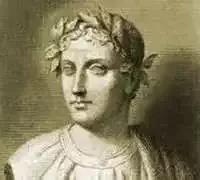
Horácio
BkIII:XV Too Old
O, dear wife of poor Ibycus,
put an end to your wickedness, at last, and all
of your infamous goings-on:
now you are nearer the season for dying,
stop playing about with the girls,
and scattering a mist over shining stars.
What fits Pholoe is not quite
fitting for you, Chloris: while your daughter’s more
suited to storming the houses of lovers,
like a Bacchante stirred by the beating drum.
Her love for Nothus forces her
to gambol like a lascivious she-goat:
the wool that’s shorn near to noble
Luceria’s fitting for you, sad old thing,
not the dark red flower of the rose,
nor the lyre, nor the wine-jars drained to their dregs
274

D.H. Lawrence
The Ship of Death
I
Now it is autumn and the falling fruit
and the long journey towards oblivion.
The apples falling like great drops of dew
to bruise themselves an exit from themselves.
And it is time to go, to bid farewell
to one's own self, and find an exit
from the fallen self.
II
Have you built your ship of death, O have you?
O build your ship of death, for you will need it.
The grim frost is at hand, when the apples will fall
thick, almost thundrous, on the hardened earth.
And death is on the air like a smell of ashes!
Ah! can't you smell it?
And in the bruised body, the frightened soul
finds itself shrinking, wincing from the cold
that blows upon it through the orifices.
III
And can a man his own quietus make
with a bare bodkin?
With daggers, bodkins, bullets, man can make
a bruise or break of exit for his life;
but is that a quietus, O tell me, is it quietus?
Surely not so! for how could murder, even self-murder
ever a quietus make?
IV
O let us talk of quiet that we know,
that we can know, the deep and lovely quiet
of a strong heart at peace!
How can we this, our own quietus, make?
V
Build then the ship of death, for you must take
the longest journey, to oblivion.
And die the death, the long and painful death
that lies between the old self and the new.
Already our bodies are fallen, bruised, badly bruised,
already our souls are oozing through the exit
of the cruel bruise.
Already the dark and endless ocean of the end
is washing in through the breaches of our wounds,
Already the flood is upon us.
Oh build your ship of death, your little ark
and furnish it with food, with little cakes, and wine
for the dark flight down oblivion.
VI
Piecemeal the body dies, and the timid soul
has her footing washed away, as the dark flood rises.
We are dying, we are dying, we are all of us dying
and nothing will stay the death-flood rising within us
and soon it will rise on the world, on the outside world.
We are dying, we are dying, piecemeal our bodies are dying
and our strength leaves us,
and our soul cowers naked in the dark rain over the flood,
cowering in the last branches of the tree of our life.
VII
We are dying, we are dying, so all we can do
is now to be willing to die, and to build the ship
of death to carry the soul on the longest journey.
A little ship, with oars and food
and little dishes, and all accoutrements
fitting and ready for the departing soul.
Now launch the small ship, now as the body dies
and life departs, launch out, the fragile soul
in the fragile ship of courage, the ark of faith
with its store of food and little cooking pans
and change of clothes,
upon the flood's black waste
upon the waters of the end
upon the sea of death, where still we sail
darkly, for we cannot steer, and have no port.
There is no port, there is nowhere to go
only the deepening blackness darkening still
blacker upon the soundless, ungurgling flood
darkness at one with darkness, up and down
and sideways utterly dark, so there is no direction any more
and the little ship is there; yet she is gone.
She is not seen, for there is nothing to see her by.
She is gone! gone! and yet
somewhere she is there.
Nowhere!
VIII
And everything is gone, the body is gone
completely under, gone, entirely gone.
The upper darkness is heavy as the lower,
between them the little ship
is gone
It is the end, it is oblivion.
IX
And yet out of eternity a thread
separates itself on the blackness,
a horizontal thread
that fumes a little with pallor upon the dark.
Is it illusion? or does the pallor fume
A little higher?
Ah wait, wait, for there's the dawn
the cruel dawn of coming back to life
out of oblivion
Wait, wait, the little ship
drifting, beneath the deathly ashy grey
of a flood-dawn.
Wait, wait! even so, a flush of yellow
and strangely, O chilled wan soul, a flush of rose.
A flush of rose, and the whole thing starts again.
X
The flood subsides, and the body, like a worn sea-shell
emerges strange and lovely.
And the little ship wings home, faltering and lapsing
on the pink flood,
and the frail soul steps out, into the house again
filling the heart with peace.
Swings the heart renewed with peace
even of oblivion.
Oh build your ship of death. Oh build it!
for you will need it.
For the voyage of oblivion awaits you.
272
Emily Dickinson
Adrift! A little boat adrift!
Adrift! A little boat adrift!
And night is coming down!
Will no one guide a little boat
Unto the nearest town?
So Sailors say-on yesterday-
Just as the dusk was brown
One little boat gave up its strife
And gurgled down and down.
So angels say-on yesterday-
Just as the dawn was red
One little boat-o'erspent with gales-
Retrimmed its masts-redecked its sails-
And shot-exultant on!
271

George Herbert
The Affliction (I)
When first thou didst entice to thee my heart,
I thought the service brave;
So many joys I writ down for my part,
Besides what I might have
Out of my stock of natural delights,
Augmented with thy gracious benefits.
I looked on thy furniture so fine,
And made it fine to me;
Thy glorious household-stuff did me entwine,
And 'tice me unto thee.
Such stars I counted mine: both heav'n and earth;
Paid me my wages in a world of mirth.
What pleasures could I want, whose King I serv'd,
Where joys my fellows were?
Thus argu'd into hopes, my thoughts reserv'd
No place for grief or fear.
Therefore my sudden soul caught at the place,
And made her youth and fierceness seek thy face.
At first thou gav'st me milk and sweetnesses;
I had my wish and way;
My days were straw'd with flow'rs and happiness;
There was no month but May.
But with my years sorrow did twist and grow,
And made a party unawares for woe.
My flesh began unto my soul in pain,
"Sicknesses cleave my bones;
Consuming agues dwell in ev'ry vein,
And tune my breath to groans."
Sorrow was all my soul; I scarce believ'd,
Till grief did tell me roundly, that I liv'd.
When I got health, thou took'st away my life,
And more, for my friends die;
My mirth and edge was lost, a blunted knife
Was of more use than I.
Thus thin and lean without a fence or friend,
I was blown through with ev'ry storm and wind.
Whereas my birth and spirit rather took
The way that takes the town;
Thou didst betray me to a ling'ring book,
And wrap me in a gown.
I was entangled in the world of strife,
Before I had the power to change my life.
Yet, for I threaten'd oft the siege to raise,
Not simp'ring all mine age,
Thou often didst with academic praise
Melt and dissolve my rage.
I took thy sweet'ned pill, till I came where
I could not go away, nor persevere.
Yet lest perchance I should too happy be
In my unhappiness,
Turning my purge to food, thou throwest me
Into more sicknesses.
Thus doth thy power cross-bias me, not making
Thine own gift good, yet me from my ways taking.
Now I am here, what thou wilt do with me
None of my books will show;
I read, and sigh, and wish I were a tree,
For sure then I should grow
To fruit or shade: at least some bird would trust
Her household to me, and I should be just.
Yet, though thou troublest me, I must be meek;
In weakness must be stout;
Well, I will change the service, and go seek
Some other master out.
Ah my dear God! though I am clean forgot,
Let me not love thee, if I love thee not.
270
Emily Dickinson
As imperceptibly as Grief
As imperceptibly as Grief
The Summer lapsed away-
Too imperceptible at last
To seem like Perfidy-
A Quietness distilled
As Twilight long begun,
Or Nature spending with herself
Sequestered Afternoon-
The Dusk drew earlier in-
The Morning foreign shone-
A courteous, yet harrowing Grace,
As Guest, that would be gone-
And thus, without a Wing
Or service of a Keel
Our Summer made her light escape
Into the Beautiful.
269
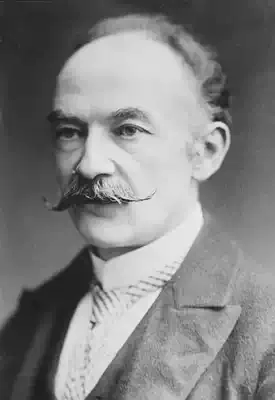
Thomas Hardy
Song of Hope
O sweet To-morrow! -
After to-day
There will away
This sense of sorrow.
Then let us borrow
Hope, for a gleaming
Soon will be streaming,
Dimmed by no gray -
No gray!
While the winds wing us
Sighs from The Gone,
Nearer to dawn
Minute-beats bring us;
When there will sing us
Larks of a glory
Waiting our story
Further anon -
Anon!
Doff the black token,
Don the red shoon,
Right and retune
Viol-strings broken;
Null the words spoken
In speeches of rueing,
The night cloud is hueing,
To-morrow shines soon -
Shines soon!
270
Emily Dickinson
Crumbling is not an instant's Act
Crumbling is not an instant's Act
A fundamental pause
Dilapidation's processes
Are organized Decays.
'Tis first a Cobweb on the Soul
A Cuticle of Dust
A Borer in the Axis
An Elemental Rust-
Ruin is formal-Devil's work
Consecutive and slow-
Fail in an instant, no man did
Slipping-is Crash's law.
A fundamental pause
Dilapidation's processes
Are organized Decays.
'Tis first a Cobweb on the Soul
A Cuticle of Dust
A Borer in the Axis
An Elemental Rust-
Ruin is formal-Devil's work
Consecutive and slow-
Fail in an instant, no man did
Slipping-is Crash's law.
269
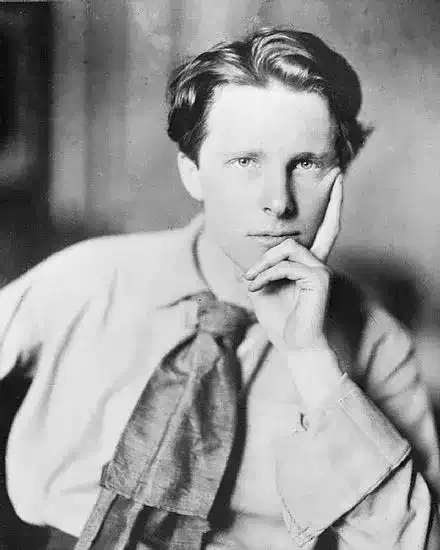
Rupert Brooke
Mary and Gabriel
Young Mary, loitering once her garden way,
Felt a warm splendour grow in the April day,
As wine that blushes water through. And soon,
Out of the gold air of the afternoon,
One knelt before her: hair he had, or fire,
Bound back above his ears with golden wire,
Baring the eager marble of his face.
Not man's nor woman's was the immortal grace
Rounding the limbs beneath that robe of white,
And lighting the proud eyes with changeless light,
Incurious. Calm as his wings, and fair,
That presence filled the garden.
She stood there,
Saying, "What would you, Sir?"
He told his word,
"Blessed art thou of women!" Half she heard,
Hands folded and face bowed, half long had known,
The message of that clear and holy tone,
That fluttered hot sweet sobs about her heart;
Such serene tidings moved such human smart.
Her breath came quick as little flakes of snow.
Her hands crept up her breast. She did but know
It was not hers. She felt a trembling stir
Within her body, a will too strong for her
That held and filled and mastered all. With eyes
Closed, and a thousand soft short broken sighs,
She gave submission; fearful, meek, and glad. . . .
She wished to speak. Under her breasts she had
Such multitudinous burnings, to and fro,
And throbs not understood; she did not know
If they were hurt or joy for her; but only
That she was grown strange to herself, half lonely,
All wonderful, filled full of pains to come
And thoughts she dare not think, swift thoughts and dumb,
Human, and quaint, her own, yet very far,
Divine, dear, terrible, familiar . . .
Her heart was faint for telling; to relate
Her limbs' sweet treachery, her strange high estate,
Over and over, whispering, half revealing,
Weeping; and so find kindness to her healing.
'Twixt tears and laughter, panic hurrying her,
She raised her eyes to that fair messenger.
He knelt unmoved, immortal; with his eyes
Gazing beyond her, calm to the calm skies;
Radiant, untroubled in his wisdom, kind.
His sheaf of lilies stirred not in the wind.
How should she, pitiful with mortality,
Try the wide peace of that felicity
With ripples of her perplexed shaken heart,
And hints of human ecstasy, human smart,
And whispers of the lonely weight she bore,
And how her womb within was hers no more
And at length hers?
Being tired, she bowed her head;
And said, "So be it!"
The great wings were spread
Showering glory on the fields, and fire.
The whole air, singing, bore him up, and higher,
Unswerving, unreluctant. Soon he shone
A gold speck in the gold skies; then was gone.
The air was colder, and grey. She stood alone.
268
Thomas Hardy
Transformations
Portion of this yew
Is a man my grandsire knew,
Bosomed here at its foot:
This branch may be his wife,
A ruddy human life
Now turned to a green shoot.
These grasses must be made
Of her who often prayed,
Last century, for repose;
And the fair girl long ago
Whom I often tried to know
May be entering this rose.
So, they are not underground,
But as nerves and veins abound
In the growths of upper air,
And they feel the sun and rain,
And the energy again
That made them what they were!
268
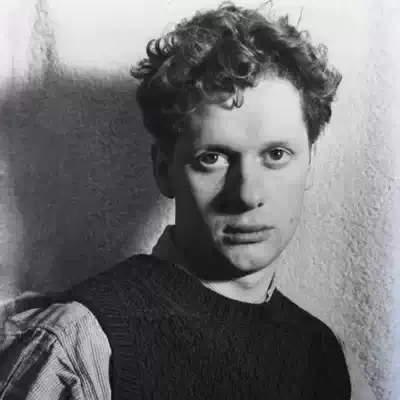
Dylan Thomas
I, In My Intricate Image
I
I, in my intricate image, stride on two levels,
Forged in man's minerals, the brassy orator
Laying my ghost in metal,
The scales of this twin world tread on the double,
My half ghost in armour hold hard in death's corridor,
To my man-iron sidle.
Beginning with doom in the bulb, the spring unravels,
Bright as her spinning-wheels, the colic season
Worked on a world of petals;
She threads off the sap and needles, blood and bubble
Casts to the pine roots, raising man like a mountain
Out of the naked entrail.
Beginning with doom in the ghost, and the springing marvels,
Image of images, my metal phantom
Forcing forth through the harebell,
My man of leaves and the bronze root, mortal, unmortal,
I, in my fusion of rose and male motion,
Create this twin miracle.
This is the fortune of manhood: the natural peril,
A steeplejack tower, bonerailed and masterless,
No death more natural;
Thus the shadowless man or ox, and the pictured devil,
In seizure of silence commit the dead nuisance.
The natural parallel.
My images stalk the trees and the slant sap's tunnel,
No tread more perilous, the green steps and spire
Mount on man's footfall,
I with the wooden insect in the tree of nettles,
In the glass bed of grapes with snail and flower,
Hearing the weather fall.
Intricate manhood of ending, the invalid rivals,
Voyaging clockwise off the symboled harbour,
Finding the water final,
On the consumptives' terrace taking their two farewells,
Sail on the level, the departing adventure,
To the sea-blown arrival.
II
They climb the country pinnacle,
Twelve winds encounter by the white host at pasture,
Corner the mounted meadows in the hill corral;
They see the squirrel stumble,
The haring snail go giddily round the flower,
A quarrel of weathers and trees in the windy spiral.
As they dive, the dust settles,
The cadaverous gravels, falls thick and steadily,
The highroad of water where the seabear and mackerel
Turn the long sea arterial
Turning a petrol face blind to the enemy
Turning the riderless dead by the channel wall.
(Death instrumental,
Splitting the long eye open, and the spiral turnkey,
Your corkscrew grave centred in navel and nipple,
The neck of the nostril,
Under the mask and the ether, they making bloody
The tray of knives, the antiseptic funeral;
Bring out the black patrol,
Your monstrous officers and the decaying army,
The sexton sentinel, garrisoned under thistles,
A cock-on-a-dunghill
Crowing to Lazarus the morning is vanity,
Dust be your saviour under the conjured soil.)
As they drown, the chime travels,
Sweetly the diver's bell in the steeple of spindrift
Rings out the Dead Sea scale;
And, clapped in water till the triton dangles,
Strung by the flaxen whale-weed, from the hangman's raft,
Hear they the salt glass breakers and the tongues of burial.
(Turn the sea-spindle lateral,
The grooved land rotating, that the stylus of lightning
Dazzle this face of voices on the moon-turned table,
Let the wax disk babble
Shames and the damp dishonours, the relic scraping.
These are your years' recorders. The circular world stands still.)
III
They suffer the undead water where the turtle nibbles,
Come unto sea-stuck towers, at the fibre scaling,
The flight of the carnal skull
And the cell-stepped thimble;
Suffer, my topsy-turvies, that a double angel
Sprout from the stony lockers like a tree on Aran.
Be by your one ghost pierced, his pointed ferrule,
Brass and the bodiless image, on a stick of folly
Star-set at Jacob's angle,
Smoke hill and hophead's valley,
And the five-fathomed Hamlet on his father's coral
Thrusting the tom-thumb vision up the iron mile.
Suffer the slash of vision by the fin-green stubble,
Be by the ships' sea broken at the manstring anchored
The stoved bones' voyage downward
In the shipwreck of muscle;
Give over, lovers, locking, and the seawax struggle,
Love like a mist or fire through the bed of eels.
And in the pincers of the boiling circle,
The sea and instrument, nicked in the locks of time,
My great blood's iron single
In the pouring town,
I, in a wind on fire, from green Adam's cradle,
No man more magical, clawed out the crocodile.
Man was the scales, the death birds on enamel,
Tail, Nile, and snout, a saddler of the rushes,
Time in the hourless houses
Shaking the sea-hatched skull,
And, as for oils and ointments on the flying grail,
All-hollowed man wept for his white apparel.
Man was Cadaver's masker, the harnessing mantle,
Windily master of man was the rotten fathom,
My ghost in his metal neptune
Forged in man's mineral.
This was the god of beginning in the intricate seawhirl,
And my images roared and rose on heaven's hill.
265

Robert W. Service
No More Music
The Porch was blazoned with geranium bloom;
Myrtle and jasmine meadows lit the lea;
With rose and violet the vale's perfume
Languished to where the hyacinthine sea
Dreamed tenderly . . . "And I must go," said he.
He spoke in that dim, ghostly voice of his:
"I was a singer; then the Was . . . and GAS."
(I had to lean to him, no word to miss.)
"We bought this little café nigh to Grasse;
With sun and flowers my last few days will pass.
"And music too. I have my mandolin:
Say! Maybe you can strum on your guitar . . .
Come on - we two will make melodious din,
While Madame sings to us behind the bar:
You'll see how sweet Italian folk-songs are."
So he would play and I would thrum the while;
I used to there every lovely day;
His wife would listen with a sunny smile,
And when I left: "Please come again," she'd say.
"He seems quite sad when you have one away."
Alas! I had to leave without good-bye,
And lived in sooty cities for ayear.
Oh, how my heart ached for that happy sky!
Then, then one day my café I drew near -
God! it was strange how I was gripped with fear.
So still it was; I saw no mandolin,
No gay guitar with ribbons blue and red;
Then all in black, stone-faced the wife came in . . .
I did not ask; I looked, she shook her head:
"La musique est fini," was all she said.
263
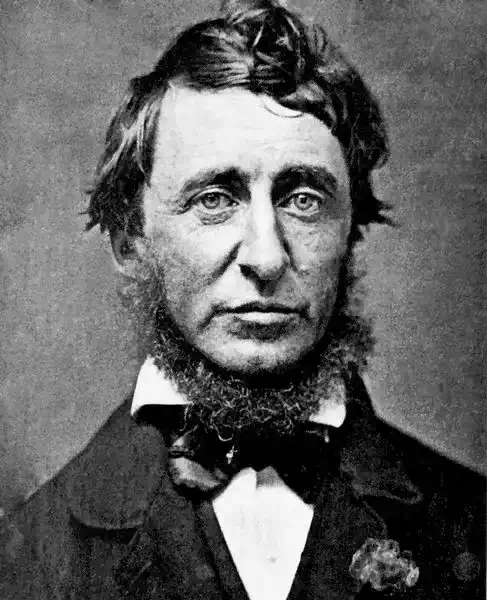
Henry David Thoreau
To a Marsh Hawk in Spring
There is health in thy gray wing,
Health of nature’s furnishing.
Say, thou modern-winged antique,
Was thy mistress ever sick?
In each heaving of thy wing
Thou dost health and leisure bring,
Thou dost waive disease and pain
And resume new life again.
Health of nature’s furnishing.
Say, thou modern-winged antique,
Was thy mistress ever sick?
In each heaving of thy wing
Thou dost health and leisure bring,
Thou dost waive disease and pain
And resume new life again.
262
Emily Dickinson
The Fingers of the Light
The Fingers of the Light
Tapped soft upon the Town
With "I am great and cannot wait
So therefore let me in."
"You're soon," the Town replied,
"My Faces are asleep-
But swear, and I will let you by,
You will not wake them up."
The easy Guest complied
But once within the Town
The transport of His Countenance
Awakened Maid and Man
The Neighbor in the Pool
Upon His Hip elate
Made loud obeisance and the Gnat
Held up His Cup for Light.
262
Dylan Thomas
From Love's First Fever to Her Plague
From love's first fever to her plague, from the soft second
And to the hollow minute of the womb,
From the unfolding to the scissored caul,
The time for breast and the green apron age
When no mouth stirred about the hanging famine,
All world was one, one windy nothing,
My world was christened in a stream of milk.
And earth and sky were as one airy hill.
The sun and mood shed one white light.
From the first print of the unshodden foot, the lifting
Hand, the breaking of the hair,
From the first scent of the heart, the warning ghost,
And to the first dumb wonder at the flesh,
The sun was red, the moon was grey,
The earth and sky were as two mountains meeting.
The body prospered, teeth in the marrowed gums,
The growing bones, the rumour of the manseed
Within the hallowed gland, blood blessed the heart,
And the four winds, that had long blown as one,
Shone in my ears the light of sound,
Called in my eyes the sound of light.
And yellow was the multiplying sand,
Each golden grain spat life into its fellow,
Green was the singing house.
The plum my mother picked matured slowly,
The boy she dropped from darkness at her side
Into the sided lap of light grew strong,
Was muscled, matted, wise to the crying thigh,
And to the voice that, like a voice of hunger,
Itched in the noise of wind and sun.
And from the first declension of the flesh
I learnt man's tongue, to twist the shapes of thoughts
Into the stony idiom of the brain,
To shade and knit anew the patch of words
Left by the dead who, in their moonless acre,
Need no word's warmth.
The root of tongues ends in a spentout cancer,
That but a name, where maggots have their X.
I learnt the verbs of will, and had my secret;
The code of night tapped on my tongue;
What had been one was many sounding minded.
One wound, one mind, spewed out the matter,
One breast gave suck the fever's issue;
From the divorcing sky I learnt the double,
The two-framed globe that spun into a score;
A million minds gave suck to such a bud
As forks my eye;
Youth did condense; the tears of spring
Dissolved in summer and the hundred seasons;
One sun, one manna, warmed and fed.
256
Thomas Hardy
The Sleep-Worker
When wilt thou wake, O Mother, wake and see -
As one who, held in trance, has laboured long
By vacant rote and prepossession strong -
The coils that thou hast wrought unwittingly;
Wherein have place, unrealized by thee,
Fair growths, foul cankers, right enmeshed with wrong,
Strange orchestras of victim-shriek and song,
And curious blends of ache and ecstasy? -
Should that morn come, and show thy opened eyes
All that Life's palpitating tissues feel,
How wilt thou bear thyself in thy surprise? -
Wilt thou destroy, in one wild shock of shame,
Thy whole high heaving firmamental frame,
Or patiently adjust, amend, and heal?
257
Emily Dickinson
The Sun—just touched the Morning
The Sun—just touched the Morning—
The Morning—Happy thing—
Supposed that He had come to dwell—
And Life would all be Spring!
She felt herself supremer—
A Raised—Ethereal Thing!
Henceforth—for Her—What Holiday!
Meanwhile—Her wheeling King—
Trailed—slow—along the Orchards—
His haughty—spangled Hems—
Leaving a new necessity!
The want of Diadems!
The Morning—fluttered—staggered—
Felt feebly—for Her Crown—
Her unanointed forehead—
Henceforth—Her only One!
253

Anaïs Nin
Risk
And then the day came,
when the risk
to remain tight
in a bud
was more painful
than the risk
it took
to Blossom.
when the risk
to remain tight
in a bud
was more painful
than the risk
it took
to Blossom.
254
Henry David Thoreau
Sic Vita
I am a parcel of vain strivings tied
By a chance bond together,
Dangling this way and that, their links
Were made so loose and wide,
Methinks,
For milder weather.
A bunch of violets without their roots,
And sorrel intermixed,
Encircled by a wisp of straw
Once coiled about their shoots,
The law
By which I'm fixed.
A nosegay which Time clutched from out
Those fair Elysian fields,
With weeds and broken stems, in haste,
Doth make the rabble rout
That waste
The day he yields.
And here I bloom for a short hour unseen,
Drinking my juices up,
With no root in the land
To keep my branches green,
But stand
In a bare cup.
Some tender buds were left upon my stem
In mimicry of life,
But ah! the children will not know,
Till time has withered them,
The woe
With which they're rife.
But now I see I was not plucked for naught,
And after in life's vase
Of glass set while I might survive,
But by a kind hand brought
Alive
To a strange place.
That stock thus thinned will soon redeem its hours,
And by another year,
Such as God knows, with freer air,
More fruits and fairer flowers
Will bear,
While I droop here.
251
Thomas Hardy
The Sick God
I
In days when men had joy of war,
A God of Battles sped each mortal jar;
The peoples pledged him heart and hand,
From Israel's land to isles afar.
II
His crimson form, with clang and chime,
Flashed on each murk and murderous meeting-time,
And kings invoked, for rape and raid,
His fearsome aid in rune and rhyme.
III
On bruise and blood-hole, scar and seam,
On blade and bolt, he flung his fulgid beam:
His haloes rayed the very gore,
And corpses wore his glory-gleam.
IV
Often an early King or Queen,
And storied hero onward, knew his sheen;
'Twas glimpsed by Wolfe, by Ney anon,
And Nelson on his blue demesne.
V
But new light spread. That god's gold nimb
And blazon have waned dimmer and more dim;
Even his flushed form begins to fade,
Till but a shade is left of him.
VI
That modern meditation broke
His spell, that penmen's pleadings dealt a stroke,
Say some; and some that crimes too dire
Did much to mire his crimson cloak.
VII
Yea, seeds of crescive sympathy
Were sown by those more excellent than he,
Long known, though long contemned till then -
The gods of men in amity.
VIII
Souls have grown seers, and thought out-brings
The mournful many-sidedness of things
With foes as friends, enfeebling ires
And fury-fires by gaingivings!
IX
He scarce impassions champions now;
They do and dare, but tensely--pale of brow;
And would they fain uplift the arm
Of that faint form they know not how.
X
Yet wars arise, though zest grows cold;
Wherefore, at whiles, as 'twere in ancient mould
He looms, bepatched with paint and lath;
But never hath he seemed the old!
XI
Let men rejoice, let men deplore.
The lurid Deity of heretofore
Succumbs to one of saner nod;
The Battle-god is god no more.
252
Emily Dickinson
The Sun kept setting—setting—still
The Sun kept setting—setting—still
No Hue of Afternoon—
Upon the Village I perceived
From House to House 'twas Noon—
The Dusk kept dropping—dropping—still
No Dew upon the Grass—
But only on my Forehead stopped—
And wandered in my Face—
My Feet kept drowsing—drowsing—still
My fingers were awake—
Yet why so little sound—Myself
Unto my Seeming—make?
How well I knew the Light before—
I could see it now—
'Tis Dying—I am doing—but
I'm not afraid to know—
248
Henry David Thoreau
I am the Autumnal Sun
Sometimes a mortal feels in himself Nature
-- not his Father but his Mother stirs
within him, and he becomes immortal with her
immortality. From time to time she claims
kindredship with us, and some globule
from her veins steals up into our own.
I am the autumnal sun,
With autumn gales my race is run;
When will the hazel put forth its flowers,
Or the grape ripen under my bowers?
When will the harvest or the hunter's moon
Turn my midnight into mid-noon?
I am all sere and yellow,
And to my core mellow.
The mast is dropping within my woods,
The winter is lurking within my moods,
And the rustling of the withered leaf
Is the constant music of my grief...
244
George Herbert
Joseph's Coat
Wounded I sing, tormented I indite,
Thrown down I fall into a bed, and rest:
Sorrow hath chang'd its note: such is his will
Who changeth all things, as him pleaseth best.
For well he knows, if but one grief and smart
Among my many had his full career,
Sure it would carry with it ev'n my heart,
And both would run until they found a bier
To fetch the body; both being due to grief.
But he hath spoil'd the race; and giv'n to anguish
One of Joy's coats, 'ticing it with relief
To linger in me, and together languish.
I live to shew his power, who once did bring
My joys to weep, and now my griefs to sing.
244