
Nostalgia

Emily Dickinson
Away from Home are some and I—
Away from Home are some and I—
An Emigrant to be
In a Metropolis of Homes
Is easy, possibly—
The Habit of a Foreign Sky
We—difficult—acquire
As Children, who remain in Face
The more their Feet retire.
An Emigrant to be
In a Metropolis of Homes
Is easy, possibly—
The Habit of a Foreign Sky
We—difficult—acquire
As Children, who remain in Face
The more their Feet retire.
207

Robert W. Service
Old David Smail
He dreamed away his hours in school;
He sat with such an absent air,
The master reckoned him a fool,
And gave him up in dull despair.
When other lads were making hay
You'd find him loafing by the stream;
He'd take a book and slip away,
And just pretend to fish . . . and dream.
His brothers passed him in the race;
They climbed the hill and clutched the prize.
He did not seem to heed, his face
Was tranquil as the evening skies.
He lived apart, he spoke with few;
Abstractedly through life he went;
Oh, what he dreamed of no one knew,
And yet he seemed to be content.
I see him now, so old and gray,
His eyes with inward vision dim;
And though he faltered on the way,
Somehow I almost envied him.
At last beside his bed I stood:
"And is Life done so soon?" he sighed;
"It's been so rich, so full, so good,
I've loved it all . . ." -- and so he died.
205
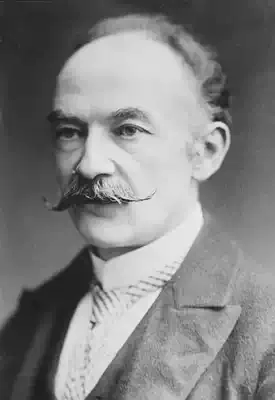
Thomas Hardy
The Ghost of the Past
We two kept house, the Past and I,
The Past and I;
I tended while it hovered nigh,
Leaving me never alone.
It was a spectral housekeeping
Where fell no jarring tone,
As strange, as still a housekeeping
As ever has been known.
As daily I went up the stair,
And down the stair,
I did not mind the Bygone there --
The Present once to me;
Its moving meek companionship
I wished might ever be,
There was in that companionship
Something of ecstasy.
It dwelt with me just as it was,
Just as it was
When first its prospects gave me pause
In wayward wanderings,
Before the years had torn old troths
As they tear all sweet things,
Before gaunt griefs had torn old troths
And dulled old rapturings.
And then its form began to fade,
Began to fade,
Its gentle echoes faintlier played
At eves upon my ear
Than when the autumn's look embrowned
The lonely chambers here,
The autumn's settling shades embrowned
Nooks that it haunted near.
And so with time my vision less,
Yea, less and less
Makes of that Past my housemistress,
It dwindles in my eye;
It looms a far-off skeleton
And not a comrade nigh,
A fitful far-off skeleton
Dimming as days draw by.
207
Thomas Hardy
To Flowers From Italy in Winter
Sunned in the South, and here to-day;
--If all organic things
Be sentient, Flowers, as some men say,
What are your ponderings?
How can you stay, nor vanish quite
From this bleak spot of thorn,
And birch, and fir, and frozen white
Expanse of the forlorn?
Frail luckless exiles hither brought!
Your dust will not regain
Old sunny haunts of Classic thought
When you shall waste and wane;
But mix with alien earth, be lit
With frigid Boreal flame,
And not a sign remain in it
To tell men whence you came.
206
Robert W. Service
Birds Of A Feather
Of bosom friends I've had but seven,
Despite my years are ripe;
I hope they're now enjoying Heaven,
Although they're not the type;
Nor, candidly, no more am I,
Though overdue to die.
For looking back I see that they
Were weak and wasteful men;
They loved a sultry jest alway,
And women now and then.
They smoked and gambled, soused and swore,
--Yet no one was a bore.
'Tis strange I took to lads like these,
On whom the good should frown;
Yet all with poetry would please
To wash his wassail down;
Their temples touched the starry way,
But O what feet of clay!
Well, all are dust, of fame bereft;
They bore a cruel cross,
And I, the canny one, am left,-Yet
as I grieve their loss,
I deem, because they loved me well,
They'll welcome me in Hell.
205
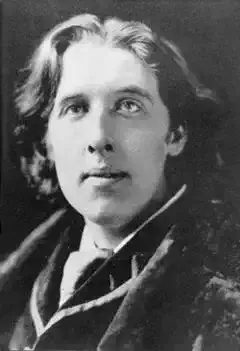
Oscar Wilde
Phedre
(To Sarah Bernhardt)
How vain and dull this common world must seem
To such a One as thou, who should'st have talked
At Florence with Mirandola, or walked
Through the cool olives of the Academe:
Thou should'st have gathered reeds from a green stream
For Goat-foot Pan's shrill piping, and have played
With the white girls in that Phaeacian glade
Where grave Odysseus wakened from his dream.
Ah! surely once some urn of Attic clay
Held thy wan dust, and thou hast come again
Back to this common world so dull and vain,
For thou wert weary of the sunless day,
The heavy fields of scentless asphodel,
The loveless lips with which men kiss in Hell.
207
Robert W. Service
The Trapper's Christmas Eve
It's mighty lonesome-like and drear.
Above the Wild the moon rides high,
And shows up sharp and needle-clear
The emptiness of earth and sky;
No happy homes with love a-glow;
No Santa Claus to make believe:
Just snow and snow, and then more snow;
It's Christmas Eve, it's Christmas Eve.
And here am I where all things end,
And Undesirables are hurled;
A poor old man without a friend,
Forgot and dead to all the world;
Clean out of sight and out of mind . . .
Well, maybe it is better so;
We all in life our level find,
And mine, I guess, is pretty low.
Yet as I sit with pipe alight
Beside the cabin-fir
take to-night
The backward trail of fifty year.
The school-house and the Christmas tree;
The children with their cheeks a-glow;
Two bright blue eyes that smile on me . . .
Just half a century ago.
Again (it's maybe forty years),
With faith and trust almost divine,
These same blue eyes, abrim with tears,
Through depths of love look into mine.
A parting, tender, soft and low,
With arms that cling and lips that cleave . . .
Ah me! it's all so long ago,
Yet seems so sweet this Christmas Eve.
Just thirty years ago, again . . .
We say a bitter, last good-bye;
Our lips are white with wrath and pain;
Our little children cling and cry.
Whose was the fault? it matters not,
For man and woman both deceive;
It's buried now and all forgot,
Forgiven, too, this Christmas Eve.
And she (God pity me) is dead;
Our children men and women grown.
I like to think that they are wed,
With little children of their own,
That crowd around their Christmas tree . . .
I would not ever have them grieve,
Or shed a single tear for me,
To mar their joy this Christmas Eve.
Stripped to the buff and gaunt and still
Lies all the land in grim distress.
Like lost soul wailing, long and shrill,
A wolf-howl cleaves the emptiness.
Then hushed as Death is everything.
The moon rides haggard and forlorn . . .
"O hark the herald angels sing!"
God bless all men -- it's Christmas morn.
205
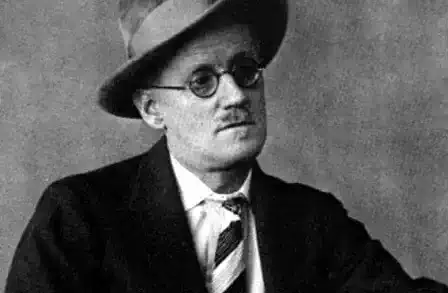
James Joyce
The Twilight Turns
The twilight turns from amethyst
To deep and deeper blue,
The lamp fills with a pale green glow
The trees of the avenue.
The old piano plays an air,
Sedate and slow and gay;
She bends upon the yellow keys,
Her head inclines this way.
Shy thought and grave wide eyes and hands
That wander as they list -- -
The twilight turns to darker blue
With lights of amethyst.
201

Henry Lawson
He Mourned His Master
INTRODUCTION
The theme is ancient as the hills,
With all their prehistoric glory;
But yet of Corney and his friend,
We’ve often longed to tell the story;
And should we jar the reader’s ear,
Or fail to please his eye observant,
We only trust that he’ll forgive
The bush muse and—your humble servant.
THE STORY
Old Corney built in Deadman’s Gap
A hut, where mountain shades grow denser,
And there he lived for many years,
A timber-getter and a fencer.
And no one knew if he’d a soul
Above long sprees, or split-rail fences,
Unless, indeed, it was his friend,
Who always kept his confidences.
There was a saw-pit in the range;
’Twas owned by three, and they were brothers,
And visitors to Corney’s hut—
’Twas seldom visited by others.
They came because, as they averred,
“Old Corney licked—a gent infernal.”
“His yarns,” if I might trust their word,
“Would made the fortune of a journal.”
In short, the splitter was a “cure”,
Who brightened up their lives’ dull courses;
And so on Sunday afternoons,
At Corney’s hut they’d hang their horses.
They’d have a game of cards and smoke,
And sometimes sing, which was a rum thing—
Unless, in spite of legal folk,
The splitter kept a “drop of something”.
If, as ’twas said, he was “a swell”
Before he sought these sombre ranges,
’Twixt mother’s arms and coffin gear
He must have seen a world of changes.
But from his lips would never fall
A hint of home, or friends, or brothers;
And if he told his tale at all,
He must have told it as another’s.
Though he was good at telling yarns,
At listening he excelled not less so,
And greatly helped the bushman’s tales
With “yes”, “exactly so”, or “jes’ so”.
In short, the hut became a club
Like our Assembly Legislative,
Combining smokeroom, hall, and “pub”,
Political and recreative.
Old Corney lived and Corney died,
As we will, too, on some to-morrow,
But not as Corney died, we hope,
Of heart disease, and rum, and sorrow.
(We hope to lead a married life,
At times the cup of comfort quaffing;
And when we leave this world of strife
We trust that we may die of laughing.)
One New Year’s Eve they found him dead—
For rum had made his life unstable—
They found him stretched upon his bed,
And also found, upon the table,
The coloured portrait of a girl—
Blue eyes of course. The hair was golden,
A faded letter and a curl,
And—well, we said the theme was olden.
The splitter had for days been dead
And cold before the sawyers found him,
And none had witnessed how he died
Except the friend who whimpered round him;
A noble friend, and of a kind
Who stay when other friends forsake us;
And he at last was left behind
To greet the rough bush undertakers.
This was a season when the bush
Was somewhat ruled by time and distance,
And bushmen came and tried the world,
And “gave it best” without assistance.
Then one might die of heart disease,
And still be spared the inquest horrors.
And when the splitter lay at ease,
So, also, did his sins and sorrows.
“Ole Corey’s dead,” the bushmen said;
“He’s gone at last, an’ ne’er a blunder.”
And so they brought a horse and dray,
And tools to “tuck the old cove under.”
The funeral wended through the range,
And slowly round its rugged corners;
The reader will not think it strange
That Corney’s friend was chief of mourners.
He must have thought the bushmen hard,
And of his misery unheeding,
Because they shunned his anxious eyes,
That seemed for explanation pleading.
At intervals his tongue would wipe
The jaws that seemed with anguish quaking;
As some strong hand impatiently
Might chide the tears for prison breaking.
They reached by rugged ways at last,
A desolate bush cemetery,
Where now (our tale is of the past),
A thriving town its dead doth bury.
And where the bones of pioneers
Are found and thrown aside unheeded—
For later sleepers, blessed with tears
Of many friends, the graves are needed.
The funeral reached the bushmen’s graves,
Where these old pioneers were sleeping,
And now while down the granite ridge
The shadow of the peak was creeping,
They dug a grave beneath a gum
And lowered the dead as gently may be
As Corney’s mother long before
Had laid him down to “hush-a-baby”.
A bushman read the words to which
The others reverently listened,
Some bearded lips were seen to twitch,
Some shaded eyes with moisture glistened.
Perhaps this weakness was because
Their work reminded them in sorrow
Of other burials long ago,
When friends “turned in to wait the morrow.”
The boys had brought the splitter’s tools,
And now they split and put together
Four panels such as Corney made,
To stand the stress of western weather.
Perhaps this second weakness rose,
From some good reason undetected;
They may have thought of other graves
Of dearer friends they left neglected.
“Old Corney’s dead, he paid his bills”
(These words upon the tree were graven)
“And oft a swagman down in luck,
At Corey’s mansion found a haven.”
If this an explanation needs,
We greatly fear we can’t afford it;
Unless they thought of other dead,
Whose virtues they had not recorded.
The day had crossed the homeward track,
And as the bushmen turned to tread it,
They thought and spoke of many things,
Remembered now to Corney’s credit;
And strange to say, above their heads
The kookaburra burst with laughter.
(Perhaps he thought of other friends
Whose virtues they remembered—after.)
But now the bushmen hurried on
Lest darkness in the range should find them;
And strange to say they never saw
That Corney’s friend had stayed behind them.
If one had thrown a backward glance
Along the rugged path they wended,
He might have seen a darker form
Upon the damp cold mound extended.
But soon their forms had vanished all,
And night came down the ranges faster,
And no one saw the shadows fall
Upon the dog that mourned his master.
204
Robert W. Service
Book Lover
I keep collecting books I know
I'll never, never read;
My wife and daughter tell me so,
And yet I never head.
"Please make me," says some wistful tome,
"A wee bit of yourself."
And so I take my treasure home,
And tuck it in a shelf.
And now my very shelves complain;
They jam and over-spill.
They say: "Why don't you ease our strain?"
"some day," I say, "I will."
So book by book they plead and sigh;
I pick and dip and scan;
Then put them back, distrest that I
Am such a busy man.
Now, there's my Boswell and my Sterne,
my Gibbon and Defoe;
To savour Swift I'll never learn,
Montaigne I may not know.
On Bacon I will never sup,
For Shakespeare I've no time;
Because I'm busy making up
These jingly bits of rhyme.
Chekov is caviare to me,
While Stendhal makes me snore;
Poor Proust is not my cup of tea,
And Balzac is a bore.
I have their books, I love their names,
And yet alas! they head,
With Lawrence, Joyce and Henry James,
My Roster of Unread.
I think it would be very well
If I commit a crime,
And get put in a prison cell
And not allowed to rhyme;
Yet given all these worthy books
According to my need,
I now caress with loving looks,
But never, never read.
202
Robert W. Service
Bindle Stiff
When I was brash and gallant-gay
Just fifty years ago,
I hit the ties and beat my way
From Maine to Mexico;
For though to Glasgow gutter bred
A hobo heart had I,
And followed where adventure led,
Beneath a brazen sky.
And as I tramped the railway track
I owned a single shirt;
Like canny Scot I bought it black
So's not to show the dirt;
A handkerchief held all my gear,
My razor and my comb;
I was a freckless lad, I fear,
With all the world for home.
Yet oh I thought the life was grand
And loved my liberty!
Romance was my bed-fellow and
The stars my company.
And I would think, each diamond dawn,
"How I have forged my fate!
Where are the Gorbals and the Tron,
And where the Gallowgate?"
Oh daft was I to wander wild,
And seek the Trouble Trail,
As weakly as a wayward child,
And darkly doomed to fail . . .
Aye, bindle-stiff I hit the track
Just fifty years ago . . .
Yet now . . . I drive my Cadillac
From Maine to Mexico.
201
Robert W. Service
Tim
My brother Tim has children ten,
While I have none.
Maybe that's why he's toiling when
To ease I've won.
But though I would some of his brood
Give hearth and care,
I know that not a one he would
Have heart to spare.
'Tis children that have kept him poor;
He's clad them neat.
They've never wanted, I am sure,
For bite to eat.
And though their future may be dim,
They laugh a lot.
Am I tearful for Brother Tim?
Oh no, I'm not.
I know he goes to work each day
With flagging feet.
'Tis hard, even with decent pay,
To make ends meet.
But when my sterile home I see,
So smugly prim,
Although my banker bows to me,
I envy Tim.
198
Robert W. Service
My Hour
Day after day behold me plying
My pen within an office drear;
The dullest dog, till homeward hieing,
Then lo! I reign a king of cheer.
A throne have I of padded leather,
A little court of kiddies three,
A wife who smiles whate'er the weather,
A feast of muffins, jam and tea.
The table cleared, a romping battle,
A fairy tale, a "Children, bed,"
A kiss, a hug, a hush of prattle
(God save each little drowsy head!)
A cozy chat with wife a-sewing,
A silver lining clouds that low'r,
Then she too goes, and with her going,
I come again into my Hour.
I poke the fire, I snugly settle,
My pipe I prime with proper care;
The water's purring in the kettle,
Rum, lemon, sugar, all are there.
And now the honest grog is steaming,
And now the trusty briar's aglow:
Alas! in smoking, drinking, dreaming,
How sadly swift the moments go!
Oh, golden hour! 'twixt love and duty,
All others I to others give;
But you are mine to yield to Beauty,
To glean Romance, to greatly live.
For in my easy-chair reclining . . .
I feel the sting of ocean spray;
And yonder wondrously are shining
The Magic Isles of Far Away.
Beyond the comber's crashing thunder
Strange beaches flash into my ken;
On jetties heaped head-high with plunder
I dance and dice with sailor-men.
Strange stars swarm down to burn above me,
Strange shadows haunt, strange voices greet;
Strange women lure and laugh and love me,
And fling their bastards at my feet.
Oh, I would wish the wide world over,
In ports of passion and unrest,
To drink and drain, a tarry rover
With dragons tattooed on my chest,
With haunted eyes that hold red glories
Of foaming seas and crashing shores,
With lips that tell the strangest stories
Of sunken ships and gold moidores;
Till sick of storm and strife and slaughter,
Some ghostly night when hides the moon,
I slip into the milk-warm water
And softly swim the stale lagoon.
Then through some jungle python-haunted,
Or plumed morass, or woodland wild,
I win my way with heart undaunted,
And all the wonder of a child.
The pathless plains shall swoon around me,
The forests frown, the floods appall;
The mountains tiptoe to confound me,
The rivers roar to speed my fall.
Wild dooms shall daunt, and dawns be gory,
And Death shall sit beside my knee;
Till after terror, torment, glory,
I win again the sea, the sea. . . .
Oh, anguish sweet! Oh, triumph splendid!
Oh, dreams adieu! my pipe is dead.
My glass is dry, my Hour is ended,
It's time indeed I stole to bed.
How peacefully the house is sleeping!
Ah! why should I strange fortunes plan?
To guard the dear ones in my keeping -That's
task enough for any man.
So through dim seas I'll ne'er go spoiling;
The red Tortugas never roam;
Please God! I'll keep the pot a-boiling,
And make at least a happy home.
My children's path shall gleam with roses,
Their grace abound, their joy increase.
And so my Hour divinely closes
With tender thoughts of praise and peace.
200
Robert W. Service
Old Sweethearts
Oh Maggie, do you mind the day
We went to school together,
And as we stoppit by the way
I rolled you in the heather?
My! but you were the bonny lass
And we were awfu' late for class.
Your locks are now as white as snow,
And you are ripe and wrinkled,
A grandmother ten times or so,
Yet how your blue eyes twinkled
At me above your spectacles,
Recalling naughty neck-tickles!
It must be fifty years today
I left you for the Yukon;
You haven't changed - your just as gay
And just as sweet to look on.
But can you see in this old fool
The lad who made you late for school?
Oh Maggie, ask me in to tea
And we can talk things over,
And contemplate the nuptial state,
For I am still your lover:
And though the bell be slow to chime
We'll no be grudgin' o' the time
200
Robert W. Service
Dance-Hall Girls
Where are the dames I used to know
In Dawson in the days of yore?
Alas, it's fifty years ago,
And most, I guess, have "gone before."
The swinging scythe is swift to mow
Alike the gallant and the fair;
And even I, with gouty toe,
Am glad to fill a rocking chair.
Ah me, I fear each gaysome girl
Who in champagne I used to toast,
or cozen in the waltz's whirl,
In now alas, a wistful ghost.
Oh where is Touch The Button Nell?
Or Minnie Dale or Rosa Lee,
Or Lorna Doone or Daisy Bell?
And where is Montreal Maree?
Fair ladies of my lusty youth,
I fear that you are dead and gone:
Where's Gertie of the Diamond Tooth,
And where the Mare of Oregon?
What's come of Violet de Vere,
Claw-fingered Kate and Gumboot Sue?
They've crossed the Great Divide, I fear;
Remembered now by just a few.
A few who like myself can see
Through half a century of haze
A heap of goodness in their glee
And kindness in their wanton ways.
Alas, my sourdough days are dead,
Yet let me toss a tankard down . . .
Here's hoping that you wed and bred,
And lives of circumspection led,
Gay dance-hall girls o Dawson Town!
200
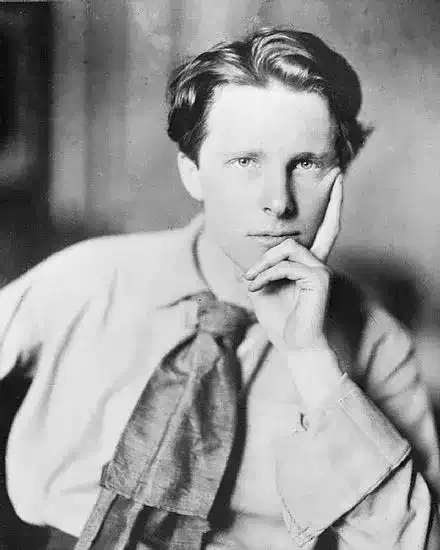
Rupert Brooke
Hauntings
In the grey tumult of these after years
Oft silence falls; the incessant wranglers part;
And less-than-echoes of remembered tears
Hush all the loud confusion of the heart;
And a shade, through the toss'd ranks of mirth and crying
Hungers, and pains, and each dull passionate mood, --
Quite lost, and all but all forgot, undying,
Comes back the ecstasy of your quietude.
So a poor ghost, beside his misty streams,
Is haunted by strange doubts, evasive dreams,
Hints of a pre-Lethean life, of men,
Stars, rocks, and flesh, things unintelligible,
And light on waving grass, he knows not when,
And feet that ran, but where, he cannot tell.
197
Rupert Brooke
Retrospect
In your arms was still delight,
Quiet as a street at night;
And thoughts of you, I do remember,
Were green leaves in a darkened chamber,
Were dark clouds in a moonless sky.
Love, in you, went passing by,
Penetrative, remote, and rare,
Like a bird in the wide air,
And, as the bird, it left no trace
In the heaven of your face.
In your stupidity I found
The sweet hush after a sweet sound.
All about you was the light
That dims the greying end of night;
Desire was the unrisen sun,
Joy the day not yet begun,
With tree whispering to tree,
Without wind, quietly.
Wisdom slept within your hair,
And Long-Suffering was there,
And, in the flowing of your dress,
Undiscerning Tenderness.
And when you thought, it seemed to me,
Infinitely, and like a sea,
About the slight world you had known
Your vast unconsciousness was thrown. . . .
O haven without wave or tide!
Silence, in which all songs have died!
Holy book, where hearts are still!
And home at length under the hill!
O mother quiet, breasts of peace,
Where love itself would faint and cease!
O infinite deep I never knew,
I would come back, come back to you,
Find you, as a pool unstirred,
Kneel down by you, and never a word,
Lay my head, and nothing said,
In your hands, ungarlanded;
And a long watch you would keep;
And I should sleep, and I should sleep!
Mataiea, January
197
Lewis Carroll
A Boat beneath a Sunny Sky
A BOAT beneath a sunny sky,
Lingering onward dreamily
In an evening of July Children
three that nestle near,
Eager eye and willing ear,
Pleased a simple tale to hear Long
has paled that sunny sky:
Echoes fade and memories die:
Autumn frosts have slain July.
Still she haunts me, phantomwise,
Alice moving under skies
Never seen by waking eyes.
Children yet, the tale to hear,
Eager eye and willing ear,
Lovingly shall nestle near.
In a Wonderland they lie,
Dreaming as the days go by,
Dreaming as the summers die:
Ever drifting down the stream Lingering
in the golden dream Life,
what is it but a dream?
199
Robert W. Service
The Sceptic
My Father Christmas passed away
When I was barely seven.
At twenty-one, alack-a-day,
I lost my hope of heaven.
Yet not in either lies the curse:
The hell of it's because
I don't know which loss hurt the worse --
My God or Santa Claus.
When I was barely seven.
At twenty-one, alack-a-day,
I lost my hope of heaven.
Yet not in either lies the curse:
The hell of it's because
I don't know which loss hurt the worse --
My God or Santa Claus.
199
Thomas Moore
I Saw From the Beach
I saw from the beach, when the morning was shining,
A bark o'er the waters move gloriously on;
I came when the sun o'er that beach was declining,
The bark was still there, but the waters were gone.
And such is the fate of our life's early promise,
So passing the spring-tide of joy we have known;
Each wave that we danced on at morning ebbs from us,
And leaves us, at eve, on the bleak shore alone.
Oh, who would not welcome that moment's returning
When passion first waked a new life through his frame,
And his soul, like the wood that grows precious in burning,
Gave out all its sweets to love's exquisite flame.
195
Thomas Moore
Oh, Ye Dead!
Oh, ye Dead! oh, ye Dead! whom we know by the light you give
From your cold gleaming eyes, though you move like men who live,
Why leave you thus your graves,
In far off fields and waves,
Where the worm and the sea-bird only know your bed,
To haunt this spot where all
Those eyes that wept your fall,
And the hearts that wail'd you, like your own, lie dead?
It is true, it is true, we are shadows cold and wan;
And the fair and the brave whom we loved on earth are gone;
But still thus even in death,
So sweet the living breath
Of the fields and the flowers in our youth we wander'd o'er,
That ere, condemn'd, we go
To freeze 'mid Hecla's snow,
We would taste it a while, and think we live once more!
195
Robert W. Service
At Thirty-Five
Three score and ten, the psalmist saith,
And half my course is well-nigh run;
I've had my flout at dusty death,
I've had my whack of feast and fun.
I've mocked at those who prate and preach;
I've laughed with any man alive;
But now with sobered heart I reach
The Great Divide of Thirty-five.
And looking back I must confess
I've little cause to feel elate.
I've played the mummer more or less;
I fumbled fortune, flouted fate.
I've vastly dreamed and little done;
I've idly watched my brothers strive:
Oh, I have loitered in the sun
By primrose paths to Thirty-five!
And those who matched me in the race,
Well, some are out and trampled down;
The others jog with sober pace;
Yet one wins delicate renown.
O midnight feast and famished dawn!
O gay, hard life, with hope alive!
O golden youth, forever gone,
How sweet you seem at Thirty-five!
Each of our lives is just a book
As absolute as Holy Writ;
We humbly read, and may not look
Ahead, nor change one word of it.
And here are joys and here are pains;
And here we fail and here we thrive;
O wondrous volume! what remains
When we reach chapter Thirty-five?
The very best, I dare to hope,
Ere Fate writes Finis to the tome;
A wiser head, a wider scope,
And for the gipsy heart, a home;
A songful home, with loved ones near,
With joy, with sunshine all alive:
Watch me grow younger every year --
Old Age! thy name is Thirty-five!
192
Robert W. Service
The Low-Down White
This is the pay-day up at the mines, when the bearded brutes come down;
There's money to burn in the streets to-night, so I've sent my klooch to town,
With a haggard face and a ribband of red entwined in her hair of brown.
And I know at the dawn she'll come reeling home with the bottles, one, two, three --
One for herself, to drown her shame, and two big bottles for me,
To make me forget the thing I am and the man I used to be.
To make me forget the brand of the dog, as I crouch in this hideous place;
To make me forget once I kindled the light of love in a lady's face,
Where even the squalid Siwash now holds me a black disgrace.
Oh, I have guarded my secret well! And who would dream as I speak
In a tribal tongue like a rogue unhung, 'mid the ranch-house filth and reek,
I could roll to bed with a Latin phrase and rise with a verse of Greek?
Yet I was a senior prizeman once, and the pride of a college eight;
Called to the bar -- my friends were true! but they could not keep me straight;
Then came the divorce, and I went abroad and "died" on the River Plate.
But I'm not dead yet; though with half a lung there isn't time to spare,
And I hope that the year will see me out, and, thank God, no one will care --
Save maybe the little slim Siwash girl with the rose of shame in her hair.
She will come with the dawn, and the dawn is near; I can see its evil glow,
Like a corpse-light seen through a frosty pane in a night of want and woe;
And yonder she comes by the bleak bull-pines, swift staggering through the snow.
196

Christina Rossetti
Aloof
THE irresponsive silence of the land,
The irresponsive sounding of the sea,
Speak both one message of one sense to me:--
Aloof, aloof, we stand aloof, so stand
Thou too aloof, bound with the flawless band
Of inner solitude; we bind not thee;
But who from thy self-chain shall set thee free?
What heart shall touch thy heart? What hand thy hand?
And I am sometimes proud and sometimes meek,
And sometimes I remember days of old
When fellowship seem'd not so far to seek,
And all the world and I seem'd much less cold,
And at the rainbow's foot lay surely gold,
And hope felt strong, and life itself not weak.
194