
Serenity and Inner Peace

Robert W. Service
Old Codger
Of garden truck he made his fare,
As his bright eyes bore witness;
Health was his habit and his care,
His hobby human fitness.
He sang the praise of open sky,
The gladth of Nature's giving;
And when at last he came to die
It was of too long living.
He held aloof from hate and strife,
Drank peace in dreamful doses;
He never voted in his life,
Loved children, dogs and roses.
Let tyrants romp in gory glee,
And revolutions roister,
He passed his days as peacefully
As friar in a cloister.
So fellow sinners, should you choose
Of doom to be a dodger,
At eighty be a bland recluse
Like this serene old codger,
Who turned his back on fear and fret,
And died nigh eighty-seven . . .
His name was--Robert Service: let
Us hope he went to Heaven
292

John Donne
Elegy IX: The Autumnal
No spring nor summer beauty hath such grace
As I have seen in one autumnal face.
Young beauties force our love, and that's a rape,
This doth but counsel, yet you cannot scape.
If 'twere a shame to love, here 'twere no shame;
Affection here takes reverence's name.
Were her first years the golden age? That's true,
But now she's gold oft tried and ever new.
That was her torrid and inflaming time,
This is her tolerable tropic clime.
Fair eyes, who asks more heat than comes from hence,
He in a fever wishes pestilence.
Call not these wrinkles, graves; if graves they were,
They were Love's graves, for else he is no where.
Yet lies not Love dead here, but here doth sit
Vow'd to this trench, like an anachorit;
And here till hers, which must be his death, come,
He doth not dig a grave, but build a tomb.
Here dwells he; though he sojourn ev'rywhere
In progress, yet his standing house is here:
Here where still evening is, not noon nor night,
Where no voluptuousness, yet all delight.
In all her words, unto all hearers fit,
You may at revels, you at council, sit.
This is Love's timber, youth his underwood;
There he, as wine in June, enrages blood,
Which then comes seasonabliest when our taste
And appetite to other things is past.
Xerxes' strange Lydian love, the platan tree,
Was lov'd for age, none being so large as she,
Or else because, being young, nature did bless
Her youth with age's glory, barrenness.
If we love things long sought, age is a thing
Which we are fifty years in compassing;
If transitory things, which soon decay,
Age must be loveliest at the latest day.
But name not winter faces, whose skin's slack,
Lank as an unthrift's purse, but a soul's sack;
Whose eyes seek light within, for all here's shade;
Whose mouths are holes, rather worn out than made;
Whose every tooth to a several place is gone,
To vex their souls at resurrection:
Name not these living death's-heads unto me,
For these, not ancient, but antique be.
I hate extremes, yet I had rather stay
With tombs than cradles, to wear out a day.
Since such love's natural lation is, may still
My love descend, and journey down the hill,
Not panting after growing beauties. So,
I shall ebb on with them who homeward go.
291

Emily Dickinson
On this wondrous sea
On this wondrous sea
Sailing silently,
Ho! Pilot, ho!
Knowest thou the shore
Where no breakers roar-
Where the storm is o'er?
In the peaceful west
Many the sails at rest-
The anchors fast-
Thither I pilot thee-
Land Ho! Eternity!
Ashore at last!
Sailing silently,
Ho! Pilot, ho!
Knowest thou the shore
Where no breakers roar-
Where the storm is o'er?
In the peaceful west
Many the sails at rest-
The anchors fast-
Thither I pilot thee-
Land Ho! Eternity!
Ashore at last!
290
Robert W. Service
An Olive Fire
An olive fire's a lovely thing;
Somehow it makes me think of Spring
As in my grate it over-spills
With dancing flames like daffodils.
They flirt and frolic, twist and twine,
The brassy fire-irons wink and shine. . . .
Leap gold, you flamelets! Laugh and sing:
An olive fire's a lovely thing.
An olive fire's a household shrine:
A crusty loaf, a jug of wine,
An apple and a chunk of cheese -
Oh I could be content with these.
But if my curse of oil is there,
To fry a fresh-caught fish, I swear
I do not envy any king,
As sitting by my hearth I sing:
An olive fire's a lovely thing.
When old and worn, of life I tire,
I'll sit before an olive fire,
And watch the feather ash like snow
As softly as a rose heart glow;
The tawny roots will loose their hoard
Of sunbeams centuries have stored,
And flames like yellow chicken's cheep,
Till in my heart Peace is so deep:
With hands prayer-clasped I sleep . . . and sleep.
289
Robert W. Service
Eyrie
Between the mountain and the sea
I've made a happy landing;
And here a peace has come to me
That passeth understanding;
A shining faith and purity
Beyond demanding.
With palm below and pine above,
Where wings of gulls are gleaming;
By orange tree and olive grove,
From walls of airy seeming,
My roses beg me not to rove,
But linger dreaming.
So I'm in love with life again,
And would with joy dissever
My days from ways of worldly men,
And mingle with them never:
Let silken roses to my ken
Whisper forever.
290

Henry Wadsworth Longfellow
In The Harbour: Chimes
Sweet chimes! that in the loneliness of night
Salute the passing hour, and in the dark
And silent chambers of the household mark
The movements of the myriad orbs of light!
Through my closed eyelids, by the inner sight,
I see the constellations in the arc
Of their great circles moving on, and hark!
I almost hear them singing in their flight.
Better than sleep it is to lie awake,
O'er-canopied by the vast starry dome
Of the immeasurable sky; to feel
The slumbering world sink under us, and make
Hardly an eddy,--a mere rush of foam
On the great sea beneath a sinking keel.
283

William Wordsworth
Memory
A pen--to register; a key--
That winds through secret wards
Are well assigned to Memory
By allegoric Bards.
As aptly, also, might be given
A Pencil to her hand;
That, softening objects, sometimes even
Outstrips the heart's demand;
That smooths foregone distress, the lines
Of lingering care subdues,
Long-vanished happiness refines,
And clothes in brighter hues;
Yet, like a tool of Fancy, works
Those Spectres to dilate
That startle Conscience, as she lurks
Within her lonely seat.
Oh! that our lives, which flee so fast,
In purity were such,
That not an image of the past
Should fear that pencil's touch!
Retirement then might hourly look
Upon a soothing scene,
Age steal to his allotted nook
Contented and serene;
With heart as calm as lakes that sleep,
In frosty moonlight glistening;
Or mountain rivers, where they creep
Along a channel smooth and deep,
To their own far-off murmurs listening.
282

Thomas Hardy
In a Wood
In a Wood
Pale beech and pine-tree blue,
Set in one clay,
Bough to bough cannot you
Bide out your day?
When the rains skim and skip,
Why mar sweet comradeship,
Blighting with poison-drip
Neighborly spray?
Heart-halt and spirit-lame,
City-opprest,
Unto this wood I came
As to a nest;
Dreaming that sylvan peace
Offered the harrowed ease—
Nature a soft release
From men’s unrest.
But, having entered in,
Great growths and small
Show them to men akin—
Combatants all!
Sycamore shoulders oak,
Bines the slim sapling yoke,
Ivy-spun halters choke
Elms stout and tall.
Touches from ash, O wych,
Sting you like scorn!
You, too, brave hollies, twitch
Sidelong from thorn.
Even the rank poplars bear
Illy a rival’s air,
Cankering in black despair
If overborne.
Since, then, no grace I find
Taught me of trees,
Turn I back to my kind,
Worthy as these.
There at least smiles abound,
There discourse trills around,
There, now and then, are found
Life-loyalties.
272
Robert W. Service
Nature's Way
To tribulations of mankind
Dame Nature is indifferent;
To human sorrow she is blind,
And deaf to human discontent.
Mid fear and fratricidal fray,
Mid woe and tyranny of toil,
She goes her unregarding way
Of sky and sun and soil.
In leaf and blade, in bud and bloom
Exultantly her gladness glows,
And careless of Man's dreary doom
Around the palm she wreathes the rose;
Creating beauty everywhere,
With happy bird in holy song . . .
Please God, let us be unaware
Like her of wrath and wrong.
Let us too be indifferent,
And in her hands our fate resign;
Aye, though the world with rage is rent
Let us be placid as the pine.
For if we turn from greed and guile
Maybe Dame Nature will relent,
And bless us with her lovely smile
Of comfort and content.
268

Christina Rossetti
Twilight Calm
Oh, pleasant eventide!
Clouds on the western side
Grow grey and greyer, hiding the warm sun:
The bees and birds, their happy labours done,
Seek their close nests and bide.
Screened in the leafy wood
The stock-doves sit and brood:
The very squirrel leaps from bough to bough
But lazily; pauses; and settles now
Where once he stored his food.
One by one the flowers close,
Lily and dewy rose
Shutting their tender petals from the moon:
The grasshoppers are still; but not so soon
Are still the noisy crows.
The dormouse squats and eats
Choice little dainty bits
Beneath the spreading roots of a broad lime
Nibbling his fill he stops from time to time
And listens where he sits.
From far the lowings come
Of cattle driven home:
From farther still the wind brings fitfully
The vast continual murmur of the sea,
Now loud, now almost dumb.
The gnats whirl in the air,
The evening gnats; and there
The owl opes broad his eyes and wings to sail
For prey; the bat wakes; and the shell-less snail
Comes forth, clammy and bare.
Hark! that's the nightingale,
Telling the selfsame tale
Her song told when this ancient earth was young:
So echoes answered when her song was sung
In the first wooded vale.
We call it love and pain
The passion of her strain;
And yet we little understand or know:
Why should it not be rather joy that so
Throbs in each throbbing vein?
In separate herds the deer
Lie; here the bucks, and here
The does, and by its mother sleeps the fawn:
Through all the hours of night until the dawn
They sleep, forgetting fear.
The hare sleeps where it lies,
With wary half-closed eyes;
The cock has ceased to crow, the hen to cluck:
Only the fox is out, some heedless duck
Or chicken to surprise.
Remote, each single star
Comes out, till there they are
All shining brightly: how the dews fall damp!
While close at hand the glow-worm lights her lamp,
Or twinkles from afar.
But evening now is done
As much as if the sun
Day-giving had arisen in the East:
For night has come; and the great calm has ceased,
The quiet sands have run.
260

Billy Collins
I Ask You
What scene would I want to be enveloped in
more than this one,
an ordinary night at the kitchen table,
floral wallpaper pressing in,
white cabinets full of glass,
the telephone silent,
a pen tilted back in my hand?
It gives me time to think
about all that is going on outside-leaves
gathering in corners,
lichen greening the high grey rocks,
while over the dunes the world sails on,
huge, ocean-going, history bubbling in its wake.
But beyond this table
there is nothing that I need,
not even a job that would allow me to row to work,
or a coffee-colored Aston Martin DB4
with cracked green leather seats.
No, it's all here,
the clear ovals of a glass of water,
a small crate of oranges, a book on Stalin,
not to mention the odd snarling fish
in a frame on the wall,
and the way these three candles-each
a different height-are
singing in perfect harmony.
So forgive me
if I lower my head now and listen
to the short bass candle as he takes a solo
while my heart
thrums under my shirt-frog
at the edge of a pond-and
my thoughts fly off to a province
made of one enormous sky
and about a million empty branches.
259
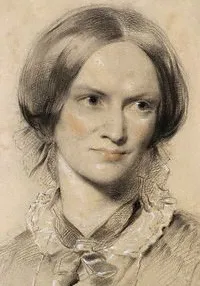
Charlotte Brontë
Evening Solace
THE human heart has hidden treasures,
In secret kept, in silence sealed;
The
thoughts, the hopes, the dreams, the pleasures,
Whose charms were broken if revealed.
And days may pass in gay confusion,
And nights in rosy riot fly,
While, lost in Fame's or Wealth's illusion,
The memory of the Past may die.
But, there are hours of lonely musing,
Such as in evening silence come,
When, soft as birds their pinions closing,
The heart's best feelings gather home.
Then in our souls there seems to languish
A tender grief that is not woe;
And thoughts that once wrung groans of anguish,
Now cause but some mild tears to flow.
And feelings, once as strong as passions,
Float softly backa
faded dream;
Our own sharp griefs and wild sensations,
The tale of others' sufferings seem.
Oh ! when the heart is freshly bleeding,
How longs it for that time to be,
When, through the mist of years receding,
Its woes but live in reverie !
And it can dwell on moonlight glimmer,
On evening shade and loneliness;
And, while the sky grows dim and dimmer,
Feel no untold and strange distress
Only
a deeper impulse given
By lonely hour and darkened room,
To solemn thoughts that soar to heaven,
Seeking a life and world to come.
255

John Greenleaf Whittier
St. Martin's Summer
Though flowers have perished at the touch
Of Frost, the early comer,
I hail the season loved so much,
The good St. Martin's summer.
O gracious morn, with rose-red dawn,
And thin moon curving o'er it!
The old year's darling, latest born,
More loved than all before it!
How flamed the sunrise through the pines!
How stretched the birchen shadows,
Braiding in long, wind-wavered lines
The westward sloping meadows!
The sweet day, opening as a flower
Unfolds its petals tender,
Renews for us at noontide's hour
The summer's tempered splendor.
The birds are hushed; alone the wind,
That through the woodland searches,
The red-oak's lingering leaves can find,
And yellow plumes of larches.
But still the balsam-breathing pine
Invites no thought of sorrow,
No hint of loss from air like wine
The earth's content can borrow.
The summer and the winter here
Midway a truce are holding,
A soft, consenting atmosphere
Their tents of peace enfolding.
The silent woods, the lonely hills,
Rise solemn in their gladness;
The quiet that the valley fills
Is scarcely joy or sadness.
How strange! The autumn yesterday
In winter's grasp seemed dying;
On whirling winds from skies of gray
The early snow was flying.
And now, while over Nature's mood
There steals a soft relenting,
I will not mar the present good,
Forecasting or lamenting.
My autumn time and Nature's hold
A dreamy tryst together,
And, both grown old, about us fold
The golden-tissued weather.
I lean my heart against the day
To feel its bland caressing;
I will not let it pass away
Before it leaves its blessing.
God's angels come not as of old
The Syrian shepherds knew them;
In reddening dawns, in sunset gold,
And warm noon lights I view them.
Nor need there is, in times like this
When heaven to earth draws nearer,
Of wing or song as witnesses
To make their presence clearer.
O stream of life, whose swifter flow
Is of the end forewarning,
Methinks thy sundown afterglow
Seems less of night than morning!
Old cares grow light; aside I lay
The doubts and fears that troubled;
The quiet of the happy day
Within my soul is doubled.
That clouds must veil this fair sunshine
Not less a joy I find it;
Nor less yon warm horizon line
That winter lurks behind it.
The mystery of the untried days
I close my eyes from reading;
His will be done whose darkest ways
To light and life are leading!
Less drear the winter night shall be,
If memory cheer and hearten
Its heavy hours with thoughts of thee,
Sweet summer of St. Martin!
253
Robert W. Service
A Song Of Sixty-Five
Brave Thackeray has trolled of days when he was twenty-one,
And bounded up five flights of stairs, a gallant garreteer;
And yet again in mellow vein when youth was gaily run,
Has dipped his nose in Gascon wine, and told of Forty Year.
But if I worthy were to sing a richer, rarer time,
I'd tune my pipes before the fire and merrily I'd strive
To praise that age when prose again has given way to rhyme,
The Indian Summer days of life when I'll be Sixty-five;
For then my work will all be done, my voyaging be past,
And I'll have earned the right to rest where folding hills are green;
So in some glassy anchorage I'll make my cable fast, --
Oh, let the seas show all their teeth, I'll sit and smile serene.
The storm may bellow round the roof, I'll bide beside the fire,
And many a scene of sail and trail within the flame I'll see;
For I'll have worn away the spur of passion and desire. . . .
Oh yes, when I am Sixty-five, what peace will come to me.
I'll take my breakfast in my bed, I'll rise at half-past ten,
When all the world is nicely groomed and full of golden song;
I'll smoke a bit and joke a bit, and read the news, and then
I'll potter round my peach-trees till I hear the luncheon gong.
And after that I think I'll doze an hour, well, maybe two,
And then I'll show some kindred soul how well my roses thrive;
I'll do the things I never yet have found the time to do. . . .
Oh, won't I be the busy man when I am Sixty-five.
I'll revel in my library; I'll read De Morgan's books;
I'll grow so garrulous I fear you'll write me down a bore;
I'll watch the ways of ants and bees in quiet sunny nooks,
I'll understand Creation as I never did before.
When gossips round the tea-cups talk I'll listen to it all;
On smiling days some kindly friend will take me for a drive:
I'll own a shaggy collie dog that dashes to my call:
I'll celebrate my second youth when I am Sixty-five.
Ah, though I've twenty years to go, I see myself quite plain,
A wrinkling, twinkling, rosy-cheeked, benevolent old chap;
I think I'll wear a tartan shawl and lean upon a cane.
I hope that I'll have silver hair beneath a velvet cap.
I see my little grandchildren a-romping round my knee;
So gay the scene, I almost wish 'twould hasten to arrive.
Let others sing of Youth and Spring, still will it seem to me
The golden time's the olden time, some time round Sixty-five.
251
Robert W. Service
Heart O' The North
And when I come to the dim trail-end,
I who have been Life's rover,
This is all I would ask, my friend,
Over and over and over:
A little space on a stony hill
With never another near me,
Sky o' the North that's vast and still,
With a single star to cheer me;
Star that gleams on a moss-grey stone
Graven by those who love me --
There would I lie alone, alone,
With a single pine above me;
Pine that the north wind whinneys through -Oh,
I have been Life's lover!
But there I'd lie and listen to
Eternity passing over.
251
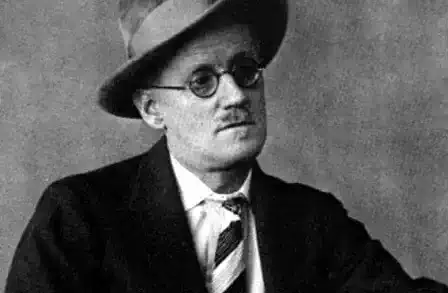
James Joyce
I Would in That Sweet Bosom Be
I would in that sweet bosom be
(O sweet it is and fair it is!)
Where no rude wind might visit me.
Because of sad austerities
I would in that sweet bosom be.
I would be ever in that heart
(O soft I knock and soft entreat her!)
Where only peace might be my part.
Austerities were all the sweeter
So I were ever in that heart.
(O sweet it is and fair it is!)
Where no rude wind might visit me.
Because of sad austerities
I would in that sweet bosom be.
I would be ever in that heart
(O soft I knock and soft entreat her!)
Where only peace might be my part.
Austerities were all the sweeter
So I were ever in that heart.
234
Robert W. Service
Wheels
Since I am sick of Wheels
That jar my day,
Unto the hush that heals
I steal away.
Unto the core of Peace
Nature reveals,
I go to win release
From Wheels.
Let me beneath the moon
Take desert trail;
Or on some lost lagoon
Serenely sail;
Win to some peak the grey
Storm cloud conceals . . .
Life, let me get away
From Wheels!
Why was I born so late?
A skin-clad man
I should have shared the fate
Of mountain clan;
My quiet flock beside,
When silence steals,
Unshocked in eventide
By Wheels.
The Wheel is King today,
And speed's a god;
Yet when I see the way
My feet have trod,
Like pilgrims who to shrine
Of Beauty kneels,
I pray: O Peace divine
Damn Wheels!
235
Robert W. Service
Baby Sitter
From torrid heat to frigid cold
I've rovered land and sea;
And now, with halting heart I hold
My grandchild on my knee:
Yet while I've eighty years all told,
Of moons she has but three.
She sleeps, that fragile miniature
Of future maidenhood;
She will be wonderful, I'm sure,
As over her I brood;
She is so innocent, so pure,
I know she will be good.
My way I've won from woe to weal,
And hard has been the fight;
Yet in my ingle-nook I feel
A wondrous peace to-night;
And over me serenely steal
Warm waves of love and light.
"What sloppy stuff!" I hear you say.
"Give us a lusty song."
Alas! I'm bent and gnarled and grey,-My
life may not be long:
Yet let its crown of glory be
This child upon me knee.
230
Robert W. Service
Fisherfolk
I like to look at fishermen
And oftentimes I wish
One would be lucky now and then
And catch a little fish.
I watch them statuesquely stand,
And at the water look;
But if they pull their float to land
It's just to bait a hook.
I ponder the psychology
That roots them in their place;
And wonder at the calm I see
In ever angler's face.
There is such patience in their eyes,
Beside the river's brink;
And waiting for a bite or rise
I do not think they think.
Or else they are just gentle men,
Who love--they know not why,
Greeen grace of trees or water when
It wimples to the sky . . .
Sweet simple souls! As vain I watch
My heart to you is kind:
Most precious prize of all you catch,
--Just Peace of Mind.
226
Emily Dickinson
Patience—has a quiet Outer
Patience—has a quiet Outer—
Patience—Look within—
Is an Insect's futile forces
Infinites—between—
'Scaping one—against the other
Fruitlesser to fling—
Patience—is the Smile's exertion
Through the quivering—
Patience—Look within—
Is an Insect's futile forces
Infinites—between—
'Scaping one—against the other
Fruitlesser to fling—
Patience—is the Smile's exertion
Through the quivering—
226
Robert W. Service
Relax
Do you recall that happy bike
With bundles on our backs?
How near to heaven it was like
To blissfully relax!
In cosy tavern of good cheer
To doff our heavy packs,
And with a mug of foamy beer
Relax.
Learn to relax: to clean the mind
Of fear and doubt and care,
And in vacuity to find
The perfect peace that's there.
With lassitude of heart and hand,
When every sinew slacks,
How good to rest the old bean and
Relax, relax.
Just sink back in an easy chair
For forty winks or so,
And fold your hands as if in prayer,
--That helps a lot, you know.
Forget that you are you awhile,
And pliable as wax,
Just beatifically smile . . .
Relax, relax, relax.
223
John Greenleaf Whittier
Summer By The Lakeside: Lake Winnipesaukee
I. NOON.
White clouds, whose shadows haunt the deep,
Light mists, whose soft embraces keep
The sunshine on the hills asleep!
O isles of calm! O dark, still wood!
And stiller skies that overbrood
Your rest with deeper quietude!
O shapes and hues, dim beckoning, through
Yon mountain gaps, my longing view
Beyond the purple and the blue,
To stiller sea and greener land,
And softer lights and airs more bland,
And skies,--the hollow of God's hand!
Transfused through you, O mountain friends!
With mine your solemn spirit blends,
And life no more hath separate ends.
I read each misty mountain sign,
I know the voice of wave and pine,
And I am yours, and ye are mine.
Life's burdens fall, its discords cease,
I lapse into the glad release
Of Nature's own exceeding peace.
O welcome calm of heart and mind!
As falls yon fir-tree's loosened rind
To leave a tenderer growth behind,
So fall the weary years away;
A child again, my head I lay
Upon the lap of this sweet day.
This western wind hath Lethean powers,
Yon noonday cloud nepenthe showers,
The lake is white with lotus-flowers!
Even Duty's voice is faint and low,
And slumberous Conscience, waking slow,
Forgets her blotted scroll to show.
The Shadow which pursues us all,
Whose ever-nearing steps appall,
Whose voice we hear behind us call,-
That Shadow blends with mountain gray,
It speaks but what the light waves say,-Death
walks apart from Fear to-day!
Rocked on her breast, these pines and I
Alike on Nature's love rely;
And equal seems to live or die.
Assured that He whose presence fills
With light the spaces of these hills
No evil to His creatures wills,
The simple faith remains, that He
Will do, whatever that may be,
The best alike for man and tree.
What mosses over one shall grow,
What light and life the other know,
Unanxious, leaving Him to show.
II. EVENING.
Yon mountain's side is black with night,
While, broad-orhed, o'er its gleaming crown
The moon, slow-rounding into sight,
On the hushed inland sea looks down.
How start to light the clustering isles,
Each silver-hemmed! How sharply show
The shadows of their rocky piles,
And tree-tops in the wave below!
How far and strange the mountains seem,
Dim-looming through the pale, still light
The vague, vast grouping of a dream,
They stretch into the solemn night.
Beneath, lake, wood, and peopled vale,
Hushed by that presence grand and grave,
Are silent, save the cricket's wail,
And low response of leaf and wave.
Fair scenes! whereto the Day and Night
Make rival love, I leave ye soon,
What time before the eastern light
The pale ghost of the setting moon
Shall hide behind yon rocky spines,
And the young archer, Morn, shall break
His arrows on the mountain pines,
And, golden-sandalled, walk the lake!
Farewell! around this smiling bay
Gay-hearted Health, and Life in bloom,
With lighter steps than mine, may stray
In radiant summers yet to come.
But none shall more regretful leave
These waters and these hills than I
Or, distant, fonder dream how eve
Or dawn is painting wave and sky;
How rising moons shine sad and mild
On wooded isle and silvering bay;
Or setting suns beyond the piled
And purple mountains lead the day;
Nor laughing girl, nor bearding boy,
Nor full-pulsed manhood, lingering here,
Shall add, to life's abounding joy,
The charmed repose to suffering dear.
Still waits kind Nature to impart
Her choicest gifts to such as gain
An entrance to her loving heart
Through the sharp discipline of pain.
Forever from the Hand that takes
One blessing from us others fall;
And, soon or late, our Father makes
His perfect recompense to all!
Oh, watched by Silence and the Night,
And folded in the strong embrace
Of the great mountains, with the light
Of the sweet heavens upon thy face,
Lake of the Northland! keep thy dower
Of beauty still, and while above
Thy solemn mountains speak of power,
Be thou the mirror of God's love.
221
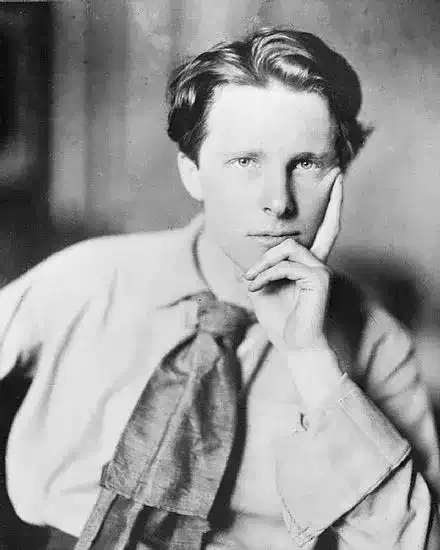
Rupert Brooke
Flight
Voices out of the shade that cried,
And long noon in the hot calm places,
And children's play by the wayside,
And country eyes, and quiet faces --
All these were round my steady paces.
Those that I could have loved went by me;
Cool gardened homes slept in the sun;
I heard the whisper of water nigh me,
Saw hands that beckoned, shone, were gone
In the green and gold. And I went on.
For if my echoing footfall slept,
Soon a far whispering there'd be
Of a little lonely wind that crept
From tree to tree, and distantly
Followed me, followed me. . . .
But the blue vaporous end of day
Brought peace, and pursuit baffled quite,
Where between pine-woods dipped the way.
I turned, slipped in and out of sight.
I trod as quiet as the night.
The pine-boles kept perpetual hush;
And in the boughs wind never swirled.
I found a flowering lowly bush,
And bowed, slid in, and sighed and curled,
Hidden at rest from all the world.
Safe! I was safe, and glad, I knew!
Yet -- with cold heart and cold wet brows
I lay. And the dark fell. . . . There grew
Meward a sound of shaken boughs;
And ceased, above my intricate house;
And silence, silence, silence found me. . . .
I felt the unfaltering movement creep
Among the leaves. They shed around me
Calm clouds of scent, that I did weep;
And stroked my face. I fell asleep.
219
Robert W. Service
Tranquilism
I call myself a Tranquilist;
With deep detachment I exist,
From friction free;
While others court the gilded throng
And worship Women, Wine and Song,
I scorn the three.
For I have reached the sober age
When I prefer to turn a page
Beside the fire,
And from the busy mart of men
To meditative book and pen
With grace retire.
If you are craving peace of mind,
In Tranquilism you will find
Philosophy;
Serenely fold your hands and wait
Be cloistered calm whatever fate
The Gods decree.
And though the world with rage be rent,
Hold it remote and claim content
With quiet heart;
You can't do much to better it,
But your good-will may help a bit,
Ere you depart.
So let us who are old and sere
To din of battle shut the ear,
And trumpet vain;
And though in no monastic mood
Accept the balm of solitude
And grace regain.
Let us be Tranquilists and try
In placid places to apply
Life's wisdom won;
In Nature's bounty we may bless
The Gods and wait with thankfulness
Our setting sun.
217