

Poems in this topic
Beauty

Ogden Nash
Good-By Now or Pardon My Gauntlet
Good-By Now or Pardon My Gauntlet
Bring down the moon for genteel Janet;
She's too refined for this gross planet.
She wears garments and you wear clothes,
You buy stockings, she purchases hose.
She say That is correct, and you say Yes,
And she disrobes and you undress.
Confronted by a mouse or moose,
You turn green, she turns chartroose.
Her speech is new-minted, freshly quarried;
She has a fore-head, you have a forehead.
Nor snake nor slowworm draweth nigh her;
You go to bed, she doth retire.
To Janet, births are blessed events,
And odors that you smell she scents.
Replete she feels, when her food is yummy,
Not in the stomach but the tummy.
If urged some novel step to show,
You say Like this, she says Like so.
Her dear ones don't die, but pass away;
Beneath her formal is lonjeray.
Of refinement she's a fount, or fountess,
And that is why she's now a countess.
She was asking for the little girls' room
And a flunky though she said the earl's room.
Bring down the moon for genteel Janet;
She's too refined for this gross planet.
She wears garments and you wear clothes,
You buy stockings, she purchases hose.
She say That is correct, and you say Yes,
And she disrobes and you undress.
Confronted by a mouse or moose,
You turn green, she turns chartroose.
Her speech is new-minted, freshly quarried;
She has a fore-head, you have a forehead.
Nor snake nor slowworm draweth nigh her;
You go to bed, she doth retire.
To Janet, births are blessed events,
And odors that you smell she scents.
Replete she feels, when her food is yummy,
Not in the stomach but the tummy.
If urged some novel step to show,
You say Like this, she says Like so.
Her dear ones don't die, but pass away;
Beneath her formal is lonjeray.
Of refinement she's a fount, or fountess,
And that is why she's now a countess.
She was asking for the little girls' room
And a flunky though she said the earl's room.
261
Ogden Nash
Biological Reflection
Biological Reflection
A girl whose cheeks are covered with paint
Has an advantage with me over one whose ain't.
A girl whose cheeks are covered with paint
Has an advantage with me over one whose ain't.
206
Ogden Nash
A Lady Who Thinks She Is Thirty
A Lady Who Thinks She Is Thirty
Unwillingly Miranda wakes,
Feels the sun with terror,
One unwilling step she takes,
Shuddering to the mirror.
Miranda in Miranda's sight
Is old and gray and dirty;
Twenty-nine she was last night;
This morning she is thirty.
Shining like the morning star,
Like the twilight shining,
Haunted by a calendar,
Miranda is a-pining.
Silly girl, silver girl,
Draw the mirror toward you;
Time who makes the years to whirl
Adorned as he adored you.
Time is timelessness for you;
Calendars for the human;
What's a year, or thirty, to
Loveliness made woman?
Oh, Night will not see thirty again,
Yet soft her wing, Miranda;
Pick up your glass and tell me, then--
How old is Spring, Miranda?
Unwillingly Miranda wakes,
Feels the sun with terror,
One unwilling step she takes,
Shuddering to the mirror.
Miranda in Miranda's sight
Is old and gray and dirty;
Twenty-nine she was last night;
This morning she is thirty.
Shining like the morning star,
Like the twilight shining,
Haunted by a calendar,
Miranda is a-pining.
Silly girl, silver girl,
Draw the mirror toward you;
Time who makes the years to whirl
Adorned as he adored you.
Time is timelessness for you;
Calendars for the human;
What's a year, or thirty, to
Loveliness made woman?
Oh, Night will not see thirty again,
Yet soft her wing, Miranda;
Pick up your glass and tell me, then--
How old is Spring, Miranda?
264
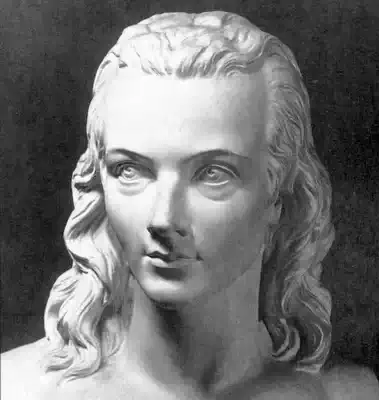
Novalis
Hymns to the Night :
Hymns to the Night :
Before all the wondrous shows of the widespread space around him, what living,
sentient thing loves not the all-joyous light -- with its colors, its rays and undulations,
its gentle omnipresence in the form of the wakening Day? The giant-world of the
unresting constellations inhales it as the innermost soul of life, and floats dancing in its
blue flood -- the sparkling, ever-tranquil stone, the thoughtful, imbibing plant, and the
wild, burning multiform beast inhales it -- but more than all, the lordly stranger with
the sense-filled eyes, the swaying walk, and the sweetly closed, melodious lips. Like a
king over earthly nature, it rouses every force to countless transformations, binds and
unbinds innumerable alliances, hangs its heavenly form around every earthly
substance. -- Its presence alone reveals the marvelous splendor of the kingdoms of the
world.
Aside I turn to the holy, unspeakable, mysterious Night. Afar lies the world -- sunk in a
deep grave -- waste and lonely is its place. In the chords of the bosom blows a deep
sadness. I am ready to sink away in drops of dew, and mingle with the ashes. -- The
distances of memory, the wishes of youth, the dreams of childhood, the brief joys and
vain hopes of a whole long life, arise in gray garments, like an evening vapor after the
sunset. In other regions the light has pitched its joyous tents. What if it should never
return to its children, who wait for it with the faith of innocence?
What springs up all at once so sweetly boding in my heart, and stills the soft air of
sadness? Dost thou also take a pleasure in us, dark Night? What holdest thou under
thy mantle, that with hidden power affects my soul? Precious balm drips from thy hand
out of its bundle of poppies. Thou upliftest the heavy-laden wings of the soul. Darkly
and inexpressibly are we moved -- joy-startled, I see a grave face that, tender and
worshipful, inclines toward me, and, amid manifold entangled locks, reveals the
youthful loveliness of the Mother. How poor and childish a thing seems to me now the
Light -- how joyous and welcome the departure of the day -- because the Night turns
away from thee thy servants, you now strew in the gulfs of space those flashing
globes, to proclaim thy omnipotence -- thy return -- in seasons of thy absence. More
heavenly than those glittering stars we hold the eternal eyes which the Night hath
opened within us. Farther they see than the palest of those countless hosts -- needing
no aid from the light, they penetrate the depths of a loving soul -- that fills a loftier
region with bliss ineffable. Glory to the queen of the world, to the great prophet of the
holier worlds, to the guardian of blissful love -- she sends thee to me -- thou tenderly
beloved -- the gracious sun of the Night, -- now am I awake -- for now am I thine and
mine -- thou hast made me know the Night -- made of me a man -- consume with
spirit-fire my body, that I, turned to finer air, may mingle more closely with thee, and
then our bridal night endure forever.
Before all the wondrous shows of the widespread space around him, what living,
sentient thing loves not the all-joyous light -- with its colors, its rays and undulations,
its gentle omnipresence in the form of the wakening Day? The giant-world of the
unresting constellations inhales it as the innermost soul of life, and floats dancing in its
blue flood -- the sparkling, ever-tranquil stone, the thoughtful, imbibing plant, and the
wild, burning multiform beast inhales it -- but more than all, the lordly stranger with
the sense-filled eyes, the swaying walk, and the sweetly closed, melodious lips. Like a
king over earthly nature, it rouses every force to countless transformations, binds and
unbinds innumerable alliances, hangs its heavenly form around every earthly
substance. -- Its presence alone reveals the marvelous splendor of the kingdoms of the
world.
Aside I turn to the holy, unspeakable, mysterious Night. Afar lies the world -- sunk in a
deep grave -- waste and lonely is its place. In the chords of the bosom blows a deep
sadness. I am ready to sink away in drops of dew, and mingle with the ashes. -- The
distances of memory, the wishes of youth, the dreams of childhood, the brief joys and
vain hopes of a whole long life, arise in gray garments, like an evening vapor after the
sunset. In other regions the light has pitched its joyous tents. What if it should never
return to its children, who wait for it with the faith of innocence?
What springs up all at once so sweetly boding in my heart, and stills the soft air of
sadness? Dost thou also take a pleasure in us, dark Night? What holdest thou under
thy mantle, that with hidden power affects my soul? Precious balm drips from thy hand
out of its bundle of poppies. Thou upliftest the heavy-laden wings of the soul. Darkly
and inexpressibly are we moved -- joy-startled, I see a grave face that, tender and
worshipful, inclines toward me, and, amid manifold entangled locks, reveals the
youthful loveliness of the Mother. How poor and childish a thing seems to me now the
Light -- how joyous and welcome the departure of the day -- because the Night turns
away from thee thy servants, you now strew in the gulfs of space those flashing
globes, to proclaim thy omnipotence -- thy return -- in seasons of thy absence. More
heavenly than those glittering stars we hold the eternal eyes which the Night hath
opened within us. Farther they see than the palest of those countless hosts -- needing
no aid from the light, they penetrate the depths of a loving soul -- that fills a loftier
region with bliss ineffable. Glory to the queen of the world, to the great prophet of the
holier worlds, to the guardian of blissful love -- she sends thee to me -- thou tenderly
beloved -- the gracious sun of the Night, -- now am I awake -- for now am I thine and
mine -- thou hast made me know the Night -- made of me a man -- consume with
spirit-fire my body, that I, turned to finer air, may mingle more closely with thee, and
then our bridal night endure forever.
407

Nazim Hikmet
Things I Didn't Know I Loved
Things I Didn't Know I Loved
it's March th
I'm sitting by the window on the Prague-Berlin train
night is falling
I never knew I liked
night descending like a tired bird on a smoky wet plain
I don't like
comparing nightfall to a tired bird
I didn't know I loved the earth
can someone who hasn't worked the earth love it
I've never worked the earth
it must be my only Platonic love
and here I've loved rivers all this time
whether motionless like this they curl skirting the hills
European hills crowned with chateaus
or whether stretched out flat as far as the eye can see
I know you can't wash in the same river even once
I know the river will bring new lights you'll never see
I know we live slightly longer than a horse but not nearly as long as a crow
I know this has troubled people before
and will trouble those after me
I know all this has been said a thousand times before
and will be said after me
I didn't know I loved the sky
cloudy or clear
the blue vault Andrei studied on his back at Borodino
in prison I translated both volumes of War and Peace into Turkish
I hear voices
not from the blue vault but from the yard
the guards are beating someone again
I didn't know I loved trees
bare beeches near Moscow in Peredelkino
they come upon me in winter noble and modest
beeches are Russian the way poplars are Turkish
"the poplars of Izmir
losing their leaves. . .
they call me The Knife. . .
lover like a young tree. . .
I blow stately mansions sky-high"
in the Ilgaz woods in I tied an embroidered linen handkerchief
to a pine bough for luck
I never knew I loved roads
even the asphalt kind
Vera's behind the wheel we're driving from Moscow to the Crimea
Koktebele
formerly "Goktepé ili" in Turkish
the two of us inside a closed box
the world flows past on both sides distant and mute
I was never so close to anyone in my life
bandits stopped me on the red road between Bolu and Geredé
when I was eighteen
apart from my life I didn't have anything in the wagon they could take
and at eighteen our lives are what we value least
I've written this somewhere before
wading through a dark muddy street I'm going to the shadow play
Ramazan night
a paper lantern leading the way
maybe nothing like this ever happened
maybe I read it somewhere an eight-year-old boy
going to the shadow play
Ramazan night in Istanbul holding his grandfather's hand
his grandfather has on a fez and is wearing the fur coat
with a sable collar over his robe
and there's a lantern in the servant's hand
and I can't contain myself for joy
flowers come to mind for some reason
poppies cactuses jonquils
in the jonquil garden in Kadikoy Istanbul I kissed Marika
fresh almonds on her breath
I was seventeen
my heart on a swing touched the sky
I didn't know I loved flowers
friends sent me three red carnations in prison
I just remembered the stars
I love them too
whether I'm floored watching them from below
or whether I'm flying at their side
I have some questions for the cosmonauts
were the stars much bigger
did they look like huge jewels on black velvet
or apricots on orange
did you feel proud to get closer to the stars
I saw color photos of the cosmos in Ogonek magazine now don't
be upset comrades but nonfigurative shall we say or abstract
well some of them looked just like such paintings which is to
say they were terribly figurative and concrete
my heart was in my mouth looking at them
they are our endless desire to grasp things
seeing them I could even think of death and not feel at all sad
I never knew I loved the cosmos
snow flashes in front of my eyes
both heavy wet steady snow and the dry whirling kind
I didn't know I liked snow
I never knew I loved the sun
even when setting cherry-red as now
in Istanbul too it sometimes sets in postcard colors
but you aren't about to paint it that way
I didn't know I loved the sea
except the Sea of Azov
or how much
I didn't know I loved clouds
whether I'm under or up above them
whether they look like giants or shaggy white beasts
moonlight the falsest the most languid the most petit-bourgeois
strikes me
I like it
I didn't know I liked rain
whether it falls like a fine net or splatters against the glass my
heart leaves me tangled up in a net or trapped inside a drop
and takes off for uncharted countries I didn't know I loved
rain but why did I suddenly discover all these passions sitting
by the window on the Prague-Berlin train
is it because I lit my sixth cigarette
one alone could kill me
is it because I'm half dead from thinking about someone back in Moscow
her hair straw-blond eyelashes blue
the train plunges on through the pitch-black night
I never knew I liked the night pitch-black
sparks fly from the engine
I didn't know I loved sparks
I didn't know I loved so many things and I had to wait until sixty
to find it out sitting by the window on the Prague-Berlin train
watching the world disappear as if on a journey of no return
April
Moscow
Trans. by Randy Blasing and Mutlu Konuk ()
it's March th
I'm sitting by the window on the Prague-Berlin train
night is falling
I never knew I liked
night descending like a tired bird on a smoky wet plain
I don't like
comparing nightfall to a tired bird
I didn't know I loved the earth
can someone who hasn't worked the earth love it
I've never worked the earth
it must be my only Platonic love
and here I've loved rivers all this time
whether motionless like this they curl skirting the hills
European hills crowned with chateaus
or whether stretched out flat as far as the eye can see
I know you can't wash in the same river even once
I know the river will bring new lights you'll never see
I know we live slightly longer than a horse but not nearly as long as a crow
I know this has troubled people before
and will trouble those after me
I know all this has been said a thousand times before
and will be said after me
I didn't know I loved the sky
cloudy or clear
the blue vault Andrei studied on his back at Borodino
in prison I translated both volumes of War and Peace into Turkish
I hear voices
not from the blue vault but from the yard
the guards are beating someone again
I didn't know I loved trees
bare beeches near Moscow in Peredelkino
they come upon me in winter noble and modest
beeches are Russian the way poplars are Turkish
"the poplars of Izmir
losing their leaves. . .
they call me The Knife. . .
lover like a young tree. . .
I blow stately mansions sky-high"
in the Ilgaz woods in I tied an embroidered linen handkerchief
to a pine bough for luck
I never knew I loved roads
even the asphalt kind
Vera's behind the wheel we're driving from Moscow to the Crimea
Koktebele
formerly "Goktepé ili" in Turkish
the two of us inside a closed box
the world flows past on both sides distant and mute
I was never so close to anyone in my life
bandits stopped me on the red road between Bolu and Geredé
when I was eighteen
apart from my life I didn't have anything in the wagon they could take
and at eighteen our lives are what we value least
I've written this somewhere before
wading through a dark muddy street I'm going to the shadow play
Ramazan night
a paper lantern leading the way
maybe nothing like this ever happened
maybe I read it somewhere an eight-year-old boy
going to the shadow play
Ramazan night in Istanbul holding his grandfather's hand
his grandfather has on a fez and is wearing the fur coat
with a sable collar over his robe
and there's a lantern in the servant's hand
and I can't contain myself for joy
flowers come to mind for some reason
poppies cactuses jonquils
in the jonquil garden in Kadikoy Istanbul I kissed Marika
fresh almonds on her breath
I was seventeen
my heart on a swing touched the sky
I didn't know I loved flowers
friends sent me three red carnations in prison
I just remembered the stars
I love them too
whether I'm floored watching them from below
or whether I'm flying at their side
I have some questions for the cosmonauts
were the stars much bigger
did they look like huge jewels on black velvet
or apricots on orange
did you feel proud to get closer to the stars
I saw color photos of the cosmos in Ogonek magazine now don't
be upset comrades but nonfigurative shall we say or abstract
well some of them looked just like such paintings which is to
say they were terribly figurative and concrete
my heart was in my mouth looking at them
they are our endless desire to grasp things
seeing them I could even think of death and not feel at all sad
I never knew I loved the cosmos
snow flashes in front of my eyes
both heavy wet steady snow and the dry whirling kind
I didn't know I liked snow
I never knew I loved the sun
even when setting cherry-red as now
in Istanbul too it sometimes sets in postcard colors
but you aren't about to paint it that way
I didn't know I loved the sea
except the Sea of Azov
or how much
I didn't know I loved clouds
whether I'm under or up above them
whether they look like giants or shaggy white beasts
moonlight the falsest the most languid the most petit-bourgeois
strikes me
I like it
I didn't know I liked rain
whether it falls like a fine net or splatters against the glass my
heart leaves me tangled up in a net or trapped inside a drop
and takes off for uncharted countries I didn't know I loved
rain but why did I suddenly discover all these passions sitting
by the window on the Prague-Berlin train
is it because I lit my sixth cigarette
one alone could kill me
is it because I'm half dead from thinking about someone back in Moscow
her hair straw-blond eyelashes blue
the train plunges on through the pitch-black night
I never knew I liked the night pitch-black
sparks fly from the engine
I didn't know I loved sparks
I didn't know I loved so many things and I had to wait until sixty
to find it out sitting by the window on the Prague-Berlin train
watching the world disappear as if on a journey of no return
April
Moscow
Trans. by Randy Blasing and Mutlu Konuk ()
384
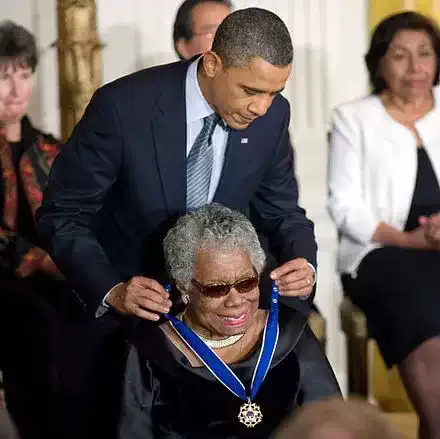
Maya Angelou
California Prodigal
California Prodigal
FOR DAVID P—B
The eye follows, the land
Slips upward, creases down, forms
The gentle buttocks of a young
Giant. In the nestle,
Old adobe bricks, washed of
Whiteness, paled to umber,
Await another century.
Star Jasmine and old vines
Lay claim upon the ghosted land,
Then quiet pools whisper
Private childhood secrets.
Flush on inner cottage walls
Antiquitous faces,
Used to the gelid breath
Of old manors, glare disdainfully
Over breached time.
Around and through these
Cold phantasmatalities,
He walks, insisting
To the languid air,
Activity, music,
A generosity of graces.
His lupin fields spurn old
Deceit and agile poppies dance
In golden riot. Each day is
Fulminant, exploding brightly
Under the gaze of his exquisite
Sires, frozen in the famed paint
Of dead masters. Audacious
Sunlight casts defiance
At their feet.
FOR DAVID P—B
The eye follows, the land
Slips upward, creases down, forms
The gentle buttocks of a young
Giant. In the nestle,
Old adobe bricks, washed of
Whiteness, paled to umber,
Await another century.
Star Jasmine and old vines
Lay claim upon the ghosted land,
Then quiet pools whisper
Private childhood secrets.
Flush on inner cottage walls
Antiquitous faces,
Used to the gelid breath
Of old manors, glare disdainfully
Over breached time.
Around and through these
Cold phantasmatalities,
He walks, insisting
To the languid air,
Activity, music,
A generosity of graces.
His lupin fields spurn old
Deceit and agile poppies dance
In golden riot. Each day is
Fulminant, exploding brightly
Under the gaze of his exquisite
Sires, frozen in the famed paint
Of dead masters. Audacious
Sunlight casts defiance
At their feet.
172

Mao Tsé-Tung
The Fairy Cave Inscription on a Picture Taken by Comrade Li Chin
The Fairy Cave Inscription on a Picture Taken by Comrade Li Chin
Amid the growing shades of dusk stand sturdy pines,
Riotous clouds sweep past, swift and tranquil.
Nature has excelled herself in the Fairy Cave,
On perilous peaks dwells beauty in her infinite variety.
Amid the growing shades of dusk stand sturdy pines,
Riotous clouds sweep past, swift and tranquil.
Nature has excelled herself in the Fairy Cave,
On perilous peaks dwells beauty in her infinite variety.
189
Mao Tsé-Tung
Snow
Snow
North country scene:
A hundred leagues locked in ice,
A thousand leagues of whirling snow.
Both sides of the Great Wall
One single white immensity.
The Yellow River's swift current
Is stilled from end to end.
The mountains dance like silver snakes
And the highlands* charge like wax-hued elephants,
Vying with heaven in stature.
On a fine day, the land,
Clad in white, adorned in red,
Grows more enchanting.
This land so rich in beauty
Has made countless heroes bow in homage.
But alas! Chin Shih-huang and Han Wu-ti
Were lacking in literary grace,
And Tang Tai-tsung and Sung Tai-tsu
Had little poetry in their souls;
And Genghis Khan,
Proud Son of Heaven for a day,
Knew only shooting eagles, bow outstretched
All are past and gone!
For truly great men
Look to this age alone.
North country scene:
A hundred leagues locked in ice,
A thousand leagues of whirling snow.
Both sides of the Great Wall
One single white immensity.
The Yellow River's swift current
Is stilled from end to end.
The mountains dance like silver snakes
And the highlands* charge like wax-hued elephants,
Vying with heaven in stature.
On a fine day, the land,
Clad in white, adorned in red,
Grows more enchanting.
This land so rich in beauty
Has made countless heroes bow in homage.
But alas! Chin Shih-huang and Han Wu-ti
Were lacking in literary grace,
And Tang Tai-tsung and Sung Tai-tsu
Had little poetry in their souls;
And Genghis Khan,
Proud Son of Heaven for a day,
Knew only shooting eagles, bow outstretched
All are past and gone!
For truly great men
Look to this age alone.
482
Mao Tsé-Tung
Tapoti
Tapoti
Red, orange, yellow, green,
blue, violet, indigo:
Who is dancing with these
rainbow colours in the sky?
Air after rain, slanting sun:
mountains and passes turning blue
in each changing moment.
Fierce battles that year:
bullet holes in village walls.
These mountains so decorated,
look even more beautiful today.
Red, orange, yellow, green,
blue, violet, indigo:
Who is dancing with these
rainbow colours in the sky?
Air after rain, slanting sun:
mountains and passes turning blue
in each changing moment.
Fierce battles that year:
bullet holes in village walls.
These mountains so decorated,
look even more beautiful today.
325
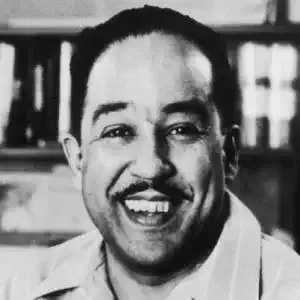
Langston Hughes
When Sue Wears Red
When Sue Wears Red
When Susanna Jones wears red
her face is like an ancient cameo
Turned brown by the ages.
Come with a blast of trumphets, Jesus!
When Susanna Jones wears red
A queen from some time-dead Egyptian night
Walks once again.
Blow trumphets, Jesus!
And the beauty of Susanna Jones in red
Burns in my heart a love-fire sharp like a pain.
Sweet silver trumphets, Jesus!
When Susanna Jones wears red
her face is like an ancient cameo
Turned brown by the ages.
Come with a blast of trumphets, Jesus!
When Susanna Jones wears red
A queen from some time-dead Egyptian night
Walks once again.
Blow trumphets, Jesus!
And the beauty of Susanna Jones in red
Burns in my heart a love-fire sharp like a pain.
Sweet silver trumphets, Jesus!
358
Langston Hughes
Quiet Girl
Quiet Girl
I would liken you
To a night without stars
Were it not for your eyes.
I would liken you
To a sleep without dreams
Were it not for your songs.
I would liken you
To a night without stars
Were it not for your eyes.
I would liken you
To a sleep without dreams
Were it not for your songs.
409
Langston Hughes
My People
My People
The night is beautiful,
So the faces of my people.
The stars are beautiful,
So the eyes of my people.
Beautiful, also, is the sun.
Beautiful, also, are the souls of my people.
The night is beautiful,
So the faces of my people.
The stars are beautiful,
So the eyes of my people.
Beautiful, also, is the sun.
Beautiful, also, are the souls of my people.
414
Langston Hughes
Helen Keller
Helen Keller
She,
In the dark,
Found light
Brighter than many ever see.
She,
Within herself,
Found loveliness,
Through the soul's own mastery.
And now the world receives
From her dower:
The message of the strength
Of inner power.
She,
In the dark,
Found light
Brighter than many ever see.
She,
Within herself,
Found loveliness,
Through the soul's own mastery.
And now the world receives
From her dower:
The message of the strength
Of inner power.
493
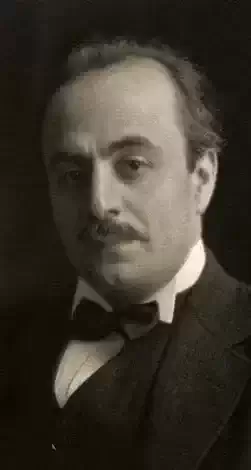
Khalil Gibran
Vision X
Vision X
There in the middle of the field, by the side of a crystalline stream, I saw a bird-cage
whose rods and hinges were fashioned by an expert's hands. In one corner lay a dead
bird, and in another were two basins -- one empty of water and the other of seeds. I
stood there reverently, as if the lifeless bird and the murmur of the water were worthy
of deep silence and respect -- something worth of examination and meditation by the
heard and conscience.
As I engrossed myself in view and thought, I found that the poor creature had died of
thirst beside a stream of water, and of hunger in the midst of a rich field, cradle of life;
like a rich man locked inside his iron safe, perishing from hunger amid heaps of gold.
Before my eyes I saw the cage turned suddenly into a human skeleton, and the dead
bird into a man's heart which was bleeding from a deep wound that looked like the lips
of a sorrowing woman. A voice came from that wound saying, "I am the human heart,
prisoner of substance and victim of earthly laws.
"In God's field of Beauty, at the edge of the stream of life, I was imprisoned in the cage
of laws made by man.
"In the center of beautiful Creation I died neglected because I was kept from enjoying
the freedom of God's bounty.
"Everything of beauty that awakens my love and desire is a disgrace, according to
man's conceptions; everything of goodness that I crave is but naught, according to his
judgment.
"I am the lost human heart, imprisoned in the foul dungeon of man's dictates, tied with
chains of earthly authority, dead and forgotten by laughing humanity whose tongue is
tied and whose eyes are empty of visible tears."
All these words I heard, and I saw them emerging with a stream of ever thinning blood
from that wounded heart.
More was said, but my misted eyes and crying should prevented further sight or
hearing.
There in the middle of the field, by the side of a crystalline stream, I saw a bird-cage
whose rods and hinges were fashioned by an expert's hands. In one corner lay a dead
bird, and in another were two basins -- one empty of water and the other of seeds. I
stood there reverently, as if the lifeless bird and the murmur of the water were worthy
of deep silence and respect -- something worth of examination and meditation by the
heard and conscience.
As I engrossed myself in view and thought, I found that the poor creature had died of
thirst beside a stream of water, and of hunger in the midst of a rich field, cradle of life;
like a rich man locked inside his iron safe, perishing from hunger amid heaps of gold.
Before my eyes I saw the cage turned suddenly into a human skeleton, and the dead
bird into a man's heart which was bleeding from a deep wound that looked like the lips
of a sorrowing woman. A voice came from that wound saying, "I am the human heart,
prisoner of substance and victim of earthly laws.
"In God's field of Beauty, at the edge of the stream of life, I was imprisoned in the cage
of laws made by man.
"In the center of beautiful Creation I died neglected because I was kept from enjoying
the freedom of God's bounty.
"Everything of beauty that awakens my love and desire is a disgrace, according to
man's conceptions; everything of goodness that I crave is but naught, according to his
judgment.
"I am the lost human heart, imprisoned in the foul dungeon of man's dictates, tied with
chains of earthly authority, dead and forgotten by laughing humanity whose tongue is
tied and whose eyes are empty of visible tears."
All these words I heard, and I saw them emerging with a stream of ever thinning blood
from that wounded heart.
More was said, but my misted eyes and crying should prevented further sight or
hearing.
358
Khalil Gibran
The Playground of Life XIX
The Playground of Life XIX
One hour devoted to the pursuit of Beauty
And Love is worth a full century of glory
Given by the frightened weak to the strong.
From that hour comes man's Truth; and
During that century Truth sleeps between
The restless arms of disturbing dreams.
In that hour the soul sees for herself
The Natural Law, and for that century she
Imprisons herself behind the law of man;
And she is shackled with irons of oppression.
That hour was the inspiration of the Songs
Of Solomon, an that century was the blind
Power which destroyed the temple of Baalbek.
That hour was the birth of the Sermon on the
Mount, and that century wrecked the castles of
Palmyra and the Tower of Babylon.
That hour was the Hegira of Mohammed and that
Century forgot Allah, Golgotha, and Sinai.
One hour devoted to mourning and lamenting the
Stolen equality of the weak is nobler than a
Century filled with greed and usurpation.
It is at that hour when the heart is
Purified by flaming sorrow and
Illuminated by the torch of Love.
And in that century, desires for Truth
Are buried in the bosom of the earth.
That hour is the root which must flourish.
That hour of meditation, the hour of
Prayer, and the hour of a new era of good.
And that century is a life of Nero spent
On self-investment taken solely from
Earthly substance.
This is life.
Portrayed on the stage for ages;
Recorded earthly for centuries;
Lived in strangeness for years;
Sung as a hymn for days;
Exalted but for an hour, but the
Hour is treasured by Eternity as a jewel.
One hour devoted to the pursuit of Beauty
And Love is worth a full century of glory
Given by the frightened weak to the strong.
From that hour comes man's Truth; and
During that century Truth sleeps between
The restless arms of disturbing dreams.
In that hour the soul sees for herself
The Natural Law, and for that century she
Imprisons herself behind the law of man;
And she is shackled with irons of oppression.
That hour was the inspiration of the Songs
Of Solomon, an that century was the blind
Power which destroyed the temple of Baalbek.
That hour was the birth of the Sermon on the
Mount, and that century wrecked the castles of
Palmyra and the Tower of Babylon.
That hour was the Hegira of Mohammed and that
Century forgot Allah, Golgotha, and Sinai.
One hour devoted to mourning and lamenting the
Stolen equality of the weak is nobler than a
Century filled with greed and usurpation.
It is at that hour when the heart is
Purified by flaming sorrow and
Illuminated by the torch of Love.
And in that century, desires for Truth
Are buried in the bosom of the earth.
That hour is the root which must flourish.
That hour of meditation, the hour of
Prayer, and the hour of a new era of good.
And that century is a life of Nero spent
On self-investment taken solely from
Earthly substance.
This is life.
Portrayed on the stage for ages;
Recorded earthly for centuries;
Lived in strangeness for years;
Sung as a hymn for days;
Exalted but for an hour, but the
Hour is treasured by Eternity as a jewel.
348
Khalil Gibran
The Creation I
The Creation I
The God separated a spirit from Himself and fashioned it into Beauty. He showered
upon her all the blessings of gracefulness and kindness. He gave her the cup of
happiness and said, "Drink not from this cup unless you forget the past and the future,
for happiness is naught but the moment." And He also gave her a cup of sorrow and
said, "Drink from this cup and you will understand the meaning of the fleeting instants
of the joy of life, for sorrow ever abounds."
And the God bestowed upon her a love that would desert he forever upon her first sigh
of earthly satisfaction, and a sweetness that would vanish with her first awareness of
flattery.
And He gave her wisdom from heaven to lead to the all-righteous path, and placed in
the depth of her heart and eye that sees the unseen, and created in he an affection
and goodness toward all things. He dressed her with raiment of hopes spun by the
angels of heaven from the sinews of the rainbow. And He cloaked her in the shadow of
confusion, which is the dawn of life and light.
Then the God took consuming fire from the furnace of anger, and searing wind from
the desert of ignorance, and sharp- cutting sands from the shore of selfishness, and
coarse earth from under the feet of ages, and combined them all and fashioned Man.
He gave to Man a blind power that rages and drives him into a madness which
extinguishes only before gratification of desire, and placed life in him which is the
specter of death.
And the god laughed and cried. He felt an overwhelming love and pity for Man, and
sheltered him beneath His guidance.
The God separated a spirit from Himself and fashioned it into Beauty. He showered
upon her all the blessings of gracefulness and kindness. He gave her the cup of
happiness and said, "Drink not from this cup unless you forget the past and the future,
for happiness is naught but the moment." And He also gave her a cup of sorrow and
said, "Drink from this cup and you will understand the meaning of the fleeting instants
of the joy of life, for sorrow ever abounds."
And the God bestowed upon her a love that would desert he forever upon her first sigh
of earthly satisfaction, and a sweetness that would vanish with her first awareness of
flattery.
And He gave her wisdom from heaven to lead to the all-righteous path, and placed in
the depth of her heart and eye that sees the unseen, and created in he an affection
and goodness toward all things. He dressed her with raiment of hopes spun by the
angels of heaven from the sinews of the rainbow. And He cloaked her in the shadow of
confusion, which is the dawn of life and light.
Then the God took consuming fire from the furnace of anger, and searing wind from
the desert of ignorance, and sharp- cutting sands from the shore of selfishness, and
coarse earth from under the feet of ages, and combined them all and fashioned Man.
He gave to Man a blind power that rages and drives him into a madness which
extinguishes only before gratification of desire, and placed life in him which is the
specter of death.
And the god laughed and cried. He felt an overwhelming love and pity for Man, and
sheltered him beneath His guidance.
400
Khalil Gibran
Beauty XXV
Beauty XXV
And a poet said, "Speak to us of Beauty."
Where shall you seek beauty, and how shall you find her unless she herself be your
way and your guide?
And how shall you speak of her except she be the weaver of your speech?
The aggrieved and the injured say, "Beauty is kind and gentle.
Like a young mother half-shy of her own glory she walks among us."
And the passionate say, "Nay, beauty is a thing of might and dread.
Like the tempest she shakes the earth beneath us and the sky above us."
The tired and the weary say, "beauty is of soft whisperings. She speaks in our spirit.
Her voice yields to our silences like a faint light that quivers in fear of the shadow."
But the restless say, "We have heard her shouting among the mountains,
And with her cries came the sound of hoofs, and the beating of wings and the roaring
of lions."
At night the watchmen of the city say, "Beauty shall rise with the dawn from the east."
And at noontide the toilers and the wayfarers say, "we have seen her leaning over the
earth from the windows of the sunset."
In winter say the snow-bound, "She shall come with the spring leaping upon the hills."
And in the summer heat the reapers say, "We have seen her dancing with the autumn
leaves, and we saw a drift of snow in her hair."
All these things have you said of beauty.
Yet in truth you spoke not of her but of needs unsatisfied,
And beauty is not a need but an ecstasy.
It is not a mouth thirsting nor an empty hand stretched forth,
But rather a heart enflamed and a soul enchanted.
It is not the image you would see nor the song you would hear,
But rather an image you see though you close your eyes and a song you hear though
you shut your ears.
It is not the sap within the furrowed bark, nor a wing attached to a claw,
But rather a garden forever in bloom and a flock of angels for ever in flight.
People of Orphalese, beauty is life when life unveils her holy face.
But you are life and you are the veil.
Beauty is eternity gazing at itself in a mirror.
But you are eternity and you are the mirror.
And a poet said, "Speak to us of Beauty."
Where shall you seek beauty, and how shall you find her unless she herself be your
way and your guide?
And how shall you speak of her except she be the weaver of your speech?
The aggrieved and the injured say, "Beauty is kind and gentle.
Like a young mother half-shy of her own glory she walks among us."
And the passionate say, "Nay, beauty is a thing of might and dread.
Like the tempest she shakes the earth beneath us and the sky above us."
The tired and the weary say, "beauty is of soft whisperings. She speaks in our spirit.
Her voice yields to our silences like a faint light that quivers in fear of the shadow."
But the restless say, "We have heard her shouting among the mountains,
And with her cries came the sound of hoofs, and the beating of wings and the roaring
of lions."
At night the watchmen of the city say, "Beauty shall rise with the dawn from the east."
And at noontide the toilers and the wayfarers say, "we have seen her leaning over the
earth from the windows of the sunset."
In winter say the snow-bound, "She shall come with the spring leaping upon the hills."
And in the summer heat the reapers say, "We have seen her dancing with the autumn
leaves, and we saw a drift of snow in her hair."
All these things have you said of beauty.
Yet in truth you spoke not of her but of needs unsatisfied,
And beauty is not a need but an ecstasy.
It is not a mouth thirsting nor an empty hand stretched forth,
But rather a heart enflamed and a soul enchanted.
It is not the image you would see nor the song you would hear,
But rather an image you see though you close your eyes and a song you hear though
you shut your ears.
It is not the sap within the furrowed bark, nor a wing attached to a claw,
But rather a garden forever in bloom and a flock of angels for ever in flight.
People of Orphalese, beauty is life when life unveils her holy face.
But you are life and you are the veil.
Beauty is eternity gazing at itself in a mirror.
But you are eternity and you are the mirror.
357

Kazi Nazrul Islam
You Are So Handsome
You Are So Handsome
You are so handsome that I can't take my eye off you,
is that my crime?
The bird that cries beholding the moon doesn't bother the moon.
I watch the flower's gradual unfolding, but the flower
doesn't mind
Nor does the cloud when the admiring bird circles round it.
The sun-flower knows it will never get the sun, and yet
undismay'd
It watches its sovereign, it is content just watching
I've got the gift of vision so that I may see you,
you beautiful being
Let this wish of mine be realized, my dearest one.
[Original: Tumi shundor tai cheye thaki; Translation: Abu Rushd]
You are so handsome that I can't take my eye off you,
is that my crime?
The bird that cries beholding the moon doesn't bother the moon.
I watch the flower's gradual unfolding, but the flower
doesn't mind
Nor does the cloud when the admiring bird circles round it.
The sun-flower knows it will never get the sun, and yet
undismay'd
It watches its sovereign, it is content just watching
I've got the gift of vision so that I may see you,
you beautiful being
Let this wish of mine be realized, my dearest one.
[Original: Tumi shundor tai cheye thaki; Translation: Abu Rushd]
838
Kazi Nazrul Islam
Ting-A-Ling, Ting-A-Ling, Ting-A-Ling,
Ting-A-Ling, Ting-A-Ling, Ting-A-Ling,
Ting-a-ling, ting-a-ling, ting-a-ling,
Who goes there stepping over the date leaves
Raising a melodious jingling?
Her scarf flutters in the dancing wind,
Her steps scatter flowers on the rocky road.
As she trips gaily on
Her arched eyebrows sparkle like a sword,
And her feet kick tiny stones
Scattering them like a jewelled necklace.
She is pretty as the peach blossoms,
And even the young Eid-moon is in love with her.
It pines for her rosy cheeks.
She is a, mirage and a vision rare
Many a prince riding an Arab mare
Sought her in vain in Sahara's desert sands.
For her many a young traveller
Lost their lives in strange, far-off lands.
And, lured by her haunting charm,
Died, many a forest deer.
[Original: Rum jhum jhum jhum; Translation: Kabir Chowdhury]
Ting-a-ling, ting-a-ling, ting-a-ling,
Who goes there stepping over the date leaves
Raising a melodious jingling?
Her scarf flutters in the dancing wind,
Her steps scatter flowers on the rocky road.
As she trips gaily on
Her arched eyebrows sparkle like a sword,
And her feet kick tiny stones
Scattering them like a jewelled necklace.
She is pretty as the peach blossoms,
And even the young Eid-moon is in love with her.
It pines for her rosy cheeks.
She is a, mirage and a vision rare
Many a prince riding an Arab mare
Sought her in vain in Sahara's desert sands.
For her many a young traveller
Lost their lives in strange, far-off lands.
And, lured by her haunting charm,
Died, many a forest deer.
[Original: Rum jhum jhum jhum; Translation: Kabir Chowdhury]
534
Kazi Nazrul Islam
The Nightingale is silent
The Nightingale is silent
The bulbul bird is silent in the nargis garden
Listening to the laments of the fallen flower
In spring next to the lovers tomb young poet sobs in solace
Pensive sky is still with clouds burdened with water
Next to the barmaids glass of wine, tears of sorrow rolIs like buds
The heart broken moon stares with melancholy eyes.
[Original: Bulbuli nirob; Translation: Kashfia Billah]
The bulbul bird is silent in the nargis garden
Listening to the laments of the fallen flower
In spring next to the lovers tomb young poet sobs in solace
Pensive sky is still with clouds burdened with water
Next to the barmaids glass of wine, tears of sorrow rolIs like buds
The heart broken moon stares with melancholy eyes.
[Original: Bulbuli nirob; Translation: Kashfia Billah]
608
Kazi Nazrul Islam
The Bird-Hunter's Song
The Bird-Hunter's Song
Who is that who looks askance at me?
Is it a look of fear, diffidence or tenderness?
She smiles at me holding the aerial roots of the banyan,
Or floating her water vessel in the pond.
As she watches me bird-hunting
Her eyes fill with tears like a pair
of mussel-shells brimmed
with water from a kohl-dark lake.
The water lilies tremble in the clasp of her palm.
She knits her brows and chides me --
Is it fear, diffidence or tenderness?
Reclining her relaxed body, she arranges her tress,
Tucks at the waist the end of her dress;
She cracks her fingers and drags her feet,
oh, how she drags her feet!
At times she dives in the water,
at times she swims about,
For dallying at the ghat, she finds all the excuse.
She wants me to believe that
she is waiting for someone else.
Is it in fear, diffidence or tenderness?
[Translated from the Bangla by Farida Majid]
Who is that who looks askance at me?
Is it a look of fear, diffidence or tenderness?
She smiles at me holding the aerial roots of the banyan,
Or floating her water vessel in the pond.
As she watches me bird-hunting
Her eyes fill with tears like a pair
of mussel-shells brimmed
with water from a kohl-dark lake.
The water lilies tremble in the clasp of her palm.
She knits her brows and chides me --
Is it fear, diffidence or tenderness?
Reclining her relaxed body, she arranges her tress,
Tucks at the waist the end of her dress;
She cracks her fingers and drags her feet,
oh, how she drags her feet!
At times she dives in the water,
at times she swims about,
For dallying at the ghat, she finds all the excuse.
She wants me to believe that
she is waiting for someone else.
Is it in fear, diffidence or tenderness?
[Translated from the Bangla by Farida Majid]
656
Kazi Nazrul Islam
In the Desert's Sandy Vastness
In the Desert's Sandy Vastness
In the desert's sandy vastness blossomed a bright flower
whose fragrance enamoured the universe.
The moon and tile sun,
the planets and the stars,
all wanted to possess it
The limitless sky bent low
in order to kiss it.
The brightness of that flower
Lit up God's throne.
Wrapping around her its many splendoured hue
the earth grew radiant.
Into the garden of that flower
flew a million birds a
and to clasp it in their breasts
yearned the leaves and the branches
of a thousand trees.
Men, angels, fairies - all craved it.
Saints, emperors and the penniless poor
all wanted to weave a garland
and wear it around their neck.
The nightingale and the bee knew
where to find that flower.
Some called it Hazrat Mohammad,
some simply 'Kamliwallah'!
[Original: Saharate Futlo Re; Translation: Kabir Chowdhury]
In the desert's sandy vastness blossomed a bright flower
whose fragrance enamoured the universe.
The moon and tile sun,
the planets and the stars,
all wanted to possess it
The limitless sky bent low
in order to kiss it.
The brightness of that flower
Lit up God's throne.
Wrapping around her its many splendoured hue
the earth grew radiant.
Into the garden of that flower
flew a million birds a
and to clasp it in their breasts
yearned the leaves and the branches
of a thousand trees.
Men, angels, fairies - all craved it.
Saints, emperors and the penniless poor
all wanted to weave a garland
and wear it around their neck.
The nightingale and the bee knew
where to find that flower.
Some called it Hazrat Mohammad,
some simply 'Kamliwallah'!
[Original: Saharate Futlo Re; Translation: Kabir Chowdhury]
540
Kazi Nazrul Islam
By the Wood
By the Wood
Who walks by the woods,
methink, he is known to me.
Beating night's silence in rhythmic patterns
his jingles ring onmidnight
wakes up in curly hair
setting a fountain in my stony bosom.
[Original: Bono pothe ke jay; Translation: Mohammad Nurul Huda]
Who walks by the woods,
methink, he is known to me.
Beating night's silence in rhythmic patterns
his jingles ring onmidnight
wakes up in curly hair
setting a fountain in my stony bosom.
[Original: Bono pothe ke jay; Translation: Mohammad Nurul Huda]
541
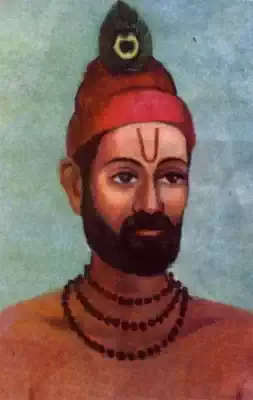
Kabir
Do Not Go To The Garden Of Flowers
Do Not Go To The Garden Of Flowers
Do not go to the garden of flowers!
Do not go to the garden of flowers!
O Friend! go not there;
In your body is the garden of flowers.
Take your seat on the thousand petals of the lotus,
and there gaze on the Infinite Beauty.
Do not go to the garden of flowers!
Do not go to the garden of flowers!
O Friend! go not there;
In your body is the garden of flowers.
Take your seat on the thousand petals of the lotus,
and there gaze on the Infinite Beauty.
288