
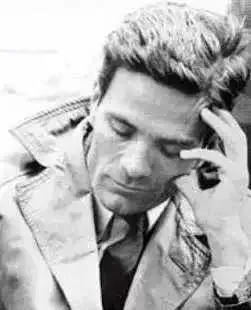
Pier Paolo Pasolini
1922–1975
· lived 53 years
 IT
IT
IT
Pier Paolo Pasolini was a multifaceted Italian intellectual, poet, filmmaker, writer, and thinker of the 20th century, known for his provocative and deeply critical work of contemporary society. His artistic and intellectual output spanned various areas, always with a sharp eye on the contradictions of modernity, marginality, religion, and politics. Pasolini stood out for his boldness in questioning established values and his ability to capture the complexity of the human condition.
n. 1922-03-05, Bolonha · m. 1975-11-02, Lido di Ostia
79
Views
Bio
Identification and basic context
Pier Paolo Pasolini was born in Bologna, Italy. He was an internationally renowned poet, writer, filmmaker, playwright, journalist, and intellectual. His work is characterized by a profound questioning of modern society, mass culture, religion, and politics. He lived during a period of intense social and cultural transformations in Italy, marked by the post-war era, the economic boom, and the emergence of new ideologies and lifestyles.Childhood and education
Son of an army officer and a teacher, Pasolini had a childhood marked by frequent changes of residence. His intellectual education was rich and diverse, with an early interest in literature, art, and languages. He studied Philology at the University of Bologna, where he developed a fascination for linguistics and ancient literature, influences that extended to his later poetic and cinematic work.Literary career
Pasolini's literary career began with poetry, with the publication of "Poesie a Casarsa" (Poems in Casarsa) in 1942, written in Friulian, his mother's language. His work evolved to prose and, later, to cinema, where he became a leading figure. His writing, both poetic and prose, is marked by a raw and direct language, exploring themes of marginality, homosexuality, and the crisis of values in Italian society.Work, style, and literary characteristics
Pasolini's work is vast and encompasses poetry, novels, essays, and films. "Ragazzi di vita" (Boys of Life, 1955) and "Una vita violenta" (A Violent Life, 1959) are novels that portray the lives of young people in the Roman outskirts. In cinema, films such as "Accattone" (1961), "Mamma Roma" (1962), and "Il Vangelo secondo Matteo" (The Gospel According to St. Matthew, 1964) explore social and religious themes with a unique aesthetic. His style is characterized by rawness, penetrating social analysis, and a profound, often unorthodox, religiosity. He frequently uses popular and dialectal language, lending authenticity to his characters and narratives.Cultural and historical context
Pasolini was a central figure in post-war Italian culture. His political positions, initially linked to the Communist Party, and his later scathing criticism of consumer society and cultural homogenization, made him a controversial figure. His work engaged with Italian history, social transformations, and the debate on national identity and modernity.Personal life
Pasolini's personal life was marked by his homosexuality, which he openly acknowledged in a still very repressive social context, and by a deep existential conflict. His personal relationships, his crises, and his constant search for meaning shaped his worldview and his artistic production. He was an engaged intellectual whose opinions and private life were frequently scrutinized by public opinion and the courts.Recognition and reception
Pasolini received international recognition, especially for his cinematic work, with several awards and distinctions. However, his work was often subject to controversy and censorship due to its themes and provocative style. His critical reception was, and continues to be, complex, oscillating between admiration for his genius and condemnation for his boldness.Influences and legacy
Pasolini was influenced by classical authors, the Bible, Marx, and figures of neorealist cinema. His legacy is immense, having influenced generations of filmmakers, writers, and thinkers with his critical approach to society, his exploration of marginality, and his profound spirituality.Interpretation and critical analysis
Pasolini's work is the subject of numerous critical interpretations. The analysis focuses on his critique of consumer society, his view of the "third world" as a refuge of authentic values, and his complex relationship with religion and sexuality. His works raise fundamental questions about the human condition, morality, and the future of civilization.Curiosities and lesser-known aspects
A curiosity about Pasolini is his obsession with documenting the lives of the popular classes and the marginalized, whom he saw as repositories of lost authenticity. His tragic and mysterious death contributed to his legendary aura.Death and memory
Pier Paolo Pasolini was brutally murdered in 1975, under circumstances that still generate debate and speculation today. His premature death deprived the world of one of the most important intellectuals and artists of the 20th century. His work continues to be studied, shown, and debated, ensuring his eternal memory.Poems
0No poems found
Videos
50
Comments (0)
Log in
to post a comment.
No comments yet. Be the first to comment.