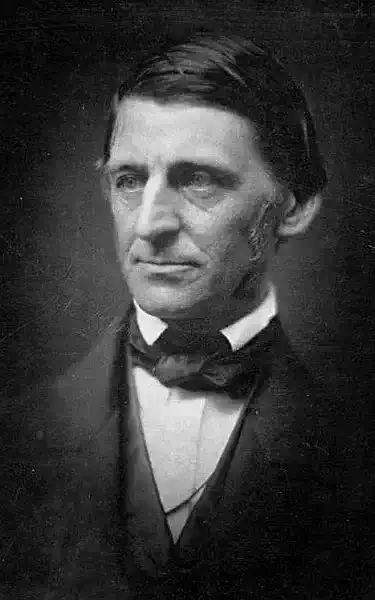
Ralph Waldo Emerson

Ralph Waldo Emerson

1803–1882 · lived 78 years US US

Ralph Waldo Emerson was a pivotal American essayist, lecturer, philosopher, and poet, widely regarded as the leader of the Transcendentalist movement. His philosophy emphasized individualism, self-reliance, the divinity of nature, and the inherent goodness of humanity. Emerson's prolific writings and eloquent lectures profoundly influenced American thought, literature, and culture, advocating for a spiritual and intellectual awakening distinct from European traditions. His ideas continue to inspire discussions on personal freedom, environmentalism, and the pursuit of truth.

n. 1803-05-25, Boston · m. 1882-04-27, Concord

69,923 Views

To-day

To-day
I rake no coffined clay, nor publish wide
The resurrection of departed pride.
Safe in their ancient crannies, dark and deep,
Let kings and conquerors, saints and soldiers sleep--
Late in the world,--too late perchance for fame,
Just late enough to reap abundant blame,--
I choose a novel theme, a bold abuse
Of critic charters, an unlaurelled Muse.
Old mouldy men and books and names and lands
Disgust my reason and defile my hands.
I had as lief respect an ancient shoe,
As love old things for age, and hate the new.
I spurn the Past, my mind disdains its nod,
Nor kneels in homage to so mean a God.
I laugh at those who, while they gape and gaze,
The bald antiquity of China praise.
Youth is (whatever cynic tubs pretend)
The fault that boys and nations soonest mend.
Read full poem
Bio

Identification and basic context

Ralph Waldo Emerson was an American essayist, lecturer, philosopher, and poet. He is best known as the central figure of the Transcendentalist movement. Born into a Unitarian ministerial family, he was a descendant of a long line of clergymen. His nationality was American, and he wrote and lectured primarily in English. Emerson lived during a period of significant intellectual and social ferment in the United States, marked by the burgeoning of American identity, reform movements (abolitionism, women's rights), and the philosophical and spiritual reorientation that characterized Transcendentalism.

Childhood and education

Emerson's childhood was marked by intellectual rigor and spiritual questioning. His father, William Emerson, was a prominent Unitarian minister, and his mother, Ruth Haskins Emerson, provided a devoted, though financially strained, upbringing. Emerson's father died when he was eight, leaving the family in precarious circumstances. He received his early education from tutors and attended the Boston Latin School. He entered Harvard College at the age of 14, graduating in 1821. He then studied at Harvard Divinity School, graduating in 1826, though he struggled with his calling to the ministry. His intellectual development was shaped by extensive reading of philosophy (Plato, Kant, Coleridge), theology, and literature, alongside a deep engagement with nature, which he viewed as a source of spiritual insight.

Literary trajectory

Emerson's formal ministry was brief, ending in 1832 due to his theological doubts and dissatisfaction with the ritualistic aspects of church services. He then embarked on a career as a public lecturer, which became his primary means of disseminating his ideas across America. His first major book, 'Nature' (1836), anonymously published, is considered the foundational text of Transcendentalism. This was followed by his influential essay "The American Scholar" (1837), delivered as an address at Harvard, which called for intellectual independence. His seminal essay collection, 'Essays: First Series' (1841), included "Self-Reliance," "The Over-Soul," and "Compensation," solidifying his reputation. 'Essays: Second Series' (1844) featured "The Poet" and "Experience." He also published 'Representative Men' (1850) and 'The Conduct of Life' (1860). Emerson was a prolific correspondent and his journals, published posthumously, are a treasure trove of his thought.

Works, style, and literary characteristics

Emerson's major works are his collections of essays, including 'Nature', 'Essays: First Series', and 'Essays: Second Series', as well as his lectures, which were often later published. His dominant themes include self-reliance, individualism, the divinity of nature, the spiritual unity of all beings (the Over-Soul), the importance of intuition over reason, social reform, and the rejection of conformity. Emerson's style is characterized by its aphoristic brilliance, eloquent prose, and a sometimes sermonic tone. He favored clarity and directness, often employing metaphors drawn from nature. His poetic voice is philosophical and inspirational, encouraging readers to seek truth within themselves and in the natural world. His language is elevated yet accessible, filled with memorable phrases that have become ingrained in the American lexicon. He championed a distinctly American literary voice, separate from European traditions.

Cultural and historical context

Emerson was a leading voice of Transcendentalism, a philosophical and literary movement that flourished in New England in the 1830s and 1840s. This movement emerged from Unitarianism but broke away to embrace a more mystical and idealistic worldview. He lived during a time of significant social reform movements in America, including abolitionism, temperance, and women's suffrage, and while he was an advocate for many reforms, his primary focus remained on individual spiritual and intellectual transformation. He engaged with contemporaries like Henry David Thoreau, Margaret Fuller, and Bronson Alcott, forming the core of the Transcendentalist circle. His ideas provided a philosophical underpinning for many of these reform efforts.

Personal life

Emerson's personal life was marked by profound intellectual curiosity and a deep connection to his family and community, though often tinged with personal loss. He married his first wife, Ellen Tucker, in 1829, but she died of tuberculosis in 1831, a loss that deeply affected him and contributed to his questioning of traditional religious frameworks. He remarried in 1835 to Lydia Jackson, who became a supportive partner and intellectual companion. He raised four children with Lydia. Emerson was a devoted friend and mentor to many, most notably Henry David Thoreau. His philosophical views were deeply held, emphasizing intuition, individual conscience, and a belief in the inherent moral order of the universe.

Recognition and reception

Emerson achieved significant recognition during his lifetime as a leading intellectual and orator. His lectures were widely attended, and his books were read with great interest, both in the United States and abroad, particularly in Britain. He was seen as a unique American voice, articulating a distinct national philosophy. While his ideas sometimes met with criticism for being too abstract or individualistic, his influence on American literature, philosophy, and public discourse was profound and enduring. He was honored with several honorary degrees and became an increasingly respected elder statesman of American letters.

Influences and legacy

Emerson was deeply influenced by German idealism (Kant), English Romantic poets (Coleridge, Wordsworth), and ancient Greek philosophy (Plato). His own influence has been immense. He is considered the father of American philosophy and a key figure in shaping American cultural identity. His ideas on self-reliance, individualism, and the importance of nature have resonated through generations, influencing writers such as Walt Whitman, Robert Frost, and many others. His advocacy for individual intuition and spiritual connection with the universe continues to inform movements in self-help, environmentalism, and New Age spirituality. His impact on American literature and thought is immeasurable.

Interpretation and critical analysis

Emerson's work is often interpreted as a call to individual spiritual and intellectual awakening. Critics have examined his philosophical concepts, such as the Over-Soul and the nature of genius, as well as his political and social implications. Debates have arisen concerning the potential for his emphasis on individualism to overlook social inequalities or to be interpreted as apolitical. However, his consistent calls for moral action and his involvement in reform movements suggest a complex engagement with societal issues. His writings continue to be analyzed for their philosophical depth, rhetorical power, and enduring relevance.

Curiosities and lesser-known aspects

Emerson was a prodigious record-keeper, filling over 17,000 pages of journals throughout his life, which served as a laboratory for his published works. He was known for his somewhat reserved public demeanor, yet possessed a sharp wit and a deep capacity for friendship. He maintained a lifelong interest in science and was fascinated by advancements in fields like geology and biology. His public speaking style was often characterized by his deliberate pace and measured delivery, which commanded attention.

Death and memory

Ralph Waldo Emerson died in 1882 at the age of 79. He passed away peacefully at his home in Concord, Massachusetts. His death was mourned by a nation that recognized him as one of its most important thinkers and writers. His legacy is preserved through his extensive body of published works, the continued study of his philosophy, and the enduring influence of his ideas on American culture, literature, and the concept of individual freedom and spiritual exploration.

Poems

34

The Bell

The Bell
I love thy music, mellow bell,
I love thine iron chime,
To life or death, to heaven or hell,
Which calls the sons of Time.
Thy voice upon the deep
The home-bound sea-boy hails,
It charms his cares to sleep,
It cheers him as he sails.
To house of God and heavenly joys
Thy summons called our sires,
And good men thought thy sacred voice
Disarmed the thunder's fires.
And soon thy music, sad death-bell,
Shall lift its notes once more,
And mix my requiem with the wind
That sweeps my native shore.
340

Sursum Corda

Sursum Corda
Seek not the Spirit, if it hide,
Inexorable to thy zeal:
Baby, do not whine and chide;
Art thou not also real?
Why should'st thou stoop to poor excuse?
Turn on the Accuser roundly; say,
"Here am I, here will I remain
Forever to myself soothfast,
Go thou, sweet Heaven, or, at thy pleasure stay."—
Already Heaven with thee its lot has cast,
For it only can absolutely deal.
384

Tact

Tact
What boots it, thy virtue,
What profit thy parts,
While one thing thou lackest,
The art of all arts!
The only credentials,
Passport to success,
Opens castle and parlor,—
Address, man, Address.
The maiden in danger
Was saved by the swain,
His stout arm restored her
To Broadway again:
The maid would reward him,—
Gay company come,—
They laugh, she laughs with them,
He is moonstruck and dumb.
This clenches the bargain,
Sails out of the bay,
Gets the vote in the Senate,
Spite of Webster and Clay;
Has for genius no mercy,
For speeches no heed,—
It lurks in the eyebeam,
It leaps to its deed.
Church, tavern, and market,
Bed and board it will sway;
It has no to-morrow,
It ends with to-day.
378

Rubies

Rubies
They brought me rubies from the mine,
And held them to the sun;
I said, they are drops of frozen wine
From Eden's vats that run.
I looked again,--I thought them hearts
Of friends to friends unknown;
Tides that should warm each neighboring life
Are locked in sparkling stone.
But fire to thaw that ruddy snow,
To break enchanted ice,
And give love's scarlet tides to flow,--
When shall that sun arise?
353

Seashore

Seashore
I heard or seemed to hear the chiding Sea
Say, Pilgrim, why so late and slow to come?
Am I not always here, thy summer home?
Is not my voice thy music, morn and eve?
My breath thy healthful climate in the heats,
My touch thy antidote, my bay thy bath?
Was ever building like my terraces?
Was ever couch magnificent as mine?
Lie on the warm rock-ledges, and there learn
A little hut suffices like a town.
I make your sculptured architecture vain,
Vain beside mine. I drive my wedges home,
And carve the coastwise mountain into caves.
Lo! here is Rome and Nineveh and Thebes,
Karnak and Pyramid and Giant's Stairs
Half piled or prostrate; and my newest slab
Older than all thy race.
Behold the Sea,
The opaline, the plentiful and strong,
Yet beautiful as is the rose in June,
Fresh as the trickling rainbow of July;
Sea full of food, the nourisher of kinds,
Purger of earth, and medicine of men;
Creating a sweet climate by my breath,
Washing out harms and griefs from memory,
And, in my mathematic ebb and flow,
Giving a hint of that which changes not.
Rich are the sea-gods:--who gives gifts but they?
They grope the sea for pearls, but more than pearls:
They pluck Force thence, and give it to the wise.
For every wave is wealth to Dædalus,
Wealth to the cunning artist who can work
This matchless strength. Where shall he find, O waves!
A load your Atlas shoulders cannot lift?
I with my hammer pounding evermore
The rocky coast, smite Andes into dust,
Strewing my bed, and, in another age,
Rebuild a continent of better men.
Then I unbar the doors: my paths lead out
The exodus of nations: I dispersed
Men to all shores that front the hoary main.
I too have arts and sorceries;
Illusion dwells forever with the wave.
I know what spells are laid. Leave me to deal
With credulous and imaginative man;
For, though he scoop my water in his palm,
A few rods off he deems it gems and clouds.
Planting strange fruits and sunshine on the shore,


I make some coast alluring, some lone isle,
To distant men, who must go there, or die.
396

Ode To William H. Channing

Ode To William H. Channing
Though loth to grieve
The evil time's sole patriot,
I cannot leave
My buried thought
For the priest's cant,
Or statesman's rant.
If I refuse
My study for their politique,
Which at the best is trick,
The angry muse
Puts confusion in my brain.
But who is he that prates
Of the culture of mankind,
Of better arts and life?
Go, blind worm, go,
Behold the famous States
Harrying Mexico
With rifle and with knife.
Or who, with accent bolder,
Dare praise the freedom-loving mountaineer,
I found by thee, O rushing Contoocook!
And in thy valleys, Agiochook!
The jackals of the negro-holder.
The God who made New Hampshire
Taunted the lofty land
With little men.
Small bat and wren
House in the oak.
If earth fire cleave
The upheaved land, and bury the folk,
The southern crocodile would grieve.
Virtue palters, right is hence,
Freedom praised but hid;
Funeral eloquence
Rattles the coffin-lid.
What boots thy zeal,
O glowing friend,
That would indignant rend
The northland from the south?
Wherefore? To what good end?
Boston Bay and Bunker Hill
Would serve things still:
Things are of the snake.
The horseman serves the horse,
The neat-herd serves the neat,


The merchant serves the purse,
The eater serves his meat;
'Tis the day of the chattel,
Web to weave, and corn to grind,
Things are in the saddle,
And ride mankind.
There are two laws discrete
Not reconciled,
Law for man, and law for thing;
The last builds town and fleet,
But it runs wild,
And doth the man unking.
'Tis fit the forest fall,
The steep be graded,
The mountain tunnelled,
The land shaded,
The orchard planted,
The globe tilled,
The prairie planted,
The steamer built.
Live for friendship, live for love,
For truth's and harmony's behoof;
The state may follow how it can,
As Olympus follows Jove.
Yet do not I implore
The wrinkled shopman to my sounding woods,
Nor bid the unwilling senator
Ask votes of thrushes in the solitudes.
Every one to his chosen work.
Foolish hands may mix and mar,
Wise and sure the issues are.
Round they roll, till dark is light,
Sex to sex, and even to odd;
The over-God,
Who marries Right to Might,
Who peoples, unpeoples,
He who exterminates
Races by stronger races,
Black by white faces,
Knows to bring honey
Out of the lion,
Grafts gentlest scion
On Pirate and Turk.
The Cossack eats Poland,
Like stolen fruit;
Her last noble is ruined,
Her last poet mute;
Straight into double band


The victors divide,
Half for freedom strike and stand,
The astonished muse finds thousands at her side.
341

Ode

Ode
Inscribed to W.H. Channing
Though loath to grieve
The evil time's sole patriot,
I cannot leave
My honeyed thought
For the priest's cant,
Or statesman's rant.
If I refuse
My study for their politic,
Which at the best is trick,
The angry Muse
Puts confusion in my brain.
But who is he that prates
Of the culture of mankind,
Of better arts and life?
Go, blindworm, go,
Behold the famous States
Harrying Mexico
With rifle and with knife!
Or who, with accent bolder
Dare praise the freedom-loving mountaineer?
I found by thee, O rushing Contoocook!
And in thy valleys, Agiochook!
The jackals of the Negro-holder.
The God who made New Hampshire
Taunted the lofty land
With little men;--
Small bat and wren
House in the oak:--
If earth-fire cleave
The upheaved land, and bury the folk,
The southern crocodile would grieve.
Virtue palters; Right is hence;
Freedom praised, but hid;
Funeral eloquence
Rattles the coffin lid.
What boots thy zeal,
O glowing friend,
That would indignant rend
The northland from the south?
Wherefore? to what good end?
Boston Bay and Bunker Hill
Would serve things still;--
Things are of the snake.


The horseman serves the horse
The neatherd serves the neat,
The merchant serves the purse,
The eater serves his meat;
'Tis the day of the chattel,
Web to weave, and corn to grind;
Things are in the saddle,
And ride mankind.
There are two laws discrete,
Not reconciled,--
Law for man, and law for thing;
The last builds town and fleet,
But it runs wild,
And doth the man unking.
'Tis fit the forest fall,
The steep be graded,
The mountain tunneled,
The sand shaded,
The orchard planted,
The glebe tilled,
The prairie granted
The steamer built.
Let man serve law for man;
Live for friendship, live for love,
For truth's and harmony's behoof;
The state may follow how it can,
As Olympus follows Jove.
Yet do not I implore
The wrinkled shopman to my sounding woods,
Nor did the unwilling senator
Ask votes of thrushes in the solitudes.
Everyone to his chosen work--
Foolish hands may mix and mar;
Wise and sure the issues are.
Round they roll till dark is light,
Sex to sex, and even to odd;--
The overgod
Who marries Right to Might,
Who peoples, unpeoples,--
He who exterminates
Races by stronger races,
Black by white faces,--
Knows to bring honey
Out of the lion;
Grafts gentlest scion
On pirate and Turk.
The Cossack eats Poland,


Like stolen fruit;
Her last noble is ruined,
Her last poet mute;
Straight, into double band
The victors divide;
Half for freedom strike and stand;--
The astonished Muse finds thousands at her side.
392

Monadnoc

Monadnoc
Thousand minstrels woke within me,
"Our music's in the hills; "—
Gayest pictures rose to win me,
Leopard-colored rills.
Up!—If thou knew'st who calls
To twilight parks of beech and pine,
High over the river intervals,
Above the ploughman's highest line,
Over the owner's farthest walls;—
Up!—where the airy citadel
O'erlooks the purging landscape's swell.
Let not unto the stones the day
Her lily and rose, her sea and land display;
Read the celestial sign!
Lo! the South answers to the North;
Bookworm, break this sloth urbane;
A greater Spirit bids thee forth,
Than the gray dreams which thee detain.
Mark how the climbing Oreads
Beckon thee to their arcades;
Youth, for a moment free as they,
Teach thy feet to feel the ground,
Ere yet arrive the wintry day
When Time thy feet has bound.
Accept the bounty of thy birth;
Taste the lordship of the earth.
I heard and I obeyed,
Assured that he who pressed the claim,
Well-known, but loving not a name,
Was not to be gainsaid.
Ere yet the summoning voice was still,
I turned to Cheshire's haughty hill.
From the fixed cone the cloud-rack flowed
Like ample banner flung abroad
Round about, a hundred miles,
With invitation to the sea, and to the bordering isles.
In his own loom's garment drest,
By his own bounty blest,
Fast abides this constant giver,
Pouring many a cheerful river;
To far eyes, an aërial isle,
Unploughed, which finer spirits pile,
Which morn and crimson evening paint
For bard, for lover, and for saint;
The country's core,
Inspirer, prophet evermore,
Pillar which God aloft had set
So that men might it not forget,


It should be their life's ornament,
And mix itself with each event;
Their calendar and dial,
Barometer, and chemic phial,
Garden of berries, perch of birds,
Pasture of pool-haunting herds,
Graced by each change of sum untold,
Earth-baking heat, stone-cleaving cold.
The Titan minds his sky-affairs,
Rich rents and wide alliance shares;
Mysteries of color daily laid
By the great sun in light and shade,
And, sweet varieties of chance,
And the mystic seasons' dance,
And thief-like step of liberal hours
Which thawed the snow-drift into flowers.
O wondrous craft of plant and stone
By eldest science done and shown!
Happy, I said, whose home is here,
Fair fortunes to the mountaineer!
Boon nature to his poorest shed
Has royal pleasure-grounds outspread.
Intent I searched the region round,
And in low hut my monarch found.
He was no eagle and no earl,
Alas! my foundling was a churl,
With heart of cat, and eyes of bug,
Dull victim of his pipe and mug;
Woe is me for my hopes' downfall!
Lord! is yon squalid peasant all
That this proud nursery could breed
For God's vicegerency and stead?
Time out of mind this forge of ores,
Quarry of spars in mountain pores,
Old cradle, hunting ground, and bier
Of wolf and otter, bear, and deer;
Well-built abode of many a race;
Tower of observance searching space;
Factory of river, and of rain;
Link in the alps' globe-girding chain;
By million changes skilled to tell
What in the Eternal standeth well,
And what obedient nature can,—
Is this colossal talisman
Kindly to creature, blood, and kind,
And speechless to the master's mind?
I thought to find the patriots
In whom the stock of freedom roots.
To myself I oft recount
Tales of many a famous mount.—


Wales, Scotland, Uri, Hungary's dells,
Roys, and Scanderbegs, and Tells.
Here now shall nature crowd her powers,
Her music, and her meteors,
And, lifting man to the blue deep
Where stars their perfect courses keep,
Like wise preceptor lure his eye
To sound the science of the sky,
And carry learning to its height
Of untried power and sane delight;
The Indian cheer, the frosty skies
Breed purer wits, inventive eyes,
Eyes that frame cities where none be,
And hands that stablish what these see:
And, by the moral of his place,
Hint summits of heroic grace;
Man in these crags a fastness find
To fight pollution of the mind;
In the wide thaw and ooze of wrong,
Adhere like this foundation strong,
The insanity of towns to stem
With simpleness for stratagem.
But if the brave old mould is broke,
And end in clowns the mountain-folk,
In tavern cheer and tavern joke,—
Sink, O mountain! in the swamp,
Hide in thy skies, O sovereign lap!
Perish like leaves the highland breed!
No sire survive, no son succeed!
Soft! let not the offended muse
Toil's hard hap with scorn accuse.
Many hamlets sought I then,
Many farms of mountain men;—
Found I not a minstrel seed,
But men of bone, and good at need.
Rallying round a parish steeple
Nestle warm the highland people,
Coarse and boisterous, yet mild,
Strong as giant, slow as child,
Smoking in a squalid room,
Where yet the westland breezes come.
Close hid in those rough guises lurk
Western magians, here they work;
Sweat and season are their arts,
Their talismans are ploughs and carts;
And well the youngest can command
Honey from the frozen land,
With sweet hay the swamp adorn,
Change the running sand to corn,
For wolves and foxes, lowing herds,
And for cold mosses, cream and curds;


Weave wood to canisters and mats,
Drain sweet maple-juice in vats.
No bird is safe that cuts the air,
From their rifle or their snare;
No fish in river or in lake,
But their long hands it thence will take;
And the country's iron face
Like wax their fashioning skill betrays,
To fill the hollows, sink the hills,
Bridge gulfs, drain swamps, build dams and mills,
And fit the bleak and howling place
For gardens of a finer race,
The world-soul knows his own affair,
Fore-looking when his hands prepare
For the next ages men of mould,
Well embodied, well ensouled,
He cools the present's fiery glow,
Sets the life pulse strong, but slow.
Bitter winds and fasts austere.
His quarantines and grottos, where
He slowly cures decrepit flesh,
And brings it infantile and fresh.
These exercises are the toys
And games with which he breathes his boys.
They bide their time, and well can prove,
If need were, their line from Jove,
Of the same stuff, and so allayed,
As that whereof the sun is made;
And of that fibre quick and strong
Whose throbs are love, whose thrills are song.
Now in sordid weeds they sleep,
Their secret now in dulness keep.
Yet, will you learn our ancient speech,
These the masters who can teach,
Fourscore or a hundred words
All their vocal muse affords,
These they turn in other fashion
Than the writer or the parson.
I can spare the college-bell,
And the learned lecture well.
Spare the clergy and libraries,
Institutes and dictionaries,
For the hardy English root
Thrives here unvalued underfoot.
Rude poets of the tavern hearth,
Squandering your unquoted mirth,
Which keeps the ground and never soars,
While Jake retorts and Reuben roars,
Tough and screaming as birch-bark,
Goes like bullet to its mark,
While the solid curse and jeer
Never balk the waiting ear:


To student ears keen-relished jokes
On truck, and stock, and farming-folks,—
Nought the mountain yields thereof
But savage health and sinews tough.
On the summit as I stood,
O'er the wide floor of plain and flood,
Seemed to me the towering hill
Was not altogether still,
But a quiet sense conveyed;
If I err not, thus it said:
Many feet in summer seek
Betimes my far-appearing peak;
In the dreaded winter-time,
None save dappling shadows climb
Under clouds my lonely head,
Old as the sun, old almost as the shade.
And comest thou
To see strange forests and new snow,
And tread uplifted land?
And leavest thou thy lowland race,
Here amid clouds to stand,
And would'st be my companion,
Where I gaze
And shall gaze
When forests fall, and man is gone,
Over tribes and over times
As the burning Lyre
Nearing me,
With its stars of northern fire,
In many a thousand years.
Ah! welcome, if thou bring
My secret in thy brain;
To mountain-top may muse's wing
With good allowance strain.
Gentle pilgrim, if thou know
The gamut old of Pan,
And how the hills began,
The frank blessings of the hill
Fall on thee, as fall they will.
'Tis the law of bush and stone—
Each can only take his own.
Let him heed who can and will,—
Enchantment fixed me here
To stand the hurts of time, until
In mightier chant I disappear.
If thou trowest
How the chemic eddies play
Pole to pole, and what they say,
And that these gray crags


Not on crags are hung,
But beads are of a rosary
On prayer and music strung;
And, credulous, through the granite seeming
Seest the smile of Reason beaming;
Can thy style-discerning eye
The hidden-working Builder spy,
Who builds, yet makes no chips, no din,
With hammer soft as snow-flake's flight;
Knowest thou this?
O pilgrim, wandering not amiss!
Already my rocks lie light,
And soon my cone will spin.
For the world was built in order,
And the atoms march in tune,
Rhyme the pipe, and time the warder,
Cannot forget the sun, the moon.
Orb and atom forth they prance,
When they hear from far the rune,
None so backward in the troop,
When the music and the dance
Reach his place and circumstance,
But knows the sun-creating sound,
And, though a pyramid, will bound.
Monadnoc is a mountain strong,
Tall and good my kind among,
But well I know, no mountain can
Measure with a perfect man;
For it is on Zodiack's writ,
Adamant is soft to wit;
And when the greater comes again,
With my music in his brain,
I shall pass as glides my shadow
Daily over hill and meadow.
Through all time
I hear the approaching feet
Along the flinty pathway beat
Of him that cometh, and shall come,—
Of him who shall as lightly bear
My daily load of woods and streams,
As now the round sky-cleaving boat
Which never strains its rocky beams,
Whose timbers, as they silent float,
Alps and Caucasus uprear,
And the long Alleghanies here,
And all town-sprinkled lands that be,
Sailing through stars with all their history.
Every morn I lift my head,
Gaze o'er New England underspread


South from Saint Lawrence to the Sound,
From Katshill east to the sea-bound.
Anchored fast for many an age,
I await the bard and sage,
Who in large thoughts, like fair pearl-seed,
Shall string Monadnoc like a bead.
Comes that cheerful troubadour,
This mound shall throb his face before,
As when with inward fires and pain
It rose a bubble from the plain.
When he cometh, I shall shed
From this well-spring in my head
Fountain drop of spicier worth
Than all vintage of the earth.
There's fruit upon my barren soil
Costlier far than wine or oil;
There's a berry blue and gold,—
Autumn-ripe its juices hold,
Sparta's stoutness, Bethlehem's heart,
Asia's rancor, Athens' art,
Slowsure Britain's secular might,
And the German's inward sight;
I will give my son to eat
Best of Pan's immortal meat,
Bread to eat and juice to drink,
So the thoughts that he shall think
Shall not be forms of stars, but stars,
Nor pictures pale, but Jove and Mars.
He comes, but not of that race bred
Who daily climb my specular head.
Oft as morning wreathes my scarf,
Fled the last plumule of the dark,
Pants up hither the spruce clerk
From South-Cove and City-wharf;
I take him up my rugged sides,
Half-repentant, scant of breath,—
Bead-eyes my granite chaos show,
And my midsummer snow;
Open the daunting map beneath,—
All his county, sea and land,
Dwarfed to measure of his hand;
His day's ride is a furlong space,
His city tops a glimmering haze:
I plant his eyes on the sky-hoop bounding;—
See there the grim gray rounding
Of the bullet of the earth
Whereon ye sail,
Tumbling steep
In the uncontinented deep;—
He looks on that, and he turns pale:
'Tis even so, this treacherous kite,


Farm-furrowed, town-incrusted sphere,
Thoughtless of its anxious freight,
Plunges eyeless on for ever,
And he, poor parasite,—
Cooped in a ship he cannot steer,
Who is the captain he knows not,
Port or pilot trows not,—
Risk or ruin he must share.
I scowl on him with my cloud,
With my north wind chill his blood,
I lame him clattering down the rocks,
And to live he is in fear.
Then, at last, I let him down
Once more into his dapper town,
To chatter frightened to his clan,
And forget me, if he can.
As in the old poetic fame
The gods are blind and lame,
And the simular despite
Betrays the more abounding might,
So call not waste that barren cone
Above the floral zone,
Where forests starve:
It is pure use;
What sheaves like those which here we glean and bind,
Of a celestial Ceres, and the Muse?
Ages are thy days,
Thou grand expressor of the present tense,
And type of permanence,
Firm ensign of the fatal Being,
Amid these coward shapes of joy and grief
That will not bide the seeing.
Hither we bring
Our insect miseries to the rocks,
And the whole flight with pestering wing
Vanish and end their murmuring,
Vanish beside these dedicated blocks,
Which, who can tell what mason laid?
Spoils of a front none need restore,
Replacing frieze and architrave;
Yet flowers each stone rosette and metope brave,
Still is the haughty pile erect
Of the old building Intellect.
Complement of human kind,
Having us at vantage still,
Our sumptuous indigence,
O barren mound! thy plenties fill.
We fool and prate,—
Thou art silent and sedate.
To million kinds and times one sense
The constant mountain doth dispense,


Shedding on all its snows and leaves,
One joy it joys, one grief it grieves.
Thou seest, O watchman tall!
Our towns and races grow and fall,
And imagest the stable Good
For which we all our lifetime grope,
In shifting form the formless mind;
And though the substance us elude,
We in thee the shadow find.
Thou in our astronomy
An opaker star,
Seen, haply, from afar,
Above the horizon's hoop.
A moment by the railway troop,
As o'er some bolder height they speed,—
By circumspect ambition,
By errant Gain,
By feasters, and the frivolous,—
Recallest us,
And makest sane.
Mute orator! well-skilled to plead,
And send conviction without phrase,
Thou dost supply
The shortness of our days,
And promise, on thy Founder's truth,
Long morrow to this mortal youth.

477

My Garden

My Garden
If I could put my woods in song
And tell what's there enjoyed,
All men would to my gardens throng,
And leave the cities void.
In my plot no tulips blow,--
Snow-loving pines and oaks instead;
And rank the savage maples grow
From Spring's faint flush to Autumn red.
My garden is a forest ledge
Which older forests bound;
The banks slope down to the blue lake-edge,
Then plunge to depths profound.
Here once the Deluge ploughed,
Laid the terraces, one by one;
Ebbing later whence it flowed,
They bleach and dry in the sun.
The sowers made haste to depart,--
The wind and the birds which sowed it;
Not for fame, nor by rules of art,
Planted these, and tempests flowed it.
Waters that wash my garden-side
Play not in Nature's lawful web,
They heed not moon or solar tide,--
Five years elapse from flood to ebb.
Hither hasted, in old time, Jove,
And every god,--none did refuse;
And be sure at last came Love,
And after Love, the Muse.
Keen ears can catch a syllable,
As if one spake to another,
In the hemlocks tall, untamable,
And what the whispering grasses smother.
Æolian harps in the pine
Ring with the song of the Fates;
Infant Bacchus in the vine,--
Far distant yet his chorus waits.
Canst thou copy in verse one chime
Of the wood-bell's peal and cry,
Write in a book the morning's prime,
Or match with words that tender sky?
Wonderful verse of the gods,
Of one import, of varied tone;


They chant the bliss of their abodes
To man imprisoned in his own.
Ever the words of the gods resound;
But the porches of man's ear
Seldom in this low life's round
Are unsealed, that he may hear.
Wandering voices in the air
And murmurs in the wold
Speak what I cannot declare,
Yet cannot all withhold.
When the shadow fell on the lake,
The whirlwind in ripples wrote
Air-bells of fortune that shine and break,
And omens above thought.
But the meanings cleave to the lake,
Cannot be carried in book or urn;
Go thy ways now, come later back,
On waves and hedges still they burn.
These the fates of men forecast,
Of better men than live to-day;
If who can read them comes at last
He will spell in the sculpture,'Stay.'
389

Merlin I

Merlin I
Thy trivial harp will never please
Or fill my craving ear;
Its chords should ring as blows the breeze,
Free, peremptory, clear.
No jingling serenader's art,
Nor tinkle of piano strings,
Can make the wild blood start
In its mystic springs.
The kingly bard
Must smite the chords rudely and hard,
As with hammer or with mace,
That they may render back
Artful thunder that conveys
Secrets of the solar track,
Sparks of the supersolar blaze.
Merlin's blows are strokes of fate,
Chiming with the forest-tone,
When boughs buffet boughs in the wood;
Chiming with the gasp and moan
Of the ice-imprisoned flood;
With the pulse of manly hearts,
With the voice of orators,
With the din of city arts,
With the cannonade of wars.
With the marches of the brave,
And prayers of might from martyrs' cave.
Great is the art,
Great be the manners of the bard!
He shall not his brain encumber
With the coil of rhythm and number,
But, leaving rule and pale forethought,
He shall aye climb
For his rhyme:
Pass in, pass in, the angels say,
In to the upper doors;
Nor count compartments of the floors,
But mount to Paradise
By the stairway of surprise.
Blameless master of the games,
King of sport that never shames;
He shall daily joy dispense
Hid in song's sweet influence.
Things more cheerly live and go,
What time the subtle mind
Plays aloud the tune whereto
Their pulses beat,
And march their feet,
And their members are combined.
By Sybarites beguiled


He shall no task decline;
Merlin's mighty line,
Extremes of nature reconciled,
Bereaved a tyrant of his will,
And made the lion mild.
Songs can the tempest still,
Scattered on the stormy air,
Mould the year to fair increase,
And bring in poetic peace.
He shall not seek to weave,
In weak unhappy times,
Efficacious rhymes;
Wait his returning strength,
Bird, that from the nadir's floor,
To the zenith's top could soar,
The soaring orbit of the muse exceeds that journey's length!
Nor, profane, affect to hit
Or compass that by meddling wit,
Which only the propitious mind
Publishes when 'tis inclined.
There are open hours
When the god's will sallies free,
And the dull idiot might see
The flowing fortunes of a thousand years;
Sudden, at unawares,
Self-moved fly-to the doors,
Nor sword of angels could reveal
What they conceal.
384

Quotes

40

Videos

50

Comments (0)

Share
Log in to post a comment.

No comments yet. Be the first to comment.