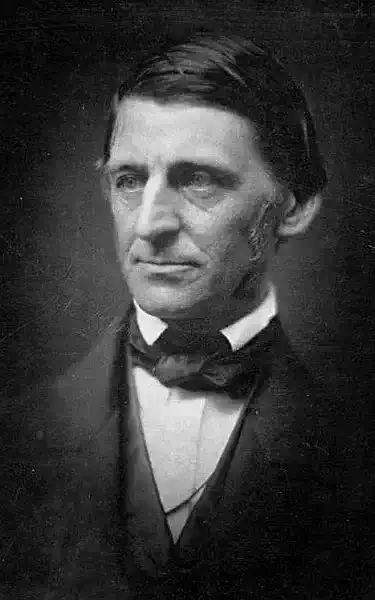
Identification and basic context
Ralph Waldo Emerson was an American essayist, lecturer, philosopher, and poet. He is best known as the central figure of the Transcendentalist movement. Born into a Unitarian ministerial family, he was a descendant of a long line of clergymen. His nationality was American, and he wrote and lectured primarily in English. Emerson lived during a period of significant intellectual and social ferment in the United States, marked by the burgeoning of American identity, reform movements (abolitionism, women's rights), and the philosophical and spiritual reorientation that characterized Transcendentalism.
Childhood and education
Emerson's childhood was marked by intellectual rigor and spiritual questioning. His father, William Emerson, was a prominent Unitarian minister, and his mother, Ruth Haskins Emerson, provided a devoted, though financially strained, upbringing. Emerson's father died when he was eight, leaving the family in precarious circumstances. He received his early education from tutors and attended the Boston Latin School. He entered Harvard College at the age of 14, graduating in 1821. He then studied at Harvard Divinity School, graduating in 1826, though he struggled with his calling to the ministry. His intellectual development was shaped by extensive reading of philosophy (Plato, Kant, Coleridge), theology, and literature, alongside a deep engagement with nature, which he viewed as a source of spiritual insight.
Literary trajectory
Emerson's formal ministry was brief, ending in 1832 due to his theological doubts and dissatisfaction with the ritualistic aspects of church services. He then embarked on a career as a public lecturer, which became his primary means of disseminating his ideas across America. His first major book, 'Nature' (1836), anonymously published, is considered the foundational text of Transcendentalism. This was followed by his influential essay "The American Scholar" (1837), delivered as an address at Harvard, which called for intellectual independence. His seminal essay collection, 'Essays: First Series' (1841), included "Self-Reliance," "The Over-Soul," and "Compensation," solidifying his reputation. 'Essays: Second Series' (1844) featured "The Poet" and "Experience." He also published 'Representative Men' (1850) and 'The Conduct of Life' (1860). Emerson was a prolific correspondent and his journals, published posthumously, are a treasure trove of his thought.
Works, style, and literary characteristics
Emerson's major works are his collections of essays, including 'Nature', 'Essays: First Series', and 'Essays: Second Series', as well as his lectures, which were often later published. His dominant themes include self-reliance, individualism, the divinity of nature, the spiritual unity of all beings (the Over-Soul), the importance of intuition over reason, social reform, and the rejection of conformity. Emerson's style is characterized by its aphoristic brilliance, eloquent prose, and a sometimes sermonic tone. He favored clarity and directness, often employing metaphors drawn from nature. His poetic voice is philosophical and inspirational, encouraging readers to seek truth within themselves and in the natural world. His language is elevated yet accessible, filled with memorable phrases that have become ingrained in the American lexicon. He championed a distinctly American literary voice, separate from European traditions.
Cultural and historical context
Emerson was a leading voice of Transcendentalism, a philosophical and literary movement that flourished in New England in the 1830s and 1840s. This movement emerged from Unitarianism but broke away to embrace a more mystical and idealistic worldview. He lived during a time of significant social reform movements in America, including abolitionism, temperance, and women's suffrage, and while he was an advocate for many reforms, his primary focus remained on individual spiritual and intellectual transformation. He engaged with contemporaries like Henry David Thoreau, Margaret Fuller, and Bronson Alcott, forming the core of the Transcendentalist circle. His ideas provided a philosophical underpinning for many of these reform efforts.
Personal life
Emerson's personal life was marked by profound intellectual curiosity and a deep connection to his family and community, though often tinged with personal loss. He married his first wife, Ellen Tucker, in 1829, but she died of tuberculosis in 1831, a loss that deeply affected him and contributed to his questioning of traditional religious frameworks. He remarried in 1835 to Lydia Jackson, who became a supportive partner and intellectual companion. He raised four children with Lydia. Emerson was a devoted friend and mentor to many, most notably Henry David Thoreau. His philosophical views were deeply held, emphasizing intuition, individual conscience, and a belief in the inherent moral order of the universe.
Recognition and reception
Emerson achieved significant recognition during his lifetime as a leading intellectual and orator. His lectures were widely attended, and his books were read with great interest, both in the United States and abroad, particularly in Britain. He was seen as a unique American voice, articulating a distinct national philosophy. While his ideas sometimes met with criticism for being too abstract or individualistic, his influence on American literature, philosophy, and public discourse was profound and enduring. He was honored with several honorary degrees and became an increasingly respected elder statesman of American letters.
Influences and legacy
Emerson was deeply influenced by German idealism (Kant), English Romantic poets (Coleridge, Wordsworth), and ancient Greek philosophy (Plato). His own influence has been immense. He is considered the father of American philosophy and a key figure in shaping American cultural identity. His ideas on self-reliance, individualism, and the importance of nature have resonated through generations, influencing writers such as Walt Whitman, Robert Frost, and many others. His advocacy for individual intuition and spiritual connection with the universe continues to inform movements in self-help, environmentalism, and New Age spirituality. His impact on American literature and thought is immeasurable.
Interpretation and critical analysis
Emerson's work is often interpreted as a call to individual spiritual and intellectual awakening. Critics have examined his philosophical concepts, such as the Over-Soul and the nature of genius, as well as his political and social implications. Debates have arisen concerning the potential for his emphasis on individualism to overlook social inequalities or to be interpreted as apolitical. However, his consistent calls for moral action and his involvement in reform movements suggest a complex engagement with societal issues. His writings continue to be analyzed for their philosophical depth, rhetorical power, and enduring relevance.
Curiosities and lesser-known aspects
Emerson was a prodigious record-keeper, filling over 17,000 pages of journals throughout his life, which served as a laboratory for his published works. He was known for his somewhat reserved public demeanor, yet possessed a sharp wit and a deep capacity for friendship. He maintained a lifelong interest in science and was fascinated by advancements in fields like geology and biology. His public speaking style was often characterized by his deliberate pace and measured delivery, which commanded attention.
Death and memory
Ralph Waldo Emerson died in 1882 at the age of 79. He passed away peacefully at his home in Concord, Massachusetts. His death was mourned by a nation that recognized him as one of its most important thinkers and writers. His legacy is preserved through his extensive body of published works, the continued study of his philosophy, and the enduring influence of his ideas on American culture, literature, and the concept of individual freedom and spiritual exploration.