
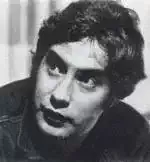
Rolf Dieter Brinkmann
1940–1975
· lived 35 years
 DE
DE
DE
Rolf Dieter Brinkmann was a German poet, a central figure in post-war German experimental poetry and concrete poetry. His work, marked by the deconstruction of language and the exploration of new forms of expression, addressed themes such as urban alienation, mass culture, and the search for authenticity in an increasingly media-driven and fragmented world. Brinkmann was an innovator, challenging literary conventions and paving the way for future poetic experimentation.
n. 1940-04-16, Vechta · m. 1975-04-23, Londres
52
Views
Bio
Identification and basic context
Rolf Dieter Brinkmann (1940-1975) was a prominent German poet, novelist, and translator. He is considered one of the most important and innovative poets in Germany in the second half of the 20th century, associated with experimental poetry and concrete poetry. His work challenged established literary conventions and explored new ways of representing reality, particularly in the context of consumer society and mass culture.Childhood and education
Brinkmann was born in Szczecin (now Poland), and his childhood was marked by the turmoil of World War II and the subsequent displacement. After the war, his family settled in West Germany. His academic training was not linear; he had an apprenticeship as an insurance agent but soon dedicated himself to literature. He was a voracious autodidact, drawing influences from diverse sources, including American literature, existentialist philosophy, and artistic avant-gardes.Literary career
Brinkmann's literary career began in the 1960s. He quickly distinguished himself with his radical and innovative approach to poetic language. He was one of the founders of the concrete poetry movement in Germany, using visual and sound elements to compose his poems. He published several books of poetry and prose, which generated both admiration and controversy. His short but intense career was marked by constant experimentation and a desire to break with traditional forms.Work, style, and literary characteristics
Work, style, and literary characteristics Brinkmann's work is characterized by the deconstruction of language, the collage of disparate elements (advertising texts, news items, quotes, colloquial language), and the exploration of the visual and sonic dimensions of the poem. Recurring themes include alienation in modern society, the influence of mass culture, ephemerality, sexuality, the search for authenticity, and criticism of conformism. He used free verse, poetic prose, and innovated with techniques such as "cut-up" (inspired by William S. Burroughs) and "collage poetry." His language is often fragmented, ironic, and visceral, reflecting the complexity and artificiality of the contemporary world. Among his most important works are "Lesebuch" (1970) and "Westwärts 1-2-3-4-5" (1972).Work, style, and literary characteristics
Cultural and historical context Brinkmann lived and produced his work during a period of great cultural and political effervescence in West Germany, marked by post-war reconstruction, the "economic miracle," the student movements of 1968, and the tensions of the Cold War. His poetry reflects skepticism towards official narratives and a deep awareness of media manipulation and the superficiality of consumer society. He was a contemporary of other important poets of his generation, with whom he dialogued and sometimes diverged.Work, style, and literary characteristics
Personal life Brinkmann's personal life was marked by an intensity and self-destruction that were reflected in his work. Far from being a reclusive figure, he had intense and sometimes tumultuous relationships. He was known for his strong personality and his confrontational stance towards social and literary norms. His life was cut short by health problems and, according to some accounts, substance abuse.Work, style, and literary characteristics
Recognition and reception During his lifetime, Brinkmann was a controversial figure, admired by some for his audacity and criticized by others for his radical and sometimes shocking approach. After his premature death, his recognition grew considerably, making him an unavoidable reference in modern and experimental German poetry. His work is the subject of academic study and continues to influence contemporary poets.Work, style, and literary characteristics
Influences and legacy Brinkmann was deeply influenced by American Beat poetry (Allen Ginsberg, Jack Kerouac), the work of Gertrude Stein and William S. Burroughs, as well as European avant-gardes and pop culture. His legacy lies in his ability to renew poetic language, to incorporate the reality of urban and media life into his verses, and to open up new possibilities for literary experimentation in Germany. He influenced later generations of poets who sought more direct and critical ways of approaching the world.Work, style, and literary characteristics
Interpretation and critical analysis Brinkmann's work is often analyzed from the perspective of social criticism, semiotics, and cultural studies, given his exploration of language as a means of reflecting on consumer society and the production of meaning. His collages and use of fragments of popular culture are seen as a way of exposing the artificiality and superficiality of media messages. His poetry invites an analysis of the relationship between the individual and a world increasingly saturated with information and stimuli.Work, style, and literary characteristics
Curiosities and lesser-known aspects A curiosity about Brinkmann is his fascination with American culture, which he saw as a model of modernity but also as a symbol of alienation and commodification. His confrontational attitude and bohemian lifestyle made him an almost mythical figure for many. His diaries and correspondence reveal a more vulnerable and introspective side, contrasting with his more challenging public image.Work, style, and literary characteristics
Death and memory Rolf Dieter Brinkmann died in 1975, at the age of 35, in Cologne, due to health complications, possibly aggravated by his lifestyle. His premature death contributed to the mythical aura surrounding his figure. Posthumous publications and reissues of his works have kept his memory and his importance in the history of German literature alive.Poems
0No poems found
Comments (0)
Log in
to post a comment.
No comments yet. Be the first to comment.