
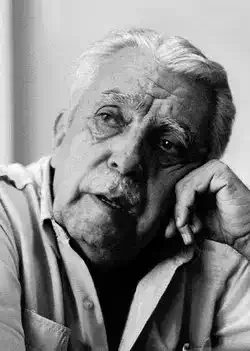
Rubem Braga
 BR
BR
Rubem Braga was one of the most important Brazilian poets of the 20th century, known for his lyrical work and his ability to capture the beauty of everyday life and the intensity of human emotions. His poetry is marked by apparent simplicity, musicality, and a worldview that oscillates between optimism and melancholy. His vast literary production, which also includes chronicles and short stories, reveals a deep love for nature, for Rio de Janeiro, and for the simple joys of life, consolidating him as a master in the art of poeticizing the prosaic and the profound.
n. 1913-01-12, Cachoeiro de Itapemirim · m. 1990-12-19, Rio de Janeiro
Bio
Identification and basic context
Rubem Braga (1913-2002) was a Brazilian poet, chronicler, and short story writer. He was born in Cachoeiro de Itapemirim, Espírito Santo, and passed away in Rio de Janeiro. He is considered one of the great names of modern Brazilian poetry and a master of the chronicle.Childhood and education
His childhood and youth in the interior of Espírito Santo, in contact with exuberant nature, profoundly shaped his poetic sensitivity and his appreciation for the natural environment, recurring themes in his work. He was largely self-taught in literature, although he started a Law degree.Literary career
Rubem Braga began writing poetry in his adolescence and quickly stood out. He moved to Rio de Janeiro, where he became a central figure in cultural life. He published his first book, "A Rua sem Sol," in 1934. Throughout his career, he published several books of poetry and chronicles, collaborating with important newspapers and magazines.Work, style, and literary characteristics
His main works include books such as "Poemas de Rubem Braga" (1955), "O Sol na Fogueira" (1947), "A Boa Terra" (1962), and "O Homem Involuntário" (1964). The dominant themes in his poetry are love, nature (with emphasis on Brazilian flora and fauna), Rio de Janeiro, the passage of time, childhood, death, and poetry itself. Braga's style is characterized by simplicity and clarity, with colloquial yet lyrical language. He uses free verse, but with a strong sense of rhythm and musicality. His poetic voice is confessional, tender, and sometimes ironic, revealing a deep empathy with human beings and the world around him.Work, style, and literary characteristics
Cultural and historical context Rubem Braga lived and produced during a period of intense transformations in Brazil and the world, including the Vargas Era, World War II, the military dictatorship, and the period of redemocratization. He was an engaged intellectual, although his poetry did not always directly address political issues, but rather the human being in their relationship with the world.Work, style, and literary characteristics
Personal life His life was marked by a great passion for nature, intense loves, and sincere friendships. He had a strong connection with the city of Rio de Janeiro, where he lived much of his life, and with his hometown. His work reflects this intense experience and his ability to extract poetry from everyday life.Work, style, and literary characteristics
Recognition and reception Rubem Braga is one of the most popular and widely read poets in Brazil. He received several literary awards, and his work is extensively studied in schools and universities. He is admired by both the general public and specialized critics.Work, style, and literary characteristics
Influences and legacy He was influenced by poets such as Manuel Bandeira and Carlos Drummond de Andrade, but he developed a unique poetic voice. His legacy is immense, especially for the way he humanized poetry, bringing it closer to the common reader and showing the beauty hidden in the simple things in life.Work, style, and literary characteristics
Interpretation and critical analysis Rubem Braga's poetry is often analyzed for its ability to merge lyricism with the prosaic, nature with the city, the lyrical self with the collective. His reflections on life, love, and death resonate deeply with the reader.Work, style, and literary characteristics
Curiosities and lesser-known aspects Rubem Braga was known for his love of animals, especially dogs, and for his intimate relationship with nature, which he often frequented at his farm in São Jacinto, Rio de Janeiro. His ability for detailed observation of the world around him is a hallmark of his writing.Work, style, and literary characteristics
Death and memory Rubem Braga passed away in 2002, at the age of 88, in Rio de Janeiro. His death was felt as the loss of one of Brazil's greatest poets. His work continues to be celebrated and to inspire new generations of readers and writers.Poems
0No poems found
Videos
50
Comments (0)
No comments yet. Be the first to comment.