Sarojini Naidu

Sarojini Naidu

1879–1949 · lived 70 years -- --

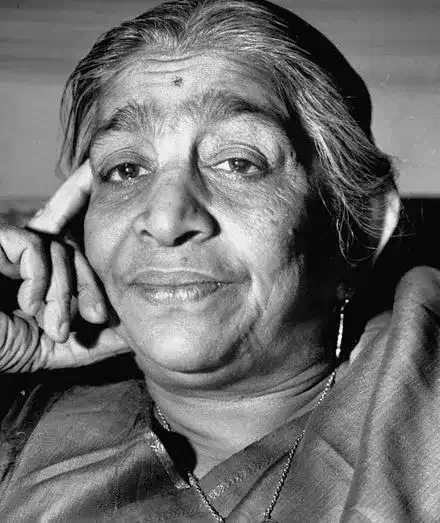
Sarojini Naidu was a prominent Indian poet and a key figure in the Indian independence movement. Known as the "Nightingale of India," her poetry often celebrated Indian culture, love, and patriotism, earning her acclaim in both India and abroad. Beyond her literary contributions, Naidu was a fervent nationalist, a suffragist, and a powerful orator who played a crucial role in India's struggle for freedom from British rule. She served as the first Indian woman to hold the office of Governor of a state in India.

n. 1879-02-13, Hyderabad · m. 1949-03-02, Lucknow

13,347 Views

Wandering Singers

Wandering Singers

WHERE the voice of the wind calls our wandering feet,
Through echoing forest and echoing street,
With lutes in our hands ever-singing we roam,
All men are our kindred, the world is our home.
Our lays are of cities whose lustre is shed,
The laughter and beauty of women long dead;
The sword of old battles, the crown of old kings,
And happy and simple and sorrowful things.
What hope shall we gather, what dreams shall we sow?
Where the wind calls our wandering footsteps we go.
No love bids us tarry, no joy bids us wait:
The voice of the wind is the voice of our fate.
Read full poem
Bio

Identification and basic context

Sarojini Naidu, born Sarojini Chattopadhyay, was a pioneering Indian poet and political activist. She is widely celebrated as the "Nightingale of India" for her lyrical poetry and her significant role in the Indian independence movement. Her life and work embody a powerful fusion of literary artistry and unwavering commitment to social and political reform.

Childhood and education

Born into a prominent Bengali family in Hyderabad, Sarojini received an excellent education. Her father, Aghorenath Chattopadhyay, was a scholar and philanthropist, and her mother, Barada Sundari Devi, was a poet. Sarojini excelled in her studies, mastering several languages, including English, Bengali, Urdu, and Persian. She attended the University of Madras and later pursued higher education in London at King's College and Girton College, Cambridge, where she continued to hone her literary talents.

Literary trajectory

Naidu's poetic journey began early, and she published her first collection, 'The Golden Threshold,' in 1905. This was followed by 'The Bird of Time' (1912) and 'The Broken Wing' (1917). Her poems were admired for their lyrical beauty, rich imagery, and themes that often celebrated Indian life, nature, love, and the nascent spirit of Indian nationalism. Her literary success brought her international recognition, and she became known as the "Nightingale of India." She continued to write throughout her life, though her political activities increasingly took precedence.

Works, style, and literary characteristics

Sarojini Naidu's poetry is characterized by its musicality, vibrant imagery, and often romantic themes. She drew inspiration from the rich tapestry of Indian culture, folklore, and landscapes. Her style is lyrical and evocative, with a strong sense of rhythm and melody, which earned her the "Nightingale" moniker. Common themes in her work include love, beauty, death, patriotism, and the spiritual aspects of Indian life. She often employed traditional poetic forms but infused them with a distinctly Indian sensibility. Her language is elegant and accessible, making her poetry popular among a wide audience. Her later poems also began to reflect her growing political consciousness and her commitment to India's freedom.

Cultural and historical context

Naidu lived during a pivotal period in Indian history, marked by the struggle for independence from British colonial rule. She was a contemporary of Mahatma Gandhi, Jawaharlal Nehru, and other leading figures of the Indian National Congress. Her life spanned significant political events, including the Non-Cooperation Movement, the Civil Disobedience Movement, and the eventual attainment of independence. Her poetry served as a source of inspiration and national pride during this era, articulating the aspirations of a nation striving for self-determination.

Personal life

Sarojini Naidu married Govindarajulu Naidu, a non-Brahmin physician, in 1898, a union that challenged the prevailing social norms of the time. She had four children. Her intellectual and political engagements led her to form strong bonds with many leaders of the independence movement. Her speeches and writings were often infused with a deep sense of compassion and a commitment to social justice, advocating for women's rights and the eradication of untouchability.

Recognition and reception

Naidu received widespread acclaim for her poetry, both in India and internationally. She was awarded the Kaisar-i-Hind Medal by the British government for her public service, though she later renounced it in protest against British policies. Her political activism was equally recognized; she presided over the Kanpur session of the Indian National Congress in 1925, becoming the first Indian woman to do so. She was a prominent voice in national and international forums, advocating for India's cause.

Influences and legacy

Naidu was influenced by Romantic poets like Tennyson, Keats, and Shelley, as well as by the Indian poetic traditions. Her own legacy is profound. As a poet, she brought Indian themes and sensibilities to a global audience. As a political leader, she was a courageous advocate for freedom and equality. Her role in the independence movement and her pioneering efforts in promoting women's rights and social reform continue to inspire.

Interpretation and critical analysis

Critics have analyzed Naidu's poetry for its blend of Eastern and Western influences, its lyrical qualities, and its role in articulating nationalist sentiment. Her work is often seen as a bridge between traditional Indian culture and the emerging modern Indian identity. The themes of love and patriotism in her poetry are often interpreted as expressions of both personal emotion and collective national aspiration.

Curiosities and lesser-known aspects

Despite her aristocratic background and international acclaim, Naidu remained deeply connected to the common people of India. Her eloquence and charisma made her a powerful public speaker, capable of galvanizing crowds. She was also known for her sharp wit and her ability to navigate complex political landscapes with grace and determination.

Death and memory

Sarojini Naidu passed away in 1949. Her death was mourned by a nation that recognized her immense contributions to literature and its struggle for freedom. She is remembered today as a national hero, a celebrated poet, and a tireless champion of human rights and Indian independence. Her works continue to be studied and cherished, and her life serves as an enduring example of dedication to art and nation.

Poems

26

Ecstasy

Ecstasy


Cover mine eyes, O my Love!
Mine eyes that are weary of bliss
As of light that is poignant and strong
O silence my lips with a kiss,
My lips that are weary of song!
Shelter my soul, O my love!
My soul is bent low with the pain
And the burden of love, like the grace
Of a flower that is smitten with rain:
O shelter my soul from thy face!
370

Corn Grinders

Corn Grinders

O little mouse, why dost thou cry
While merry stars laugh in the sky?


Alas! alas! my lord is dead!
Ah, who will ease my bitter pain?
He went to seek a millet-grain
In the rich farmer's granary shed;
They caught him in a baited snare,
And slew my lover unaware:
Alas! alas! my lord is dead.


O little deer, why dost thou moan,
Hid in thy forest-bower alone?


Alas! alas! my lord is dead!
Ah! who will quiet my lament?


At fall of eventide he went
To drink beside the river-head;
A waiting hunter threw his dart,
And struck my lover through the heart.
Alas! alas! my lord is dead.


O little bride, why dost thou weep
With all the happy world asleep?


Alas! alas! my lord is dead!
Ah, who will stay these hungry tears,
Or still the want of famished years,
And crown with love my marriage-bed?
My soul burns with the quenchless fire
That lit my lover's funeral pyre:
Alas! alas! my lord is dead.
308

Cradle Song

Cradle Song

FROM groves of spice,
O'er fields of rice,
Athwart the lotus-stream,
I bring for you,
Aglint with dew
A little lovely dream.


Sweet, shut your eyes,
The wild fire-fiies
Dance through the fairy neem;
From the poppy-bole
For you I stole
A little lovely dream.


Dear eyes, good-night,
In golden light
The stars around you gleam;
On you I press
With soft caress
A little lovely dream.
487

An Indian Love Song

An Indian Love Song

He


Lift up the veils that darken the delicate moon
of thy glory and grace,
Withhold not, O love, from the night
of my longing the joy of thy luminous face,
Give me a spear of the scented keora
guarding thy pinioned curls,
Or a silken thread from the fringes
that trouble the dream of thy glimmering pearls;
Faint grows my soul with thy tresses' perfume
and the song of thy anklets' caprice,
Revive me, I pray, with the magical nectar
that dwells in the flower of thy kiss.


She


How shall I yield to the voice of thy pleading,
how shall I grant thy prayer,
Or give thee a rose-red silken tassel,
a scented leaf from my hair?
Or fling in the flame of thy heart's desire the veils that cover my face,
Profane the law of my father's creed for a foe
of my father's race?
Thy kinsmen have broken our sacred altars and slaughtered our sacred kine,
The feud of old faiths and the blood of old battles sever thy people and mine.


He


What are the sins of my race, Beloved,
what are my people to thee?
And what are thy shrines, and kine and kindred,
what are thy gods to me?
Love recks not of feuds and bitter follies,
of stranger, comrade or kin,
Alike in his ear sound the temple bells
and the cry of the muezzin.
For Love shall cancel the ancient wrong
and conquer the ancient rage,
Redeem with his tears the memoried sorrow
that sullied a bygone age.
996

A Rajput Love Song

A Rajput Love Song

(Parvati at her lattice)
O Love! were you a basil-wreath to twine
among my tresses,
A jewelled clasp of shining gold to bind around my sleeve,
O Love! were you the keora's soul that haunts
my silken raiment,
A bright, vermilion tassel in the girdles that I weave;


O Love! were you the scented fan
that lies upon my pillow,
A sandal lute, or silver lamp that burns before my shrine,
Why should I fear the jealous dawn
that spreads with cruel laughter,
Sad veils of separation between your face and mine?


Haste, O wild-bee hours, to the gardens of the sun set!
Fly, wild-parrot day, to the orchards of the west!
Come, O tender night, with your sweet,
consoling darkness,
And bring me my Beloved to the shelter of my breast!


(Amar Singh in the saddle)
O Love! were you the hooded hawk upon my hand
that flutters,
Its collar-band of gleaming bells atinkle as I ride,
O Love! were you a turban-spray or
floating heron-feather,
The radiant, swift, unconquered sword
that swingeth at my side;


O Love! were you a shield against the
arrows of my foemen,
An amulet of jade against the perils of the way,
How should the drum-beats of the dawn
divide me from your bosom,
Or the union of the midnight be ended with the day?


Haste, O wild-deer hours, to the meadows of the sunset!
Fly, wild stallion day, to the pastures of the west!
Come, O tranquil night, with your soft,
consenting darkness,
And bear me to the fragrance of my Beloved's breast!
560

A Love Song from the North

A Love Song from the North

Tell me no more of thy love, papeeha,
Wouldst thou recall to my heart, papeeha,
Dreams of delight that are gone,
When swift to my side came the feet of my lover
With stars of the dusk and the dawn?
I see the soft wings of the clouds on the river,
And jewelled with raindrops the mango-leaves quiver,
And tender boughs flower on the plain.....
But what is their beauty to me, papeeha,
Beauty of blossom and shower, papeeha,
That brings not my lover again?
Tell me no more of thy love, papeeha,
Wouldst thou revive in my heart, papeeha
Grief for the joy that is gone?
I hear the bright peacock in glimmering woodlands
Cry to its mate in the dawn;
I hear the black koel's slow, tremulous wooing,
And sweet in the gardens the calling and cooing
Of passionate bulbul and dove....
But what is their music to me, papeeha
Songs of their laughter and love, papeeha,
To me, forsaken of love?
479

Videos

50

Comments (0)

Share
Log in to post a comment.

No comments yet. Be the first to comment.