
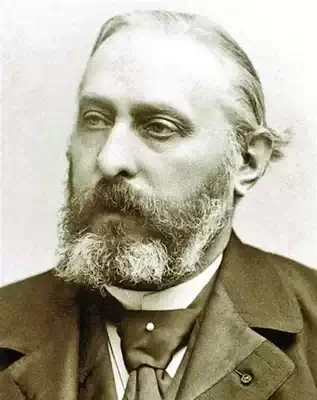
Sully Prudhomme
 FR
FR
Sully Prudhomme was a French Parnassian poet, known for his poetry that explored philosophical, scientific, and psychological themes with a rigorous style and precise language. His works reflect a melancholic pessimism and a fascination with reason, science, and the human condition. He was the first poet to receive the Nobel Prize in Literature, in 1901, in recognition of his lyrical work which demonstrated a high artistic ideal, a profound humanity, and a rare combination of the qualities of a keen heart and mind.
n. 1839-03-16, 10.º arrondissement de Paris · m. 1907-09-06, Châtenay-Malabry
Bio
Identification and basic context
René François Armand Prudhomme, better known by the pseudonym Sully Prudhomme, was born on March 16, 1839, in Paris, France, and died on September 6, 1907, in Châtenay-Malabry, also in France. He was a French poet and essayist. He belonged to the French Academy from 1881 onwards. He is recognized as one of the main representatives of the Parnassian movement in French literature and was awarded the first Nobel Prize in Literature in 1901.Childhood and education
Sully Prudhomme was born into a bourgeois family and showed early aptitude for science and philosophy. Initially, he intended to pursue a career as an engineer, having studied in Parisian high schools. However, fragile health and an attraction to poetry led him to abandon the scientific path to dedicate himself to literature. He absorbed influences from the philosophical thought of the time, including Schopenhauer, and from growing science, which would shape his worldview.Literary career
The beginning of his literary career was marked by the publication of "Stances et Poèmes" (1865), a work that brought him immediate recognition and placed him within the Parnassian circle. Throughout his life, Prudhomme published several collections of poems, exploring a gradual evolution in his themes while maintaining stylistic coherence. He collaborated with various literary magazines and was an active intellectual in his time.Work, style, and literary characteristics
Sully Prudhomme's work is vast and diverse, addressing themes such as love, death, pain, happiness, science, philosophy, and the human condition. His style is marked by clarity, precision, and elegance, with a formal rigor aligned with the precepts of Parnassianism. He frequently used the sonnet and other classical poetic forms, but also experimented with free verse in longer, philosophical poems. His language is cultured and imagistic, but without the excessive ornamentation of other Symbolist poets. The tone of his poetry is often melancholic, reflective, and at times pessimistic, reflecting his existential and intellectual anxieties. Prudhomme sought to reconcile art with science and philosophy, creating an intellectualized poetry of profound introspection.Work, style, and literary characteristics
Cultural and historical context Sully Prudhomme lived in a period of great scientific, social, and political transformations in France, such as the Second Industrial Revolution, the development of positivism, and the tensions between the Republic and conservative forces. He was part of the group of Parnassian poets, who opposed Romantic sentimentalism and sought a more objective, formal poetry inspired by classical art and scientific discoveries. He was a contemporary of poets such as Leconte de Lisle and Théophile Gautier. His work reflected the skepticism and intellectual anxieties of an era marked by scientific advancement and a crisis of traditional values.Work, style, and literary characteristics
Personal life Sully Prudhomme's personal life was marked by physical fragility and a certain melancholy. His family relationships were important, although details about his love life are less prominent in his public biography. He was an intellectual dedicated to his art, with a strong work ethic. His political stance was moderate, aligned with republican ideals, but his primary focus was artistic production and philosophical reflection.Work, style, and literary characteristics
Recognition and reception Sully Prudhomme enjoyed great prestige during his lifetime, being considered one of the greatest French poets of his generation. His election to the French Academy and, especially, the awarding of the Nobel Prize in Literature in 1901 solidified his institutional and international recognition. His poetry was praised for its aesthetic quality and the depth of its themes.Work, style, and literary characteristics
Influences and legacy Sully Prudhomme was influenced by classical poets, philosophers (such as Schopenhauer), and the scientific spirit of his time. In turn, he influenced later generations of poets with his intellectual approach to poetry and his ability to reconcile form and content. His legacy lies in his contribution to Parnassianism and his ability to create poetry that dialogues with the great questions of human existence and scientific knowledge.Work, style, and literary characteristics
Interpretation and critical analysis Sully Prudhomme's work has been analyzed from various perspectives, highlighting his exploration of the conflict between reason and emotion, the search for truth in a constantly changing world, and resignation in the face of the limitations of the human condition. His pessimism and his skeptical view of happiness are recurring themes in critical analyses.Work, style, and literary characteristics
Curiosities and lesser-known aspects A notable curiosity about Sully Prudhomme is his deep concern for suffering and injustice in the world, which led him to donate a large part of the Nobel Prize money to create a literary prize for young writers. His dedication to poetry was such that, in his later years, progressive blindness prevented him from reading, but not from composing, with the help of others.Work, style, and literary characteristics
Death and memory Sully Prudhomme died naturally at the age of 68, after a long illness. His memory is perpetuated through his work, which continues to be studied and appreciated, and by his distinction as the first recipient of the Nobel Prize in Literature, a milestone in the history of poetry.Poems
0No poems found
Comments (0)
No comments yet. Be the first to comment.