
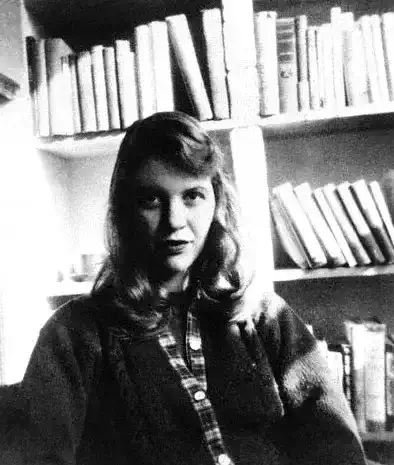
Sylvia Plath
1932–1963
· lived 30 years
 US
US
US
Sylvia Plath was an American poet, novelist, and short-story writer, known for the emotional intensity and visceral imagery of her work. Her writing explores themes of death, identity, motherhood, and the female condition, often reflecting her own struggles with mental illness. Plath is considered a central figure in 20th-century poetry and a pioneer of confessional poetry, whose work continues to resonate deeply with readers and critics.
n. 1932-10-27, Boston · m. 1963-02-11, Londres
1,558
Views
Bio
Identification and basic context
Sylvia Plath was born in Boston, Massachusetts, on October 27, 1932. She used her birth name throughout her career. She was a citizen of the United States and wrote predominantly in English. She lived during a period of significant social and cultural transformation in the United States, marked by the Cold War, the rise of consumer culture, and debates about the role of women in society.Childhood and education
Daughter of German and Scandinavian immigrant parents, Plath's childhood was marked by the early loss of her father, Otto Plath, a university professor and beekeeper, when she was only eight years old. This loss had a profound and lasting impact on her life and work. She showed early talent for writing, publishing her first poem at 17. She attended Smith College and later Cambridge University (Newnham College), where she studied English literature. Her early readings included poets such as T. S. Eliot and W. B. Yeats, and her academic training exposed her to a wide range of literature and criticism.Literary career
Sylvia Plath's literary career began early, with publications in literary magazines during her adolescence and college years. Her experience as a guest editor at Mademoiselle magazine in New York, which would later inspire her semi-autobiographical novel "The Bell Jar," was a formative moment. She published her first poetry collection, "The Colossus and Other Poems," in 1960. However, it was after her death that her work achieved greater recognition, with the posthumous publication of "Ariel" in 1965, which solidified her place in literary history.Work, style, and literary characteristics
Sylvia Plath's work is dominated by themes of death, trauma, identity, motherhood, and the struggle against oppression and madness. She frequently used free verse but also explored more traditional forms. Her style is marked by raw emotional intensity, powerful and sometimes disturbing imagery, with frequent use of violent and frightening metaphors. Her poetic voice is confessional, personal, and deeply visceral, conveying a sense of anguish and despair, but also of resistance and self-discovery. The language is dense, laden with symbolism, and often has a frenetic rhythm. Plath is associated with the confessional poetry movement, and her work introduced a brutal frankness in the exploration of the female psyche and traumatic experiences.Work, style, and literary characteristics
Cultural and historical context Plath wrote during the 1950s and early 1960s, a post-war period in the US, with significant social and cultural tensions. Her work reflects the unease of a generation and the restrictive expectations placed on women at the time. Her relationships with other poets and writers were complex; she was associated with poets such as Robert Lowell and Anne Sexton, other exponents of confessional poetry. Her generation, sometimes referred to as the "Beat Generation," shared a spirit of rebellion, although Plath had a more formal and restrained style in her early works. Her political stance was more implicit in her work, reflecting criticisms of patriarchal society and social norms.Work, style, and literary characteristics
Personal life Sylvia Plath's personal life was marked by profound emotional and psychological crises, including several suicide attempts and long periods of psychiatric treatment. Her marriage to poet Ted Hughes was intense and tumultuous, resulting in separation and deep feelings of abandonment and anger, which are reflected in many of her most celebrated poems. Motherhood was also a complex theme in her life and work. Although she held no parallel professions, her writing was her main occupation and source of livelihood, albeit often precarious.Work, style, and literary characteristics
Recognition and reception Although she published two books during her lifetime, Sylvia Plath's work achieved massive recognition after her death, especially with the publication of "Ariel." Today, she is considered one of the most important voices in 20th-century American poetry. She received several literary awards, and her work is widely studied in universities around the world. Her popularity among readers is immense, transcending academia.Work, style, and literary characteristics
Influences and legacy Sylvia Plath was influenced by poets such as W. B. Yeats, T. S. Eliot, and Emily Dickinson. Her legacy is immense; she influenced countless generations of poets, especially women, who found in her work a powerful expression for their own experiences. Her confessional approach and exploration of taboo themes opened new paths for poetry. "Ariel" is often cited as a landmark in modern poetry, and her work continues to be the subject of intense academic study and critical debate.Work, style, and literary characteristics
Interpretation and critical analysis Plath's work has been interpreted in various ways, from autobiographical readings that see it as a direct mirror of her life experiences, to analyses that emphasize her technical mastery and the universality of the themes she addresses. Issues concerning her mental health, her relationship with feminism, and the representation of aggression and trauma are central to critical debates about her poetry.Work, style, and literary characteristics
Curiosities and lesser-known aspects Sylvia Plath was known for her rigorous work ethic and dedication to writing. A curious aspect is her fascination with and study of bees, a recurring theme in some of her poems, possibly reflecting a metaphor for hard work, social hive, and mortality. Her connection to Devon, England, where she lived her final years and wrote many of her most famous poems, is also a notable aspect.Work, style, and literary characteristics
Death and memory Sylvia Plath died in London on February 11, 1963, by suicide by gas inhalation. Her premature death intensified interest in her life and work, and the posthumous publication of "Ariel" just a few years later solidified her position as a literary icon. Plath's memory is tied to her powerful work and her tragic life, making her a cult figure for many.Poems
0No poems found
Quotes
39No poems found
Comments (0)
Log in
to post a comment.
No comments yet. Be the first to comment.