
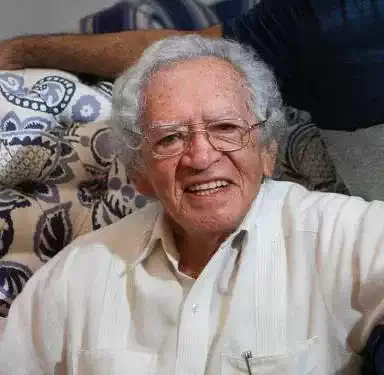
Thiago de Mello
1926–2022
· lived 95 years
 BR
BR
BR
Thiago de Mello was an internationally renowned Brazilian poet, known for his work deeply connected to the Amazon and social and environmental issues. His poetry is characterized by its musicality, imagistic strength, and political and existential engagement. Celebrated for his vast literary production, which includes poetry, prose, and translation, he became an important voice in contemporary literature, both in Brazil and abroad, receiving numerous honors and awards throughout his career.
n. 1926-03-30, Barreirinha · m. 2022-01-14, Manaus
65
Views
Bio
Identification and Basic Context
Full name: Amadeu Thiago de Mello Date and place of birth: June 4, 1926, Barreirinhas, Maranhão Nationality: Brazilian Language of writing: Portuguese Historical context in which he lived: Born during the Old Republic, he lived through the Vargas Era, the redemocratization after the military dictatorship, and the social and cultural transformations of Brazil in the 20th and early 21st centuries. His work is marked by strong engagement with issues concerning the Amazon, Brazilian identity, and human rights, reflecting the turbulent political and social periods the country experienced.Childhood and Education
Family background and social environment: Coming from a middle-class family, son of a pharmacist and a housewife, Thiago de Mello spent his childhood between Maranhão and Pará, which awakened his deep love and connection with the Amazon region. Formal education and self-study: He completed secondary school at Colégio Cearense and later at Colégio Pedro II, in Rio de Janeiro. He graduated in Law from the Federal University of Rio de Janeiro (UFRJ), but his passion for literature led him to pursue a literary career. Early influences: He was influenced by authors such as Manuel Bandeira, Carlos Drummond de Andrade, and Cecília Meireles, and by Maranhão and Amazonian popular culture. French Symbolist poetry also had some impact on his formation. Literary, philosophical, or artistic movements absorbed: Although associated with Brazilian Modernism in its more mature phase, Thiago de Mello developed a unique poetic voice, distant from rigid labels, with a strong regional and universal accent. He absorbed elements of social poetry and resistance poetry. Milestones in his youth: The move to Rio de Janeiro and contact with the intellectual milieu of the time were decisive for the beginning of his literary career.Literary Career
Start of writing: He began writing poetry in his adolescence, influenced by his readings and the cultural environment of Rio de Janeiro. He published his first poems in newspapers and literary magazines. Evolution over time: His work evolved from an initial, more lyrical poetry to poetry of deep social and political engagement, with a strong identity linked to the Amazon. His poems gained thematic and formal density, addressing the exploitation of nature, the struggle of indigenous peoples, and criticism of colonialism. Chronological evolution of his work: He published his first book, "O Ciclo do Pássaro Negro" (The Cycle of the Black Bird), in 1947. This was followed by works such as "Mãos do Povo" (Hands of the People) (1950), "Poesia" (Poetry) (1952), "A Terra Prometida" (The Promised Land) (1953), "Poemas Sacros" (Sacred Poems) (1960), "Faz Escurecer o Coração" (It Darkens the Heart) (1961), "Os Guerreiros" (The Warriors) (1960), "Mementos" (1961), "B Bells" (1964), "Corpo Noturno" (Night Body) (1965), "Maranhão: Dramas e Cantos" (Maranhão: Dramas and Songs) (1965), "Os Pássaros da Noite" (The Birds of the Night) (1966), "Coração do Brasil" (Heart of Brazil) (1974), "Os Horrores da Guerra" (The Horrors of War) (1976), "O Amazonas" (The Amazon) (1977), "Tempo de Clarineta" (Clarinet Time) (1984), "No Ponto de Partida" (At the Starting Point) (1987), "Um Rio de Voo Inteiro" (A River of Full Flight) (1993), "Os Vários Cantos" (The Various Songs) (2000), "Poesia" (Poetry) (2005), "A Lenda do Uirapuru" (The Legend of the Uirapuru) (2008), and "Os Vários Cantos" (The Various Songs) (2009). Contributions to magazines, newspapers, and anthologies: He actively collaborated with various literary publications in Brazil and abroad. Activity as critic, translator, or editor: He translated poets such as Pablo Neruda and also worked as an editor and journalist.Work, Style, and Literary Characteristics
Work, style, and literary characteristics Major works: "O Ciclo do Pássaro Negro" (1947), "A Terra Prometida" (1953), "Os Guerreiros" (1960), "Faz Escurecer o Coração" (1961), "Coração do Brasil" (1974), "O Amazonas" (1977), "Um Rio de Voo Inteiro" (1993). Dominant themes: The Amazon (its nature, its peoples, its exploitation), Brazilian identity, freedom, resistance, social and political criticism, love, death, and spirituality. Form and structure: He used both free verse and more traditional forms, demonstrating great formal flexibility. His poetry is marked by intense rhythm and musicality. Poetic devices: Profuse use of metaphors, similes, personifications, and sensory imagery, with a strong visual and auditory appeal. Tone and poetic voice: The tone varies between lyrical, epic, elegiac, and engaged. The poetic voice is often personal but transcends the individual to reach a universal dimension, speaking on behalf of oppressed peoples and the threatened environment. Language and style: Accessible language, yet rich in imagery and symbolism, with a vocabulary that blends the popular and the erudite. His poems are dense in imagery and carry a peculiar sonority. Formal or thematic innovations: He introduced an Amazonian perspective into Brazilian poetry, giving voice to the peoples and nature of the region. His work is a landmark in protest poetry and in the appreciation of indigenous culture. Relationship with tradition and modernity: He maintained a dialogue with the Brazilian literary tradition while embracing the formal and thematic innovations of modernity, developing a unique style. Associated literary movements: Although not strictly fitting into a single movement, his work dialogues with Modernism and with social and engaged poetry. Lesser-known or unpublished works: He has a vast body of work that includes short stories, chronicles, and essays, as well as translations. Many of his lesser-known works are also of great literary value.Work, Style, and Literary Characteristics
Cultural and historical context Relationship with historical events: His work intensely reflects the periods of military dictatorship in Brazil, the struggle for redemocratization, emerging environmental issues, and the exploitation of the Amazon's natural and human resources. He was persecuted by the military dictatorship. Relationship with other writers or literary circles: He maintained friendships and collaborated with important Brazilian and Latin American writers, such as Jorge Amado and Pablo Neruda. Generation or movement to which he belongs: Although his work began in the generation following Modernism, he is distinguished by his own style and an engagement that transcends classifications. Political or philosophical stance: A defender of social justice, freedom, and environmental preservation, he clearly positioned himself against authoritarian regimes and colonial and capitalist exploitation. Influence of society and culture on his work: Amazonian culture, indigenous myths, social struggles, and the natural beauty of the region are the raw material of his poetry. Dialogues and tensions with contemporaries: He established dialogues with Latin American social poetry and engaged with Brazilian poets of different generations. Critical reception during life vs. posthumous recognition: He was widely recognized during his lifetime, receiving awards and honors, and his legacy continues to be celebrated and studied after his death.Work, Style, and Literary Characteristics
Personal life Significant affective and family relationships and how they shaped his work: Although details about his personal life are less publicized, the connection with his homeland, Maranhão and the Amazon, is a central element that profoundly shaped his work and worldview. Literary friendships and rivalries: He maintained friendships with many important writers, such as Jorge Amado, Pablo Neruda, and Mario Quintana. Personal experiences, crises, illnesses, or conflicts: He suffered political persecution during the military dictatorship, which forced him into temporary exile. Parallel professions: Besides being a poet, he was a journalist, editor, and translator. Religious, spiritual, or philosophical beliefs: His work reveals a deep spirituality, connected to nature and indigenous cosmogonies, without being bound to specific religious dogmas. He admired ancestral wisdom and the sacred connection with the earth. Political positions and civic involvement: He was a committed activist, using his poetry as a tool for denunciation and social and political awareness.Work, Style, and Literary Characteristics
Recognition and reception Place in national and international literature: He is considered one of the greatest Brazilian poets of the 20th century and an important figure in Latin American literature. His work is translated into several languages. Awards, distinctions, and institutional recognition: He received numerous awards, such as the Jabuti Prize and the Camões Prize, as well as honorary titles and commendations in various countries. Critical reception during life and over time: His poetry has always been praised by critics for its originality, expressive power, and thematic relevance. Critical reception has remained positive and growing. Popularity vs. academic recognition: He enjoys both great popularity among readers who identify with his social and environmental message and solid recognition in academia, being the subject of studies and theses.Work, Style, and Literary Characteristics
Influences and legacy Authors who influenced him: Manuel Bandeira, Carlos Drummond de Andrade, Cecília Meireles, Pablo Neruda, Jorge Amado, Walt Whitman, Walt Disney (in the sense of representing the children's universe and fantasy). Poets and movements he influenced: He influenced generations of Brazilian and Latin American poets with his engaged poetry, his connection with nature, and his way of giving voice to the marginalized and the Amazon. Impact on national and world literature and subsequent generations of poets: His legacy is marked by the uncompromising defense of the Amazon, the appreciation of Brazilian culture, and poetry that combines lyricism, social criticism, and universality. He is a reference for poets seeking to reconcile art with social and environmental commitment. Entry into the literary canon: He is a consolidated figure in the canon of Brazilian and Latin American literature. Translations and international dissemination: His work has been translated into over 30 languages, ensuring wide international dissemination. Adaptations: Some of his poems have been set to music and served as inspiration for artistic works. Academic studies dedicated to his work: His work is the subject of numerous academic studies, theses, and dissertations in Brazilian and foreign universities.Work, Style, and Literary Characteristics
Interpretation and critical analysis Possible readings of his work: It can be read as an epic song to the Amazon, a cry of resistance against oppression and environmental destruction, a reflection on identity and the human condition, and a celebration of life and beauty. Philosophical and existential themes: He addresses themes such as the relationship between man and nature, the pursuit of freedom and justice, the finitude of life, and the importance of memory and culture. Controversies or critical debates: Few significant controversies surround his work, being mostly acclaimed for its relevance and literary quality. The main discussion revolves around its insertion in literary movements and its ability to transcend classifications.Work, Style, and Literary Characteristics
Curiosities and lesser-known aspects Lesser-known aspects of his personality: He was known for his humility, simplicity, and deep respect for nature and human beings, especially indigenous peoples. Contradictions between life and work: There are no significant contradictions; his life and work went hand in hand, reflecting his ideals and his passion for the Amazon. Memorable or anecdotal episodes that illuminate the author's profile: His closeness to indigenous peoples and his passionate defense of the Amazon are striking features of his profile. Objects, places, or rituals associated with poetic creation: The Amazon, particularly the landscapes of Maranhão and Pará, and contact with nature were primary sources of his inspiration. He believed in poetry as an act of resistance and healing. Writing habits: He dedicated himself to writing with discipline, but also sought inspiration in lived experience and contact with the world. Curious episodes: During his exile, he lived in various countries but always maintained a strong connection with Brazil and the Amazon. Manuscripts, diaries, or correspondence: His correspondence and manuscripts are valuable sources for the study of his work and life.Work, Style, and Literary Characteristics
Death and memory Circumstances of death: He passed away due to complications from pneumonia. Posthumous publications: His work continues to be published and reissued, keeping his memory and literary legacy alive.Poems
0No poems found
Videos
50
Comments (0)
Log in
to post a comment.
No comments yet. Be the first to comment.