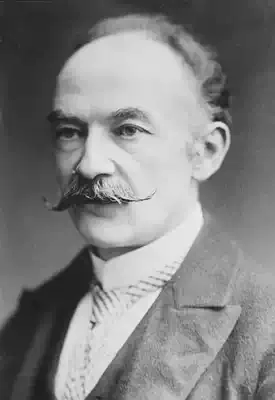
Identification and basic context
Full name: Thomas Hardy.
Date and place of birth: Born June 2, 1840, in Higher Bockhampton, Dorset, England. Died January 11, 1928, in Dorchester, Dorset, England.
Family background, social class, and cultural context of origin: Born into a rural, lower-middle-class family in Dorset, a region that heavily influenced his work. His father was a stonemason and builder. Hardy's background provided him with intimate knowledge of country life, its traditions, and the social strata within it.
Nationality and language(s) of writing: English.
Historical context in which they lived: Hardy lived through the Victorian and Edwardian eras, periods of immense social, industrial, and intellectual change in Britain. His work reflects the decline of rural traditions, the rise of industrialization, and the impact of scientific thought (especially Darwinism) on prevailing beliefs about humanity and its place in the universe.
Childhood and education
Family background and social environment: Grew up in a rural setting, which he depicted in his novels. His family provided a stable, if modest, upbringing.
Formal education and self-education: Received a basic schooling but was largely self-taught, developing a deep interest in classical languages, literature, and philosophy. He was apprenticed to a local architect, John Hicks.
Early influences (readings, culture, religion, politics): Influenced by the Bible, classical poets (Homer, Virgil), Shakespeare, and contemporary writers like Charles Dickens. The works of Darwin and other scientists challenged his early religious beliefs, leading him towards a more skeptical and deterministic worldview.
Literary, philosophical, or artistic movements absorbed: Hardy's novels are often associated with Naturalism, emphasizing determinism, the influence of environment, and the often bleak workings of fate. However, his work also contains elements of realism and a unique poetic sensibility.
Significant events in youth: His apprenticeship and early architectural work in London exposed him to different social environments and further broadened his intellectual horizons.
Literary trajectory
Beginning of writing (when and how it started): Hardy began his literary career writing poetry, but initially struggled to get it published. He found greater success with novels, beginning with "The Poor Man and the Lady" (unpublished) and "Desperate Remedies" (1871). His first major success was "Far from the Madding Crowd" (1874).
Development over time (phases, changes in style): His novels generally moved from more melodramatic plots towards greater realism and psychological depth. His later novels, "Tess of the d'Urbervilles" and "Jude the Obscure," became increasingly bleak and controversial, leading to his withdrawal from novel-writing. He then focused on poetry, where his style matured into a distinctive modern idiom.
Chronological evolution of the work: He produced over a dozen novels, several short story collections, and a vast body of poetry, including "Wessex Poems and Other Verses" (1898), "Poems of the Past and the Present" (1901), "The Dynasts" (1903-1908), and "Late Lyrics and Earlier" (1922).
Contributions to magazines, newspapers, and anthologies: Many of his novels were first serialized in magazines, often in expurgated versions to suit public taste.
Activity as a critic, translator, or editor: While primarily a novelist and poet, he also wrote some critical essays and was involved in the editing and revision of his own works.
Works, style, and literary characteristics
Major works with dates and context of production:
- "Far from the Madding Crowd" (1874): A pastoral novel that brought him fame.
- "The Return of the Native" (1878): Explores fate and character in a rural setting.
- "Tess of the d'Urbervilles" (1891): A tragic novel about a peasant girl, considered one of his masterpieces.
- "Jude the Obscure" (1895): A highly controversial novel critiquing Victorian social and religious conventions.
- "Wessex Poems" (1898): His first major poetry collection.
- "The Dynasts" (1903-1908): An epic drama in verse depicting the Napoleonic Wars.
Dominant themes — love, death, time, nature, identity, homeland, spirituality, etc.: Hardy's work is permeated by themes of fate and determinism, the destructive power of social conventions, the resilience and vulnerability of rural life, the decline of traditional ways, the complexities of love and loss, the indifference of the universe, and the passage of time.
Form and structure — use of the sonnet, free verse, fixed forms, metrical experimentation: In poetry, he employed a wide range of traditional forms, including ballads, lyrics, and sonnets, often with subtle metrical variations. "The Dynasts" is a monumental epic drama in verse.
Poetic devices (metaphor, rhythm, musicality): His poetry is characterized by a stark, often melancholic tone, vivid imagery (especially of the Dorset landscape), and a conversational yet precise language. He used irony and understatement effectively.
Tone and poetic voice — lyrical, satirical, elegiac, epic, ironic, confessional: His tone can be elegiac, ironic, philosophical, and sometimes bleak. The poetic voice often reflects a profound sympathy for human suffering and a detached, critical observation of human folly.
Poetic voice (personal, universal, fragmented, etc.): The voice is often personal and reflective, but it also speaks to universal human experiences of struggle, loss, and the search for meaning.
Language and style — vocabulary, imagery density, preferred rhetorical devices: Hardy's prose is precise, often incorporating dialect and descriptions of rural crafts. His poetry uses a direct, sometimes colloquial language, but with great economy and resonance. He favored stark imagery and often employed irony and paradox.
Formal or thematic innovations introduced into literature: He challenged Victorian social and sexual mores, particularly in "Tess of the d'Urbervilles" and "Jude the Obscure." In poetry, he contributed to the development of a modern poetic voice that confronted doubt and disillusionment.
Relationship with tradition and modernity: Hardy navigated the transition from Victorian to Modernist sensibilities. He retained an appreciation for traditional forms and rural life while grappling with modern scientific and philosophical ideas that eroded old certainties.
Associated literary movements (e.g., symbolism, modernism): Associated with Naturalism in his novels. His poetry is often seen as bridging Victorian and Modernist sensibilities, anticipating aspects of Modernist poetry in its themes of doubt and its direct language.
Lesser-known or unpublished works: "The Poor Man and the Lady" was his first novel, but it was never published. Many of his poems were written over decades before their collection and publication.
Cultural and historical context
Relationship with historical events (wars, revolutions, regimes): The decline of agriculture, the rise of industrialization, and the impact of scientific discoveries (like Darwinism) fundamentally altered the rural society he depicted. He lived through the Victorian era's social transformations and the early stages of the Edwardian period.
Relationship with other writers or literary circles: He associated with figures like George Meredith and later, through his poetry, with younger modernists. However, his tendency towards isolation and the controversial nature of his later novels sometimes distanced him from literary society.
Generation or movement to which they belong (e.g., Romanticism, Modernism, Surrealism): Primarily considered a Victorian-Edwardian novelist, though his novels lean towards Naturalism. His poetry is often seen as a precursor to Modernism.
Political or philosophical stance: Hardy held a deeply pessimistic and deterministic worldview, often described as "meliorism" – the belief that the world is fundamentally flawed but could, perhaps, be improved through human effort, though he had little faith in this possibility. He was critical of social injustice and rigid conventions.
Influence of society and culture on the work: The changing social landscape of rural England, the erosion of traditional values, and the intellectual climate of doubt and skepticism deeply influenced his themes of loss, fate, and the human condition.
Dialogues and tensions with contemporaries: His unflinching portrayal of social issues and often tragic outcomes put him at odds with the prevailing moral sentiments of the Victorian era, leading to significant controversy.
Critical reception during life vs. posthumous recognition: While his novels achieved popularity and critical acclaim, they also generated significant controversy, particularly "Tess" and "Jude." His poetry was initially overlooked but gained substantial recognition posthumously, leading to his elevation as a major figure in English verse.
Personal life
Significant emotional and family relationships and how they shaped the work: His marriage to Emma Gifford was complex and unhappy, and her death profoundly affected him, inspiring many of his later poems, particularly those collected in "Poems of the Past and the Present."
Friendships and literary rivalries: He maintained some friendships but was generally a private man. He was not known for significant literary rivalries.
Personal experiences and crises, illnesses, or conflicts: The controversy surrounding his later novels caused him considerable distress and led him to abandon novel-writing. His personal relationships were often fraught with emotional difficulties.
Parallel professions (if they did not live solely from poetry): He was trained and worked as an architect for many years before becoming a full-time writer. He did not live solely from poetry, but from his novels and short stories initially.
Religious, spiritual, or philosophical beliefs: Hardy rejected conventional religious dogma and developed a personal philosophy rooted in skepticism, determinism, and a compassionate, albeit often bleak, view of human existence.
Political positions and civic engagement: He was not overtly political in his writing but his works championed the common people and criticized social injustices and rigid hierarchies.
Recognition and reception
Place in national and international literature: Hardy is a towering figure in English literature, celebrated for both his novels and his poetry. He is considered one of the greatest English novelists and a highly influential poet.
Awards, distinctions, and institutional recognition: He received several honorary doctorates and was offered a knighthood, which he declined. He was a member of the Order of Merit.
Popularity vs. academic recognition: His novels, though controversial, were popular. His poetry, initially less so, achieved significant academic and critical acclaim, and enduring popularity, especially after his death.
Influences and legacy
Authors who influenced them: William Shakespeare, John Milton, the Bible, classical poets, Charles Darwin, and philosophers like Schopenhauer.
Poets and movements they influenced: His poetic realism, his thematic focus on doubt and the human condition, and his innovative use of traditional forms influenced many 20th-century poets, including W. H. Auden and Philip Larkin.
Impact on national and world literature and on later generations of poets: Hardy's exploration of rural life, his critical engagement with social change, and his profound, often pessimistic, philosophy have left a lasting impact. His poetry's unique voice and thematic depth are still widely studied and admired.
Inclusion in the literary canon: He is a fundamental figure in the English literary canon.
Translations and international dissemination: His novels and poetry are widely translated and have a significant international readership.
Adaptations (music, theater, film): Many of his novels have been adapted into successful films and television series.
Academic studies dedicated to the work: There is extensive academic scholarship on his novels, his poetry, and his philosophical outlook.
Interpretation and critical analysis
Possible readings of the work: Hardy's works are often interpreted through the lens of Naturalism, determinism, and his personal philosophical skepticism. Critics analyze his exploration of fate, social critique, and the complex interplay of human agency and external forces.
Philosophical and existential themes: His central concerns revolve around the indifference of the universe, the harshness of fate, the fragility of human happiness, and the search for meaning in a world stripped of traditional certainties.
Controversies or critical debates: The "New Woman" characterizations and explicit or implied critiques of marriage and societal norms in "Tess" and "Jude" caused immense scandal and debate during his lifetime, and continue to be subjects of critical analysis regarding their feminist implications.
Curiosities and lesser-known aspects
Lesser-known aspects of personality: Despite his bleak themes, Hardy had a dry wit and a deep appreciation for music, particularly folk music from his native Dorset.
Contradictions between life and work: The deep sorrow and disillusionment evident in his work contrast with his continued dedication to his craft and his eventual acceptance into the establishment he often implicitly criticized.
Significant or anecdotal episodes that illuminate the author’s profile: His decision to abandon novel-writing after the outcry over "Jude the Obscure" demonstrates the profound impact of public reaction on his creative output.
Objects, places, or rituals associated with poetic creation: The landscapes of Dorset, the "Wessex" country he created, were his constant muse. He often returned to his birthplace to write.
Writing habits: He was a methodical writer, often working for many hours a day. He meticulously revised his manuscripts.
Curious episodes: His ashes were cremated and interred in Westminster Abbey, but his heart was buried separately in his beloved Dorset, a poignant testament to his divided loyalties.
Manuscripts, diaries, or correspondence: His letters and journals offer profound insights into his creative process and his internal struggles.
Death and memory
Circumstances of death: Died peacefully at his home in Dorchester, Dorset, at the age of 87.
Posthumous publications: Following his death, his extensive collection of poetry was published in full, solidifying his reputation as a major poet.