Poems List

The Lost Pyx: A Mediaeval Legend

The Lost Pyx: A Mediaeval Legend
Some say the spot is banned; that the pillar Cross-and-Hand
Attests to a deed of hell;
But of else than of bale is the mystic tale
That ancient Vale-folk tell.
Ere Cernel's Abbey ceased hereabout there dwelt a priest,
(In later life sub-prior
Of the brotherhood there, whose bones are now bare
In the field that was Cernel choir).
One night in his cell at the foot of yon dell
The priest heard a frequent cry:
"Go, father, in haste to the cot on the waste,
And shrive a man waiting to die."
Said the priest in a shout to the caller without,
"The night howls, the tree-trunks bow;
One may barely by day track so rugged a way,
And can I then do so now?"
No further word from the dark was heard,
And the priest moved never a limb;
And he slept and dreamed; till a Visage seemed
To frown from Heaven at him.
In a sweat he arose; and the storm shrieked shrill,
And smote as in savage joy;
While High-Stoy trees twanged to Bubb-Down Hill,
And Bubb-Down to High-Stoy.
There seemed not a holy thing in hail,
Nor shape of light or love,
From the Abbey north of Blackmore Vale
To the Abbey south thereof.
Yet he plodded thence through the dark immense,
And with many a stumbling stride
Through copse and briar climbed nigh and nigher
To the cot and the sick man's side.
When he would have unslung the Vessels uphung
To his arm in the steep ascent,
He made loud moan: the Pyx was gone
Of the Blessed Sacrament.
Then in dolorous dread he beat his head:
"No earthly prize or pelf
Is the thing I've lost in tempest tossed,
But the Body of Christ Himself!"
He thought of the Visage his dream revealed,
And turned towards whence he came,


Hands groping the ground along foot-track and field,
And head in a heat of shame.
Till here on the hill, betwixt vill and vill,
He noted a clear straight ray
Stretching down from the sky to a spot hard by,
Which shone with the light of day.
And gathered around the illumined ground
Were common beasts and rare,
All kneeling at gaze, and in pause profound
Attent on an object there.
'Twas the Pyx, unharmed 'mid the circling rows
Of Blackmore's hairy throng,
Whereof were oxen, sheep, and does,
And hares from the brakes among;
And badgers grey, and conies keen,
And squirrels of the tree,
And many a member seldom seen
Of Nature's family.
The ireful winds that scoured and swept
Through coppice, clump, and dell,
Within that holy circle slept
Calm as in hermit's cell.
Then the priest bent likewise to the sod
And thanked the Lord of Love,
And Blessed Mary, Mother of God,
And all the saints above.
And turning straight with his priceless freight,
He reached the dying one,
Whose passing sprite had been stayed for the rite
Without which bliss hath none.
And when by grace the priest won place,
And served the Abbey well,
He reared this stone to mark where shone
That midnight miracle.
193

The Masked Face

The Masked Face
I found me in a great surging space,
At either end a door,
And I said: "What is this giddying place,
With no firm-fixéd floor,
That I knew not of before?"
"It is Life," said a mask-clad face.
I asked: "But how do I come here,
Who never wished to come;
Can the light and air be made more clear,
The floor more quietsome,
And the doors set wide? They numb
Fast-locked, and fill with fear."
The mask put on a bleak smile then,
And said, "O vassal-wight,
There once complained a goosequill pen
To the scribe of the Infinite
Of the words it had to write
Because they were past its ken."
267

The Last Chrysanthemum

The Last Chrysanthemum
Why should this flower delay so long
To show its tremulous plumes?
Now is the time of plaintive robin-song,
When flowers are in their tombs.
Through the slow summer, when the sun
Called to each frond and whorl
That all he could for flowers was being done,
Why did it not uncurl?
It must have felt that fervid call
Although it took no heed,
Waking but now, when leaves like corpses fall,
And saps all retrocede.
Too late its beauty, lonely thing,
The season's shine is spent,
Nothing remains for it but shivering
In tempests turbulent.
Had it a reason for delay,
Dreaming in witlessness
That for a bloom so delicately gay
Winter would stay its stress?
- I talk as if the thing were born
With sense to work its mind;
Yet it is but one mask of many worn
By the Great Face behind.
297

The King's Experiment

The King's Experiment
It was a wet wan hour in spring,
And Nature met King Doom beside a lane,
Wherein Hodge trudged, all blithely ballading
The Mother's smiling reign.
"Why warbles he that skies are fair
And coombs alight," she cried, "and fallows gay,
When I have placed no sunshine in the air
Or glow on earth to-day?"
"'Tis in the comedy of things
That such should be," returned the one of Doom;
"Charge now the scene with brightest blazonings,
And he shall call them gloom."
She gave the word: the sun outbroke,
All Froomside shone, the hedgebirds raised a song;
And later Hodge, upon the midday stroke,
Returned the lane along,
Low murmuring: "O this bitter scene,
And thrice accurst horizon hung with gloom!
How deadly like this sky, these fields, these treen,
To trappings of the tomb!"
The Beldame then: "The fool and blind!
Such mad perverseness who may apprehend?" -
"Nay; there's no madness in it; thou shalt find
Thy law there," said her friend.
"When Hodge went forth 'twas to his Love,
To make her, ere this eve, his wedded prize,
And Earth, despite the heaviness above,
Was bright as Paradise.
"But I sent on my messenger,
With cunning arrows poisonous and keen,
To take forthwith her laughing life from her,
And dull her little een,
"And white her cheek, and still her breath,
Ere her too buoyant Hodge had reached her side;
So, when he came, he clasped her but in death,
And never as his bride.
"And there's the humour, as I said;
Thy dreary dawn he saw as gleaming gold,
And in thy glistening green and radiant red
Funereal gloom and cold."
230

The Inconsistent

The Inconsistent
I say, "She was as good as fair,"
When standing by her mound;
"Such passing sweetness," I declare,
"No longer treads the ground."
I say, "What living Love can catch
Her bloom and bonhomie,
And what in newer maidens match
Her olden warmth to me!"
- There stands within yon vestry-nook
Where bonded lovers sign,
Her name upon a faded book
With one that is not mine.
To him she breathed the tender vow
She once had breathed to me,
But yet I say, "O love, even now
Would I had died for thee!"
198

The House of Hospitalities

The House of Hospitalities
Here we broached the Christmas barrel,
Pushed up the charred log-ends;
Here we sang the Christmas carol,
And called in friends.
Time has tired me since we met here
When the folk now dead were young,
And the viands were outset here
And quaint songs sung.
And the worm has bored the viol
That used to lead the tune,
Rust eaten out the dial
That struck night's noon.
Now no Christmas brings in neighbours,
And the New Year comes unlit;
Where we sang the mole now labours,
And spiders knit.
Yet at midnight if here walking,
When the moon sheets wall and tree,
I see forms of old time talking,
Who smile on me.
196

The Ghost of the Past

The Ghost of the Past
We two kept house, the Past and I,
The Past and I;
I tended while it hovered nigh,
Leaving me never alone.
It was a spectral housekeeping
Where fell no jarring tone,
As strange, as still a housekeeping
As ever has been known.
As daily I went up the stair,
And down the stair,
I did not mind the Bygone there --
The Present once to me;
Its moving meek companionship
I wished might ever be,
There was in that companionship
Something of ecstasy.
It dwelt with me just as it was,
Just as it was
When first its prospects gave me pause
In wayward wanderings,
Before the years had torn old troths
As they tear all sweet things,
Before gaunt griefs had torn old troths
And dulled old rapturings.
And then its form began to fade,
Began to fade,
Its gentle echoes faintlier played
At eves upon my ear
Than when the autumn's look embrowned
The lonely chambers here,
The autumn's settling shades embrowned
Nooks that it haunted near.
And so with time my vision less,
Yea, less and less
Makes of that Past my housemistress,
It dwindles in my eye;
It looms a far-off skeleton
And not a comrade nigh,
A fitful far-off skeleton
Dimming as days draw by.
180

The Going of the Battery Wives. (Lament)

The Going of the Battery Wives. (Lament)
I
O it was sad enough, weak enough, mad enough -
Light in their loving as soldiers can be -
First to risk choosing them, leave alone losing them
Now, in far battle, beyond the South Sea! . . .
II
- Rain came down drenchingly; but we unblenchingly
Trudged on beside them through mirk and through mire,
They stepping steadily--only too readily! -
Scarce as if stepping brought parting-time nigher.
III
Great guns were gleaming there, living things seeming there,
Cloaked in their tar-cloths, upmouthed to the night;
Wheels wet and yellow from axle to felloe,
Throats blank of sound, but prophetic to sight.
IV
Gas-glimmers drearily, blearily, eerily
Lit our pale faces outstretched for one kiss,
While we stood prest to them, with a last quest to them
Not to court perils that honour could miss.
V
Sharp were those sighs of ours, blinded these eyes of ours,
When at last moved away under the arch
All we loved. Aid for them each woman prayed for them,
Treading back slowly the track of their march.
VI
Someone said: "Nevermore will they come: evermore
Are they now lost to us." O it was wrong!
Though may be hard their ways, some Hand will guard their ways,
Bear them through safely, in brief time or long.
VII
- Yet, voices haunting us, daunting us, taunting us,
Hint in the night-time when life beats are low
Other and graver things . . . Hold we to braver things,
Wait we, in trust, what Time's fulness shall show.
228

The Dream-Follower

The Dream-Follower
A dream of mine flew over the mead
To the halls where my old Love reigns;
And it drew me on to follow its lead:
And I stood at her window-panes;
And I saw but a thing of flesh and bone
Speeding on to its cleft in the clay;
And my dream was scared, and expired on a moan,
And I whitely hastened away.
218

The Fire at Tranter Sweatley’s

The Fire at Tranter Sweatley’s
They had long met o’ Zundays—her true love and she—
And at junketings, maypoles, and flings;
But she bode wi’ a thirtover uncle, and he
Swore by noon and by night that her goodman should be
Naibor Sweatley—a gaffer oft weak at the knee
From taking o’ sommat more cheerful than tea—
Who tranted, and moved people’s things.
She cried, “O pray pity me!” Nought would he hear;
Then with wild rainy eyes she obeyed,
She chid when her Love was for clinking off wi’ her.
The pa’son was told, as the season drew near
To throw over pu’pit the names of the peäir
As fitting one flesh to be made.
The wedding-day dawned and the morning drew on;
The couple stood bridegroom and bride;
The evening was passed, and when midnight had gone
The folks horned out, “God save the King,” and anon
The two home-along gloomily hied.
The lover Tim Tankens mourned heart-sick and drear
To be thus of his darling deprived:
He roamed in the dark ath’art field, mound, and mere,
And, a’most without knowing it, found himself near
The house of the tranter, and now of his Dear,
Where the lantern-light showed ’em arrived.
The bride sought her cham’er so calm and so pale
That a Northern had thought her resigned;
But to eyes that had seen her in tide-times of weal,
Like the white cloud o’ smoke, the red battlefield’s vail,
That look spak’ of havoc behind.
The bridegroom yet laitered a beaker to drain,
Then reeled to the linhay for more,
When the candle-snoff kindled some chaff from his grain—
Flames spread, and red vlankers, wi’ might and wi’ main,
And round beams, thatch, and chimley-tun roar.
Young Tim away yond, rafted up by the light,
Through brimble and underwood tears,
Till he comes to the orchet, when crooping thereright
In the lewth of a codlin-tree, bivering wi’ fright,
Wi’ on’y her night-rail to screen her from sight,
His lonesome young Barbree appears.
Her cwold little figure half-naked he views
Played about by the frolicsome breeze,


Her light-tripping totties, her ten little tooes,
All bare and besprinkled wi’ Fall’s chilly dews,
While her great gallied eyes, through her hair hanging loose,
Sheened as stars through a tardle o’ trees.
She eyed en; and, as when a weir-hatch is drawn,
Her tears, penned by terror afore,
With a rushing of sobs in a shower were strawn,
Till her power to pour ’em seemed wasted and gone
From the heft o’ misfortune she bore.
“O Tim, my own Tim I must call ’ee—I will!
All the world ha’ turned round on me so!
Can you help her who loved ’ee, though acting so ill?
Can you pity her misery—feel for her still?
When worse than her body so quivering and chill
Is her heart in its winter o’ woe!
“I think I mid almost ha’ borne it,” she said,
“Had my griefs one by one come to hand;
But O, to be slave to thik husbird for bread,
And then, upon top o’ that, driven to wed,
And then, upon top o’ that, burnt out o’ bed,
Is more than my nater can stand!”
Tim’s soul like a lion ’ithin en outsprung—
(Tim had a great soul when his feelings were wrung)—
“Feel for ’ee, dear Barbree?” he cried;
And his warm working-jacket about her he flung,
Made a back, horsed her up, till behind him she clung
Like a chiel on a gipsy, her figure uphung
By the sleeves that around her he tied.
Over piggeries, and mixens, and apples, and hay,
They lumpered straight into the night;
And finding bylong where a halter-path lay,
At dawn reached Tim’s house, on’y seen on their way
By a naibor or two who were up wi’ the day;
But they gathered no clue to the sight.
Then tender Tim Tankens he searched here and there
For some garment to clothe her fair skin;
But though he had breeches and waistcoats to spare,
He had nothing quite seemly for Barbree to wear,
Who, half shrammed to death, stood and cried on a chair
At the caddle she found herself in.
There was one thing to do, and that one thing he did,
He lent her some clouts of his own,
And she took ’em perforce; and while in ’em she slid,
Tim turned to the winder, as modesty bid,
Thinking, “O that the picter my duty keeps hid


To the sight o’ my eyes mid be shown!”
In the tallet he stowed her; there huddied she lay,
Shortening sleeves, legs, and tails to her limbs;
But most o’ the time in a mortal bad way,
Well knowing that there’d be the divel to pay
If ’twere found that, instead o’ the elements’ prey,
She was living in lodgings at Tim’s.
“Where’s the tranter?” said men and boys; “where can er be?”
“Where’s the tranter?” said Barbree alone.
“Where on e’th is the tranter?” said everybod-y:
They sifted the dust of his perished roof-tree,
And all they could find was a bone.
Then the uncle cried, “Lord, pray have mercy on me!”
And in terror began to repent.
But before ’twas complete, and till sure she was free,
Barbree drew up her loft-ladder, tight turned her key—
Tim bringing up breakfast and dinner and tea—
Till the news of her hiding got vent.
Then followed the custom-kept rout, shout, and flare
Of a skimmington-ride through the naiborhood, ere
Folk had proof o’ wold Sweatley’s decay.
Whereupon decent people all stood in a stare,
Saying Tim and his lodger should risk it, and pair:
So he took her to church. An’ some laughing lads there
Cried to Tim, “After Sweatley!” She said, “I declare
I stand as a maiden to-day!”
207

Comments (0)

Log in to post a comment.

NoComments

Identification and basic context

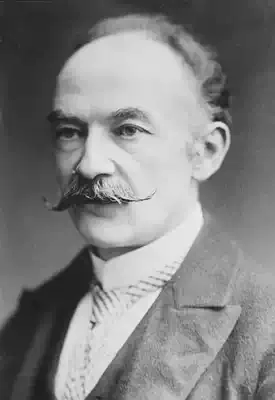
Full name: Thomas Hardy. Date and place of birth: Born June 2, 1840, in Higher Bockhampton, Dorset, England. Died January 11, 1928, in Dorchester, Dorset, England. Family background, social class, and cultural context of origin: Born into a rural, lower-middle-class family in Dorset, a region that heavily influenced his work. His father was a stonemason and builder. Hardy's background provided him with intimate knowledge of country life, its traditions, and the social strata within it. Nationality and language(s) of writing: English. Historical context in which they lived: Hardy lived through the Victorian and Edwardian eras, periods of immense social, industrial, and intellectual change in Britain. His work reflects the decline of rural traditions, the rise of industrialization, and the impact of scientific thought (especially Darwinism) on prevailing beliefs about humanity and its place in the universe.

Childhood and education

Family background and social environment: Grew up in a rural setting, which he depicted in his novels. His family provided a stable, if modest, upbringing. Formal education and self-education: Received a basic schooling but was largely self-taught, developing a deep interest in classical languages, literature, and philosophy. He was apprenticed to a local architect, John Hicks. Early influences (readings, culture, religion, politics): Influenced by the Bible, classical poets (Homer, Virgil), Shakespeare, and contemporary writers like Charles Dickens. The works of Darwin and other scientists challenged his early religious beliefs, leading him towards a more skeptical and deterministic worldview. Literary, philosophical, or artistic movements absorbed: Hardy's novels are often associated with Naturalism, emphasizing determinism, the influence of environment, and the often bleak workings of fate. However, his work also contains elements of realism and a unique poetic sensibility. Significant events in youth: His apprenticeship and early architectural work in London exposed him to different social environments and further broadened his intellectual horizons.

Literary trajectory

Beginning of writing (when and how it started): Hardy began his literary career writing poetry, but initially struggled to get it published. He found greater success with novels, beginning with "The Poor Man and the Lady" (unpublished) and "Desperate Remedies" (1871). His first major success was "Far from the Madding Crowd" (1874). Development over time (phases, changes in style): His novels generally moved from more melodramatic plots towards greater realism and psychological depth. His later novels, "Tess of the d'Urbervilles" and "Jude the Obscure," became increasingly bleak and controversial, leading to his withdrawal from novel-writing. He then focused on poetry, where his style matured into a distinctive modern idiom. Chronological evolution of the work: He produced over a dozen novels, several short story collections, and a vast body of poetry, including "Wessex Poems and Other Verses" (1898), "Poems of the Past and the Present" (1901), "The Dynasts" (1903-1908), and "Late Lyrics and Earlier" (1922). Contributions to magazines, newspapers, and anthologies: Many of his novels were first serialized in magazines, often in expurgated versions to suit public taste. Activity as a critic, translator, or editor: While primarily a novelist and poet, he also wrote some critical essays and was involved in the editing and revision of his own works.

Works, style, and literary characteristics

Major works with dates and context of production: - "Far from the Madding Crowd" (1874): A pastoral novel that brought him fame. - "The Return of the Native" (1878): Explores fate and character in a rural setting. - "Tess of the d'Urbervilles" (1891): A tragic novel about a peasant girl, considered one of his masterpieces. - "Jude the Obscure" (1895): A highly controversial novel critiquing Victorian social and religious conventions. - "Wessex Poems" (1898): His first major poetry collection. - "The Dynasts" (1903-1908): An epic drama in verse depicting the Napoleonic Wars. Dominant themes — love, death, time, nature, identity, homeland, spirituality, etc.: Hardy's work is permeated by themes of fate and determinism, the destructive power of social conventions, the resilience and vulnerability of rural life, the decline of traditional ways, the complexities of love and loss, the indifference of the universe, and the passage of time. Form and structure — use of the sonnet, free verse, fixed forms, metrical experimentation: In poetry, he employed a wide range of traditional forms, including ballads, lyrics, and sonnets, often with subtle metrical variations. "The Dynasts" is a monumental epic drama in verse. Poetic devices (metaphor, rhythm, musicality): His poetry is characterized by a stark, often melancholic tone, vivid imagery (especially of the Dorset landscape), and a conversational yet precise language. He used irony and understatement effectively. Tone and poetic voice — lyrical, satirical, elegiac, epic, ironic, confessional: His tone can be elegiac, ironic, philosophical, and sometimes bleak. The poetic voice often reflects a profound sympathy for human suffering and a detached, critical observation of human folly. Poetic voice (personal, universal, fragmented, etc.): The voice is often personal and reflective, but it also speaks to universal human experiences of struggle, loss, and the search for meaning. Language and style — vocabulary, imagery density, preferred rhetorical devices: Hardy's prose is precise, often incorporating dialect and descriptions of rural crafts. His poetry uses a direct, sometimes colloquial language, but with great economy and resonance. He favored stark imagery and often employed irony and paradox. Formal or thematic innovations introduced into literature: He challenged Victorian social and sexual mores, particularly in "Tess of the d'Urbervilles" and "Jude the Obscure." In poetry, he contributed to the development of a modern poetic voice that confronted doubt and disillusionment. Relationship with tradition and modernity: Hardy navigated the transition from Victorian to Modernist sensibilities. He retained an appreciation for traditional forms and rural life while grappling with modern scientific and philosophical ideas that eroded old certainties. Associated literary movements (e.g., symbolism, modernism): Associated with Naturalism in his novels. His poetry is often seen as bridging Victorian and Modernist sensibilities, anticipating aspects of Modernist poetry in its themes of doubt and its direct language. Lesser-known or unpublished works: "The Poor Man and the Lady" was his first novel, but it was never published. Many of his poems were written over decades before their collection and publication.

Cultural and historical context

Relationship with historical events (wars, revolutions, regimes): The decline of agriculture, the rise of industrialization, and the impact of scientific discoveries (like Darwinism) fundamentally altered the rural society he depicted. He lived through the Victorian era's social transformations and the early stages of the Edwardian period. Relationship with other writers or literary circles: He associated with figures like George Meredith and later, through his poetry, with younger modernists. However, his tendency towards isolation and the controversial nature of his later novels sometimes distanced him from literary society. Generation or movement to which they belong (e.g., Romanticism, Modernism, Surrealism): Primarily considered a Victorian-Edwardian novelist, though his novels lean towards Naturalism. His poetry is often seen as a precursor to Modernism. Political or philosophical stance: Hardy held a deeply pessimistic and deterministic worldview, often described as "meliorism" – the belief that the world is fundamentally flawed but could, perhaps, be improved through human effort, though he had little faith in this possibility. He was critical of social injustice and rigid conventions. Influence of society and culture on the work: The changing social landscape of rural England, the erosion of traditional values, and the intellectual climate of doubt and skepticism deeply influenced his themes of loss, fate, and the human condition. Dialogues and tensions with contemporaries: His unflinching portrayal of social issues and often tragic outcomes put him at odds with the prevailing moral sentiments of the Victorian era, leading to significant controversy. Critical reception during life vs. posthumous recognition: While his novels achieved popularity and critical acclaim, they also generated significant controversy, particularly "Tess" and "Jude." His poetry was initially overlooked but gained substantial recognition posthumously, leading to his elevation as a major figure in English verse.

Personal life

Significant emotional and family relationships and how they shaped the work: His marriage to Emma Gifford was complex and unhappy, and her death profoundly affected him, inspiring many of his later poems, particularly those collected in "Poems of the Past and the Present." Friendships and literary rivalries: He maintained some friendships but was generally a private man. He was not known for significant literary rivalries. Personal experiences and crises, illnesses, or conflicts: The controversy surrounding his later novels caused him considerable distress and led him to abandon novel-writing. His personal relationships were often fraught with emotional difficulties. Parallel professions (if they did not live solely from poetry): He was trained and worked as an architect for many years before becoming a full-time writer. He did not live solely from poetry, but from his novels and short stories initially. Religious, spiritual, or philosophical beliefs: Hardy rejected conventional religious dogma and developed a personal philosophy rooted in skepticism, determinism, and a compassionate, albeit often bleak, view of human existence. Political positions and civic engagement: He was not overtly political in his writing but his works championed the common people and criticized social injustices and rigid hierarchies.

Recognition and reception

Place in national and international literature: Hardy is a towering figure in English literature, celebrated for both his novels and his poetry. He is considered one of the greatest English novelists and a highly influential poet. Awards, distinctions, and institutional recognition: He received several honorary doctorates and was offered a knighthood, which he declined. He was a member of the Order of Merit. Popularity vs. academic recognition: His novels, though controversial, were popular. His poetry, initially less so, achieved significant academic and critical acclaim, and enduring popularity, especially after his death.

Influences and legacy

Authors who influenced them: William Shakespeare, John Milton, the Bible, classical poets, Charles Darwin, and philosophers like Schopenhauer. Poets and movements they influenced: His poetic realism, his thematic focus on doubt and the human condition, and his innovative use of traditional forms influenced many 20th-century poets, including W. H. Auden and Philip Larkin. Impact on national and world literature and on later generations of poets: Hardy's exploration of rural life, his critical engagement with social change, and his profound, often pessimistic, philosophy have left a lasting impact. His poetry's unique voice and thematic depth are still widely studied and admired. Inclusion in the literary canon: He is a fundamental figure in the English literary canon. Translations and international dissemination: His novels and poetry are widely translated and have a significant international readership. Adaptations (music, theater, film): Many of his novels have been adapted into successful films and television series. Academic studies dedicated to the work: There is extensive academic scholarship on his novels, his poetry, and his philosophical outlook.

Interpretation and critical analysis

Possible readings of the work: Hardy's works are often interpreted through the lens of Naturalism, determinism, and his personal philosophical skepticism. Critics analyze his exploration of fate, social critique, and the complex interplay of human agency and external forces. Philosophical and existential themes: His central concerns revolve around the indifference of the universe, the harshness of fate, the fragility of human happiness, and the search for meaning in a world stripped of traditional certainties. Controversies or critical debates: The "New Woman" characterizations and explicit or implied critiques of marriage and societal norms in "Tess" and "Jude" caused immense scandal and debate during his lifetime, and continue to be subjects of critical analysis regarding their feminist implications.

Curiosities and lesser-known aspects

Lesser-known aspects of personality: Despite his bleak themes, Hardy had a dry wit and a deep appreciation for music, particularly folk music from his native Dorset. Contradictions between life and work: The deep sorrow and disillusionment evident in his work contrast with his continued dedication to his craft and his eventual acceptance into the establishment he often implicitly criticized. Significant or anecdotal episodes that illuminate the author’s profile: His decision to abandon novel-writing after the outcry over "Jude the Obscure" demonstrates the profound impact of public reaction on his creative output. Objects, places, or rituals associated with poetic creation: The landscapes of Dorset, the "Wessex" country he created, were his constant muse. He often returned to his birthplace to write. Writing habits: He was a methodical writer, often working for many hours a day. He meticulously revised his manuscripts. Curious episodes: His ashes were cremated and interred in Westminster Abbey, but his heart was buried separately in his beloved Dorset, a poignant testament to his divided loyalties. Manuscripts, diaries, or correspondence: His letters and journals offer profound insights into his creative process and his internal struggles.

Death and memory

Circumstances of death: Died peacefully at his home in Dorchester, Dorset, at the age of 87. Posthumous publications: Following his death, his extensive collection of poetry was published in full, solidifying his reputation as a major poet.