
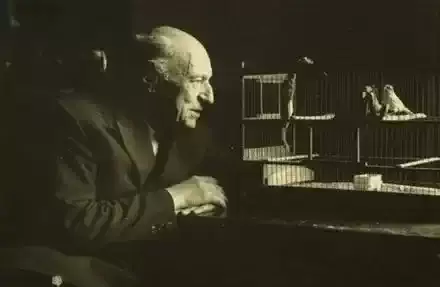
Umberto Saba
1883–1957
· lived 74 years
 IT
IT
IT
Umberto Saba, born Umberto Poli, was an Italian poet, known for his lyrical, autobiographical poetry with a strong intimate tone. His work is characterized by colloquial language, the exploration of daily life, the city of Trieste, and the complexities of the human soul, including motherhood, fatherhood, and identity itself. Despite a life marked by personal difficulties and instability, Saba maintained a constant dedication to poetry, becoming a unique voice in 20th-century Italian literature.
n. 1883-03-09, Trieste · m. 1957-08-26, Gorizia
66
Views
Bio
Identification and Basic Context
Umberto Saba, whose birth name was Umberto Poli, was a prominent Italian poet. He was born in Trieste on March 17, 1883, and died in the same city on September 25, 1957. His family background was complex, being the son of a Jewish merchant and a mother of Austrian origin, with whom he had a difficult relationship. Most of his life and work are intrinsically linked to Trieste.Childhood and Education
Saba's childhood was marked by his father's absence and family instability. He was raised by his mother and his wet nurse, figures who would have a great influence on his work. His education was partly self-taught, with an interest in classical and modern literature. The cosmopolitan and multilingual atmosphere of Trieste also shaped his perception and language.Literary Career
Saba began his poetic career young, adopting the pseudonym "Saba" (which may have referred to his wet nurse or the Hebrew word for "grandfather"). His most significant work, "Canzoniere" (Songs), is an extensive collection of poems written over decades, reflecting his life experiences, his loves, his crises, and his city.Work, Style, and Literary Characteristics
"Canzoniere" is Saba's central work, gathering poems that address themes such as the city of Trieste, war, love, family, lost childhood, old age, and the complexities of the human psyche. Saba cultivated a lyrical and confessional style, using language that approaches everyday speech, but with great precision and musicality. His poetry is often described as "prosaic" and "realistic," distancing itself from the linguistic experiments of other modernists. He sought an inner truth and raw sincerity in his verses, exploring the beauty and pain of existence with a unique voice.Cultural and Historical Context
Saba lived in a period of great transformations in Italy and Europe, including the two World Wars and the advent of fascism. Trieste, his birthplace, had a turbulent history, transitioning from Austro-Hungarian to Italian rule. Saba, of Jewish origin, suffered from the fascist racial laws, which added a layer of suffering and exile to his life.Personal Life
Saba's life was marked by difficulties: financial instability, bouts of depression, marital problems, and a complex relationship with his mother. He served in the Italian army and held various professions, including that of a bookseller. His search for personal stability and serenity was a recurring theme in his work.Recognition and Reception
Although he received modest recognition for most of his life, Saba's work gained increasing appreciation after World War II. Poets like Eugenio Montale and Pier Paolo Pasolini were important advocates for his work. Today, he is widely considered one of the most important poets of 20th-century Italian literature, praised for his honesty and the depth of his vision.Influences and Legacy
Saba was influenced by classical Italian poetry and by authors such as Carducci and Pascoli. His legacy lies in his ability to find the universal in the particular, to explore the depths of the human soul with accessible and authentic language. His poetry influenced generations of poets who sought a lyrical expression more connected to reality and personal experience.Interpretation and Critical Analysis
Saba's work has been the subject of numerous critical analyses, focusing on themes such as the Oedipus complex, the relationship with the maternal figure, Jewish identity, and psychoanalysis (Saba was an enthusiast of Freud). His "Canzoniere" is seen as a poetic self-portrait in constant construction.Curiosities and Lesser-Known Aspects
Saba kept a diary where he recorded his experiences and reflections, many of which were incorporated into or inspired his poems. His passion for animals, especially dogs, is another aspect that comes through in his work.Death and Memory
Umberto Saba died in Trieste in 1957. Posthumously, his works continued to be published and studied, consolidating his position as a fundamental poet of Italian literature, whose "Canzoniere" is considered a unique testament to the human condition.Poems
0No poems found
Videos
50
Comments (0)
Log in
to post a comment.
No comments yet. Be the first to comment.