
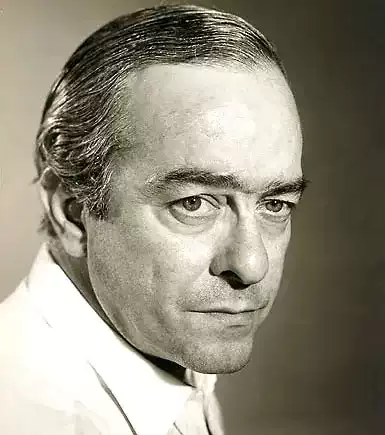
Vinicius de Moraes
1913–1980
· lived 66 years
 BR
BR
BR
Vinicius de Moraes was a Brazilian poet, playwright, journalist, and composer, considered one of the greatest exponents of lyric poetry in the Portuguese language. His work is marked by deep lyricism, exploring themes such as love, beauty, melancholy, and everyday life, with an accessible and musical language. He is also remembered as one of the fathers of Bossa Nova, having composed several songs that became classics of Brazilian popular music.
n. 1913-10-19, Rio de Janeiro · m. 1980-07-09, Rio de Janeiro
224
Views
Bio
Identification and basic context
Vinicius de Moraes, whose full name was Marcus Vinicius da Cruz de Mello Moraes, was a Brazilian poet, playwright, journalist, diplomat, and composer. Born in Rio de Janeiro, he intensely lived the Brazilian culture of the mid-20th century. His work is predominantly written in Portuguese.Childhood and education
Born into an upper-middle-class family, Vinicius spent his childhood in Rio de Janeiro and Minas Gerais. From an early age, he showed an interest in literature, influenced by poetry readings and the cultural atmosphere of the time. He studied in traditional schools and even enrolled in the Faculty of Law in Rio de Janeiro, but his true vocation was art.Literary career
The beginning of his literary career occurred with the publication of his first book of poems, "O Caminho para a Distância" (The Path to Distance), in 1933. Throughout his life, Vinicius alternated the office of diplomat with his poetic and musical production. His work evolved from an initial, sometimes spiritualist, lyricism to a more sensual and everyday poetry, especially after the emergence of Bossa Nova.Work, style, and literary characteristics
Among his most notable works are "Primeiros Cantos" (First Songs) (1945), "Sonetos e Baladas" (Sonnets and Ballads) (1949), "Forma e Exegese" (Form and Exegesis) (1955), "Poemas, Sonetos e Baladas" (Poems, Sonnets, and Ballads) (1960), and "A Arte de Amar e Outros Poemas" (The Art of Loving and Other Poems) (1969). His poems explore love in its various facets, sensuality, the joy of living, melancholy, death, and the beauty of simple things. He frequently used the sonnet, but also experimented with free verse. His language is colloquial, musical, and direct, with a strong sensory appeal. Vinicius is often associated with Brazilian Modernism, although his work transcends rigid classifications, dialoguing with lyrical tradition and innovation.Work, style, and literary characteristics
Cultural and historical context Vinicius de Moraes lived in a period of cultural effervescence in Brazil, especially in Rio de Janeiro. He was a friend and contemporary of great names in literature and music, such as Tom Jobim, João Gilberto, Carlos Drummond de Andrade, and Manuel Bandeira. His work reflects the bohemian and intellectual atmosphere of the time, and he himself became an emblematic figure of Bossa Nova.Work, style, and literary characteristics
Personal life Vinicius was married three times and had children. His bohemian life, marked by parties, friendships, and romances, is often associated with his work, which celebrates love and pleasure. He served as a diplomat in various embassies, which provided him with contact with other cultures, but his dedication to poetry and music led him to leave his diplomatic career to dedicate himself fully to art.Work, style, and literary characteristics
Recognition and reception Vinicius de Moraes is widely recognized as one of the greatest Brazilian poets of the 20th century. His work is studied in schools and universities, and his songs are part of the repertoire of Brazilian popular music. He received numerous tributes, and his name became synonymous with lyrical poetry and a certain lifestyle.Work, style, and literary characteristics
Influences and legacy He was influenced by poets such as Manuel Bandeira and Carlos Drummond de Andrade. His legacy extends beyond poetry, with his fundamental contribution to Brazilian popular music, especially Bossa Nova. He influenced generations of poets and composers with his authentic lyricism and his ability to translate human feelings into verses.Work, style, and literary characteristics
Interpretation and critical analysis Vinicius's work is celebrated for its apparent simplicity and emotional depth. His poems about love, in particular, are the subject of numerous analyses, exploring idealization, sensuality, and the pain of loss. His poetry is seen as a mirror of life's contradictions and beauties.Work, style, and literary characteristics
Curiosities and lesser-known aspects Vinicius was known for his charismatic and bohemian personality. His relationship with whiskey and cigarettes was notorious, and he had a habit of writing in often incomplete notebooks. A curiosity is that he considered Bossa Nova a natural development of his poetry.Work, style, and literary characteristics
Death and memory Vinicius de Moraes passed away in 1980 in Rio de Janeiro. His death caused great national commotion. His work remains alive, perpetuated in books, musical recordings, and in the affective memory of many Brazilians, being considered one of the most beloved and popular poets in Brazil.Poems
0No poems found
Videos
50
Comments (0)
Log in
to post a comment.
No comments yet. Be the first to comment.