
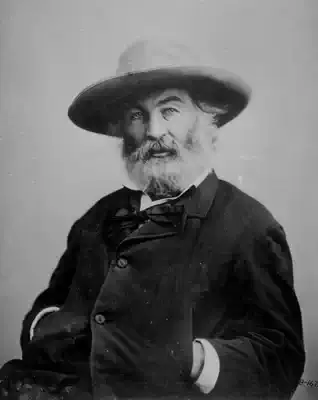
Walt Whitman

Walt Whitman

1819–1892 · lived 72 years US US

Walt Whitman was an American poet, essayist, journalist, and a deliberate humanist who became one of the most influential figures in American poetry. He is often called the "father of free verse." His seminal work, "Leaves of Grass," was a radical departure from the conventional poetry of its time, celebrating the individual, democracy, the body, and the spirit in expansive, cataloging lines. Whitman's poetry embraced a wide range of subjects, from the natural world and urban life to the experiences of laborers and soldiers. His work is characterized by its inclusive spirit, its celebration of the sensual and the spiritual, and its democratic vision. He sought to capture the diverse American experience in all its complexity and vitality, making him a truly unique voice in literature.

n. 1819-05-31, West Hills · m. 1892-03-26, Camden

77,565 Views

Years Of The Modern

Years Of The Modern

YEARS of the modern! years of the unperform'd!
Your horizon rises--I see it parting away for more august dramas;
I see not America only--I see not only Liberty's nation, but other


nations preparing;
I see tremendous entrances and exits--I see new combinations--I see
the solidarity of races;
I see that force advancing with irresistible power on the world's
stage;
(Have the old forces, the old wars, played their parts? are the acts
suitable to them closed?)
I see Freedom, completely arm'd, and victorious, and very haughty,

with Law on one side, and Peace on the other,
A stupendous Trio, all issuing forth against the idea of caste;
--What historic denouements are these we so rapidly approach?
I see men marching and countermarching by swift millions; 10
I see the frontiers and boundaries of the old aristocracies broken;
I see the landmarks of European kings removed;
I see this day the People beginning their landmarks, (all others give

way;)
--Never were such sharp questions ask'd as this day;
Never was average man, his soul, more energetic, more like a God;
Lo! how he urges and urges, leaving the masses no rest;
His daring foot is on land and sea everywhere--he colonizes the

Pacific, the archipelagoes;
With the steam-ship, the electric telegraph, the newspaper, the
wholesale engines of war,
With these, and the world-spreading factories, he interlinks all
geography, all lands;
--What whispers are these, O lands, running ahead of you, passing
under the seas? 20
Are all nations communing? is there going to be but one heart to the
globe?
Is humanity forming, en-masse?--for lo! tyrants tremble, crowns grow
dim;
The earth, restive, confronts a new era, perhaps a general divine
war;
No one knows what will happen next--such portents fill the days and
nights;
Years prophetical! the space ahead as I walk, as I vainly try to

pierce it, is full of phantoms;
Unborn deeds, things soon to be, project their shapes around me;
This incredible rush and heat--this strange extatic fever of dreams,


O years!
Your dreams, O year, how they penetrate through me! (I know not
whether I sleep or wake!)
The perform'd America and Europe grow dim, retiring in shadow behind
me,
The unperform'd, more gigantic than ever, advance, advance upon
me. 30
Read full poem
Bio

Identification and basic context

Walt Whitman was an American poet, essayist, journalist, and humanist. Born on Long Island, New York, he is considered one of the most influential figures in American literature. He wrote in English.

Childhood and education

Whitman's formal schooling was limited; he left school at the age of eleven to work. He became a printer and later worked as a journalist, editor, and teacher. This practical experience exposed him to a wide range of society and ideas, which deeply informed his writing. He was largely self-educated, voraciously reading literature, philosophy, and the Bible, and absorbing the democratic ideals of his time.

Literary trajectory

Whitman began his literary career as a journalist and editor, writing essays, short stories, and editorials. His major turning point was the publication of the first edition of 'Leaves of Grass' in 1855, a collection of poems that he would revise and expand throughout his life. This work was controversial but also groundbreaking, establishing his unique voice and style. He continued to write and publish new poems and editions of 'Leaves of Grass' for the rest of his life, self-publishing some editions and revising extensively.

Works, style, and literary characteristics

Whitman's magnum opus is 'Leaves of Grass,' first published in 1855 and issued in numerous expanded editions until his death. Other notable works include 'Democratic Vistas' (prose essays) and 'Specimen Days' (autobiographical sketches). Whitman's poetry is characterized by its radical use of free verse, lengthy, incantatory lines, and an expansive, catalogues approach to imagery. He celebrated the "self" as a microcosm of humanity and the cosmos, championing democracy, equality, the physical body, sensuality, nature, and the spiritual interconnectedness of all things. His tone is often prophetic, embracing, and deeply democratic. His language is robust, colloquial, and American, incorporating a vast vocabulary and a direct, unadorned style that sought to capture the essence of American experience.

Cultural and historical context

Whitman lived and wrote during a period of immense national transformation in the United States, including westward expansion, industrialization, and the tumultuous lead-up to and aftermath of the Civil War. He was a staunch advocate for democracy and envisioned a uniquely American poetry that reflected the diverse peoples and landscapes of the nation. His work was informed by Transcendentalist ideas, particularly the writings of Emerson, and he engaged with the social and political issues of his day, notably abolitionism.

Personal life

Whitman's personal life was complex and somewhat elusive. He never married and had no children. He served as a volunteer nurse in army hospitals during the Civil War, an experience that deeply affected him and led to poems like "The Wound-Dresser." His intense friendships, often with men, were significant, and he celebrated physical and spiritual connection. He lived a relatively simple life, often in poverty, but remained committed to his poetic vision.

Recognition and reception

Whitman's work was met with both fierce criticism and enthusiastic praise during his lifetime. While initially seen as scandalous and incomprehensible by many, he gradually gained recognition from literary figures like Emerson and was eventually hailed as a major American poet. His reputation grew posthumously, and he is now considered a cornerstone of American literature.

Influences and legacy

Whitman was influenced by Emerson, the Bible, and classical literature, but he forged a completely new poetic voice. He profoundly influenced the development of American poetry, paving the way for free verse and modern poetic sensibilities. His celebration of the individual, democracy, and the body continues to inspire poets and thinkers worldwide.

Interpretation and critical analysis

Critical interpretations of Whitman's poetry often center on his innovative use of free verse, his democratic ideals, his embrace of the body and sexuality, and his complex exploration of American identity. Debates have occurred regarding the sincerity of his democratic vision and the autobiographical elements within his work.

Curiosities and lesser-known aspects

Whitman was known for his distinctive appearance, often sporting a beard and informal clothing. He was also a skilled carpenter and builder in his youth. His extensive revisions of 'Leaves of Grass' show his meticulous attention to craft, despite his unconventional style.

Death and memory

Whitman died in Camden, New Jersey. He is remembered as one of America's most important and original poets, a visionary voice who captured the spirit of a nation in transformation and celebrated the inherent dignity of all human beings.

Poems

168

To You

To You

STRANGER! if you, passing, meet me, and desire to speak to me, why
should you not speak to me?
And why should I not speak to you?
513

To The Reader At Parting

To The Reader At Parting

NOW, dearest comrade, lift me to your face,
We must separate awhile--Here! take from my lips this kiss.
Whoever you are, I give it especially to you;
So long!--And I hope we shall meet again.
430

To The Leaven'd Soil They Trod

To The Leaven'd Soil They Trod

TO the leaven'd soil they trod, calling, I sing, for the last;
(Not cities, nor man alone, nor war, nor the dead,
But forth from my tent emerging for good--loosing, untying the tent


ropes;)
In the freshness, the forenoon air, in the far-stretching circuits
and vistas, again to peace restored,
To the fiery fields emanative, and the endless vistas beyond--to the
south and the north;
To the leaven'd soil of the general western world, to attest my


songs,
(To the average earth, the wordless earth, witness of war and peace,)
To the Alleghanian hills, and the tireless Mississippi,
To the rocks I, calling, sing, and all the trees in the woods,
To the plain of the poems of heroes, to the prairie spreading

wide, 10
To the far-off sea, and the unseen winds, and the same impalpable


air;
... And responding, they answer all, (but not in words,)
The average earth, the witness of war and peace, acknowledges mutely;
The prairie draws me close, as the father, to bosom broad, the son;
The Northern ice and rain, that began me, nourish me to the end;
But the hot sun of the South is to ripen my songs.
425

To The East And To The West

To The East And To The West

TO the East and to the West;
To the man of the Seaside State, and of Pennsylvania,
To the Kanadian of the North--to the Southerner I love;
These, with perfect trust, to depict you as myself--the germs are in


all men;
I believe the main purport of These States is to found a superb
friendship, exalté, previously unknown,
Because I perceive it waits, and has been always waiting, latent in
all men.
435

To Oratists

To Oratists

TO ORATISTS--to male or female,
Vocalism, measure, concentration, determination, and the divine power
to use words.
Are you full-lung'd and limber-lipp'd from long trial? from vigorous

practice? from physique?
Do you move in these broad lands as broad as they?
Come duly to the divine power to use words?


For only at last, after many years--after chastity, friendship,

procreation, prudence, and nakedness;
After treading ground and breasting river and lake;
After a loosen'd throat--after absorbing eras, temperaments, races-


after knowledge, freedom, crimes;
After complete faith--after clarifyings, elevations, and removing
obstructions;
After these, and more, it is just possible there comes to a man, a
woman, the divine power to use words. 10


Then toward that man or that woman, swiftly hasten all--None refuse,
all attend;

Armies, ships, antiquities, the dead, libraries, paintings, machines,
cities, hate, despair, amity, pain, theft, murder, aspiration,
form in close ranks;


They debouch as they are wanted to march obediently through the mouth
of that man, or that woman.

.... O I see arise orators fit for inland America;
And I see it is as slow to become an orator as to become a man;
And I see that all power is folded in a great vocalism.


Of a great vocalism, the merciless light thereof shall pour, and the

storm rage,
Every flash shall be a revelation, an insult,
The glaring flame on depths, on heights, on suns, on stars,
On the interior and exterior of man or woman, 20
On the laws of Nature--on passive materials,
On what you called death--(and what to you therefore was death,
As far as there can be death.)
494

To Foreign Lands

To Foreign Lands

I HEARD that you ask'd for something to prove this puzzle, the New

World,

And to define America, her athletic Democracy;

Therefore I send you my poems, that you behold in them what you

wanted.
314

To Old Age

To Old Age

I SEE in you the estuary that enlarges and spreads itself grandly as
it pours in the great Sea.
430

To A President

To A President

ALL you are doing and saying is to America dangled mirages,
You have not learn'd of Nature--of the politics of Nature, you have

not learn'd the great amplitude, rectitude, impartiality;
You have not seen that only such as they are for These States,
And that what is less than they, must sooner or later lift off from

These States.
352

To A Stranger

To A Stranger

PASSING stranger! you do not know how longingly I look upon you,
You must be he I was seeking, or she I was seeking, (it comes to me,

as of a dream,)
I have somewhere surely lived a life of joy with you,
All is recall'd as we flit by each other, fluid, affectionate,


chaste, matured,
You grew up with me, were a boy with me, or a girl with me,
I ate with you, and slept with you--your body has become not yours

only, nor left my body mine only,
You give me the pleasure of your eyes, face, flesh, as we pass--you
take of my beard, breast, hands, in return,
I am not to speak to you--I am to think of you when I sit alone, or

wake at night alone,
I am to wait--I do not doubt I am to meet you again,
I am to see to it that I do not lose you. 10
490

To A Common Prostitute

To A Common Prostitute

To a Common Prostitute

BE composed--be at ease with me--I am Walt Whitman, liberal and lusty

as Nature;
Not till the sun excludes you, do I exclude you;
Not till the waters refuse to glisten for you, and the leaves to


rustle for you, do my words refuse to glisten and rustle for
you.

My girl, I appoint with you an appointment--and I charge you that you
make preparation to be worthy to meet me,
And I charge you that you be patient and perfect till I come.

Till then, I salute you with a significant look, that you do not
forget me.
377

Quotes

40

Videos

50

Comments (0)

Share
Log in to post a comment.

No comments yet. Be the first to comment.