
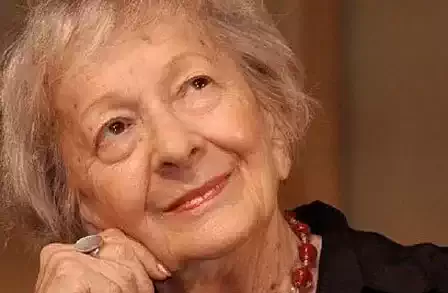
Wisława Szymborska
1923–2012
· lived 88 years
 PL
PL
PL
Wisława Szymborska was a Polish poet, essayist, and translator, awarded the Nobel Prize in Literature in 1996. Her poetry is known for its clarity, irony, and the ability to find the extraordinary in the everyday, exploring themes such as existence, nature, and the human condition with a philosophical and accessible perspective.
n. 1923-07-02, Prowent · m. 2012-02-01, Cracóvia
93
Views
Bio
Identification and basic context
Wisława Szymborska was a prominent Polish poet, essayist, and translator, awarded the Nobel Prize in Literature in 1996. She was born in Kórnik, Poland. She was a central figure in 20th and 21st-century Polish literature.Childhood and education
Szymborska moved to Krakow with her family when she was eight years old. She attended the Jagiellonian University and the University of Adam Mickiewicz in Poznań, studying Polish and sociology. Her early readings and the intellectual atmosphere of Krakow shaped her initial development.Literary career
Her first published poem was "Prośba" ("Request") in 1945. Her work evolved from an early phase more linked to socialist realism to a more personal and ironic style. She was an active contributor to several Polish literary magazines, including "Życie Literackie."Work, style, and literary characteristics
Her most notable works include "The Unfinished City" (1957), "Salt from the Earth" (1965), "Can Anything Be More" (1972), "The Great Number" (1976), "A Thousand and One Nights of Life" (1982), and "End and Beginning" (1993). Her style is characterized by clarity, precision, subtle irony, and a deep sense of existential questioning. She explores themes such as the ephemerality of life, the individual's relationship with the cosmos, the nature of reality, and memory. She frequently uses metaphor, personification, and philosophical reflection to address the everyday and the universe. Her poetic voice is often distant, observant, but intensely human.Cultural and historical context
Szymborska lived and wrote during the communist era in Poland, a period that influenced her critical detachment and her ability to observe reality with an ironic gaze. She was part of the "generation of 1956," a group of writers who redefined Polish poetry after World War II. Her international recognition grew significantly after the fall of communism.Personal life
Szymborska was married twice. She led a relatively discreet life in Krakow, dedicating herself intensely to her writing and her work as a translator. Her personal life, though private, is reflected in her reflections on existence and human relationships.Recognition and reception
The Nobel Prize in Literature in 1996 was the pinnacle of her recognition, but she was already a respected figure in Poland. Her poetry is widely translated and admired internationally for its intelligence, humanity, and accessibility.Influences and legacy
Influenced by poets such as Konstanty Ildefons Gałczyński and Julian Tuwim, Szymborska developed a unique style. Her legacy lies in her ability to make philosophy and the complexity of existence accessible through clear and insightful poetry. She has influenced generations of poets with her mastery of language and her worldview.Interpretation and critical analysis
Szymborska's work is often analyzed for its approach to epistemology, metacognition, and her skeptical yet wonderfully curious view of human existence. Her poetry invites reflection on the place of human beings in the universe and on the nature of truth.Curiosities and lesser-known aspects
Szymborska was known for her humility and her reluctance to expose herself publicly. She was an avid reader and a keen observer of the world around her. Her correspondence with the poet Kornel Filipowicz is particularly well-known.Death and memory
Wisława Szymborska passed away in 2012, in Krakow. Her death was mourned in Poland and internationally, and her work continues to be celebrated and studied.Poems
0No poems found
Quotes
2Comments (0)
Log in
to post a comment.
No comments yet. Be the first to comment.