
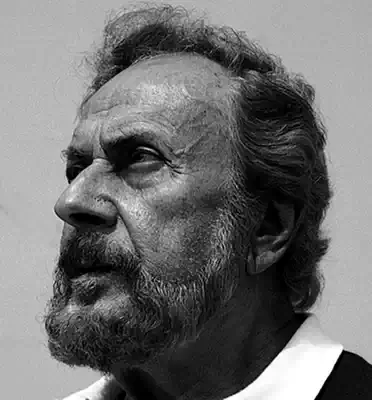
Yannis Ritsos
1909–1990
· lived 81 years
 GR
GR
GR
Yannis Ritsos was one of the most important Greek poets of the 20th century, known for his vast body of work and his political and social engagement. His poetry, deeply rooted in the Greek experience, addresses universal themes such as love, death, injustice, and human resistance. Considered one of the great names in modern poetry, Ritsos explored various poetic forms, from free verse to more elaborate structures, always with accessible language but loaded with symbolism and emotion.
n. 1909-05-01, Monemvasia · m. 1990-11-11, Atenas
72
Views
Bio
Identification and Basic Context
Ioannis Ritsos, known as Yannis Ritsos, was a Greek poet. He was born in Monemvasia, Laconia, and died in Athens. He was a central figure in modern Greek literature and an active member of the Communist Party of Greece. His work is written in Modern Greek.Childhood and Education
Ritsos was born into a wealthy family in Laconia. His childhood was marked by family tragedies, including the deaths of his mother and older brother, which deeply affected him. He received a formal education, but his intellectual formation was also shaped by his readings and the political and cultural environment of the time. The period between the two World Wars and World War II were crucial in his ideological and artistic development.Literary Career
Ritsos began writing poetry early. His first collection, "Tractor", was published in 1934. His work evolved over the decades, reflecting his personal experiences, the political changes in Greece, and his constant search for new forms of poetic expression. He actively participated in literary publications and was an influential voice in the Greek cultural landscape, also acting as a critic and translator.Work, Style, and Literary Characteristics
Among his most important works are "Epitaph" (1936), "Romiosyni" (1947), "18 Small Poems for the Ukrainian People" (1974), and "My Sister's Song" (1975). The dominant themes in his poetry include the struggle for freedom, human dignity, historical memory, the beauty of nature, love, and solitude. His style is marked by direct and lyrical language, but often laden with powerful symbolism and metaphors. He predominantly used free verse, exploring musicality and rhythm. His poetic voice is often confessional and empathetic, reflecting a deep connection with the suffering and aspirations of the people. Ritsos is associated with the Symbolist movement and, later, with Greek modernism. He introduced innovations by integrating social and political poetry with deep lyrical introspection.Cultural and Historical Context
Ritsos lived in a turbulent period of Greek history, marked by dictatorship, World War II, civil war, and the dictatorship of the colonels. His political involvement and his poetry reflect these realities. He was a contemporary of other great Greek poets, such as George Seferis and Odysseus Elytis, with whom he had complex relationships. His poetry is a testament to resistance and hope in difficult times.Personal Life
Ritsos's life was marked by political activism, which led him to be arrested and exiled several times. His family and romantic relationships, although less publicly documented, influenced his poetic sensibility. He lived a modest life, dedicating his life to writing and the struggle for his ideals.Recognition and Reception
Considered one of the greatest Greek poets, Ritsos enjoyed broad recognition during his life and after his death. He received various literary awards in Greece and internationally. His work is widely studied and appreciated, both in academia and by the general public.Influences and Legacy
In his youth, Ritsos was influenced by Greek and European poets, such as Constantinos Kavafis and Pablo Neruda. His legacy is immense, having influenced generations of poets in Greece and abroad. His poetry continues to be translated and inspire readers worldwide, and he is considered an essential figure in 20th-century literature.Interpretation and Critical Analysis
Ritsos's work has been the subject of numerous critical analyses, which highlight his ability to reconcile personal lyricism with social and political denunciation. His poems are often interpreted as a reflection of the human condition, resilience, and the search for a more just world.Curiosities and Lesser-Known Aspects
Ritsos was known for his prolific literary output, writing poems, plays, and essays. Despite his fame, he maintained a humble and discreet demeanor. His manuscripts and correspondence reveal the depth of his thought and his dedication to art.Death and Memory
Yannis Ritsos died in 1990 in Athens. His death was felt as a great loss to Greek and world culture. His works continue to be published, and his memory is celebrated through foundations, study centers, and cultural events dedicated to his poetry.Poems
0No poems found
Videos
50
Comments (0)
Log in
to post a comment.
No comments yet. Be the first to comment.