Some Poems

The Princess (prologue)

The Princess (prologue)

Sir Walter Vivian all a summer's day
Gave his broad lawns until the set of sun
Up to the people: thither flocked at noon
His tenants, wife and child, and thither half
The neighbouring borough with their Institute
Of which he was the patron. I was there
From college, visiting the son,--the son
A Walter too,--with others of our set,
Five others: we were seven at Vivian-place.


And me that morning Walter showed the house,
Greek, set with busts: from vases in the hall
Flowers of all heavens, and lovelier than their names,
Grew side by side; and on the pavement lay
Carved stones of the Abbey-ruin in the park,
Huge Ammonites, and the first bones of Time;
And on the tables every clime and age
Jumbled together; celts and calumets,
Claymore and snowshoe, toys in lava, fans
Of sandal, amber, ancient rosaries,
Laborious orient ivory sphere in sphere,
The cursed Malayan crease, and battle-clubs
From the isles of palm: and higher on the walls,
Betwixt the monstrous horns of elk and deer,
His own forefathers' arms and armour hung.


And 'this' he said 'was Hugh's at Agincourt;
And that was old Sir Ralph's at Ascalon:
A good knight he! we keep a chronicle
With all about him'--which he brought, and I
Dived in a hoard of tales that dealt with knights,
Half-legend, half-historic, counts and kings
Who laid about them at their wills and died;
And mixt with these, a lady, one that armed
Her own fair head, and sallying through the gate,
Had beat her foes with slaughter from her walls.


'O miracle of women,' said the book,
'O noble heart who, being strait-besieged
By this wild king to force her to his wish,
Nor bent, nor broke, nor shunned a soldier's death,
But now when all was lost or seemed as lost--
Her stature more than mortal in the burst
Of sunrise, her arm lifted, eyes on fire--
Brake with a blast of trumpets from the gate,
And, falling on them like a thunderbolt,
She trampled some beneath her horses' heels,
And some were whelmed with missiles of the wall,
And some were pushed with lances from the rock,
And part were drowned within the whirling brook:
O miracle of noble womanhood!'


So sang the gallant glorious chronicle;
And, I all rapt in this, 'Come out,' he said,
'To the Abbey: there is Aunt Elizabeth
And sister Lilia with the rest.' We went
(I kept the book and had my finger in it)
Down through the park: strange was the sight to me;
For all the sloping pasture murmured, sown
With happy faces and with holiday.
There moved the multitude, a thousand heads:
The patient leaders of their Institute
Taught them with facts. One reared a font of stone
And drew, from butts of water on the slope,
The fountain of the moment, playing, now
A twisted snake, and now a rain of pearls,
Or steep-up spout whereon the gilded ball
Danced like a wisp: and somewhat lower down
A man with knobs and wires and vials fired
A cannon: Echo answered in her sleep
From hollow fields: and here were telescopes
For azure views; and there a group of girls
In circle waited, whom the electric shock
Dislinked with shrieks and laughter: round the lake
A little clock-work steamer paddling plied
And shook the lilies: perched about the knolls
A dozen angry models jetted steam:
A petty railway ran: a fire-balloon
Rose gem-like up before the dusky groves
And dropt a fairy parachute and past:
And there through twenty posts of telegraph
They flashed a saucy message to and fro
Between the mimic stations; so that sport
Went hand in hand with Science; otherwhere
Pure sport; a herd of boys with clamour bowled
And stumped the wicket; babies rolled about
Like tumbled fruit in grass; and men and maids
Arranged a country dance, and flew through light
And shadow, while the twangling violin
Struck up with Soldier-laddie, and overhead
The broad ambrosial aisles of lofty lime
Made noise with bees and breeze from end to end.


Strange was the sight and smacking of the time;
And long we gazed, but satiated at length
Came to the ruins. High-arched and ivy-claspt,
Of finest Gothic lighter than a fire,
Through one wide chasm of time and frost they gave
The park, the crowd, the house; but all within
The sward was trim as any garden lawn:
And here we lit on Aunt Elizabeth,
And Lilia with the rest, and lady friends
From neighbour seats: and there was Ralph himself,
A broken statue propt against the wall,


As gay as any. Lilia, wild with sport,
Half child half woman as she was, had wound
A scarf of orange round the stony helm,
And robed the shoulders in a rosy silk,
That made the old warrior from his ivied nook
Glow like a sunbeam: near his tomb a feast
Shone, silver-set; about it lay the guests,
And there we joined them: then the maiden Aunt
Took this fair day for text, and from it preached
An universal culture for the crowd,
And all things great; but we, unworthier, told
Of college: he had climbed across the spikes,
And he had squeezed himself betwixt the bars,
And he had breathed the Proctor's dogs; and one
Discussed his tutor, rough to common men,
But honeying at the whisper of a lord;
And one the Master, as a rogue in grain
Veneered with sanctimonious theory.
But while they talked, above their heads I saw
The feudal warrior lady-clad; which brought
My book to mind: and opening this I read
Of old Sir Ralph a page or two that rang
With tilt and tourney; then the tale of her
That drove her foes with slaughter from her walls,
And much I praised her nobleness, and 'Where,'
Asked Walter, patting Lilia's head (she lay
Beside him) 'lives there such a woman now?'


Quick answered Lilia 'There are thousands now
Such women, but convention beats them down:
It is but bringing up; no more than that:
You men have done it: how I hate you all!
Ah, were I something great! I wish I were
Some might poetess, I would shame you then,
That love to keep us children! O I wish
That I were some great princess, I would build
Far off from men a college like a man's,
And I would teach them all that men are taught;
We are twice as quick!' And here she shook aside
The hand that played the patron with her curls.


And one said smiling 'Pretty were the sight
If our old halls could change their sex, and flaunt
With prudes for proctors, dowagers for deans,
And sweet girl-graduates in their golden hair.
I think they should not wear our rusty gowns,
But move as rich as Emperor-moths, or Ralph
Who shines so in the corner; yet I fear,
If there were many Lilias in the brood,
However deep you might embower the nest,
Some boy would spy it.'


At this upon the sward


She tapt her tiny silken-sandaled foot:
'That's your light way; but I would make it death
For any male thing but to peep at us.'


Petulant she spoke, and at herself she laughed;


A rosebud set with little wilful thorns,


And sweet as English air could make her, she:


But Walter hailed a score of names upon her,


And 'petty Ogress', and 'ungrateful Puss',


And swore he longed at college, only longed,


All else was well, for she-society.


They boated and they cricketed; they talked


At wine, in clubs, of art, of politics;


They lost their weeks; they vext the souls of deans;


They rode; they betted; made a hundred friends,


And caught the blossom of the flying terms,


But missed the mignonette of Vivian-place,


The little hearth-flower Lilia. Thus he spoke,


Part banter, part affection.
'True,' she said,

'We doubt not that. O yes, you missed us much.

I'll stake my ruby ring upon it you did.'

She held it out; and as a parrot turns

Up through gilt wires a crafty loving eye,

And takes a lady's finger with all care,

And bites it for true heart and not for harm,

So he with Lilia's. Daintily she shrieked

And wrung it. 'Doubt my word again!' he said.

'Come, listen! here is proof that you were missed:

We seven stayed at Christmas up to read;

And there we took one tutor as to read:

The hard-grained Muses of the cube and square

Were out of season: never man, I think,

So mouldered in a sinecure as he:

For while our cloisters echoed frosty feet,

And our long walks were stript as bare as brooms,

We did but talk you over, pledge you all

In wassail; often, like as many girls--

Sick for the hollies and the yews of home--

As many little trifling Lilias--played

Charades and riddles as at Christmas here,

And ~what's my thought~ and ~when~ and ~where~ and ~how~,

As here at Christmas.'
She remembered that:

A pleasant game, she thought: she liked it more

Than magic music, forfeits, all the rest.

But these--what kind of tales did men tell men,

She wondered, by themselves?
A half-disdain

Perched on the pouted blossom of her lips:

And Walter nodded at me; '~He~ began,


The rest would follow, each in turn; and so
We forged a sevenfold story. Kind? what kind?
Chimeras, crotchets, Christmas solecisms,
Seven-headed monsters only made to kill
Time by the fire in winter.'


'Kill him now,
The tyrant! kill him in the summer too,'
Said Lilia; 'Why not now?' the maiden Aunt.
'Why not a summer's as a winter's tale?
A tale for summer as befits the time,
And something it should be to suit the place,
Heroic, for a hero lies beneath,
Grave, solemn!'

Walter warped his mouth at this
To something so mock-solemn, that I laughed
And Lilia woke with sudden-thrilling mirth
An echo like a ghostly woodpecker,
Hid in the ruins; till the maiden Aunt
(A little sense of wrong had touched her face
With colour) turned to me with 'As you will;
Heroic if you will, or what you will,
Or be yourself you hero if you will.'

'Take Lilia, then, for heroine' clamoured he,
'And make her some great Princess, six feet high,
Grand, epic, homicidal; and be you
The Prince to win her!'


'Then follow me, the Prince,'
I answered, 'each be hero in his turn!
Seven and yet one, like shadows in a dream.--
Heroic seems our Princess as required--
But something made to suit with Time and place,
A Gothic ruin and a Grecian house,
A talk of college and of ladies' rights,
A feudal knight in silken masquerade,
And, yonder, shrieks and strange experiments
For which the good Sir Ralph had burnt them all--
This ~were~ a medley! we should have him back
Who told the "Winter's tale" to do it for us.
No matter: we will say whatever comes.
And let the ladies sing us, if they will,
From time to time, some ballad or a song
To give us breathing-space.'

So I began,
And the rest followed: and the women sang
Between the rougher voices of the men,
Like linnets in the pauses of the wind:
And here I give the story and the songs.

Sir Launcelot and Queen Guinevere

Sir Launcelot and Queen Guinevere

LIKE souls that balance joy and pain,
With tears and smiles from heaven again
The maiden Spring upon the plain
Came in a sun-lit fall of rain.


In crystal vapour everywhere
Blue isles of heaven laugh'd between,
And far, in forest-deeps unseen,
The topmost elm-tree gather'd green

From draughts of balmy air.

Sometimes the linnet piped his song:
Sometimes the throstle whistled strong:
Sometimes the sparhawk, wheel'd along,
Hush'd all the groves from fear of wrong:

By grassy capes with fuller sound
In curves the yellowing river ran,
And drooping chestnut-buds began
To spread into the perfect fan,

Above the teeming ground.

Then, in the boyhood of the year,
Sir Launcelot and Queen Guinevere
Rode thro' the coverts of the deer,
With blissful treble ringing clear.

She seem'd a part of joyous Spring:
A gown of grass-green silk she wore,
Buckled with golden clasps before;
A light-green tuft of plumes she bore

Closed in a golden ring.

Now on some twisted ivy-net,
Now by some tinkling rivulet,
In mosses mixt with violet
Her cream-white mule his pastern set:


And fleeter now she skimm'd the plains
Than she whose elfin prancer springs
By night to eery warblings,
When all the glimmering moorland rings

With jingling bridle-reins.

As she fled fast thro' sun and shade,
The happy winds upon her play'd,
Blowing the ringlet from the braid:
She look'd so lovely, as she sway'd

The rein with dainty finger-tips,
A man had given all other bliss,
And all his worldly worth for this,
To waste his whole heart in one kiss

Upon her perfect lips.

The Letters

The Letters

Still on the tower stood the vane,
A black yew gloomed the stagnant air,
I peered athwart the chancel pane
And saw the altar cold and bare.
A clog of lead was round my feet,
A band of pain across my brow;
"Cold altar, Heaven and earth shall meet
Before you hear my marriage vow."


I turned and hummed a bitter song
That mocked the wholesome human heart,
And then we met in wrath and wrong,
We met, but only met to part.
Full cold my greeting was and dry;
She faintly smiled, she hardly moved;
I saw with half-unconscious eye
She wore the colours I approved.


She took the little ivory chest,
With half a sigh she turned the key,
Then raised her head with lips comprest,
And gave my letters back to me.
And gave the trinkets and the rings,
My gifts, when gifts of mine could please;
As looks a father on the things
Of his dead son, I looked on these.


She told me all her friends had said;
I raged against the public liar;
She talked as if her love were dead,
But in my words were seeds of fire.
"No more of love; your sex is known:
I never will be twice deceived.
Henceforth I trust the man alone,
The woman cannot be believed.


Through slander, meanest spawn of Hell -
And woman's slander is the worst,
And you, whom once I loved so well,
Through you, my life will be accurst."
I spoke with heart, and heat and force,
I shook her breast with vague alarms -
Like torrents from a mountain's source
We rushed into each other's arms.


We parted: sweetly gleamed the stars,
And sweet the vapour-braided blue,
Low breezes fanned the belfry bars,
As homeward by the church I drew.
The very graves appeared to smile,
So fresh they rose in shadowed swells;
"Dark porch," I said, "and silent aisle,


There comes a sound of marriage bells."

The Lady of Shalott (1842)

The Lady of Shalott (1842)

PART I

On either side the river lie
Long fields of barley and of rye,
That clothe the wold and meet the sky;
And thro' the field the road runs by

To many-tower'd Camelot;
And up and down the people go,
Gazing where the lilies blow
Round an island there below,


The island of Shalott.

Willows whiten, aspens quiver,
Little breezes dusk and shiver
Thro' the wave that runs for ever
By the island in the river


Flowing down to Camelot.
Four gray walls, and four gray towers,
Overlook a space of flowers,
And the silent isle imbowers

The Lady of Shalott.

By the margin, willow veil'd,
Slide the heavy barges trail'd
By slow horses; and unhail'd
The shallop flitteth silken-sail'd


Skimming down to Camelot:
But who hath seen her wave her hand?
Or at the casement seen her stand?
Or is she known in all the land,

The Lady of Shalott?

Only reapers, reaping early
In among the bearded barley,
Hear a song that echoes cheerly
From the river winding clearly,


Down to tower'd Camelot:
And by the moon the reaper weary,
Piling sheaves in uplands airy,
Listening, whispers " 'Tis the fairy


Lady of Shalott."PART II

There she weaves by night and day
A magic web with colours gay.
She has heard a whisper say,
A curse is on her if she stay


To look down to Camelot.
She knows not what the curse may be,
And so she weaveth steadily,
And little other care hath she,

The Lady of Shalott.

And moving thro' a mirror clear


That hangs before her all the year,
Shadows of the world appear.
There she sees the highway near

Winding down to Camelot:
There the river eddy whirls,
And there the surly village-churls,
And the red cloaks of market girls,

Pass onward from Shalott.

Sometimes a troop of damsels glad,
An abbot on an ambling pad,
Sometimes a curly shepherd-lad,
Or long-hair'd page in crimson clad,

Goes by to tower'd Camelot;

And sometimes thro' the mirror blue
The knights come riding two and two:
She hath no loyal knight and true,

The Lady of Shalott.

But in her web she still delights
To weave the mirror's magic sights,
For often thro' the silent nights
A funeral, with plumes and lights

And music, went to Camelot:
Or when the moon was overhead,
Came two young lovers lately wed:
"I am half sick of shadows," said

The Lady of Shalott.PART III

A bow-shot from her bower-eaves,
He rode between the barley-sheaves,
The sun came dazzling thro' the leaves,
And flamed upon the brazen greaves


Of bold Sir Lancelot.
A red-cross knight for ever kneel'd
To a lady in his shield,
That sparkled on the yellow field,

Beside remote Shalott.

The gemmy bridle glitter'd free,
Like to some branch of stars we see
Hung in the golden Galaxy.
The bridle bells rang merrily


As he rode down to Camelot:
And from his blazon'd baldric slung
A mighty silver bugle hung,
And as he rode his armour rung,

Beside remote Shalott.

All in the blue unclouded weather
Thick-jewell'd shone the saddle-leather,
The helmet and the helmet-feather


Burn'd like one burning flame together,

As he rode down to Camelot.
As often thro' the purple night,
Below the starry clusters bright,
Some bearded meteor, trailing light,


Moves over still Shalott.

His broad clear brow in sunlight glow'd;
On burnish'd hooves his war-horse trode;
From underneath his helmet flow'd
His coal-black curls as on he rode,


As he rode down to Camelot.
From the bank and from the river
He flash'd into the crystal mirror,
"Tirra lirra," by the river

Sang Sir Lancelot.

She left the web, she left the loom,
She made three paces thro' the room,
She saw the water-lily bloom,
She saw the helmet and the plume,


She look'd down to Camelot.
Out flew the web and floated wide;
The mirror crack'd from side to side;
"The curse is come upon me," cried

The Lady of Shalott.PART IV

In the stormy east-wind straining,
The pale yellow woods were waning,
The broad stream in his banks complaining,
Heavily the low sky raining


Over tower'd Camelot;
Down she came and found a boat
Beneath a willow left afloat,
And round about the prow she wrote

The Lady of Shalott.

And down the river's dim expanse
Like some bold seër in a trance,
Seeing all his own mischance-With
a glassy countenance

Did she look to Camelot.
And at the closing of the day
She loosed the chain, and down she lay;
The broad stream bore her far away,

The Lady of Shalott.


Lying, robed in snowy white
That loosely flew to left and right-The
leaves upon her falling light-Thro'
the noises of the night


She floated down to Camelot:
And as the boat-head wound along
The willowy hills and fields among,
They heard her singing her last song,


The Lady of Shalott.

Heard a carol, mournful, holy,
Chanted loudly, chanted lowly,
Till her blood was frozen slowly,
And her eyes were darken'd wholly,


Turn'd to tower'd Camelot.
For ere she reach'd upon the tide
The first house by the water-side,
Singing in her song she died,


The Lady of Shalott.

Under tower and balcony,
By garden-wall and gallery,
A gleaming shape she floated by,
Dead-pale between the houses high,


Silent into Camelot.
Out upon the wharfs they came,
Knight and burgher, lord and dame,
And round the prow they read her name,

The Lady of Shalott.

Who is this? and what is here?
And in the lighted palace near
Died the sound of royal cheer;
And they cross'd themselves for fear,


All the knights at Camelot:
But Lancelot mused a little space;
He said, "She has a lovely face;
God in his mercy lend her grace,


The Lady of Shalott."
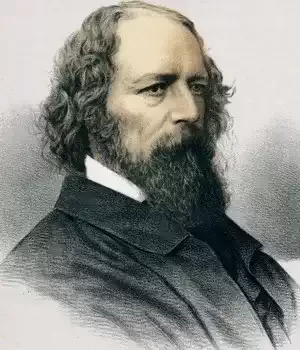
Alfred Lord Tennyson (6 August 1809 – 6 October 1892) Alfred Tennyson, 1st Baron Tennyson, FRS was Poet Laureate of the United Kingdom during much of Queen Victoria's reign and remains one of the most popular poets in the English language. Tennyson excelled at penning short lyrics, such as "In the Valley of Cauteretz", "Break, Break, Break", "The Charge of the Light Brigade", "Tears, Idle Tears" and "Crossing the Bar". Much of his verse was based on classical mythological themes, such as Ulysses, although In Memoriam A.H.H. was written to commemorate his best friend Arthur Hallam, a fellow poet and fellow student at Trinity College, Cambridge, who was engaged to Tennyson's sister, but died from a brain haemorrhage before they could marry. Tennyson also wrote some notable blank verse including Idylls of the King, "Ulysses," and "Tithonus." During his career, Tennyson attempted drama, but his plays enjoyed little success. A number of phrases from Tennyson's work have become commonplaces of the English language, including "Nature, red in tooth and claw", "'Tis better to have loved and lost / Than never to have loved at all", "Theirs not to reason why, / Theirs but to do and die", "My strength is as the strength of ten, / Because my heart is pure", "Knowledge comes, but Wisdom lingers", and "The old order changeth, yielding place to new". He is the ninth most frequently quoted writer in The Oxford Dictionary of Quotations. Early life Tennyson was born in Somersby, Lincolnshire, a rector's son and fourth of 12 children. He derived from a middle-class line of Tennysons, but also had noble and royal ancestry. His father, George Clayton Tennyson (1778–1831), was rector of Somersby (1807–1831), also rector of Benniworth and Bag Enderby, and vicar of Grimsby (1815). The rector was the elder of two sons, but was disinherited at an early age by his father, the landowner George Tennyson (1750–1835) (owner of Bayons Manor and Usselby Hall), in favour of his younger brother Charles, who later took the name Charles Tennyson d'Eyncourt. Rev. George Clayton Tennyson raised a large family and "was a man of superior abilities and varied attainments, who tried his hand with fair success in architecture, painting, music, and poetry. He was comfortably well off for a country clergyman and his shrewd money management enabled the family to spend summers at Mablethorpe and Skegness, on the eastern coast of England." Alfred Tennyson's mother, Elizabeth Fytche (1781–1865), was the daughter of Stephen Fytche (1734–1799), vicar of St. James Church, Louth (1764) and rector of Withcall (1780), a small village between Horncastle and Louth. Tennyson's father "carefully attended to the education and training of his children." Tennyson and two of his elder brothers were writing poetry in their teens, and a collection of poems by all three were published locally when Alfred was only 17. One of those brothers, Charles Tennyson Turner later married Louisa Sellwood, the younger sister of Alfred's future wife; the other was Frederick Tennyson. Another of Tennyson's brothers, Edward Tennyson, was institutionalised at a private asylum, where he died. Education and first publication Tennyson was first a student of Louth Grammar School for four years (1816–1820) and then attended Scaitcliffe School, Englefield Green and King Edward VI Grammar School, Louth. He entered Trinity College, Cambridge in 1827,[4] where he joined a secret society called the Cambridge Apostles. At Cambridge Tennyson met Arthur Henry Hallam, who became his closest friend. His first publication was a collection of "his boyish rhymes and those of his elder brother Charles" entitled Poems by Two Brothers published in 1827. In 1829 he was awarded the Chancellor's Gold Medal at Cambridge for one of his first pieces, "Timbuctoo." Reportedly, "it was thought to be no slight honour for a young man of twenty to win the chancellor's gold medal."He published his first solo collection of poems, Poems Chiefly Lyrical in 1830. "Claribel" and "Mariana", which later took their place among Tennyson's most celebrated poems, were included in this volume. Although decried by some critics as overly sentimental, his verse soon proved popular and brought Tennyson to the attention of well-known writers of the day, including Samuel Taylor Coleridge. Return to Lincolnshire and second publication In the spring of 1831 Tennyson's father died, requiring him to leave Cambridge before taking his degree. He returned to the rectory, where he was permitted to live for another six years, and shared responsibility for his widowed mother and the family. Arthur Hallam came to stay with his family during the summer and became engaged to Tennyson's sister, Emilia Tennyson. In 1833, Tennyson published his second book of poetry, which included his well-known poem, The Lady of Shalott. The volume met heavy criticism, which so discouraged Tennyson that he did not publish again for 10 years, although he continued to write. That same year, Hallam died suddenly and unexpectedly after suffering a cerebral haemorrhage while on vacation in Vienna. Hallam's sudden and unexpected death in 1833 had a profound impact on Tennyson, and inspired several masterpieces, including "In the Valley of Cauteretz" and In Memoriam A.H.H., a long poem detailing the 'Way of the Soul'. Tennyson and his family were allowed to stay in the rectory for some time, but later moved to High Beach, Essex in 1837. An unwise investment in an ecclesiastical wood-carving enterprise soon led to the loss of much of the family fortune. Tennyson then moved to London, and lived for a time at Chapel House, Twickenham. Third publication In 1842, while living modestly in London, Tennyson published two volumes of Poems, of which the first included works already published and the second was made up almost entirely of new poems. They met with immediate success. Poems from this collection, such as Locksley Hall, "Tithonus", and "Ulysses" have met enduring fame. The Princess: A Medley, a satire on women's education, which came out in 1847, was also popular for its lyrics. W. S. Gilbert later adapted and parodied the piece twice: in The Princess (1870) and in Princess Ida (1884). It was in 1850 that Tennyson reached the pinnacle of his career, finally publishing his masterpiece, In Memoriam A.H.H., dedicated to Hallam. Later the same year he was appointed Poet Laureate, succeeding William Wordsworth . In the same year (on 13 June), Tennyson married Emily Sellwood, whom he had known since childhood, in the village of Shiplake. They had two sons, Hallam Tennyson (b. 11 August 1852) – named after his friend – and Lionel (b. 16 March 1854). Poet Laureate After Wordsworth's death in 1850, and Samuel Rogers' refusal, Tennyson was appointed to the position of Poet Laureate, which he held until his own death in 1892, by far the longest tenure of any laureate before or since. He fulfilled the requirements of this position by turning out appropriate but often uninspired verse, such as a poem of greeting to Alexandra of Denmark when she arrived in Britain to marry the future King Edward VII. In 1855, Tennyson produced one of his best known works, "The Charge of the Light Brigade", a dramatic tribute to the British cavalrymen involved in an ill-advised charge on 25 October 1854, during the Crimean War. Other esteemed works written in the post of Poet Laureate include Ode on the Death of the Duke of Wellington and Ode Sung at the Opening of the International Exhibition. Queen Victoria was an ardent admirer of Tennyson's work, and in 1884 created him Baron Tennyson, of Aldworth in the County of Sussex and of Freshwater in the Isle of Wight. Tennyson initially declined a baronetcy in 1865 and 1868 (when tendered by Disraeli), finally accepting a peerage in 1883 at Gladstone's earnest solicitation. He took his seat in the House of Lords on 11 March 1884. Tennyson also wrote a substantial quantity of non-official political verse, from the bellicose "Form, Riflemen, Form", on the French crisis of 1859, to "Steersman, be not precipitate in thine act/of steering", deploring Gladstone's Home Rule Bill. Tennyson was the first to be raised to a British Peerage for his writing. A passionate man with some peculiarities of nature, he was never particularly comfortable as a peer, and it is widely held that he took the peerage in order to secure a future for his son Hallam. Thomas Edison made sound recordings of Tennyson reading his own poetry, late in his life. They include recordings of The Charge of the Light Brigade, and excerpts from "The splendour falls" (from The Princess), "Come into the garden" (from Maud), "Ask me no more", "Ode on the death of the Duke of Wellington", "Charge of the Heavy Brigade", and "Lancelot and Elaine"; the sound quality is as poor as wax cylinder recordings usually are. Towards the end of his life Tennyson revealed that his "religious beliefs also defied convention, leaning towards agnosticism and pandeism": Famously, he wrote in In Memoriam: "There lives more faith in honest doubt, believe me, than in half the creeds." [The context directly contradicts the apparent meaning of this quote.] In Maud, 1855, he wrote: "The churches have killed their Christ." In "Locksley Hall Sixty Years After," Tennyson wrote: "Christian love among the churches look'd the twin of heathen hate." In his play, Becket, he wrote: "We are self-uncertain creatures, and we may, Yea, even when we know not, mix our spites and private hates with our defence of Heaven." Tennyson recorded in his Diary (p. 127): "I believe in Pantheism of a sort." His son's biography confirms that Tennyson was not an orthodox Christian, noting that Tennyson praised Giordano Bruno and Spinoza on his deathbed, saying of Bruno, "His view of God is in some ways mine," in 1892. Tennyson continued writing into his eighties. He died on 6 October 1892 at Aldworth, aged 83. He was buried at Westminster Abbey. A memorial was erected in All Saints' Church, Freshwater. His last words were; "Oh that press will have me now!". He was succeeded as 2nd Baron Tennyson by his son, Hallam, who produced an authorised biography of his father in 1897, and was later the second Governor-General of Australia. The art of Tennyson's poetry Tennyson used a wide range of subject matter, ranging from medieval legends to classical myths and from domestic situations to observations of nature, as source material for his poetry. The influence of John Keats and other Romantic poets published before and during his childhood is evident from the richness of his imagery and descriptive writing. He also handled rhythm masterfully. The insistent beat of Break, Break, Break emphasises the relentless sadness of the subject matter. Tennyson's use of the musical qualities of words to emphasise his rhythms and meanings is sensitive. The language of "I come from haunts of coot and hern" lilts and ripples like the brook in the poem and the last two lines of "Come down O maid from yonder mountain height" illustrate his telling combination of onomatopoeia, alliteration and assonance: The moan of doves in immemorial elms And murmuring of innumerable bees. Tennyson was a craftsman who polished and revised his manuscripts extensively. Few poets have used such a variety of styles with such an exact understanding of metre; like many Victorian poets, he experimented in adapting the quantitative metres of Greek and Latin poetry to English. He reflects the Victorian period of his maturity in his feeling for order and his tendency towards moralising and self-indulgent melancholy. He also reflects a concern common among Victorian writers in being troubled by the conflict between religious faith and expanding scientific knowledge. Like many writers who write a great deal over a long time, he can be pompous or banal, but his personality rings throughout all his works – work that reflects a grand and special variability in its quality. Tennyson possessed the strongest poetic power; he put great length into many works, most famous of which are Maud and Idylls of the King, the latter one of literature's treatments of the legend of King Arthur and The Knights of the Round Table. Eserleri: Poems, Chiefly Lyrical (1830): Lady Clara Vere de Vere (1832) Poems (1833): The Lady of Shalott (1832, 1842) The Palace of Art St. Simeon Stylites (1833) Poems (1842): The Two Voices (1834) "Ulysses" (1833) The Princess; A Medley (1847) In Memoriam A.H.H. (1849) Ring Out, Wild Bells (1850) The Eagle (1851) Maud; A Monodrama (1855/1856) The Charge of the Light Brigade (1854) Enoch Arden and Other Poems (1862/1864) Flower in the crannied wall (1869) The Window – Song cycle with Arthur Sullivan. (1871) Harold (1876) Idylls of the King (composed 1833–1874) Locksley Hall Sixty Years After (1886) Crossing the Bar (1889) The Foresters – a play with incidental music by Arthur Sullivan (1891) Kapiolani (published after his death by Hallam Tennyson)
wer54w66sf32re2
Ulysses - Alfred Tennyson (Powerful Life Poetry)
The Lady of Shalott by Alfred Lord Tennyson - Read by Poet Arthur L Wood
The Circle Of The Hills: a biography of Alfred, Lord Tennyson.
Alfred, Lord Tennyson | Literary Lives
All Things Will Die | Alfred Lord Tennyson (Poem)
Helen Mirren Reads Poetry To An Emotional Stephen Colbert
"Ulysses" by Alfred, Lord Tennyson (read by Tom O'Bedlam)
Crossing The Bar by Alfred Lord Tennyson - Poetry Reading
La charge de la brigade légère – Pascal Ruiz joue Lord Tennyson
The Charge of the Light Brigade
Alfred Lord Tennyson and the Charge of the Light Brigade
04 - Ulysses (Alfred, Lord Tennyson) - Sir John Gielgud.mpg
Mariana by Alfred, Lord Tennyson (read by Ben W Smith)
Break, Break, Break by Alfred Lord Tennyson [with text] - Read by Poet Arthur L Wood
Alfred Lord Tennyson | Alfred Lord Tennyson Life & Works | A L Tennyson Poems
Alfred, Lord Tennyson Crossing the Bar
In Memoriam A.H.H. by Alfred, Lord TENNYSON read by Elizabeth Klett | Full Audio Book
🔵 The Kraken Poem by Alfred Lord Tennyson - Summary Analysis Reading The Kraken Alfred Lord Tennyson
Morte d'Arthur by Alfred Lord Tennyson
الرابع الاعدادي. حياة الشاعر الفريد Alfred Lord Tennyson
"The Brook" by Alfred, Lord Tennyson (read by Tom O'Bedlam)
Alfred, Lord Tennyson, Ulysses and The Lady of Shallott
Alfred Lord Tennyson:Victorian poet
'Break, Break, Break' by Alfred Lord Tennyson - Read by Sir John Gielgud
Alfred Lord Tennyson in Hindi
To strive, to seek, to find, and not to yield. -ULYSSES by Alfred Lord Tennyson
🔵 The Eagle Poem by Alfred Lord Tennyson - Summary Analysis Reading - The Eagle Alfred Lord Tennyson
🔵Alfred Lord Tennyson Crossing the Bar Alfred Lord Tennyson Analysis Reading Alfred Lord Tennyson
Lord Tennyson - brief introduction
Ulysses by Alfred, Lord Tennyson
VICTORIAN POETS: Alfred Lord Tennyson
"The Lotos Eaters" by Alfred, Lord Tennyson (read by Tom O'Bedlam)
Daily Poetry Readings #331: Crossing the Bar by Alfred, Lord Tennyson read by Dr Iain McGilchrist
Alfred Lord Tennyson Biography In Hindi : Works Detail : Life and Works : Victorian Poet
Alfred Lord Tennyson MCQs PYQs || TGT PGT UGC NET || Literature Lovers || AKSRajveer
Alfred Lord Tennyson A Victorian Poet With Exam Points | AKSRajveer | Literature Lovers | UGC NET
THE BROOK BY ALFRED LORD TENNYSON CLASS 12 ALTERNATIVE ENGLISH
Alfred, Lord Tennyson "The Charge of the Light Brigade"Wax Cylinder Poem animation
The Charge of the Light Brigade - Poem by Alfred Lord Tennyson
Alfred Lord Tennyson - The Lady of Shalott
🔵Break Break Break Poem Alfred Lord Tennyson Summary Analysis Break Break Break Alfred Lord Tennyson
"Ulysses" by Alfred, Lord Tennyson: Analysis
The Brook by Alfred Lord Tennyson | Line by Line Explanation ONLY IN ENGLISH | Class 9 | Class 12
Tithonus by Alfred, Lord Tennyson (read by Tom O'Bedlam)
"The Brook" by Alfred Lord Tennyson
Fascinating facts of Alfred Lord Tennyson/Daniel's Poetry Academy
Lord Alfred Tennyson shortcut(victorian period)
Ulysses by Alfred Lord Tennyson - Read by Arthur L Wood
Alfred Lord Tennyson Full Biography &Work essay explanation in tamil #baenglish #poet
The Eagle (Animation)- Alfred Lord Tennyson

See also

Who likes

Followers