Carl Sandburg

Carl Sandburg

1878–1967 · lived 89 years US US

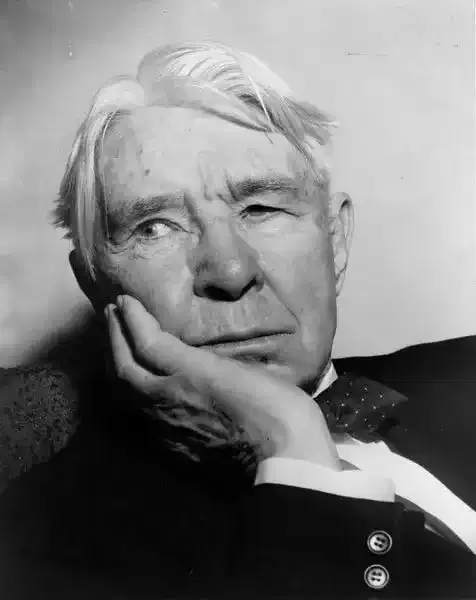
Carl Sandburg was an American poet, historian, novelist, and lexicographer. He is considered one of the most important American poets of the 20th century, known for his free verse and his focus on the American working class and the landscapes of the American Midwest. His poetry often celebrated the common man and the industrial might of America, earning him a reputation as the "poet of the people." Beyond his poetry, Sandburg was also a prolific biographer, most notably of Abraham Lincoln, and a collector of folklore and songs.

n. 1878-01-06, Galesburg · m. 1967-07-22, Flat Rock

52,608 Views

Grass

Pile the bodies high at Austerlitz and Waterloo.
Shovel them under and let me work
-I am the grass; I cover all.

And pile them high at Gettysburg
And pile them high at Ypres and Verdun.
Shovel them under and let me work.
Two years, ten years, and the passengers ask the conductor:

What place is this?
Where are we now?

I am the grass.
Let me work.
Read full poem
Bio

Identification and basic context

Carl Sandburg was an American poet, writer, historian, novelist, and lexicographer. He is widely celebrated for his free verse poetry, which often depicted the American people, especially the working class, and the landscapes of the American Midwest. His work captured the spirit of industrial America and the lives of ordinary people. Sandburg was born in Galesburg, Illinois, and was of Swedish immigrant descent. His linguistic background and early exposure to different cultures influenced his writing style.

Childhood and education

Sandburg's childhood was marked by hard work and limited formal schooling. He left school at the age of thirteen to work and help support his family. Despite this, he was an avid reader and possessed a strong desire for self-education. He worked various jobs, including as a milkman, a railroad laborer, and a salesman, which exposed him to a wide range of American life and experiences. His early readings included works that would later influence his poetic voice, instilling in him a deep appreciation for the vernacular and the common person's experience.

Literary trajectory

Sandburg's literary career began to take shape in his early adulthood. He attended Lombard College in Galesburg, Illinois, where he began writing poetry. His early work was published in small magazines. A pivotal moment was his involvement with Alfred Stieglitz's gallery and his association with the avant-garde literary scene in Chicago. He gained national recognition with the publication of "Chicago Poems" in 1916. His work evolved through distinct phases, increasingly embracing themes of American identity, industry, and the lives of everyday people. He was also active as a journalist, contributing to various publications and anthologies.

Works, style, and literary characteristics

Sandburg's major works include "Chicago Poems" (1916), "Cornhuskers" (1918), "Smoke and Steel" (1920), and "The People, Yes" (1936). His style is characterized by its use of free verse, colloquial language, and vivid imagery, often drawing from the sounds and sights of industrial America. He explored themes of the American dream, the struggle of the working class, the beauty of the common, and the vastness of the American landscape. His poetic voice is often direct, celebratory, and deeply empathetic towards ordinary individuals. Sandburg's language was accessible, reflecting the vernacular of the people he wrote about, and his poems often possessed a strong, rhythmic quality, reminiscent of American folk music. He is noted for bringing the language and spirit of the American Midwest into poetry.

Cultural and historical context

Sandburg lived and wrote during a period of immense transformation in American history, including industrialization, World War I, the Roaring Twenties, the Great Depression, and World War II. He was closely associated with the Chicago Renaissance, a flourishing of arts and literature in Chicago in the early 20th century. He was part of a generation of poets who sought to break away from traditional poetic forms and embrace a more modern, American idiom. His work often reflected the social and economic conditions of his time, particularly the lives of laborers and immigrants. He engaged with the political and social issues of his era, aligning himself with progressive ideals.

Personal life

Sandburg was married to photographer and artist Lilian Steichen, sister of photographer Edward Steichen. They had three daughters. His personal life, though often private, was deeply intertwined with his work, providing him with inspiration and grounding. He was known for his deep connection to the land and his simple lifestyle. He and his family lived on a farm in North Carolina for many years, where he continued to write and pursue his interests in folklore and music. His beliefs were generally progressive, and he was a strong advocate for the common person.

Recognition and reception

Sandburg received significant recognition during his lifetime, including two Pulitzer Prizes: one for his "Complete Poems" (1951) and another for his biography of Abraham Lincoln (1940). He was widely read and admired, hailed as a voice for the common American. His work continues to be studied and appreciated for its enduring portrayal of American life and its innovative use of language. While some critics noted his departure from more traditional poetic forms, his impact and popularity have solidified his place in American literature.

Influences and legacy

Sandburg was influenced by Walt Whitman's embrace of democracy and expansive verse, as well as by the realism and social consciousness of other contemporary writers. He, in turn, influenced generations of American poets with his accessible style, his championing of vernacular language, and his focus on the lives of ordinary Americans. His biography of Lincoln is considered a monumental work in American historiography. Sandburg's legacy lies in his profound connection to the American spirit and his ability to make the lives and experiences of common people the subject of celebrated poetry.

Interpretation and critical analysis

Sandburg's poetry is often interpreted as a celebration of American democracy and the resilience of its people. Critics have analyzed his use of free verse and colloquial language as a deliberate attempt to democratize poetry, making it accessible to a wider audience. His works are seen as a vital record of early 20th-century American life, capturing its industrial dynamism and its social struggles. The critical discourse often centers on his ability to balance a grounded realism with a lyrical sensibility.

Curiosities and lesser-known aspects

Sandburg was also a dedicated folk singer and collector of American folk songs. He amassed a large collection of these songs, which he performed and compiled. He was a multifaceted figure, also known for his collection of Lincolniana. His writing habits were often described as disciplined, but he also possessed a spontaneous and improvisational spirit, much like the folk music he loved. He was known to carry notebooks and jot down observations constantly.

Death and memory

Carl Sandburg died of natural causes at the age of 89. His passing was widely mourned, and his contributions to American literature and culture were deeply acknowledged. His home in Flat Rock, North Carolina, has been preserved as the Carl Sandburg Home National Historic Site, ensuring his legacy continues to inspire future generations.

Poems

116

Grass

Pile the bodies high at Austerlitz and Waterloo.
Shovel them under and let me work
-I am the grass; I cover all.

And pile them high at Gettysburg
And pile them high at Ypres and Verdun.
Shovel them under and let me work.
Two years, ten years, and the passengers ask the conductor:

What place is this?
Where are we now?

I am the grass.
Let me work.
6,899

Young Bullfrogs

Young Bullfrogs

Jimmy Wimbleton listened a first week in June.
Ditches along prairie roads of Northern Illinois
Filled the arch of night with young bullfrog songs.
Infinite mathematical metronomic croaks rose and spoke,
Rose and sang, rose in a choir of puzzles.
They made his head ache with riddles of music.
They rested his head with beaten cadence.
Jimmy Wimbledon listened.
334

Work Gangs

Work Gangs

Box cars run by a mile long.
And I wonder what they say to each other
When they stop a mile long on a sidetrack.
Maybe their chatter goes:
I came from Fargo with a load of wheat up to the danger line.
I came from Omaha with a load of shorthorns and they splintered my boards.
I came from Detroit heavy with a load of fivers.
I carried apples from the Hood river last year and this year bunches of bananas from
Florida; they look for me with watermelons from Mississippi next year.


Hammers and shovels of work gangs sleep in shop corners
when the dark stars come on the sky and the night watchmen walk and look.


Then the hammer heads talk to the handles,
then the scoops of the shovels talk,
how the day’s work nicked and trimmed them,
how they swung and lifted all day,
how the hands of the work gangs smelled of hope.
In the night of the dark stars
when the curve of the sky is a work gang handle,
in the night on the mile long sidetracks,
in the night where the hammers and shovels sleep in corners,
the night watchmen stuff their pipes with dreams—
and sometimes they doze and don’t care for nothin’,
and sometimes they search their heads for meanings, stories, stars.
The stuff of it runs like this:
A long way we come; a long way to go; long rests and long deep sniffs for our lungs on
the way.
Sleep is a belonging of all; even if all songs are old songs and the singing heart is
snuffed out like a switchman’s lantern with the oil gone, even if we forget our names
and houses in the finish, the secret of sleep is left us, sleep belongs to all, sleep is the
first and last and best of all.


People singing; people with song mouths connecting with song hearts; people who
must sing or die; people whose song hearts break if there is no song mouth; these are
my people.
395

Woman With A Past

Woman With A Past

There was a woman tore off a red velvet gown
And slashed the white skin of her right shoulder
And a crimson zigzag wrote a finger nail hurry.


There was a woman spoke six short words
And quit a life that was old to her
For a life that was new.


There was a woman swore an oath
And gave hoarse whisper to a prayer
And it was all over.


She was a thief and a whore and a kept woman,
She was a thing to be used and played with.
She wore an ancient scarlet sash.


The story is thin and wavering,
White as a face in the first apple blossoms,
White as a birch in the snow of a winter moon.


The story is never told.
There are white lips whisper alone.
There are red lips whisper alone.


In the cool of the old walls,
In the white of the old walls,
The red song is over.
266

Who Am I?

Who Am I?

My head knocks against the stars.
My feet are on the hilltops.
My finger-tips are in the valleys and shores of
universal life.
Down in the sounding foam of primal things I
reach my hands and play with pebbles of
destiny.
I have been to hell and back many times.
I know all about heaven, for I have talked with God.
I dabble in the blood and guts of the terrible.
I know the passionate seizure of beauty
And the marvelous rebellion of man at all signs
reading "Keep Off."
My name is Truth and I am the most elusive captive
in the universe.
417

Waiting

Waiting


Today I will let the old boat stand
Where the sweep of the harbor tide comes in
To the pulse of a far, deep-steady sway.
And I will rest and dream and sit on the deck

Watching the world go by
And take my pay for many hard days gone I remember.


I will choose what clouds I like
In the great white fleets that wander the blue
As I lie on my back or loaf at the rail.
And I will listen as the veering winds kiss me and fold me
And put on my brow the touch of the world's great will.


Daybreak will hear the heart of the boat beat,

Engine throb and piston play
In the quiver and leap at call of life.
To-morrow we move in the gaps and heights
On changing floors of unlevel seas
And no man shall stop us and no man follow
For ours is the quest of an unknown shore
And we are husky and lusty and shouting-gay.
334

White Shoulders

White Shoulders

Your white shoulders
I remember
And your shrug of laughter.


Low laughter
Shaken slow
From your white shoulders.
303

Under the Harvest Moon

Under the Harvest Moon

Under the harvest moon,
When the soft silver
Drips shimmering
Over the garden nights,
Death, the gray mocker,
Comes and whispers to you
As a beautiful friend
Who remembers.


Under the summer roses
When the flagrant crimson
Lurks in the dusk
Of the wild red leaves,
Love, with little hands,
Comes and touches you
With a thousand memories,
And asks you
Beautiful, unanswerable questions.
356

Upstairs

Upstairs


I too have a garret of old playthings.
I have tin soldiers with broken arms upstairs.
I have a wagon and the wheels gone upstairs.
I have guns and a drum, a jumping-jack and a magic lantern.
And dust is on them and I never look at them upstairs.
I too have a garret of old playthings.
325

Under A Hat Rim

Under A Hat Rim

While the hum and the hurry
Of passing footfalls
Beat in my ear like the restless surf
Of a wind-blown sea,
A soul came to me
Out of the look on a face.


Eyes like a lake


Where a storm-wind roams


Caught me from under


The rim of a hat.
I thought of a midsea wreck
and bruised fingers clinging
to a broken state-room door.
326

Quotes

40

Videos

50

Comments (0)

Share
Log in to post a comment.

No comments yet. Be the first to comment.