
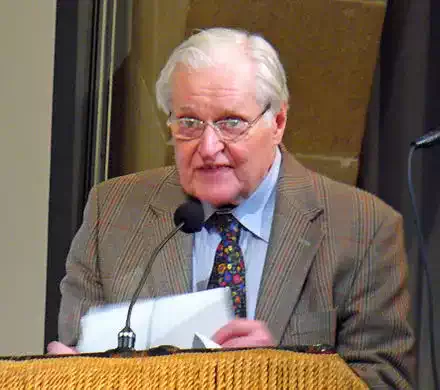
John Ashbery
 US
US
John Ashbery was one of the most influential American poets of the second half of the 20th century, known for his challenging and innovative poetry. His work explores the nature of language, consciousness, and reality, often through lengthy, stream-of-consciousness poems. Ashbery demonstrated a remarkable ability to blend the colloquial with the sublime, the personal with the impersonal, creating a unique style that defies easy categorization. He was also a respected literary critic and teacher, leaving a lasting legacy on contemporary poetry.
n. 1927-07-28, Rochester · m. 2017-09-03, Hudson
Bio
Identification and Basic Context
John Ashbery (1927-2017) was a prominent and influential American poet, considered a central figure in American post-war poetry. Although best known by his given name, John Ashbery, his writing is marked by a complexity and depth that often transcend direct personal identification. He was born in Rochester, New York, to a family with rural and academic roots, and his primary language of writing was always English. He lived and worked predominantly in the United States, but his work resonates internationally. The historical context in which he lived spanned the Cold War, the civil rights movement, the counterculture of the 1960s, and the rise of globalization, elements that, subtly or explicitly, are reflected in his poetry.Childhood and Education
Ashbery grew up in Sodus, a small town in New York's Finger Lakes region, in a family environment marked by the absence of his mother, a pianist, and the presence of his father, a farmer. This childhood in a somewhat isolated rural landscape may have contributed to the introspection and detailed observation that characterize his work. He attended Deerfield Academy and later Harvard University, where he studied English literature and graduated in 1949. It was at Harvard that he developed his interest in poetry and literary criticism, encountering other future writers and intellectuals. His early readings included poets from the modernist tradition like T.S. Eliot and W.H. Auden, but he also developed an interest in Surrealist poetry and philosophy.Literary Career
Ashbery began writing poetry seriously during his university years. His first published book, "Some Trees," appeared in 1956, already showing hints of his peculiar style. This was followed by "The Tennis Court Oath" (1962), a book that marked a shift towards more fragmented and experimental language. Over the following decades, he published a vast body of work, including "Rivers and Mountains" (1966), "The Double Dream of Spring" (1970), and the acclaimed "Self-Portrait in a Convex Mirror" (1975), which earned him the Pulitzer Prize, the National Book Award, and the National Book Critics Circle Award. Ashbery was also a prolific literary critic, with regular contributions to publications such as "Partisan Review" and "New York Magazine," where he wrote for many years. He also worked as an editor and taught at various institutions, including Brooklyn College and Bard College.Work, Style, and Literary Characteristics
Ashbery's work is known for its complexity, ambiguity, and exploration of subjectivity. His poems often challenge linear narratives and conventional logic, using stream of consciousness, the juxtaposition of disparate images, and language that transitions between the everyday and the philosophical. Recurring themes include the nature of perception, memory, time, identity, art, and language itself. Ashbery experimented with various poetic forms, but he is particularly noted for his mastery of free verse and his creation of long, meditative poems that seem to unfold organically. His tone can vary from lyrical and contemplative to ironic and melancholic, often within the same piece. The language is dense, replete with unexpected metaphors and diverse cultural allusions, creating an effect of polyphony and multiplicity of voices. Ashbery is often associated with late Modernism and a form of Postmodernism, but his style is so unique that it resists strict categorization. Lesser-known works include his prose writings and his translations.Cultural and Historical Context
John Ashbery emerged as a poet during a period of intense cultural effervescence in the United States, following World War II. He was associated with the so-called "New York School" of poetry, a group of poets who shared a certain cosmopolitanism, an interest in visual art (particularly abstract expressionism), and a more colloquial and experimental approach to poetic language, in contrast to the more formalist poetry of other movements. He lived a relatively private life, away from the spotlight, but his circle included prominent figures from the arts, such as painters Willem de Kooning and Jasper Johns, and other poets like Frank O'Hara and Kenneth Koch. His poetry reflects a constant dialogue with contemporary culture, absorbing and questioning its values and forms of expression. His work, though often abstract, can be seen as a response to the anxieties and transformations of post-war American society.Personal Life
John Ashbery maintained a long-term relationship with the painter David Kermani. Although his personal life was generally private, his emotional relationships and experiences, often transmuted into poetic images, are an underlying element in his work. Ashbery worked as a literature professor at various universities, which provided him with financial stability to dedicate himself to writing. His philosophical beliefs seemed to lean towards a certain existential skepticism and an appreciation of aesthetic experience as a means of apprehending reality. No significant explicit political involvement is known in his life, but his poetry, by questioning forms of representation and communication, can be seen as a subtle act of resistance to dominant ideologies.Recognition and Reception
John Ashbery received wide recognition throughout his career, culminating in the prestigious awards for "Self-Portrait in a Convex Mirror." He was considered by many critics to be the greatest living American poet during the last decades of the 20th century and the early 21st century. His poetry, however, was always subject to debate: while some celebrated it for its originality and depth, others criticized it for its difficulty and hermeticism. Academic recognition was substantial, with numerous studies and essays dedicated to his work. His popularity among the general public was more moderate, given the challenging nature of his poetry, but he maintained considerable influence among more dedicated poets and readers.Influences and Legacy
Ashbery was deeply influenced by poets such as Arthur Rimbaud, Stéphane Mallarmé, W.H. Auden, Wallace Stevens, and the French Surrealists. His own legacy is immense. He forged new paths for American poetry, demonstrating that it was possible to be innovative and complex without resorting to excessive formalism or explicit confessions. He influenced generations of poets who sought to explore language, subjectivity, and the intersection between inner life and the external world. His work is part of the American literary canon and has been widely translated into various languages, promoting the international diffusion of his poetry. Academic studies continue to investigate his vast and complex work.Interpretation and Critical Analysis
Ashbery's work invites multiple readings, challenging unique and definitive interpretations. Many critics highlight the philosophical dimension of his poetry, which addresses fundamental questions about existence, consciousness, and the nature of reality. His exploration of ambiguity and the fragmentation of modern experience has been debated, with some seeing in it a reflection of the postmodern condition and others finding a profound existential resonance. The constant tension between the personal and the impersonal, the familiar and the strange, is one of the most fascinating and debated aspects of his poetry.Curiosities and Lesser-Known Aspects
Ashbery was known for his modesty and amiable disposition, contrasting with the sometimes daunting complexity of his poetry. He appreciated everyday life and small pleasures, elements that, unexpectedly, could find their way into his poems. His collaborations with visual artists, such as writing texts for works by Jasper Johns, reveal a creative intersection between poetry and other arts. His writing habits were, according to accounts, regular but not ritualistic, dedicating time to reading and reflection. His correspondence and diaries, when published, offer valuable insights into his creative process and his perspective on the literary world.Death and Memory
John Ashbery passed away in 2017, at the age of 90, at his home in Hudson, New York. His death was felt as the loss of one of the most important and original voices in American poetry. Posthumous publications and the ongoing reassessment of his work ensure that his memory and poetic legacy remain alive and influential. His work continues to be studied, debated, and appreciated by new generations of readers and poets.Poems
0No poems found
Quotes
9
Videos
50
Comments (0)
No comments yet. Be the first to comment.