 Escritas.org

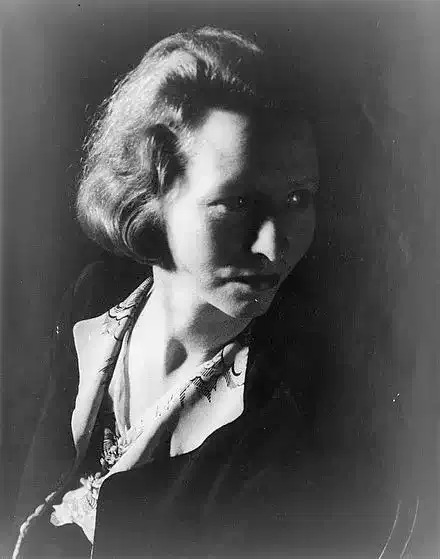
Edna St. Vincent Millay
Edna St. Vincent Millay was a prominent American poet and playwright, celebrated for her lyrical verse and her passionate, often rebellious, spirit. A leading voice of the "Lost Generation," her work captured the zeitgeist of the Jazz Age with its themes of love, freedom, social injustice, and the complexities of modern life. Millay's skillful use of traditional forms, such as the sonnet, combined with her bold modern sensibilities, earned her widespread acclaim and a devoted readership.
28706
0
0
Some Poems
Biography
Videos
Books
Edna St. Vincent Millay (February 22, 1892 – October 19, 1950)
Edna St. Vincent Millay was an American lyrical poet, playwright and
feminist. She received the Pulitzer Prize for Poetry, and was known for her
activism and her many love affairs. She used the pseudonym Nancy Boyd for
her prose work.
Early Life
Millay was born in Rockland, Maine to Cora Lounella, a nurse, and Henry
Tollman Millay, a schoolteacher who would later become superintendent of
schools. Her middle name derives from St. Vincent's Hospital in New York,
where her uncle's life had been saved just before her birth. The family's
house was "between the mountains and the sea where baskets of apples and
drying herbs on the porch mingled their scents with those of the neighboring
pine woods." In 1904, Cora officially divorced Millay's father for financial
irresponsibility, but they had already been separated for some years. Cora
and her three daughters, Edna (who called herself "Vincent"), Norma, and
Kathleen, moved from town to town, living in poverty. Cora travelled with a
trunk full of classic literature, including Shakespeare and Milton, which she
read to her children. The family settled in a small house on the property of
Cora's aunt in Camden, Maine, where Millay would write the first of the
poems that would bring her literary fame.
The three sisters were independent and spoke their minds, which did not
always sit well with the authority figures in their lives. Millay's grade school
principal, offended by her frank attitudes, refused to call her Vincent.
Instead, he called her by any woman's name that started with a V. At
Camden High School, Millay began developing her literary talents, starting at
the school's literary magazine, The Megunticook. At 14 she won the St.
Nicholas Gold Badge for poetry, and by 15 she had published her poetry in
the popular children's magazine St. Nicholas, the Camden Herald, and the
high-profile anthology Current Literature. While at school she had several
relationships with women, including Edith Wynne Matthison, who would go
on to become an actress in silent films. Millay entered Vassar College at 21,
later than usual, and had relationships with several fellow students during
her time there.
Millay’s fame began in 1912 when she entered her poem “Renascence” in a
poetry contest in The Lyric Year. The poem was widely considered the best
submission and when it was ultimately awarded fourth place, it created a
scandal which brought Millay publicity. The first-place winner Orrick Johns
was among those who felt that “Renascence” was the best poem, and stated
that “the award was as much an embarrassment to me as a triumph." A
second-prize winner offered Millay his $250 prize money. In the immediate
aftermath of the Lyric Year controversy, Caroline B. Dow heard Millay reciting
her poetry and playing the piano at the Whitehall Inn in Camden, Maine, and
was so impressed that she offered to pay for Millay’s education at Vassar
College. Millay moved to New York City after her graduation in 1917.
Career
Millay lived in a number of places in Greenwich Village, including a house
owned by the Cherry Lane Theatre, renowned for being the smallest in New
York City. The critic Floyd Dell wrote that the red-haired and beautiful Millay
was "a frivolous young woman, with a brand-new pair of dancing slippers
and a mouth like a valentine." Millay described her life in New York as "very,
very poor and very, very merry." Openly bisexual, she counted among her
close friends the writers Witter Bynner, Arthur Davison Ficke, and Susan
Glaspell, as well as Floyd Dell and the critic Edmund Wilson, both of whom
proposed marriage to her and were refused.
Her 1920 collection A Few Figs From Thistles drew controversy for its novel
exploration of female sexuality and feminism. In 1919 she wrote the anti-war
play Aria da Capo which starred her sister Norma Millay at the Provincetown
Playhouse in New York City. Millay won the Pulitzer Prize for Poetry in 1923
for "The Ballad of the Harp-Weaver"; she was the third woman to win the
poetry prize.
In 1923 she married 43-year-old Eugen Jan Boissevain (1880–1949), the
widower of the labor lawyer and war correspondent Inez Milholland, a
political icon Millay had met during her time at Vassar. A self-proclaimed
feminist, Boissevain supported her career and took primary care of domestic
responsibilities. Both Millay and Boissevain had other lovers throughout their
twenty-six-year marriage. Millay's most significant such relationship during
this time was with the poet George Dillon, who was fourteen years her
junior, and for whom she wrote a number of her sonnets.
In 1925, Boissevain and Millay bought Steepletop near Austerlitz, New York,
which had been a 635-acre (257 ha) blueberry farm. The couple built a barn
(from a Sears Roebuck kit), and then a writing cabin and a tennis court.
Millay grew her own vegetables in a small garden. The couple later bought
Ragged Island in Casco Bay, Maine, as a summer retreat.
Millay's reputation was damaged by the poetry she wrote about the Allied
war effort during World War II. Merle Rubin noted: "She seems to have
caught more flak from the literary critics for supporting democracy than Ezra
Pound did for championing fascism." In the New York Times Millay mourned
the Czechoslovak city of Lidice, the site of a Nazi massacre:
The whole world holds in its arms today
The murdered village of Lidice,
Like the murdered body of a little child.
In 1943 Millay was the sixth person and the second woman to be awarded
the Frost Medal for her lifetime contribution to American poetry. Boissevain
died in 1949 of lung cancer, and Millay lived alone for the last year of her
life.
Death and Steepletop Legacy
Millay died at her home on October 19, 1950. She had fallen down stairs and
was found approximately eight hours after her death. Her physician reported
that she had had a heart attack following a coronary occlusion. She was 58
years old.
Millay's sister Norma and her husband, the painter and actor Charles
Frederick Ellis, moved to Steepletop after Millay's death. In 1973 they
established Millay Colony for the Arts on the seven acres (2.8 ha) around the
house and barn. After the death of her husband in 1976, Norma continued to
run the program until her death in 1986. The poet Mary Oliver visited
Steepletop and became a close friend of Norma. Oliver eventually lived there
for seven years and helped to organize Millay's papers.Mary Oliver herself
went on to become a Pulitzer Prize-winning poet, greatly inspired by Millay's
work. In 2006, the state of New York paid $1.69 million to acquire 230 acres
(0.93 km2) of Steepletop, with the intention to add the land to a nearby
state forest preserve. The proceeds of the sale were to be used by the Edna
St. Vincent Millay Society to restore the farmhouse and grounds and turn it
into a museum. Since summer, 2010 the museum has been open to the
public. Parts of the grounds of Steepletop, including a Poet's Walk that leads
to Millay's grave, are now open to the public year-round. From the final
weekend of May through the middle of October each year guided tours of
Steepletop and Millay's gardens are available.
Eserleri:
Poetry Collections
Renascence, and Other Poems (title poem first published under name E.
Vincent Millay in The Lyric Year, 1912; collection includes God's World), M.
Kennerley, 1917. reprinted, Books for Libraries Press, 1972.
A Few Figs From Thistles: Poems and Four Sonnets, F. Shay, 1920, second
[enlarged] edition published as A Few Figs From Thistles: Poems and
Sonnets,F. Shay, 1921.
Second April (poems; includes Spring, Ode to Silence,and The Beanstalk), M.
Kennerley, 1921. reprinted, Harper, 1935
The Ballad of the Harp-Weaver, F. Shay, 1922, reprinted as The
Harp-Weaver, in The Harp-Weaver, and Other Poems (includes The Concert,
Euclid Alone has Looked on Beauty Bare, and Sonnets from an Ungrafted
Tree), Harper, 1923.
Poems, M. Secker, 1923.
(Under pseudonym Nancy Boyd) Distressing Dialogues, preface by Edna St.
Vincent Millay, Harper, 1924.
The Buck in the Snow, and Other Poems (includes The Buck in the Snow
[also see below] and On Hearing a Symphony of Beethoven), Harper, 1928.
Fatal Interview (sonnets), Harper, 1931.
Wine from These Grapes (poems; includes Epitaph for the Race of Man and
In the Grave No Flower), Harper, 1934.
(Translator with George Dillon; and author of introduction) Charles
Baudelaire, Flowers of Evil, Harper, 1936.
Conversation at Midnight (narrative poem), Harper, 1937.
Huntsman, What Quarry? (poems), Harper, 1939.
There Are No Islands, Any More: Lines Written in Passion and in Deep
Concern for England, France, and My Own Country, Harper, 1940.
Make Bright the Arrows: 1940 Notebook (poems), Harper, 1940.
The Murder of Lidice (poem), Harper, 1942.
Second April [and] The Buck in the Snow, introduction by William Rose
Benét, Harper, 1950.
Mine the Harvest (poems), edited by Norma Millay, Harper, 1954.
Take Up the Song, Harper, 1986, reprinted with music by William Albright as
Take Up the Song: Soprano Solo, Mixed Chorus, and Piano, Henmar Press,
1994.
Selected Poems/The Centenary Edition, edited by Colin Falck, Harper
Perennial, 1992.
Plays
(And director) Aria da capo (one-act play in verse; first produced in
Greenwich Village, NY, December 5, 1919), M. Kennerley, 1921 (also see
below).
The Lamp and the Bell (five-act play; first produced June 18, 1921), F. Shay,
1921 (also see below).
Two Slatterns and a King: A Moral Interlude (play), Stewart Kidd, 1921.
Three Plays (contains Two Slatterns and a King, Aria da capo, and The Lamp
and the Bell), Harper, 1926.
(Author of libretto) The King's Henchman (three-act play; first produced in
New York, February 17, 1927), Harper, 1927.
The Princess Marries the Page (one-act play), Harper, 1932.
Letters
Letters of Edna St. Vincent Millay, edited by Allan Ross Macdougall, Harper,
1952.
[Four Sonnets (1922)]
I1.
Love, though for this you riddle me with darts,
.
And drag me at your chariot till I die, -.
Oh, heavy prince! Oh, panderer of hearts! -.
Yet hear me tell how in their throats they lie
.
Who shout you mighty: thick about my hair,
.
Day in, day out, your ominous arrows purr,
.
Who still am free, unto no querulous care
.
A fool, and in no temple worshiper!
.
I, that have bared me to your quiver's fire,
.
Lifted my face into its puny rain,
.
Do wreathe you Impotent to Evoke Desire
.
As you are Powerless to Elicit Pain!
.
(Now will the god, for blasphemy so brave,
.
Punish me, surely, with the shaft I crave!) II2.
I think I should have loved you presently,
.
And given in earnest words I flung in jest;
.
And lifted honest eyes for you to see,
.
And caught your hand against my cheek and breast;
.
And all my pretty follies flung aside
.
That won you to me, and beneath your gaze,
.
Naked of reticence and shorn of pride,
.
Spread like a chart my little wicked ways.
.
I, that had been to you, had you remained,
.
But one more waking from a recurrent dream,
.
Cherish no less the certain stakes I gained,
.
And walk your memory's halls, austere, supreme,
.
A ghost in marble of a girl you knew
.
Who would have loved you in a day or two. III3.
Oh, think not I am faithful to a vow!
.
Faithless am I save to love's self alone.
.
Were you not lovely I would leave you now:
.
After the feet of beauty fly my own.
.
Were you not still my hunger's rarest food,
.
And water ever to my wildest thirst,
.
I would desert you -- think not but I would! -.
And seek another as I sought you first.
.
But you are mobile as the veering air,
.
And all your charms more changeful than the tide,
.
Wherefore to be inconstant is no care:
.
I have but to continue at your side.
.
So wanton, light and false, my love, are you,
.
I am most faithless when I most am true. IV4.
I shall forget you presently, my dear,
.
So make the most of this, your little day,
.
Your little month, your little half a year,
.
Ere I forget, or die, or move away,
Edna St. Vincent Millay documentary
Edna St. Vincent Millay reads "I Shall Forget You Presently My Dear"
Edna St. Vincent Millay reads Love is Not All
Edna St. Vincent Millay reads "Recuerdo"
"Only until this cigarette is ended" by Edna St. Vincent Millay
"What Lips My Lips Have Kissed" by Edna St. Vincent Millay (read by Tom O'Bedlam)
Eavan Boland Reads the Poems of Edna St. Vincent Millay
"Ashes of Life" by Edna St. Vincent Millay (read by Tom O'Bedlam)
Poem - Travel- by : Edna St. Vincent Millay
Edna St Vincent Millay - Time Does Not Bring Relief (Poetry Reading)
"I, Being Born A Woman" By Edna St. Vincent Millay
"Think not I am Faithful" by Edna St. Vincent Millay (read by Tom O'Bedlam)
Dirge Without Music by Edna St. Vincent Millay, 1928
Renascence by Edna St. Vincent Millay
Women's History in the Hudson Valley: Edna St. Vincent Millay
Edna St Vincent Millay - Sorrow (Poetry Reading)
What Lips My Lips Have Kissed by Edna St. Vincent Millay - Poetry Reading
Edna St.Vincent Millay - Spring (audio with text)
Edna St. Vincent Millay reads Recuerdo
National Poetry Month: "First Fig" by Edna St. Vincent Millay
Poems by Edna St. Vincent MILLAY read by Various | Full Audio Book
Edna St. Vincent Millay
"Souvenir" By Edna St Vincent Millay
The Poetry of Edna St. Vincent Millay - Read by Judith Anderson
Millay at Steepletop Trailer
RENASCENCE BY EDNA ST. VINCENT MILLAY [THE POET EXPLORE THEMES OF SUFFERING, REBIRTH & SPIRITUALITY]
"Travel" By Edna St. Vincent Millay
Ashes of Life by Edna St. Vincent Millay - Read by Arthur L Wood
Poetry: "Love is Not All" (Sonnet XXX) by Edna St. Vincent Millay (read by Jodie Foster)
Travel poem (SONG) by Edna St. Vincent Millay, Class 6
Edna St. Vincent Millay reads "Ballad of the Harpweaver"
Epitaph by Edna St. Vincent Millay
"First Fig" Edna St. Vincent Millay GREAT POEM captures wild spirit of 1920s, Gatsby, flappers
CONSCIENTIOUS OBJECTOR by Edna St Vincent Millay (1892-1950)
"Travel" by Edna St. Vincent Millay
And You as Well Must Die - Edna St. Vincent Millay
Edna St Vincent Millay -- Sonnet -- Love is Not All Analysis
"Recuerdo" by Edna St. Vincent Millay (read by Tom O'Bedlam)
Edna St. Vincent Millay reads "Childhood Is The Kingdom Where Nobody Dies"
Love Is Not All by Edna St. Vincent Millay - Poetry Reading
I, Being Born a Woman and Distressed by Edna St. Vincent Millay
Tandy Cronyn presents "Recuerdo" by Edna St. Vincent Millay
Travel by Edna St. Vincent Millay
Edna St. Vincent Millay: "Only until this cigarette is ended..." - read by Jensen Gray
"I, Being Born a Woman and Distressed" by Edna St. Vincent Millay (read by Tom O'Bedlam)
Kyrie Laybourn — Margaret Bonds: “Feast” (Edna St. Vincent Millay)
What lips my lips have kissed by Edna St. Vincent Millay
Departure by Edna St. Vincent Millay
Sonnets X by Edna St. Vincent Millay
Travel by Edna St. Vincent Millay