 Escritas.org

Some Poems
Biography
Videos
Books
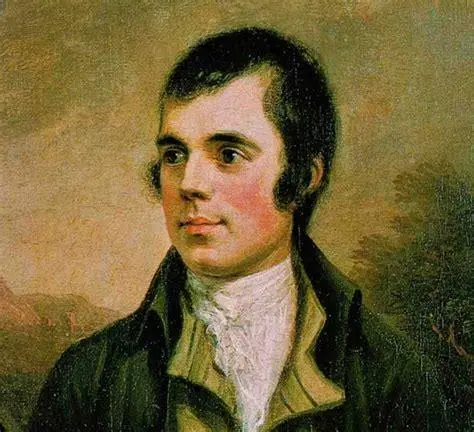
Burns, sometimes known as the 'ploughman poet', was the eldest son of a
poverty-stricken farmer. Though his father had moved to Ayrshire, where
Burns was born, in order to attempt to improve his fortunes, he eventually
died as a bankrupt - after taking on first one farm and then, unsuccessful,
moving to another - in . Robert, who had been to school since the age
of six, and was also educated at home by a teacher, had, by the age of
fifteen, already become the farm's chief labourer. He had also acquired a
reading knowledge of French and Latin and had read Shakespeare, Dryden,
Milton and the Bible. After his father's death, he and his brother continued
farming together, working now at Mossigiel.
The poverty of Burns' early life, though far from being overcome, had
produced in him a supporter of the French Revolution and a rebel against
both Calvinism and the social order of his time. His rebellious nature soon
became evident in his acts. Burns' first illegitimate child was borne to him by
Elizabeth Paton in . Two sets of twins later followed, and various
amorous intrigues, from Jean Amour, whom he afterward married.
It was also during this period that Burns' first achieved literary success.
Though he had thought of emigration to Jamaica as a possible way to avoid
his mounting problems, he published his Poems Chiefly in the Scottish
Dialect on July at Kilmarnock. This volume contained, among others,
'The Cotter's Saturday Night', 'To a Mouse', 'To a Mountain Daisy' and 'The
Holy Fair', all of which were written at Mossigiel. The volume brought him
immediate success.
After Burns, married in and having moved to Ellisland with his
bride, worked chiefly for James Johnson, whom he met in Edinburgh, and,
later, for George Thomson. It was for these men that Burns compiled and
added to the two great compilations of Scottish songs: Thomson's Scott's
Musical Museum and Johnson's Select Collection of Original Scottish Airs for
the Voice. Alongside this work, which Burns did on an unpaid basis, he also
worked, from onward, as an Excise Officer. This allowed him to give up
farming and move to the Dumfries. He died from rheumatic fever just five
years later, having also published, again in , his last major work, a
narrative poem entitled 'Tom O'Shanter'.
Life of Robert Burns in 10 Minutes:
Robert Burns The Peoples Poet BBC Documentary
What is Burns Night? | All About Robert Burns for Kids
The Story of Robert Burns
"To A Mouse" by Robert Burns (read by Sir William "Billy" Connolly)
Listen to The Prince of Wales recite My Heart’s In The Highlands by poet Robert Burns
Robert Burns: Explained, a little.
My Heart's In The Highlands - Robert Burns
Burns Night 2021 with the BBC Scottish Symphony Orchestra and friends
Address to a Haggis | Burns Night 2023 | British Army
What is Burns Night and how is it celebrated? | Newsround
Robert Burns - Complete Songs, Volume 1 (1996) [Complete CD]
5 Surprising Facts About Robert Burns
Midge Ure performs the Robert Burns song “A Man’s a Man for A’ That”
Your First Burns Supper - What It Is & What to Expect
Tam o' Shanter By Robert Burns - Performed By Karen Dunbar | Loop
ADDRESS TO A HAGGIS BY ROBERT BURNS PERFORMED BY ACTOR GARETH MORRISON
An Ayrshire farmer recites 'Tam O'Shanter' by Robert Burns
A Red, Red Rose by Robert Burns - Poetry Reading
Robert Burns: The Man And His Legend (Documentary)
Robert Burns - Complete Songs Of Robert Burns, Vol. 11 [Complete 2 CD Set]
Robert Burns - The Peoples Poet - BBC Documentary
'Auld Lang Syne' by Robert Burns
A Man's A Man for A' That - Robert Burns
King Charles III quotes Robert Burns as he makes historic first visit to Scottish Parliament
Whisky, pudding and poetry: The curious history of (Robert) Burns Night
Robert Burns 'The Address to the Haggis' Explained
Robert Burns -Eddi Reader AE fond kiss
Robert Burns.. The Myth & The Man
Outlander's Sam Heughan recites "Address To A Haggis" Robert Burns poem
Robert Burns - Ye Jacobites By Name [Ian Bruce]
My Heart's in the Highlands.
Two poems for Burns Night
What's the New Year's Eve song? Learn "Auld Lang Syne" and about Robert Burns | Liam Cox | TEDxBasel
Robert Burns - Scots Wha Hae
Robert Burns - To A Mouse - Poem
The Poetry of Robert Burns - 'John Anderson, My Jo'.
Robert Burns Died Here
♫ Scottish Music - My Love Is Like A Red Red Rose (LYRICS) ♫
The Bobby Burns - a cocktail for Burns Night
ROBERT BURNS - TAM O'SHANTER
"To A Louse" by Robert Burns (read by Robert Carlyle)
A RED, RED ROSE by Robert Burns, sung by Andy M. Stewart
Ye Banks and Braes by Robert Burns. Matthew McAllister (Guitar).
DOUGIE MacLEAN ~ Ae Fond Kiss ~ Robert Burns
THE SCOTTISH ENLIGHTENMENT AND ROBERT BURNS CELEBRATION - This day in Scottish History: 25th January
Robert Burns - Facial Reconstruction
In Search Of Robert Burns
The Selkirk Grace (Robert Burns)
Love Poetry From The Heart | Robert Burns