 Escritas.org

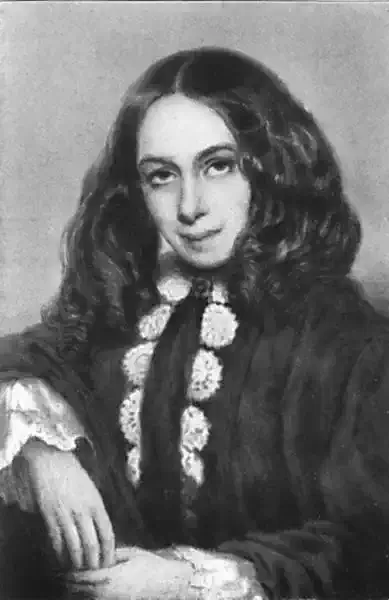
Aurora Leigh (excerpts)
Aurora Leigh (excerpts)
[Book 1]
I am like,
They tell me, my dear father. Broader brows
Howbeit, upon a slenderer undergrowth
Of delicate features, -- paler, near as grave ;
But then my mother's smile breaks up the whole,
And makes it better sometimes than itself.
So, nine full years, our days were hid with God
Among his mountains : I was just thirteen,
Still growing like the plants from unseen roots
In tongue-tied Springs, -- and suddenly awoke
To full life and life 's needs and agonies,
With an intense, strong, struggling heart beside
A stone-dead father. Life, struck sharp on death,
Makes awful lightning. His last word was, `Love --'
`Love, my child, love, love !' -- (then he had done with grief)
`Love, my child.' Ere I answered he was gone,
And none was left to love in all the world.
There, ended childhood. What succeeded next
I recollect as, after fevers, men
Thread back the passage of delirium,
Missing the turn still, baffled by the door ;
Smooth endless days, notched here and there with knives ;
A weary, wormy darkness, spurr'd i' the flank
With flame, that it should eat and end itself
Like some tormented scorpion. Then at last
I do remember clearly, how there came
A stranger with authority, not right,
(I thought not) who commanded, caught me up
From old Assunta's neck ; how, with a shriek,
She let me go, -- while I, with ears too full
Of my father's silence, to shriek back a word,
In all a child's astonishment at grief
Stared at the wharf-edge where she stood and moaned,
My poor Assunta, where she stood and moaned !
The white walls, the blue hills, my Italy,
Drawn backward from the shuddering steamer-deck,
Like one in anger drawing back her skirts
Which supplicants catch at. Then the bitter sea
Inexorably pushed between us both,
And sweeping up the ship with my despair
Threw us out as a pasture to the stars.
Ten nights and days we voyaged on the deep ;
Ten nights and days, without the common face
Of any day or night ; the moon and sun
Cut off from the green reconciling earth,
To starve into a blind ferocity
And glare unnatural ; the very sky
(Dropping its bell-net down upon the sea
As if no human heart should 'scape alive,)
Bedraggled with the desolating salt,
Until it seemed no more that holy heaven
To which my father went. All new and strange
The universe turned stranger, for a child.
Then, land ! -- then, England ! oh, the frosty cliffs
Looked cold upon me. Could I find a home
Among those mean red houses through the fog ?
And when I heard my father's language first
From alien lips which had no kiss for mine
I wept aloud, then laughed, then wept, then wept,
And some one near me said the child was mad
Through much sea-sickness. The train swept us on.
Was this my father's England ? the great isle ?
The ground seemed cut up from the fellowship
Of verdure, field from field, as man from man ;
The skies themselves looked low and positive,
As almost you could touch them with a hand,
And dared to do it they were so far off
From God's celestial crystals ; all things blurred
And dull and vague. Did Shakspeare and his mates
Absorb the light here ? -- not a hill or stone
With heart to strike a radiant colour up
Or active outline on the indifferent air.
I think I see my father's sister stand
Upon the hall-step of her country-house
To give me welcome. She stood straight and calm,
Her somewhat narrow forehead braided tight
As if for taming accidental thoughts
From possible pulses ; brown hair pricked with grey
By frigid use of life, (she was not old
Although my father's elder by a year)
A nose drawn sharply yet in delicate lines ;
A close mild mouth, a little soured about
The ends, through speaking unrequited loves
Or peradventure niggardly half-truths ;
Eyes of no colour, -- once they might have smiled,
But never, never have forgot themselves
In smiling ; cheeks, in which was yet a rose
Of perished summers, like a rose in a book,
Kept more for ruth than pleasure, -- if past bloom,
Past fading also.
She had lived, we'll say,
A harmless life, she called a virtuous life,
A quiet life, which was not life at all,
(But that, she had not lived enough to know)
Between the vicar and the country squires,
The lord-lieutenant looking down sometimes
From the empyrean to assure their souls
Against chance-vulgarisms, and, in the abyss
The apothecary, looked on once a year
To prove their soundness of humility.
The poor-club exercised her Christian gifts
Of knitting stockings, stitching petticoats,
Because we are of one flesh after all
And need one flannel (with a proper sense
Of difference in the quality) -- and still
The book-club, guarded from your modern trick
Of shaking dangerous questions from the crease,
Preserved her intellectual. She had lived
A sort of cage-bird life, born in a cage,
Accounting that to leap from perch to perch
Was act and joy enough for any bird.
Dear heaven, how silly are the things that live
In thickets, and eat berries !
I, alas,
A wild bird scarcely fledged, was brought to her cage,
And she was there to meet me. Very kind.
Bring the clean water, give out the fresh seed.
She stood upon the steps to welcome me,
Calm, in black garb. I clung about her neck, --
Young babes, who catch at every shred of wool
To draw the new light closer, catch and cling
Less blindly. In my ears, my father's word
Hummed ignorantly, as the sea in shells,
`Love, love, my child.' She, black there with my grief,
Might feel my love -- she was his sister once,
I clung to her. A moment, she seemed moved,
Kissed me with cold lips, suffered me to cling,
And drew me feebly through the hall into
The room she sate in.
There, with some strange spasm
Of pain and passion, she wrung loose my hands
Imperiously, and held me at arm's length,
And with two grey-steel naked-bladed eyes
Searched through my face, -- ay, stabbed it through and through,
Through brows and cheeks and chin, as if to find
A wicked murderer in my innocent face,
If not here, there perhaps. Then, drawing breath,
She struggled for her ordinary calm
And missed it rather, -- told me not to shrink,
As if she had told me not to lie or swear, -
`She loved my father, and would love me too
As long as I deserved it.' Very kind.
[Book 5]
AURORA LEIGH, be humble. Shall I hope
To speak my poems in mysterious tune
With man and nature ? -- with the lava-lymph
That trickles from successive galaxies
Still drop by drop adown the finger of God
In still new worlds ? -- with summer-days in this ?
That scarce dare breathe they are so beautiful ?--
With spring's delicious trouble in the ground,
Tormented by the quickened blood of roots,
And softly pricked by golden crocus-sheaves
In token of the harvest-time of flowers ?--
With winters and with autumns, -- and beyond,
With the human heart's large seasons, when it hopes
And fears, joys, grieves, and loves ? -- with all that strain
Of sexual passion, which devours the flesh
In a sacrament of souls ? with mother's breasts
Which, round the new-made creatures hanging there,
Throb luminous and harmonious like pure spheres ? --
With multitudinous life, and finally
With the great escapings of ecstatic souls,
Who, in a rush of too long prisoned flame,
Their radiant faces upward, burn away
This dark of the body, issuing on a world,
Beyond our mortal ? -- can I speak my verse
Sp plainly in tune to these things and the rest,
That men shall feel it catch them on the quick,
As having the same warrant over them
To hold and move them if they will or no,
Alike imperious as the primal rhythm
Of that theurgic nature ? I must fail,
Who fail at the beginning to hold and move
One man, -- and he my cousin, and he my friend,
And he born tender, made intelligent,
Inclined to ponder the precipitous sides
Of difficult questions ; yet, obtuse to me,
Of me, incurious ! likes me very well,
And wishes me a paradise of good,
Good looks, good means, and good digestion, -- ay,
But otherwise evades me, puts me off
With kindness, with a tolerant gentleness, --
Too light a book for a grave man's reading ! Go,
Aurora Leigh : be humble.
There it is,
We women are too apt to look to One,
Which proves a certain impotence in art.
We strain our natures at doing something great,
Far less because it 's something great to do,
Than haply that we, so, commend ourselves
As being not small, and more appreciable
To some one friend. We must have mediators
Betwixt our highest conscience and the judge ;
Some sweet saint's blood must quicken in our palms
Or all the life in heaven seems slow and cold :
Good only being perceived as the end of good,
And God alone pleased, -- that's too poor, we think,
And not enough for us by any means.
Ay, Romney, I remember, told me once
We miss the abstract when we comprehend.
We miss it most when we aspire, -- and fail.
Yet, so, I will not. -- This vile woman's way
Of trailing garments, shall not trip me up :
I 'll have no traffic with the personal thought
In art's pure temple. Must I work in vain,
Without the approbation of a man ?
It cannot be ; it shall not. Fame itself,
That approbation of the general race,
Presents a poor end, (though the arrow speed,
Shot straight with vigorous finger to the white,)
And the highest fame was never reached except
By what was aimed above it. Art for art,
And good for God Himself, the essential Good !
We 'll keep our aims sublime, our eyes erect,
Although our woman-hands should shake and fail ;
And if we fail .. But must we ? -
Shall I fail ?
The Greeks said grandly in their tragic phrase,
`Let no one be called happy till his death.'
To which I add, -- Let no one till his death
Be called unhappy. Measure not the work
Until the day 's out and the labour done,
Then bring your gauges. If the day's work 's scant,
Why, call it scant ; affect no compromise ;
And, in that we have nobly striven at least,
Deal with us nobly, women though we be.
And honour us with truth if not with praise.
[Book 1]
I am like,
They tell me, my dear father. Broader brows
Howbeit, upon a slenderer undergrowth
Of delicate features, -- paler, near as grave ;
But then my mother's smile breaks up the whole,
And makes it better sometimes than itself.
So, nine full years, our days were hid with God
Among his mountains : I was just thirteen,
Still growing like the plants from unseen roots
In tongue-tied Springs, -- and suddenly awoke
To full life and life 's needs and agonies,
With an intense, strong, struggling heart beside
A stone-dead father. Life, struck sharp on death,
Makes awful lightning. His last word was, `Love --'
`Love, my child, love, love !' -- (then he had done with grief)
`Love, my child.' Ere I answered he was gone,
And none was left to love in all the world.
There, ended childhood. What succeeded next
I recollect as, after fevers, men
Thread back the passage of delirium,
Missing the turn still, baffled by the door ;
Smooth endless days, notched here and there with knives ;
A weary, wormy darkness, spurr'd i' the flank
With flame, that it should eat and end itself
Like some tormented scorpion. Then at last
I do remember clearly, how there came
A stranger with authority, not right,
(I thought not) who commanded, caught me up
From old Assunta's neck ; how, with a shriek,
She let me go, -- while I, with ears too full
Of my father's silence, to shriek back a word,
In all a child's astonishment at grief
Stared at the wharf-edge where she stood and moaned,
My poor Assunta, where she stood and moaned !
The white walls, the blue hills, my Italy,
Drawn backward from the shuddering steamer-deck,
Like one in anger drawing back her skirts
Which supplicants catch at. Then the bitter sea
Inexorably pushed between us both,
And sweeping up the ship with my despair
Threw us out as a pasture to the stars.
Ten nights and days we voyaged on the deep ;
Ten nights and days, without the common face
Of any day or night ; the moon and sun
Cut off from the green reconciling earth,
To starve into a blind ferocity
And glare unnatural ; the very sky
(Dropping its bell-net down upon the sea
As if no human heart should 'scape alive,)
Bedraggled with the desolating salt,
Until it seemed no more that holy heaven
To which my father went. All new and strange
The universe turned stranger, for a child.
Then, land ! -- then, England ! oh, the frosty cliffs
Looked cold upon me. Could I find a home
Among those mean red houses through the fog ?
And when I heard my father's language first
From alien lips which had no kiss for mine
I wept aloud, then laughed, then wept, then wept,
And some one near me said the child was mad
Through much sea-sickness. The train swept us on.
Was this my father's England ? the great isle ?
The ground seemed cut up from the fellowship
Of verdure, field from field, as man from man ;
The skies themselves looked low and positive,
As almost you could touch them with a hand,
And dared to do it they were so far off
From God's celestial crystals ; all things blurred
And dull and vague. Did Shakspeare and his mates
Absorb the light here ? -- not a hill or stone
With heart to strike a radiant colour up
Or active outline on the indifferent air.
I think I see my father's sister stand
Upon the hall-step of her country-house
To give me welcome. She stood straight and calm,
Her somewhat narrow forehead braided tight
As if for taming accidental thoughts
From possible pulses ; brown hair pricked with grey
By frigid use of life, (she was not old
Although my father's elder by a year)
A nose drawn sharply yet in delicate lines ;
A close mild mouth, a little soured about
The ends, through speaking unrequited loves
Or peradventure niggardly half-truths ;
Eyes of no colour, -- once they might have smiled,
But never, never have forgot themselves
In smiling ; cheeks, in which was yet a rose
Of perished summers, like a rose in a book,
Kept more for ruth than pleasure, -- if past bloom,
Past fading also.
She had lived, we'll say,
A harmless life, she called a virtuous life,
A quiet life, which was not life at all,
(But that, she had not lived enough to know)
Between the vicar and the country squires,
The lord-lieutenant looking down sometimes
From the empyrean to assure their souls
Against chance-vulgarisms, and, in the abyss
The apothecary, looked on once a year
To prove their soundness of humility.
The poor-club exercised her Christian gifts
Of knitting stockings, stitching petticoats,
Because we are of one flesh after all
And need one flannel (with a proper sense
Of difference in the quality) -- and still
The book-club, guarded from your modern trick
Of shaking dangerous questions from the crease,
Preserved her intellectual. She had lived
A sort of cage-bird life, born in a cage,
Accounting that to leap from perch to perch
Was act and joy enough for any bird.
Dear heaven, how silly are the things that live
In thickets, and eat berries !
I, alas,
A wild bird scarcely fledged, was brought to her cage,
And she was there to meet me. Very kind.
Bring the clean water, give out the fresh seed.
She stood upon the steps to welcome me,
Calm, in black garb. I clung about her neck, --
Young babes, who catch at every shred of wool
To draw the new light closer, catch and cling
Less blindly. In my ears, my father's word
Hummed ignorantly, as the sea in shells,
`Love, love, my child.' She, black there with my grief,
Might feel my love -- she was his sister once,
I clung to her. A moment, she seemed moved,
Kissed me with cold lips, suffered me to cling,
And drew me feebly through the hall into
The room she sate in.
There, with some strange spasm
Of pain and passion, she wrung loose my hands
Imperiously, and held me at arm's length,
And with two grey-steel naked-bladed eyes
Searched through my face, -- ay, stabbed it through and through,
Through brows and cheeks and chin, as if to find
A wicked murderer in my innocent face,
If not here, there perhaps. Then, drawing breath,
She struggled for her ordinary calm
And missed it rather, -- told me not to shrink,
As if she had told me not to lie or swear, -
`She loved my father, and would love me too
As long as I deserved it.' Very kind.
[Book 5]
AURORA LEIGH, be humble. Shall I hope
To speak my poems in mysterious tune
With man and nature ? -- with the lava-lymph
That trickles from successive galaxies
Still drop by drop adown the finger of God
In still new worlds ? -- with summer-days in this ?
That scarce dare breathe they are so beautiful ?--
With spring's delicious trouble in the ground,
Tormented by the quickened blood of roots,
And softly pricked by golden crocus-sheaves
In token of the harvest-time of flowers ?--
With winters and with autumns, -- and beyond,
With the human heart's large seasons, when it hopes
And fears, joys, grieves, and loves ? -- with all that strain
Of sexual passion, which devours the flesh
In a sacrament of souls ? with mother's breasts
Which, round the new-made creatures hanging there,
Throb luminous and harmonious like pure spheres ? --
With multitudinous life, and finally
With the great escapings of ecstatic souls,
Who, in a rush of too long prisoned flame,
Their radiant faces upward, burn away
This dark of the body, issuing on a world,
Beyond our mortal ? -- can I speak my verse
Sp plainly in tune to these things and the rest,
That men shall feel it catch them on the quick,
As having the same warrant over them
To hold and move them if they will or no,
Alike imperious as the primal rhythm
Of that theurgic nature ? I must fail,
Who fail at the beginning to hold and move
One man, -- and he my cousin, and he my friend,
And he born tender, made intelligent,
Inclined to ponder the precipitous sides
Of difficult questions ; yet, obtuse to me,
Of me, incurious ! likes me very well,
And wishes me a paradise of good,
Good looks, good means, and good digestion, -- ay,
But otherwise evades me, puts me off
With kindness, with a tolerant gentleness, --
Too light a book for a grave man's reading ! Go,
Aurora Leigh : be humble.
There it is,
We women are too apt to look to One,
Which proves a certain impotence in art.
We strain our natures at doing something great,
Far less because it 's something great to do,
Than haply that we, so, commend ourselves
As being not small, and more appreciable
To some one friend. We must have mediators
Betwixt our highest conscience and the judge ;
Some sweet saint's blood must quicken in our palms
Or all the life in heaven seems slow and cold :
Good only being perceived as the end of good,
And God alone pleased, -- that's too poor, we think,
And not enough for us by any means.
Ay, Romney, I remember, told me once
We miss the abstract when we comprehend.
We miss it most when we aspire, -- and fail.
Yet, so, I will not. -- This vile woman's way
Of trailing garments, shall not trip me up :
I 'll have no traffic with the personal thought
In art's pure temple. Must I work in vain,
Without the approbation of a man ?
It cannot be ; it shall not. Fame itself,
That approbation of the general race,
Presents a poor end, (though the arrow speed,
Shot straight with vigorous finger to the white,)
And the highest fame was never reached except
By what was aimed above it. Art for art,
And good for God Himself, the essential Good !
We 'll keep our aims sublime, our eyes erect,
Although our woman-hands should shake and fail ;
And if we fail .. But must we ? -
Shall I fail ?
The Greeks said grandly in their tragic phrase,
`Let no one be called happy till his death.'
To which I add, -- Let no one till his death
Be called unhappy. Measure not the work
Until the day 's out and the labour done,
Then bring your gauges. If the day's work 's scant,
Why, call it scant ; affect no compromise ;
And, in that we have nobly striven at least,
Deal with us nobly, women though we be.
And honour us with truth if not with praise.
483
0
More like this
See also