 Escritas.org

Some Poems
Biography
Images
Videos
Books
Elizabeth Barrett Browning (6 March 1806 – 29 June 1861)
Elizabeth Barrett Browning was one of the most prominent poets of the
Victorian era. Her poetry was widely popular in both England and the United
States during her lifetime. A collection of her last poems was published by
her husband, Robert Browning, shortly after her death.
Early Life
Some of Barrett's family had lived in Jamaica for several centuries. The main
wealth of Barrett's household derived from Edward Barrett (1734–1798),
landowner of 10,000 acres (40 km2) in Cinnamon Hill, Cornwall, Cambridge,
and Oxford estates in northern Jamaica. Barrett Browning's maternal
grandfather owned sugar plantations, mills, glassworks and ships that traded
between Jamaica and Newcastle. Biographer Julia Markus stated that the
poet ‘believed that she had African blood through her grandfather Charles
Moulton’. There is no evidence to suggest her line of the Barrett family had
any African ancestry, although other branches did, through the children of
plantation owners and slaves. What the family believed to be their genealogy
over several hundred years in the West Indies, is unclear.
The family wished to hand down their name as well as their wealth,
stipulating that Barrett should be held as a surname. In some cases
inheritance was given on the prerequisite that the name Barrett had to be
used by the beneficiary. Given the strong tradition, Elizabeth used 'Elizabeth
Barrett Moulton Barrett' on legal documents and before she was married
often signed herself as 'Elizabeth Barrett Barrett', or ‘EBB’ (initials she was
able to keep after her wedding). Elizabeth's father chose to raise his family in
England while his fortune grew in Jamaica. The Graham Clarke family wealth,
also derived in part from slave labour, was also considerable.
Elizabeth Barrett Moulton-Barrett was born on 6 March 1806, in Coxhoe Hall,
between the villages of Coxhoe and Kelloe in County Durham, England. Her
parents were Edward Barrett Moulton Barrett and Mary Graham Clarke;
Elizabeth was the eldest of their 12 children (eight boys and four girls). All
the children lived to adulthood except for one girl, who died at the age of
three when Elizabeth was eight. The children in her family all had nicknames:
Elizabeth's was "Ba". Elizabeth was baptized in 1809 at Kelloe Parish Church,
though she had already been baptized by a family friend in the first week
after she was born. Later that year, after the fifth child, Henrietta, was born,
their father bought Hope End, a 500-acre (2.0 km2) estate near the Malvern
Hills in Ledbury, Herefordshire, where Elizabeth spent her childhood. Her
time at Hope End would inspire her in later life to write Aurora Leigh.
She was educated at home and attended lessons with her brothers' tutor.
During the Hope End period, she was an intensely studious, precocious child.
She writes that at six she was reading novels, at eight she was entranced by
Pope's translations of Homer, studying Greek at ten and writing her own
Homeric epic The Battle of Marathon. Her mother compiled early efforts of
the child's poetry into collections of "Poems by Elizabeth B. Barrett". Her
father called her the 'Poet Laureate of Hope End’ and encouraged her work.
The result is one of the largest collections of juvenilia of any English writer.
On her 14th birthday her father gave the gift of 50 printed copies of the epic.
She went on to delight in reading Virgil in the original Latin, Shakespeare
and Milton. By 1821 she had read Mary Wollstonecraft's Vindication of the
Rights of Woman (1792), and she became a passionate supporter of
Wollstonecraft's ideas. She watched her brothers go off to school knowing
that there was no chance of that education for herself. The child's intellectual
fascination with the classics and metaphysics was reflected in a religious
intensity which she later described as "not the deep persuasion of the mild
Christian but the wild visions of an enthusiast". The Barretts attended
services at the nearest Dissenting chapel, and Edward was active in Bible
and Missionary societies.
Elizabeth was very close to her siblings and had great respect for her father:
she claimed that life was no fun without him, and her mother agreed.
Publication
Barrett Browning's first known poem was written at the age of six or eight,
"On the Cruelty of Forcement to Man". The manuscript is currently in the
Berg Collection of the New York Public Library; the exact date is controversial
because the "2" in the date 1812 is written over something else that is
scratched out. Her first independent publication was "Stanzas Excited by
Reflections on the Present State of Greece" in The New Monthly Magazine of
May 1821; this was followed in the same publication two months later by
"Thoughts Awakened by Contemplating a Piece of the Palm which Grows on
the Summit of the Acropolis at Athens".
Her first collection of poems, An Essay on Mind, with Other Poems, was
published in 1826 and reflected her passion for Byron and Greek politics. Its
publication drew the attention of a blind scholar of the Greek language, Hugh
Stuart Boyd, and that of another Greek scholar, Uvedale Price, with whom
she maintained a sustained scholarly correspondence.
Among other neighbours was Mrs. James Martin from Colwall, with whom she
also corresponded throughout her life. Later, at Boyd's suggestion, she
translated Aeschylus' Prometheus Bound (published in 1833; retranslated in
1850). During their friendship Barrett studied Greek literature, including
Homer, Pindar and Aristophanes.
At about age 15 Barrett Browning began to battle with a lifelong illness,
which the medical science of the time was unable to diagnose. All three
sisters came down with the syndrome although it lasted only with Elizabeth.
She had intense head and spinal pain with loss of mobility. Apocryphally it
was told that she fell while trying to saddle a horse or was creating the
illness but there is strong evidence that she was seriously sick. The illnesses
of this time were, however, unrelated to the lung disease she suffered in
1837. This illness caused her to be frail and weak.
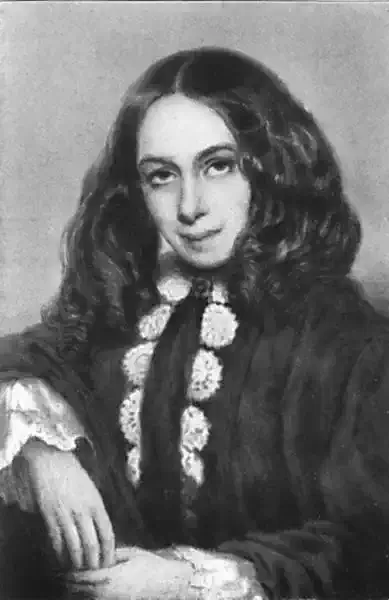
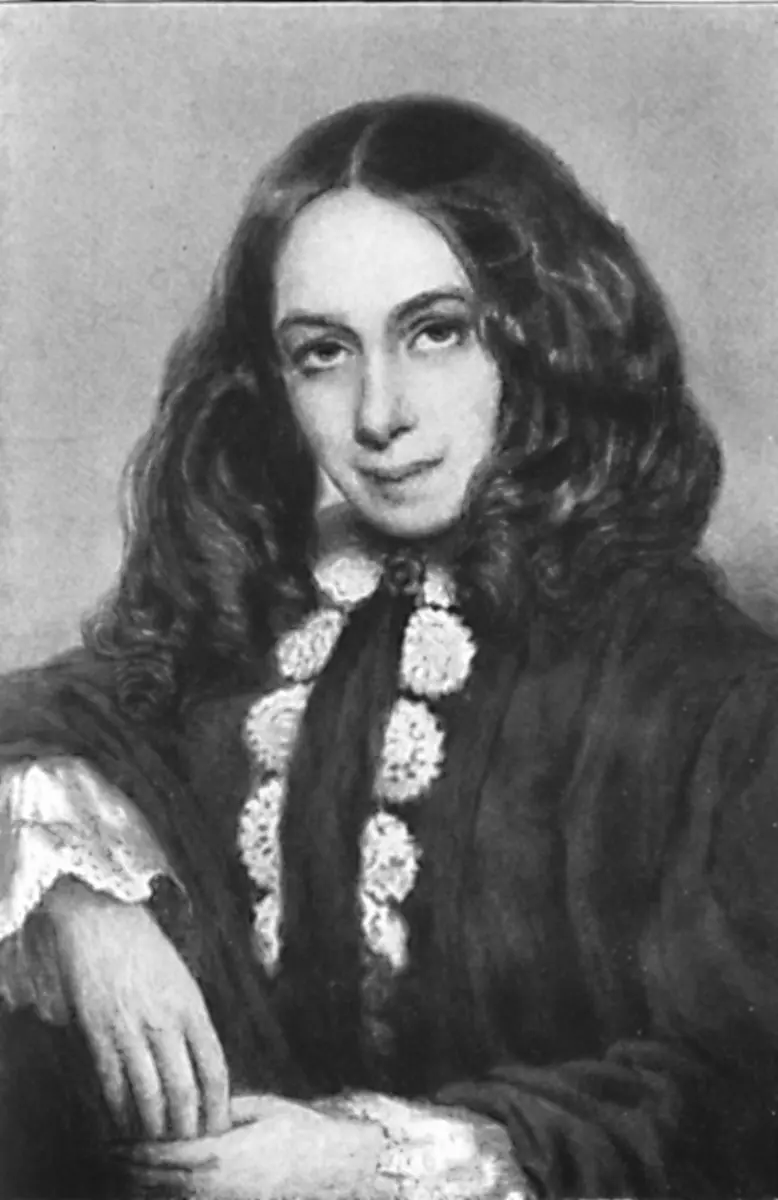
Mary Russell Mitford described the young Barrett Browning at this time, as
having "a slight, delicate figure, with a shower of dark curls falling on each
side of a most expressive face; large, tender eyes, richly fringed by dark
eyelashes, and a smile like a sunbeam". She began to take opiates for the
pain, Laudanum (and opium concoction) then morphine, commonly
prescribed at the time. She would become dependent on them for much of
her adulthood; the use from an early age would have contributed to her frail
health. Biographers such as Alethea Hayter have suggested that this may
have contributed to the wild vividness of her imagination and the poetry it
produced.
In 1828, Barrett Browning’s mother died. She wrote "scarcely I was a woman
when I lost my mother". She is buried at the Parish Church of St Michael and
All Angels in Ledbury, next to her daughter Mary. Sarah Graham-Clarke,
Elizabeth Barrett Browning's aunt, helped to care of the children and was
known to clash with the strong will of Elizabeth. In 1831 Barrett Browning's
grandmother, Elizabeth Moulton, died. The family moved three times
between 1832 and 1837, first to a white Georgian building in Sidmouth,
Devonshire, where they remained for three years. Later they moved on to
Gloucester Place in London.
Elizabeth Barrett Browning opposed slavery and published two poems
highlighting the barbarity of slavers and her support for the abolitionist
cause. The poems opposing slavery include "The Runaway Slave at Pilgrim's
Point" and "A Curse for a Nation"; in the first she describes the experience of
a slave woman who is whipped, raped, and made pregnant as she curses the
slavers. She declared herself glad that the slaves were "virtually free" when
the Emancipation Act abolishing slavery in British colonies was passed in
1833, despite the fact that her father believed that Abolitionism would ruin
his business.
The date of publication of these poems is in dispute but her position on
slavery in the poems is clear and may have led to a rift between Elizabeth
and her father. She wrote to John Ruskin in 1855 "I belong to a family of
West Indian slaveholders, and if I believed in curses, I should be afraid".
After the Jamaican slave uprising of 1831–2 her father and uncle continued
to treat the slaves humanely but the family became mired in thirty-eight
years of chancery litigation over the division of land and other property.
Following lawsuits and the abolition of slavery Mr. Barrett incurred great
financial and investment losses that forced him to sell Hope End.
Although the family were never poor, the place was seized and put up for
sale to satisfy creditors. Always secret in his financial dealings, he would not
discuss his situation and the family was haunted by the idea that they might
have to move to Jamaica. In 1838, some years after the sale of Hope End
the family settled at 50 Wimpole Street.
In London John Kenyon, a distant cousin, introduced her to literary figures
including William Wordsworth, Mary Russell Mitford, Samuel Taylor Coleridge,
Alfred Lord Tennyson and Thomas Carlyle. Barrett Browning continued to
write, contributing "The Romaunt of Margaret", "The Romaunt of the Page",
"The Poet's Vow", and other pieces to various periodicals.
She corresponded with other writers, including Mary Russell Mitford, who
would become a close friend and support Barrett Browning in furthering her
literary ambitions. In 1838 The Seraphim and Other Poems appeared, the
first volume of Elizabeth's mature poetry to appear under her own name.
During 1837–8 the poet was struck with illness again, with symptoms today
suggesting tuberculous ulceration of the lungs. In 1838, at her physician's
insistence, Barrett Browning moved from London to Torquay, on the
Devonshire coast. Two tragedies then struck: in February 1840 her brother
Samuel died of a fever in Jamaica and her brother Edward ('Bro'), with whom
she was very close, went with her to Torquay and was drowned in a sailing
accident in July.
This had a serious effect on her already fragile health; when they found his
body after a couple of days, she had no strength for tears or words. She felt
guilty as her father had disapproved of Edward's trip to Torquay but did not
hinder the visit. She wrote to Mitford "That was a very near escape from
madness, absolute hopeless madness". The family returned to Wimpole
Street in 1841.
Success
At Wimpole Street Barrett Browning spent most of her time in her upstairs
room, and her health began to recover, though she saw few people other
than her immediate family. One of those she did see was Kenyon, a wealthy
friend of the family and patron of the arts. She received comfort from her
spaniel named “Flush”, which had been a gift from Mary Mitford. (Virginia
Woolf later fictionalised the life of the dog, making him the protagonist of her
1933 novel Flush: A Biography).
Between 1841–4 Barrett Browning was prolific in poetry, translation and
prose. The poem "The Cry of the Children", published in 1842 in Blackwoods,
condemned child labour and helped bring about child labour reforms by
rousing support for Lord Shaftesbury's Ten Hours Bill (1844). At about the
same time, she contributed some critical prose pieces to Richard Henry
Horne's A New Spirit of the Age. In 1844 she published two volumes of
Poems, which included "A Drama of Exile", "A Vision of Poets", and "Lady
Geraldine's Courtship" and two substantial critical essays for 1842 issues of
The Athenaeum. “Since she was not burdened with any domestic duties
expected of her sisters, Elizabeth could now devote herself entirely to the life
of the mind, cultivating an enormous correspondence, reading widely”. Her
prolific output made her a rival to Tennyson's as a candidate for poet
laureate in 1850 on the death of Wordsworth.
Robert Browning and Italy
Her 1844 volume Poems made her one of the most popular writers in the
country at the time and inspired Robert Browning to write to her, telling her
how much he loved her work. He had been an admirer of her poetry for a
long time and wrote "I love your verses with all my heart, dear Miss Barrett"
praising their "fresh strange music, the affluent language, the exquisite
pathos and true new brave thought". Kenyon arranged for Robert Browning
to meet Elizabeth on 20 May 1845, in her rooms, and so began one of the
most famous courtships in literature. Elizabeth had produced a large amount
of work and had been writing long before Robert Browning had.
However, he had a great influence on her writing, as did she on his: two of
Barrett’s most famous pieces were produced after she met Browning,
Sonnets from the Portuguese and Aurora Leigh. Robert's Men and Women is
a product of that time. Some critics, however, point to him as an
undermining influence: "Until her relationship with Robert Browning began in
1845, Barrett’s willingness to engage in public discourse about social issues
and about aesthetic issues in poetry, which had been so strong in her youth,
gradually diminished, as did her physical health. As an intellectual presence
and a physical being, she was becoming a shadow of herself". Her doctors
strongly encouraged her to go to the warmer climates of Italy to avoid
another English winter, but her father would not hear of it.
"Portuguese" was a pet name Browning used. Sonnets from the Portuguese
also refers to the series of sonnets of the 16th-century Portuguese poet Luís
de Camões; in all these poems she used rhyme schemes typical of the
Portuguese sonnets. The verse-novel Aurora Leigh, her most ambitious and
perhaps the most popular of her longer poems, appeared in 1856. It is the
story of a female writer making her way in life, balancing work and love. The
writings depicted in this novel are based on similar, personal experiences
that Elizabeth suffered through herself. The North American Review praised
Elizabeth’s poem in these words: "Mrs. Browning’s poems are, in all respects,
the utterance of a woman—of a woman of great learning, rich experience,
and powerful genius, uniting to her woman’s nature the strength which is
sometimes thought peculiar to a man".
The courtship and marriage between Robert Browning and Elizabeth were
carried out secretly as she and her siblings were convinced their father would
disapprove. Six years his elder and an invalid, she could not believe that the
vigorous and worldly Robert Browning really loved her as much as he
professed to. After a private marriage at St. Marylebone Parish Church, they
honeymooned in Paris. Browning then imitated his hero Shelley by spiriting
his wife off to Italy, in September 1846, which became her home almost
continuously until her death. Elizabeth's loyal nurse, Wilson, who witnessed
the marriage, accompanied the couple to Italy.
Mr. Barrett disinherited Elizabeth, as he did each of his children who married.
Elizabeth had foreseen her father's anger but not expected the disgust of her
brothers, who saw Browning as a lower-class gold-digger and refused to see
him.
As Elizabeth had some money of her own, the couple were reasonably
comfortable in Italy, and their relationship together was harmonious. The
Brownings were well respected in Italy, and even famous. Elizabeth grew
stronger and in 1849, at the age of 43, between four miscarriages, she gave
birth to a son, Robert Wiedemann Barrett Browning, whom they called Pen.
Their son later married but had no legitimate children. At her husband's
insistence, the second edition of Elizabeth’s Poems included her love
sonnets; as a result, her popularity increased (as well as critical regard), and
her position was confirmed.
The couple came to know a wide circle of artists and writers including, in
Italy, William Makepeace Thackeray, sculptor Harriet Hosmer (who, she
wrote, seemed to be the "perfectly emancipated female") and Harriet
Beecher Stowe. In 1849 she met Margaret Fuller and the female French
novelist George Sand in 1852, whom she had long admired. They met with
Lord Tennyson in Paris, and John Forster, Samuel Rogers, and the Carlyles in
London, later befriending Charles Kingsley and John Ruskin.
Decline
At the death of an old friend, G.B. Hunter, and then of her father, her health
faded again, centering around deteriorating lung function. She was moved
from Florence to Siena, residing at the Villa Alberti. Deeply engrossed in
Italian politics, she issued a small volume of political poems titled Poems
before Congress (1860) “most of which were written to express her
sympathy with the Italian cause after the outbreak of fighting in 1859”. They
caused a furore in England and she was labelled as a fanatic by conservative
magazines Blackwood's and the Saturday Review. She dedicated this book to
her husband. Her last work was A Musical Instrument, published
posthumously.
In 1860 they returned to Rome, only to find that Elizabeth’s sister Henrietta
had died, news which made Elizabeth weak and depressed. She became
gradually weaker, using morphine to ease her pain. She died on 29 June
1861 in her husband's arms. Browning said that she died "smilingly, happily,
and with a face like a girl's. … Her last word was—… 'Beautiful'". She was
buried in the Protestant English Cemetery of Florence. “On Monday July 1 the
shops in the section of the city around Casa Guidi were closed, while
Elizabeth was mourned with unusual demonstrations.” The nature of her
illness is still unclear, although medical and literary scholars have speculated
that longstanding pulmonary problems, combined with palliative opiates,
contributed to her decline.
Spiritual Influence
Much of Barrett Browning’s work carries a religious theme. She had read and
studied such famous literary works as Milton's Paradise Lost and Dante's
Inferno. She says in her writing, "We want the sense of the saturation of
Christ's blood upon the souls of our poets, that it may cry through them in
answer to the ceaseless wail of the Sphinx of our humanity, expounding
agony into renovation. Something of this has been perceived in art when its
glory was at the fullest. Something of a yearning after this may be seen
among the Greek Christian poets, something which would have been much
with a stronger faculty". She believed that "Christ's religion is essentially
poetry—poetry glorified". She explored the religious aspect in many of her
poems, especially in her early work, such as the sonnets. She was interested
in theological debate, had learned Hebrew and read the Hebrew Bible. The
poem Aurora Leigh, for example, features religious imagery and allusion to
the apocalypse.
Critical Reception
American poet Edgar Allan Poe was inspired by Barrett Browning's poem
Lady Geraldine's Courtship and specifically borrowed the poem's meter for
his poem The Raven. Poe had reviewed Barrett's work in the January 1845
issue of the Broadway Journal and said that "her poetic inspiration is the
highest—we can conceive of nothing more august. Her sense of Art is pure in
itself." In return, she praised The Raven and Poe dedicated his 1845
collection The Raven and Other Poems to her, referring to her as "the noblest
of her sex".
Her poetry greatly influenced Emily Dickinson, who admired her as a woman
of achievement. Her popularity in the United States and Britain was further
advanced by her stands against social injustice, including slavery in the
United States, injustice toward Italian citizens by foreign rulers, and child
labour.
In Lilian Whiting's 1899 biography of Elizabeth she describes her as "the
most philosophical poet" and depicts her life as "a Gospel of applied
Christianity". To Whiting, the term "art for art's sake" did not apply to Barrett
Browning's work for the reason that each poem, distinctively purposeful, was
borne of a more "honest vision". In this critical analysis, Whiting portrays
Barrett Browning as a poet who uses knowledge of Classical literature with
an "intuitive gift of spiritual divination". In Elizabeth Barrett Browning,
Angela Leighton suggests that the portrayal of Barrett Browning as the
"pious iconography of womanhood" has distracted us from her poetic
achievements. Leighton cites the 1931 play by Rudolf Besier, The Barretts of
Wimpole Street, as evidence that 20th century literary criticism of Barrett
Browning's work has suffered more as a result of her popularity than poetic
ineptitude. The play was popularized by actress Katharine Cornell, for whom
it became a signature role. It was an enormous success, both artistically and
commercially, and was revived several times and adapted twice into movies.
Throughout the 20th century, literary criticism of Barrett Browning's poetry
remained sparse until her poems were discovered by the women's
movement. She once described herself as being inclined to reject several
women's rights principles, suggesting in letters to Mary Russell Mitford and
her husband that she believed that there was an inferiority of intellect in
women. In Aurora Leigh, however, she created a strong and independent
woman who embraces both work and love. Leighton writes that because she
participates in the literary world, where voice and diction are dominated by
perceived masculine superiority, she "is defined only in mysterious opposition
to everything that distinguishes the male subject who writes..." A
five-volume scholarly edition of her works was published in 2010, the first in
over a century.
Works:
1820: The Battle of Marathon: A Poem. Privately printed
1826: A Essay On Mind, with Other Poems. London: James Duncan
1833: Prometheus Bound, Translated from the Greek of Aeschylus,and
Miscellaneous Poems. London: A.J. Valpy
1838: The Seraphim, and Other Poems. London: Saunders and Otley
1844: Poems (UK) / A Drama of Exile, and other Poems (US). London:
Edward Moxon. New York: Henry G. Langley
1850: Poems ("New Edition", 2 vols.) Revision of 1844 edition adding
Sonnets from the Portuguese and others. London: Chapman & Hall
1851: Casa Guidi Windows. London: Chapman & Hall
1853: Poems (3d ed.). London: Chapman & Hall
1854: Two Poems: "A Plea for the Ragged Schools of London" and "The
Twins". London: Bradbury & Evans
1856: Poems (4th ed.). London: Chapman & Hall
1857: Aurora Leigh. London: Chapman and Hall
1860: Poems Before Congress. London: Chapman & Hall
1862: Last Poems. London: Chapman & Hall
Posthumous Publications
1863: The Greek Christian Poets and the English Poets. London: Chapman &
Hall
1877: The Earlier Poems of Elizabeth Barrett Browning, 1826–1833, ed.
Richard Herne Shepherd. London: Bartholomew Robson
1877: Letters of Elizabeth Barrett Browning Addressed to Richard Hengist
Horne, with comments on contemporaries, 2 vols., ed. S.R.T. Mayer. London:
Richard Bentley & Son
1897: Letters of Elizabeth Barrett Browning, 2 vols., ed. Frederic G. Kenyon.
London:Smith, Elder,& Co.
1899: Letters of Robert Browning and Elizabeth Barrett Barrett 1845–1846, 2
vol., ed Robert W. Barrett Browning. London: Smith, Elder & Co.
1914: New Poems by Robert Browning and Elizabeth Barrett Browning, ed.
Frederic G Kenyon. London: Smith, Elder & Co.
1929: Elizabeth Barrett Browning: Letters to Her Sister, 1846–1859, ed.
Leonard Huxley. London: John Murray
1935: Twenty-Two Unpublished Letters of Elizabeth Barrett Browning and
Robert Browning to Henrietta and Arabella Moulton Barrett. New York: United
Feature Syndicate
1939: Letters from Elizabeth Barrett to B.R. Haydon, ed. Martha Hale
Shackford. New York: Oxford University Press
1954: Elizabeth Barrett to Miss Mitford, ed. Betty Miller. London: John Murry
1955: Unpublished Letters of Elizabeth Barrett Browning to Hugh Stuart
Boyd, ed. Barbara P. McCarthy. New Heaven, Conn.: Yale University Press
1958: Letters of the Brownings to George Barrett, ed. Paul Landis with
Ronald E. Freeman. Urbana: University of Illinois Press
1974: Elizabeth Barrett Browning's Letters to Mrs. David Ogilvy, 1849–1861,
ed. P. Heydon and P. Kelley. New York: Quadrangle, New York Times Book
Co., and Browning Institute
1984: The Brownings' Correspondence, ed. Phillip Kelley, Ronald Hudson,
and Scott Lewis. Winfield, Kans.: Wedgestone Press
A Child Asleep
How he sleepeth! having drunken
Weary childhood's mandragore,
From his pretty eyes have sunken
Pleasures, to make room for more---
Sleeping near the withered nosegay, which he pulled the day before.
Nosegays! leave them for the waking:
Throw them earthward where they grew.
Dim are such, beside the breaking
Amaranths he looks unto---
Folded eyes see brighter colours than the open ever do.
Heaven-flowers, rayed by shadows golden
From the paths they sprang beneath,
Now perhaps divinely holden,
Swing against him in a wreath---
We may think so from the quickening of his bloom and of his breath.
Vision unto vision calleth,
While the young child dreameth on.
Fair, O dreamer, thee befalleth
With the glory thou hast won!
Darker wert thou in the garden, yestermorn, by summer sun.
We should see the spirits ringing
Round thee,---were the clouds away.
'Tis the child-heart draws them, singing
In the silent-seeming clay--Singing!---
Stars that seem the mutest, go in music all the way.
As the moths around a taper,
As the bees around a rose,
As the gnats around a vapour,--So
the Spirits group and close
Round about a holy childhood, as if drinking its repose.
Shapes of brightness overlean thee,--Flash
their diadems of youth
On the ringlets which half screen thee,--While
thou smilest, . . . not in sooth
Thy smile . . . but the overfair one, dropt from some aethereal mouth.
Haply it is angels' duty,
During slumber, shade by shade:
To fine down this childish beauty
To the thing it must be made,
Ere the world shall bring it praises, or the tomb shall see it fade.
Softly, softly! make no noises!
Now he lieth dead and dumb--Now
he hears the angels' voices
Folding silence in the room--
The life and work of Elizabeth Barrett Browning
How Do I Love Thee? (Sonnet 43) by Elizabeth Barrett Browning (read by Dame Judi Dench)
Love Story: Robert Browning & Elizabeth Barrett
If Thou Must Love Me by Elizabeth Barrett Browning - Poetry Reading
Elizabeth Barrett Browning - Sonnet 14: If Thou Must Love Me (Poetry Reading)
How Do I Love Thee? (Sonnet 43) by Elizabeth Barrett Browning (read by Dame Helen Mirren)
How do I love thee? || Poem by Elizabeth Barrett Browning (Sonnet 43)
🔵 If thou must love me Sonnet 14 Elizabeth Barrett Browning Summary Analysis Poem Elizabeth Browning
The Life Of Elizabeth Barrett Browning
Two-Way Mirror: The Life of Elizabeth Barrett Browning
How Do I Love Thee by Elizabeth Barrett Browning performed by Lindsay Gurley
Robert and Elizabeth Browning
How Do I Love Thee by Elizabeth Barrett Browning (Sonnet 43) ANALYSIS 🥰
Elizabeth Barrett Browning - Sonnet 29 - I Think of Thee (Poetry Reading)
How Do I Love Thee? (Sonnet 43) by Elizabeth Barrett Browning - Poems for Children, FreeSchool
Robert Browning and Elizabeth Barrett Browning
Elizabeth Barrett Browning Exam Points | AKSRajveer | Literature Lovers | UGC NET ENGLISH
The Biography of Elizabeth Barrett Browning
Elizabeth Barrett Browning: 'Sonnet 29 (XXIX)' Mr Bruff Analysis
Elizabeth Barrett Browning
Summary, “Elizabeth Barrett Browning: A Biography” by Margaret Forster in 3 Minutes - Book Review
Love Story of Elizabeth Barrett and Robert Browning - Matinee Theater
WOMEN POETS: ELIZABETH BARRETT BROWNING
Elizabeth Barret Browning
How Do I Love Thee? by Elizabeth Barrett-Browning - poem analysis.
"The Best Thing in the World" by Elizabeth Barrett Browning (read by John Lithgow)
How Do I Love Thee? Sonnet 43 by Elizabeth Barrett Browning
If Thou Must Love Me ~ Elizabeth Barrett Browning
Sonnet 43 by Elizabeth Barrett Browning - Poetry Reading
Sonnet 43 by Elizabeth Barrett Browning
Elizabeth Barrett Browning's Death
Love Poem: ~ "Go From Me"~Elizabeth Barrett Browning ~ read by Juliet Stevenson~music Oliver Wakeman
Victorian Era: Elizabeth Barrett Browning - Sonnet 43 (Lecture)
Elizabeth Barrett Browning: The making of a pioneering poet
"How Do I Love Thee?" by Elizabeth Barrett Browning (read by Tom O'Bedlam)
Sonnet 27 - Elizabeth Barrett Browning
Elizabeth Barrett Browning - I Thank All That Have Loved Me in their Hearts (Poetry Reading)
Analysing Elizabeth Barrett Browning's 'Sonnet 43' (Part One) - DystopiaJunkie Analysis
Grief - Elizabeth Barrett Browning (Poetry reading by Jordan Harling) | Jordan Harling Reads
How Do I Love Thee by Elizabeth Barrett Browning - Summary and Line by Line Explanation in Hindi
How Do I Love Thee? Sonnet 43 - Elizabeth Barrett Browning poem reading | Jordan Harling Reads
how do i love thee in hindi by Elizabeth Barret Browning full explanation and analysis
Sonnet 20: Beloved, My Beloved - by Elizabeth Barrett Browning (Poetry Reading)
Poesia "Como Eu Te Amo ? SONETO XLIII" [Elizabeth Barrett Browning]
The Runaway Slave At Pilgrim's Point By Elizabeth Barrett Browning
Summary, “Sonnets from the Portuguese” by Elizabeth Barrett Browning in 5 m - Review of love sonnets
Sonnets From the Portuguese sonnet #5 by Elizabeth Barrett Browning
Elizabeth Barrett Browning
How Do I Love Thee by Elizabeth Barrett Browning
Comfort By Elizabeth Barrett Browning