 Escritas.org

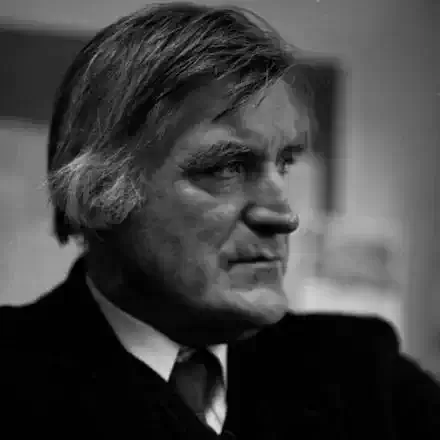
Ted Hughes
Ted Hughes was a prominent English poet, translator, and children's writer, celebrated for his powerful and visceral depictions of the natural world and its raw, primal forces. His poetry is characterized by its intensity, rugged language, and exploration of myth, the animal kingdom, and the darker aspects of human nature. Hughes's work often draws upon mythologies and folk traditions, imbuing his verse with a profound sense of elemental power and ancient wisdom.
7397
0
0
Some Poems
Biography
Videos
Books
Ted Hughes (1930 - 1998)
Ted Hughes is consistently described as one of the twentieth century’s
greatest English poets. Born August 17th, 1930 in Mytholmroyd, Yorkshire,
his family moved to Mexborough when he was seven to run a newspaper and
tobacco shop. He attended Mexborough grammar school, and wrote his first
poems from the age of fifteen, some of which made their way into the school
magazine. Before beginning English studies at Cambridge University (having
won a scholarship in 1948), he spent much of his National service time
reading and rereading all of Shakespeare. According to report, he could
recite it all by heart. At Cambridge, he he 'spent most..time reading folklore
and Yeat's poems,' and switched from English to Archaeology and
Anthropology in his third year.
His first published poem appeared in 1954, the year he graduated from
Cambridge. He used two pseudonyms for the early publications, Daniel
Hearing and Peter Crew. From 1955 to 1956, he worked as a rose gardener,
night-watchman, zoo attendant, schoolteacher, and reader for J. Arthur
Rank, and planned to teach in Spain then emigrate to Australia. February 26
saw the launch of the literary magazine, the St Botolph's Review, for which
Hughes was one of six co-producers. It was also the day he met Sylvia Plath;
they were married in four months.
Hughe's first book of poems, Hawk in the Rain, was published in 1957 to
immediate acclaim, winning the Harper publication contest. Over the next 41
years, he would write upwards of 90 books, and win numerous prizes and
fellowships including the following (in that order):
Harper publication contest, Guiness Poetry Award, Guggenheim fellowship,
Somerset Maughan award, city of Florence International Poetry Prize, Premio
Internazionale Taormina Prize, Queen’s Gold Medal for Poetry, OBE, vote for
the best writing in English in the New Poetry Poll, Whitbread Book of the
Year, W.H. Smith Literature award, Forward Prize for Poetry, Queen’s Order
of Merit, T.S. Eliot Prize for Poetry, South Bank Award for Literature,
Whitbread Prize for Poetry, and the Whitbread Book of the Year again.
In 1984, he was appointed England’s poet laureate.
Hughes is what some have called a nature poet. A keen countryman and
hunter from a young age, he viewed writing poems as a continuation of his
earlier passion. ‘This is hunting and the poem is a new species of creature, a
new specimen of the life outside your own.’ (Poetry in the Making , 1967)
Hughes and Plath
www.PoemHunter.com - The World's Poetry Archive
A strong indirect source of interest in the person of Hughes (aside from his
poetry) is his seven-year marriage to the well-known American Poet, Sylvia
Plath. Birthday Letters is a sequence of lyrics written by Hughes in the first
year of their marriage, cast as a continued conversation with Plath.
When Plath committed suicide in 1963 (they had separated in 1962), many
held Hughes responsible for her death as a consequence of his adulterous
relationship with Assia Wevill; recent biographies such as Elaine Feinstein’s
Ted Hughes: The Life of a Poet have attempted to ‘set the record straight
and clear the air of rancor and recrimination’ (Brooke Allen, The New York
Times ).
Though deeply marked by the loss, Hughes was publicly silent on the subject
for more than 30 years out of his sense of responsibility to protect the
couple's two young children, whose perceptions of their mother would have
otherwise been impossibly spoiled by external interference. The publication
of Birthday Letters has been seen as a 'retaking' of the histories that had
been stolen from the family through the cracks in the armour.
Quotes
‘Each image denotates another, so that the whole poem throbs’ – Edward
Lucie Smith on Hughes’ poetry, British Poetry since 1945
‘Imagine what you are writing about. See it and live it.’ –Ted Hughes, Poetry
in the Making
‘You write interestingly only about the things that genuinely interest you.
This is an infallible rule.. in writing, you have to be able to distinguish
between those things about which you are merely curious –things you heard
about last week or read about yesterday- and things which are a deep part of
your life… So you say, ‘What part of my life would I die to be separated
from?’ –Ted Hughes, Poetry in the Making
‘It is occasionally possible, just for brief moments, to find the words that will
unlock the doors of all those many mansions in the head and express
something – perhaps not much, just something – of the crush of information
that presses in on us from the way a crow flies over and the way a man
walks and the look of a street and from what we did one day a dozen years
ago. Words that will express something of the deep complexity that makes
us precisely the way we are.’-Ted Hughes, Poetry in the Making
www.PoemHunter.com - The World's Poetry Archive
Ted Hughes: Stronger Than Death
The Extraordinary Love of Sylvia Plath and Ted Hughes
The Forgotten Tragedy of Assia Wevill | Sinister Sam
Ted Hughes: Force of Nature
Ted Hughes [The Thought-Fox]
101 Poems. Anthology, (various). Read by Ted Hughes.
Exploring the Poems of Ted Hughes
Ted Hughes interview and a reading from The Iron Man
Readings of poems by DH Lawrence, Ted Hughes and Sylvia Plath. Enjoy!
hawk roosting poem read by author ted hughes
Ted Hughes, Seamus Heaney and the Barrie Cooke archive
CROW - written and read by Ted Hughes
Fishing with Ted Hughes
Jonathan Bate on The Unauthorised Life of Ted Hughes
Fishing with Ted Hughes
Ted Hughes BBC Radio Interview Clip from 1992
TED HUGHES reads "Lovesong"
Ted Hughes: Biography & Context
"The Iron Man" by Ted Hughes (from BBC Two)
Alice Oswald on Ted Hughes, featuring archive readings by Hughes
Thought Fox by Ted Hughes
Ted Hughes - Tales from Ovid audiobook
Jonathan Bate, author of 'Ted Hughes: The Unauthorised Biography' talks to Anne Farrar Donovan
Richard Armitage reads Ted Hughes' letters
Book at Lunchtime: Ted Hughes: The Unauthorised Life
The Thought-fox by Ted Hughes | Summary | English Literature Lessons
Dylan Thomas, Philip Larkin, Ted Hughes | E@6 Videopedia | TES | Kalyani Vallath | NTA NET, K SET
Cillian Murphy reads Lovesong by Ted Hughes
A Tribute To Sylvia Plath And Ted Hughes Part 2
Bayonet Charge - Poem by Ted Hughes
Ted Hughes’s 'Crow' at Fifty: a Seminar
Ted Hughes-brief introduction
Poetry: "You Hated Spain" By Ted Hughes ‖ Tom Hiddleston ‖ Words and Music: Memory
The Thought Fox by Ted Hughes | Malayalam Summary | Litmosphere | Calicut University
Ted Hughes: An Animal Poet | Dr. Susan Mathew | Department of English
Sylvia Plath and Ted Hughes Intense Love for one Another
Hawk Roosting | Ted Hughes | Poetry Analysis | GCSE Literature | English with Kayleigh
Ted Hughes | biographic | Literary work | style | Important points | Urdu and Hindi |
The Horses by Ted Hughes
The Harvest Moon | Ted Hughes | Poetry Analysis | GCSE Literature | English with Kayleigh
Ted Hughes
The Warm and the Cold by Ted Hughes
'Bayonet Charge' by Ted Hughes in 5.5 Minutes: Quick Revision
Sylvia Plath: Two of a Kind: Poets in Partnership
Ted Hughes on 'Crow'
WIND - Ted Hughes
Ted Hughes: mi escritor macho predilecto
Ted Hughes: 'Bayonet Charge' Mr Bruff Analysis
Wind | Ted Hughes | Poetry Analysis| Literature | English with Kayleigh
Ted Hughes memorial marks poetic evolution