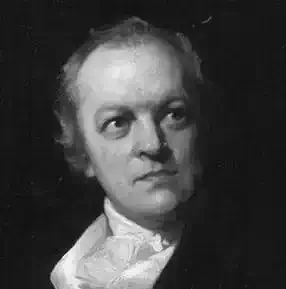
William Blake

William Blake

1757–1827 · lived 69 years GB GB

William Blake was an English poet, painter, and printmaker whose visionary works explored profound spiritual and philosophical themes. He is renowned for his prophetic books, which combine his unique mythology with his distinct artistic style, often characterized by intense symbolism and imaginative power. Blake's work defied easy categorization, blending elements of Romanticism with his own highly personal brand of mysticism. His poetry, such as "Songs of Innocence and of Experience," continues to captivate readers with its exploration of dualities like innocence and corruption, joy and sorrow, and the spiritual and the material.

n. 1757-11-28, Londres · m. 1827-08-12, Charing Cross

58,811 Views

A Cradle Song

A Cradle Song
Sweet dreams form a shade,
O'er my lovely infants head.
Sweet dreams of pleasant streams,
By happy silent moony beams
Sweet sleep with soft down.
Weave thy brows an infant crown.
Sweet sleep Angel mild,
Hover o'er my happy child.
Sweet smiles in the night,
Hover over my delight.
Sweet smiles Mothers smiles,
All the livelong night beguiles.
Sweet moans, dovelike sighs,
Chase not slumber from thy eyes,
Sweet moans, sweeter smiles,
All the dovelike moans beguiles.
Sleep sleep happy child,
All creation slept and smil'd.
Sleep sleep, happy sleep.
While o'er thee thy mother weep
Sweet babe in thy face,
Holy image I can trace.
Sweet babe once like thee.
Thy maker lay and wept for me
Wept for me for thee for all,
When he was an infant small.
Thou his image ever see.
Heavenly face that smiles on thee,
Smiles on thee on me on all,
Who became an infant small,
Infant smiles are His own smiles,
Heaven & earth to peace beguiles.
Read full poem
Bio

Identification and basic context

William Blake was an English poet, painter, and printmaker. He is widely regarded as a visionary artist and a key figure in the Romantic movement, though his work often defied conventional categorization and is characterized by its unique spiritual and philosophical depth. Blake's primary language of expression was English. His imaginative and often mystical worldview set him apart from many of his contemporaries. He is best known for his illuminated books, which combine his poetry with his own intricate illustrations.

Childhood and education

Born in London, Blake came from a modest background. His father was a hosier. He received little formal schooling, attending only a dame school. However, he was a voracious reader and possessed a remarkable natural talent for drawing and poetry from a young age. His parents recognized his artistic abilities and apprenticed him to an engraver at the age of ten. This apprenticeship provided him with crucial technical skills and exposed him to various artistic styles and historical prints, which would later inform his own work. His early education was thus largely practical and self-directed, fueled by an innate creative drive.

Literary trajectory

Blake began his literary career by writing poetry, including early works that would later be revised and published in collections like "Poetical Sketches" (1783). His true innovation came with the development of his "illuminated printing" technique, where he combined his poetry and illustrations into single plates, printed and colored by hand. This led to the creation of his prophetic books, beginning with "Songs of Innocence" (1789) and "Songs of Experience" (1794), which explore complex theological and philosophical ideas through allegorical poetry and vivid imagery. His literary trajectory was marked by a consistent development of his personal mythology and a relentless pursuit of spiritual and artistic expression, often in defiance of contemporary literary and artistic conventions.

Works, style, and literary characteristics

Blake's most famous works include "Songs of Innocence and of Experience," "The Marriage of Heaven and Hell," "Jerusalem," and "Milton." His dominant themes often revolve around the dualities of human existence: innocence and experience, good and evil, heaven and hell, reason and imagination, freedom and oppression. He developed a complex personal mythology populated by symbolic figures like Urizen (reason), Los (imagination), and Enitharmon (spirituality). His style is characterized by its visionary intensity, rich symbolism, and often paradoxical pronouncements. Blake employed a variety of forms, from lyrical songs to epic prophecies, often utilizing rhythmic structures and vivid, dreamlike imagery. His language can be both deceptively simple and profoundly complex, challenging conventional interpretations of morality and spirituality.

Cultural and historical context

Blake lived during a period of significant social and political upheaval in Britain, including the American and French Revolutions, which deeply influenced his thinking on liberty, tyranny, and social justice. He was part of a generation of artists and writers associated with Romanticism, which emphasized emotion, individualism, and the sublime in nature, though Blake's vision was often more overtly spiritual and prophetic. He was deeply critical of the established church, state, and industrialization, viewing them as forces that stifled human imagination and spiritual freedom. His radical religious and political views often led to his isolation from mainstream artistic and literary circles.

Personal life

Blake's personal life was marked by his deep devotion to his wife, Catherine Boucher, whom he taught to read and write and who became his artistic collaborator. They lived a relatively simple life, often facing financial hardship. Blake's intense inner world and visionary experiences sometimes led others to perceive him as eccentric or even insane, though he maintained a consistent creative output. His spiritual beliefs were central to his life and work, forming the basis of his unique cosmology.

Recognition and reception

During his lifetime, Blake was largely unrecognized for his poetic genius and was primarily known as a talented engraver. His visionary works were often misunderstood or dismissed by critics and the public. It was only in the 20th century, with the rise of modernist and postmodernist thought, that his work began to be re-evaluated and appreciated for its originality, depth, and prophetic power. Today, he is considered one of Britain's greatest poets and artists, with his work studied extensively in literature and art history.

Influences and legacy

Blake was influenced by the Bible, Milton, Shakespeare, and various mystical traditions. His radical ideas and unique artistic vision, in turn, influenced numerous artists, writers, and thinkers, including the Pre-Raphaelites, the Symbolists, and later figures in literature and art who embraced his emphasis on imagination and spiritual truth. His critique of industrial society and his celebration of individual vision continue to resonate. His inclusion in the literary and artistic canon is now firmly established, and his works are widely translated and studied internationally.

Interpretation and critical analysis

Blake's work is rich with layers of symbolic meaning, inviting diverse interpretations. Critics often analyze his complex mythology, his critique of established religious and political institutions, and his exploration of the human psyche. Debates frequently arise concerning the precise nature of his spiritual beliefs and the extent to which his visions should be understood literally or metaphorically. His exploration of the "contraries" of life remains a central theme for critical inquiry.

Curiosities and lesser-known aspects

Blake claimed to have seen visions from childhood, including seeing angels in a tree. He developed a unique method of printing his books, which he called "illuminated printing," involving etching both text and image onto copper plates. He was a vocal critic of the rationalism and materialism of his age. His personal notebooks contain numerous aphorisms and observations that reveal his independent and often provocative thinking.

Death and memory

William Blake died in relative obscurity in 1827. His memory was kept alive by a small circle of admirers, but his widespread recognition as a major artistic and literary figure only emerged much later. Posthumous publications and exhibitions have cemented his legacy as a unique and profoundly influential visionary artist and poet.

Poems

93

Why Was Cupid a Boy

Why Was Cupid a Boy
Why was Cupid a boy,
And why a boy was he?
He should have been a girl,
For aught that I can see.
For he shoots with his bow,
And the girl shoots with her eye,
And they both are merry and glad,
And laugh when we do cry.
And to make Cupid a boy
Was the Cupid girl's mocking plan;
For a boy can't interpret the thing
Till he is become a man.
And then he's so pierc'd with cares,
And wounded with arrowy smarts,
That the whole business of his life
Is to pick out the heads of the darts.
'Twas the Greeks' love of war
Turn'd Love into a boy,
And woman into a statue of stone--
And away fled every joy.
436

When Klopstock England Defied

When Klopstock England Defied
When Klopstock England defied,
Uprose William Blake in his pride;
For old Nobodaddy aloft
. . . and belch'd and cough'd;
Then swore a great oath that made Heaven quake,
And call'd aloud to English Blake.
Blake was giving his body ease,
At Lambeth beneath the poplar trees.
From his seat then started he
And turn'd him round three times three.
The moon at that sight blush'd scarlet red,
The stars threw down their cups and fled,
And all the devils that were in hell,
Answerèd with a ninefold yell.
Klopstock felt the intripled turn,
And all his bowels began to churn,
And his bowels turn'd round three times three,
And lock'd in his soul with a ninefold key; . . .
Then again old Nobodaddy swore
He ne'er had seen such a thing before,
Since Noah was shut in the ark,
Since Eve first chose her hellfire spark,
Since 'twas the fashion to go naked,
Since the old Anything was created . . .
440

To Tirzah

To Tirzah
Whate'er is Born of Mortal Birth
Must be consumed with the Earth
To rise from Generation free:
Then what have I to do with thee?
The Sexes sprung from Shame & Pride,
Blow'd in the morn, in evening died;
But Mercy chang'd Death into Sleep;
The Sexes rose to work & weep.
Thou, Mother of my Mortal part,
With cruelty didst mould my Heart,
And with false self-deceiving tears
Didst bind my Nostrils, Eyes, & Ears:
Didst close my Tongue in senseless clay,
And me to Mortal Life betray.
The Death of Jesus set me free:
Then what have I to do with thee?
407

To the Muses

To the Muses
Whether on Ida's shady brow,
Or in the chambers of the East,
The chambers of the sun, that now
From ancient melody have ceas'd;
Whether in Heav'n ye wander fair,
Or the green corners of the earth,
Or the blue regions of the air,
Where the melodious winds have birth;
Whether on crystal rocks ye rove,
Beneath the bosom of the sea
Wand'ring in many a coral grove,
Fair Nine, forsaking Poetry!
How have you left the ancient love
That bards of old enjoy'd in you!
The languid strings do scarcely move!
The sound is forc'd, the notes are few!
458

To The Accuser Who is The God of This World

To The Accuser Who is The God of This World
Truly My Satan thou art but a Dunce
And dost not know the Garment from the Man
Every Harlot was a Virgin once
Nor canst thou ever change Kate into Nan
Tho thou art Worship'd by the Names Divine
Of Jesus & Jehovah thou art still
The Son of Morn in weary Nights decline
The lost Travellers Dream under the Hill
384

To Spring

To Spring
O thou with dewy locks, who lookest down
Thro' the clear windows of the morning, turn
Thine angel eyes upon our western isle,
Which in full choir hails thy approach, O Spring!
The hills tell each other, and the listening
Valleys hear; all our longing eyes are turned
Up to thy bright pavilions: issue forth,
And let thy holy feet visit our clime.
Come o'er the eastern hills, and let our winds
Kiss thy perfumed garments; let us taste
Thy morn and evening breath; scatter thy pearls
Upon our love-sick land that mourns for thee.
O deck her forth with thy fair fingers; pour
Thy soft kisses on her bosom; and put
Thy golden crown upon her languished head,
Whose modest tresses were bound up for thee.
448

To Autum

To Autum
O Autumn, laden with fruit, and stain'd
With the blood of the grape, pass not, but sit
Beneath my shady roof; there thou may'st rest,
And tune thy jolly voice to my fresh pipe,
And all the daughters of the year shall dance!
Sing now the lusty song of fruits and flowers.
'The narrow bud opens her beauties to
The sun, and love runs in her thrilling veins;
Blossoms hang round the brows of Morning, and
Flourish down the bright cheek of modest Eve,
Till clust'ring Summer breaks forth into singing,
And feather'd clouds strew flowers round her head.
'The spirits of the air live in the smells
Of fruit; and Joy, with pinions light, roves round
The gardens, or sits singing in the trees.'
Thus sang the jolly Autumn as he sat,
Then rose, girded himself, and o'er the bleak
Hills fled from our sight; but left his golden load.
478

To Morning

To Morning
O holy virgin! clad in purest white,
Unlock heav'n's golden gates, and issue forth;
Awake the dawn that sleeps in heaven; let light
Rise from the chambers of the east, and bring
The honey'd dew that cometh on waking day.
O radiant morning, salute the sun
Rous'd like a huntsman to the chase, and with
Thy buskin'd feet appear upon our hills.
430

The Voice of the Ancient Bard

The Voice of the Ancient Bard
Youth of delight, come hither,
And see the opening morn,
Image of truth new born.
Doubt is fled, & clouds of reason,
Dark disputes & artful teazing.
Folly is an endless maze,
Tangled roots perplex her ways.
How many have fallen there!
They stumble all night over bones of the dead,
And feel they know not what but care,
And wish to lead others, when they should be led.
369

Three Things to Remember

Three Things to Remember
A Robin Redbreast in a cage,
Puts all Heaven in a rage.
A skylark wounded on the wing
Doth make a cherub cease to sing.
He who shall hurt the little wren
Shall never be beloved by men.
432

Quotes

40

Videos

50

Comments (0)

Share
Log in to post a comment.

No comments yet. Be the first to comment.