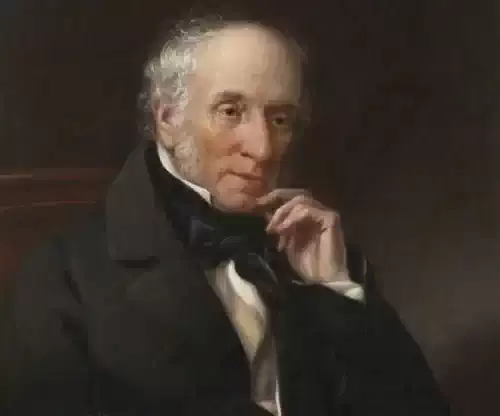
William Wordsworth

William Wordsworth

1770-04-07 Wordsworth House, Cockermouth, Reino Unido
1850-04-23 Cumberland, Reino Unido
23061
0
0


Some Poems

Kitten And Falling Leaves, The

Kitten And Falling Leaves, The
That way look, my Infant, lo!
What a pretty baby-show!
See the kitten on the wall,
Sporting with the leaves that fall,
Withered leaves---one---two---and three---
From the lofty elder-tree!
Through the calm and frosty air
Of this morning bright and fair,
Eddying round and round they sink
Softly, slowly: one might think,
From the motions that are made,
Every little leaf conveyed
Sylph or Faery hither tending,---
To this lower world descending,
Each invisible and mute,
In his wavering parachute.
---But the Kitten, how she starts,
Crouches, stretches, paws, and darts!
First at one, and then its fellow
Just as light and just as yellow;
There are many now---now one---
Now they stop and there are none
What intenseness of desire
In her upward eye of fire!
With a tiger-leap half way
Now she meets the coming prey,
Lets it go as fast, and then
Has it in her power again:
Now she works with three or four,
Like an Indian conjurer;
Quick as he in feats of art,
Far beyond in joy of heart.
Were her antics played in the eye
Of a thousand standers-by,
Clapping hands with shout and stare,
What would little Tabby care
For the plaudits of the crowd?
Over happy to be proud,
Over wealthy in the treasure
Of her own exceeding pleasure!
'Tis a pretty baby-treat;
Nor, I deem, for me unmeet;
Here, for neither Babe nor me,
Other play-mate can I see.
Of the countless living things,
That with stir of feet and wings
(In the sun or under shade,
Upon bough or grassy blade)
And with busy revellings,
Chirp and song, and murmurings,
Made this orchard's narrow space,
And this vale so blithe a place;


Multitudes are swept away
Never more to breathe the day:
Some are sleeping; some in bands
Travelled into distant lands;
Others slunk to moor and wood,
Far from human neighborhood;
And, among the Kinds that keep
With us closer fellowship,
With us openly abide,
All have laid their mirth aside.
Where is he that giddy Sprite,
Blue-cap, with his colors bright,
Who was blest as bird could be,
Feeding in the apple-tree;
Made such wanton spoil and rout,
Turning blossoms inside out;
Hung---head pointing towards the ground---
Fluttered, perched, into a round
Bound himself, and then unbound;
Lithest, gaudiest Harlequin!
Prettiest Tumbler ever seen!
Light of heart and light of limb;
What is now become of Him?
Lambs, that through the mountains went
Frisking, bleating merriment,
When the year was in its prime,
They are sobered by this time.
If you look to vale or hill,
If you listen, all is still,
Save a little neighboring rill,
That from out the rocky ground
Strikes a solitary sound.
Vainly glitter hill and plain,
And the air is calm in vain;
Vainly Morning spreads the lure
Of a sky serene and pure;
Creature none can she decoy
Into open sign of joy:
Is it that they have a fear
Of the dreary season near?
Or that other pleasures be
Sweeter even than gaiety ?
Yet, whate'er enjoyments dwell
In the impenetrable cell
Of the silent heart which Nature
Furnishes to every creature;
Whatsoe'er we feel and know
Too sedate for outward show,
Such a light of gladness breaks,
Pretty Kitten! from thy freaks,---
Spreads with such a living grace
O'er my little Dora's face;


Yes, the sight so stirs and charms
Thee, Baby, laughing in my arms,
That almost I could repine
That your transports are not mine,
That I do not wholly fare
Even as ye do, thoughtless pair!
And I will have my careless season
Spite of melancholy reason,
Will walk through life in such a way
That, when time brings on decay,
Now and then I may possess
Hours of perfect gladsomeness.
---Pleased by any random toy;
By a kitten's busy joy,
Or an infant's laughing eye
Sharing in the ecstasy;
I would fare like that or this,
Find my wisdom in my bliss;
Keep the sprightly soul awake,
And have faculties to take,
Even from things by sorrow wrought,
Matter for a jocund thought,
Spite of care, and spite of grief,
To gambol with Life's falling Leaf.

Ellen Irwin

Ellen Irwin
Fair Ellen Irwin, when she sate
Upon the braes of Kirtle,
Was lovely as a Grecian maid
Adorned with wreaths of myrtle;
Young Adam Bruce beside her lay,
And there did they beguile the day
With love and gentle speeches,
Beneath the budding beeches.
From many knights and many squires
The Bruce had been selected;
And Gordon, fairest of them all,
By Ellen was rejected.
Sad tidings to that noble Youth!
For it may be proclaimed with truth,
If Bruce hath loved sincerely,
That Gordon loves as dearly.
But what are Gordon's form and face,
His shattered hopes and crosses,
To them, 'mid Kirtle's pleasant braes,
Reclined on flowers and mosses?
Alas that ever he was born!
The Gordon, couched behind a thorn,
Sees them and their caressing;
Beholds them blest and blessing.
Proud Gordon, maddened by the thoughts
That through his brain are travelling,
Rushed forth, and at the heart of Bruce
He launched a deadly javelin!
Fair Ellen saw it as it came,
And, starting up to meet the same,
Did with her body cover
The Youth, her chosen lover.
And, falling into Bruce's arms,
Thus died the beauteous Ellen,
Thus, from the heart of her True-love,
The mortal spear repelling.
And Bruce, as soon as he had slain
The Gordon, sailed away to Spain;
And fought with rage incessant
Against the Moorish crescent.
But many days, and many months,
And many years ensuing,
This wretched Knight did vainly seek
The death that he was wooing.
So, coming his last help to crave,
Heart-broken, upon Ellen's grave
His body he extended,


And there his sorrow ended.
Now ye, who willingly have heard
The tale I have been telling,
May in Kirkconnel churchyard view
The grave of lovely Ellen:
By Ellen's side the Bruce is laid;
And, for the stone upon his head,
May no rude hand deface it,
And its forlorn "Hie jacet"!

The Kitten And Falling Leaves

The Kitten And Falling Leaves
THAT way look, my Infant, lo!
What a pretty baby-show!
See the kitten on the wall,
Sporting with the leaves that fall,
Withered leaves---one---two---and three---
From the lofty elder-tree!
Through the calm and frosty air
Of this morning bright and fair,
Eddying round and round they sink
Softly, slowly: one might think,
From the motions that are made,
Every little leaf conveyed
Sylph or Faery hither tending,---
To this lower world descending,
Each invisible and mute,
In his wavering parachute.
---But the Kitten, how she starts,
Crouches, stretches, paws, and darts!
First at one, and then its fellow
Just as light and just as yellow;
There are many now---now one---
Now they stop and there are none
What intenseness of desire
In her upward eye of fire!
With a tiger-leap half way
Now she meets the coming prey,
Lets it go as fast, and then
Has it in her power again:
Now she works with three or four,
Like an Indian conjurer;
Quick as he in feats of art,
Far beyond in joy of heart.
Were her antics played in the eye
Of a thousand standers-by,
Clapping hands with shout and stare,
What would little Tabby care
For the plaudits of the crowd?
Over happy to be proud,
Over wealthy in the treasure
Of her own exceeding pleasure!
'Tis a pretty baby-treat;
Nor, I deem, for me unmeet;
Here, for neither Babe nor me,
Other play-mate can I see.
Of the countless living things,
That with stir of feet and wings
(In the sun or under shade,
Upon bough or grassy blade)
And with busy revellings,
Chirp and song, and murmurings,
Made this orchard's narrow space,
And this vale so blithe a place;


Multitudes are swept away
Never more to breathe the day:
Some are sleeping; some in bands
Travelled into distant lands;
Others slunk to moor and wood,
Far from human neighborhood;
And, among the Kinds that keep
With us closer fellowship,
With us openly abide,
All have laid their mirth aside.
Where is he that giddy Sprite,
Blue-cap, with his colors bright,
Who was blest as bird could be,
Feeding in the apple-tree;
Made such wanton spoil and rout,
Turning blossoms inside out;
Hung---head pointing towards the ground---
Fluttered, perched, into a round
Bound himself, and then unbound;
Lithest, gaudiest Harlequin!
Prettiest Tumbler ever seen!
Light of heart and light of limb;
What is now become of Him?
Lambs, that through the mountains went
Frisking, bleating merriment,
When the year was in its prime,
They are sobered by this time.
If you look to vale or hill,
If you listen, all is still,
Save a little neighboring rill,
That from out the rocky ground
Strikes a solitary sound.
Vainly glitter hill and plain,
And the air is calm in vain;
Vainly Morning spreads the lure
Of a sky serene and pure;
Creature none can she decoy
Into open sign of joy:
Is it that they have a fear
Of the dreary season near?
Or that other pleasures be
Sweeter even than gaiety ?
Yet, whate'er enjoyments dwell
In the impenetrable cell
Of the silent heart which Nature
Furnishes to every creature;
Whatsoe'er we feel and know
Too sedate for outward show,
Such a light of gladness breaks,
Pretty Kitten! from thy freaks,---
Spreads with such a living grace
O'er my little Dora's face;


Yes, the sight so stirs and charms
Thee, Baby, laughing in my arms,
That almost I could repine
That your transports are not mine,
That I do not wholly fare
Even as ye do, thoughtless pair!
And I will have my careless season
Spite of melancholy reason,
Will walk through life in such a way
That, when time brings on decay,
Now and then I may possess
Hours of perfect gladsomeness.
---Pleased by any random toy;
By a kitten's busy joy,
Or an infant's laughing eye
Sharing in the ecstasy;
I would fare like that or this,
Find my wisdom in my bliss;
Keep the sprightly soul awake,
And have faculties to take,
Even from things by sorrow wrought,
Matter for a jocund thought,
Spite of care, and spite of grief,
To gambol with Life's falling Leaf.

Ode, Composed On A May Morning

Ode, Composed On A May Morning
While from the purpling east departs
The star that led the dawn,
Blithe Flora from her couch upstarts,
For May is on the lawn.
A quickening hope, a freshening glee,
Foreran the expected Power,
Whose first-drawn breath, from bush and tree,
Shakes off that pearly shower.
All Nature welcomes Her whose sway
Tempers the year's extremes;
Who scattereth lustres o'er noon-day,
Like morning's dewy gleams;
While mellow warble, sprightly trill,
The tremulous heart excite;
And hums the balmy air to still
The balance of delight.
Time was, blest Power! when youth and maids
At peep of dawn would rise,
And wander forth, in forest glades
Thy birth to solemnize.
Though mute the song---to grace the rite
Untouched the hawthorn bough,
Thy Spirit triumphs o'er the slight;
Man changes, but not Thou!
Thy feathered Lieges bill and wings
In love's disport employ;
Warmed by thy influence, creeping things
Awake to silent joy:
Queen art thou still for each gay plant
Where the slim wild deer roves;
And served in depths where fishes haunt
Their own mysterious groves.
Cloud-piercing peak, and trackless heath,
Instinctive homage pay;
Nor wants the dim-lit cave a wreath
To honor thee, sweet May!
Where cities fanned by thy brisk airs
Behold a smokeless sky,
Their puniest flower-pot-nursling dares
To open a bright eye.
And if, on this thy natal morn,
The pole, from which thy name
Hath not departed, stands forlorn
Of song and dance and game;
Still from the village-green a vow
Aspires to thee addrest,
Wherever peace is on the brow,


Or love within the breast.
Yes! where Love nestles thou canst teach
The soul to love the more;
Hearts also shall thy lessons reach
That never loved before.
Stript is the haughty one of pride,
The bashful freed from fear,
While rising, like the ocean-tide,
In flow the joyous year.
Hush, feeble lyre! weak words refuse
The service to prolong!
To yon exulting thrush the Muse
Entrusts the imperfect song;
His voice shall chant, in accents clear,
Throughout the live-long day,
Till the first silver star appear,
The sovereignty of May.

The Fountain

The Fountain
A Conversation
We talked with open heart, and tongue
Affectionate and true,
A pair of friends, though I was young,
And Matthew seventy-two.
We lay beneath a spreading oak,
Beside a mossy seat;
And from the turf a fountain broke
And gurgled at our feet.
`Now, Matthew!' said I, `let us match
This water's pleasant tune
With some old border-song, or catch
That suits a summer's noon;
`Or of the church-clock and the chimes
Sing here beneath the shade
That half-mad thing of witty rhymes
Which you last April made!'
In silence Matthew lay, and eyed
The spring beneath the tree;
And thus the dear old man replied,
The grey-haired man of glee:
`No check, no stay, this streamlet fears,
How merrily it goes!
'Twill murmur on a thousand years
And flow as now it flows.
`And here, on this delightful day,
I cannot choose but think
How oft, a vigorous man, I lay
Beside this fountain's brink.
`My eyes are dim with childish tears,
My heart is idly stirred,
For the same sound is in my ears
Which in those days I heard.
`Thus fares it still in our decay:
And yet the wiser mind
Mourns less for what Age takes away,
Than what it leaves behind.
`The blackbird amid leafy trees,
The lark above the hill,
Let loose their carols when they please,
Are quiet when they will.


`With Nature never do they wage
A foolish strife; they see
A happy youth, and their old age
Is beautiful and free:
`But we are pressed by heavy laws;
And often, glad no more,
We wear a face of joy, because
We have been glad of yore.
`If there be one who need bemoan
His kindred laid in earth,
The household hearts that were his own, -
It is the man of mirth.
`My days, my friend, are almost gone,
My life has been approved,
And many love me; but by none
Am I enough beloved.'
`Now both himself and me he wrongs,
The man who thus complains!
I live and sing my idle songs
Upon these happy plains:
`And, Matthew, for thy children dead
I'll be a son to thee!'
At this he grasped my hand and said
`Alas! that cannot be.'
We rose up from the fountain-side;
And down the smooth descent
Of the green sheep-track did we glide;
And through the wood we went;
And ere we came to Leonard's Rock
He sang those witty rhymes
About the crazy old church-clock,
And the bewildered chimes.
Wordsworth, born in his beloved Lake District, was the son of an attorney. He went to school first at Penrith and then at Hawkshead Grammar school before studying, from , at St John's College, Cambridge - all of which periods were later to be described vividly in The Prelude. In he went with friends on a walking tour to France, the Alps and Italy, before arriving in France where Wordsworth was to spend the next year. Whilst in France he fell in love twice over: once with a young French woman, Annette Vallon, who subsequently bore him a daughter, and then, once more, with the French Revolution. Returning to England he wrote, and left unpublished, his Letter to the Bishop of Llandaff - a tract in support of the French Revolutionary cause. In , after receiving a legacy, Wordsworth lived with his sister Dorothy first in Dorset and then at Alfoxden, Dorset, close to Coleridge. In these years he wrote many of his greatest poems and also travelled with Coleridge and Dorothy, in the winter of -, to Germany. Two years later the second and enlarged edition of the Lyrical Ballads appeared in , just one year before Wordsworth married Mary Hutchinson. This was followed, in , by the publication of Poems in Two Volumes, which included the poems 'Resolution and Independence' and 'Intimations of Immortality from Recollections of Early Childhood'. During this period he also made new friendships with Walter Scott, Sir G. Beaumont and De Quincy, wrote such poems as 'Elegaic Stanzas suggested by a Picture of Peele Castle' (), and fathered five children. He received a civil list pension in and was made poet-laureate just one year later. Today Wordsworth's poetry remains widely read. Its almost universal appeal is perhaps best explained by Wordsworth's own words on the role, for him, of poetry; what he called "the most philosophical of all writing" whose object is "truth...carried alive into the heart by passion". www.PoemHunter.com - The World's Poetry Archive "A Narrow Girdle of Rough Stones and Crags," A narrow girdle of rough stones and crags, A rude and natural causeway, interposed Between the water and a winding slope Of copse and thicket, leaves the eastern shore Of Grasmere safe in its own privacy: And there myself and two beloved Friends, One calm September morning, ere the mist Had altogether yielded to the sun, Sauntered on this retired and difficult way. ----Ill suits the road with one in haste; but we Played with our time; and, as we strolled along, It was our occupation to observe Such objects as the waves had tossed ashore-- Feather, or leaf, or weed, or withered bough, Each on the other heaped, along the line Of the dry wreck. And, in our vacant mood, Not seldom did we stop to watch some tuft Of dandelion seed or thistle's beard, That skimmed the surface of the dead calm lake, Suddenly halting now--a lifeless stand! And starting off again with freak as sudden; In all its sportive wanderings, all the while, Making report of an invisible breeze That was its wings, its chariot, and its horse, Its playmate, rather say, its moving soul. --And often, trifling with a privilege Alike indulged to all, we paused, one now, And now the other, to point out, perchance To pluck, some flower or water-weed, too fair Either to be divided from the place On which it grew, or to be left alone To its own beauty. Many such there are, Fair ferns and flowers, and chiefly that tall fern, So stately, of the queen Osmunda named; Plant lovelier, in its own retired abode On Grasmere's beach, than Naiad by the side Of Grecian brook, or Lady of the Mere, Sole-sitting by the shores of old romance. --So fared we that bright morning: from the fields Meanwhile, a noise was heard, the busy mirth Of reapers, men and women, boys and girls. Delighted much to listen to those sounds, And feeding thus our fancies, we advanced Along the indented shore; when suddenly, Through a thin veil of glittering haze was seen Before us, on a point of jutting land, The tall and upright figure of a Man Attired in peasant's garb, who stood alone, Angling beside the margin of the lake. "Improvident and reckless," we exclaimed, "The Man must be, who thus can lose a day Of the mid harvest, when the labourer's hire
wer54w66sf32re2
Daffodils – William Wordsworth (An Inspirational Poem)
William Wordsworth documentary
I Wandered Lonely as a Cloud by William Wordsworth — Poetry Reading
Introduction to William Wordsworth
William Wordsworth documentary
Wordsworth Documentary
"Ode on Intimations of Immortality" by William Wordsworth (read by Michael Sheen)
William Wordsworth's daffodils poem (I wandered lonely as a cloud)
Wordsworth, Coleridge and the Poetic Revolution
🔴William Wordsworth - Quick Revision
Arturo Cattaneo - William Wordsworth: The father of English Romanticism and the poetry of the self
English Literature | William Wordsworth: poetic style and main themes
William Wordsworth Part 1 | E@6 Videopedia | TES | Kalyani Vallath | NTA NET, K SET, G SET,GATE
William Wordsworth Life and Works || UP TGT PGT UGC NET etc
Preface to Lyrical Ballads | William Wordsworth | Romantic Criticism
Poems of William Wordsworth (Selected) | The World Is Too Much With Us
Daffodils Poem by William Wordsworth - I Wandered Lonely as a Cloud
Tintern Abbey | William Wordsworth - Line by Line Explanation
Letteratura Inglese | William Wordsworth: poetica, temi, stile e interpretazioni
William Wordsworth's Poem that tells us a lot about our life | THE HAPPY WARRIOR
Poems of William Wordsworth (Selected) | Ode: Intimations of Immortality
Daffodils - A William Wordsworth's Poem | Harshitha | Martin Kartenjer | Original Music for Poetry
"We Are Seven" by William Wordsworth (read by Tom O'Bedlam)
The Solitary Reaper by William Wordsworth
"Daffodils" or "I Wandered Lonely as a Cloud" by William Wordsworth (Memorization Song)
Lines Written in Early Spring by William Wordsworth Class 11 Alternative English
Biography of William Wordsworth, Poet famous for launching Romantic Age in English literature
William Wordsworth - Context & Background
Daffodils I wandered lonely as a cloud | William Wordsworth| English Poem Recitation for Competition
"Ode: Intimations of Immortality" by William Wordsworth (read by Toby Jones)
London, 1802: poem by William Wordsworth in Hindi summary Explanation and line by line analysis
Daffodils || William Wordsworth || ICSE Poem || ICSE Treasure Trove ||
William Wordsworth - Oda a la inmortalidad
Understanding "I Wandered Lonely as a Cloud," by William Wordsworth
"My heart leaps up" by William Wordsworth (read by Benedict Cumberbatch)
10 Lines on William Wordsworth in English | Few Lines on William Wordsworth
"Lines Composed a Few Miles above Tintern Abbey" by William Wordsworth (read by Michael Sheen)
The World is too much with us by William Wordsworth in Hindi
William Wordsworth | Lucy Poems | life and Works Blueprint in hindi
THE DAFFODILS,A POEM BY THE NATURE POET WILLIAM WORDSWORTH .WATCH THIS VIDEO TO UNDERSTAND IT
10 lines Essay On William Wordsworth | Easy Sentences About William Wordsworth In English
I Wandered Lonely As a Cloud by William Wordsworth: Daffodils - Poems for Kids, FreeSchool
Daffodils Part 2 || William Wordsworth || ICSE Poem || ICSE Treasure Trove ||
William Wordsworth
Ode: Intimations of Immortality from Recollections of Early Childhood BY WILLIAM WORDSWORTH in Hindi
🔵The Solitary Reaper Poem William Wordsworth Summary Analysis The Solitary Reaper William Wordsworth
Daffodils by William Wordsworth in Hindi | i wandered lonely as a cloud in hindi
Lines Written a Few Miles above Tintern Abbey Poem by William Wordsworth in Hindi
Do You know Why William Wordsworth And S T Coleridge Broke their Friendship?
Poems of William Wordsworth (Selected) | Lines Composed a Few Miles Above Tintern Abbey

See also

Who likes

Followers