
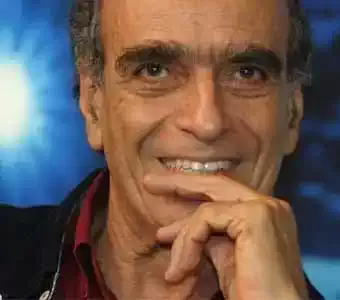
Affonso Romano de Sant'Anna
 BR
BR
Affonso Romano de Sant'Anna was a Brazilian poet, literary critic, and essayist, known for his poetry that explores language, metalanguage, and the human condition, often with a philosophical and ironic tone. His work addresses themes such as time, memory, the city, and the individual's relationship with the modern world, using dense and imagistic language. Distinguished for his contribution to Brazilian literature and culture, Sant'Anna also stood out as a university professor and commentator in various media, disseminating literary knowledge and critical reflection. His poetry is marked by formal experimentation and thematic depth, consolidating him as one of the most relevant voices in contemporary Portuguese-language poetry.
n. 1937-03-27, Belo Horizonte · m. 2025-03-04, Rio de Janeiro
Bio
Identification and Basic Context
Affonso Romano de Sant'Anna is a renowned Brazilian poet, essayist, literary critic, and university professor. He was born in Caratinga, Minas Gerais, on April 23, 1937. His poetic work is marked by profound reflection on language, metalanguage, the city, time, memory, and the human condition, often with an ironic and philosophical tone. He is known for his dense, imagistic, and experimental language. His nationality is Brazilian and the language of writing is Portuguese.Childhood and Education
Born in Minas Gerais, Sant'Anna had a childhood marked by the family and cultural environment of the interior. His academic background was solid, having graduated in Law and subsequently obtained a Master's degree in Comparative Literature and a Ph.D. in Letters from Paris III University (Sorbonne Nouvelle) in France. This international experience and contact with different literary and philosophical currents were crucial in shaping his thought and writing. He absorbed influences from modern and contemporary poetry, as well as philosophical currents that questioned language and reality.Literary Career
The beginning of his literary career occurred with the publication of his first poems, which soon attracted attention for their originality and depth. Over time, his work evolved, presenting different phases and formal and thematic experiments. He published several poetry books, which were gathered into collections, and also dedicated himself to literary criticism and essay writing. He actively participated in academic life, being a professor at important universities, and also took part in literary and cultural magazines, consolidating his career as a poet and intellectual.Work, Style, and Literary Characteristics
Among his most important poetic works are "O Canibal" (1971), "Que País é Este?" (1978), "Parábola do Cantor" (1981), "Debaixo da Cicatriz" (1991), and "Agoray" (2001). His dominant themes include the city as an existential space, the complexity of time and memory, reflection on poetry and language itself, and criticism of contemporary society. In terms of form and structure, Sant'Anna explored both free verse and more experimental forms, always seeking the adaptation of form to content. His poetic resources are marked by imagistic density, rhythm, and musicality, often with a confessional, ironic, and philosophical tone. The language used is erudite, but accessible, with great richness of vocabulary and exploration of wordplay. His work dialogues with literary tradition but innovates by bringing themes and approaches of modernity and postmodernity to Brazilian poetry. He is frequently associated with what can be called conceptual poetry or metapoetry.Cultural and Historical Context
Affonso Romano de Sant'Anna lived and produced his work in a period of intense social, political, and cultural transformations in Brazil and the world. His poetry reflects the tensions and dilemmas of modern society, growing urbanization, and existential crises that accompany technological advancement and globalization. As an intellectual, he participated in important debates and maintained contact with other writers and artists of his generation, contributing to the Brazilian cultural scene. His work, although not explicitly engaged in specific political movements, carries a strong charge of critical reflection on reality.Personal Life
Little is publicized about Affonso Romano de Sant'Anna's personal life compared to his work. It is known that his academic training abroad, especially in France, was an important period that influenced his worldview. His career as a university professor at institutions such as UFRJ (Federal University of Rio de Janeiro) and his participation in cultural and literary debates occupied a large part of his life. His dedication to poetry and critical thinking seems to have been the central axis of his existence.Recognition and Reception
Affonso Romano de Sant'Anna is widely recognized as one of the most important poets in contemporary Brazilian literature. His work has received several awards and distinctions throughout his career, and his production is a subject of study in universities in Brazil and abroad. The critical reception of his books has been consistently positive, highlighting the originality, depth, and aesthetic quality of his poetry and essays. His popularity extends both in academia and among readers who appreciate more reflective and challenging poetry.Influences and Legacy
Sant'Anna was influenced by a wide range of authors, from classical to contemporary poetry, with emphasis on poets who explored language and metalanguage. His legacy lies in the way he renewed Brazilian poetry, introducing new thematic and stylistic approaches, and in his ability to articulate poetic reflection with critical thought. He influenced later generations of poets and writers to explore the potential of language and reflect on the condition of being a poet in a constantly changing world. His work is part of the Brazilian literary canon and has been widely disseminated and studied.Interpretation and Critical Analysis
Sant'Anna's work is rich in interpretative possibilities. Critical analyses often focus on the philosophical and existential dimension of his poems, exploring themes such as the ephemerality of time, the search for meaning in a fragmented world, and the relationship between the individual and the urban collective. His poems invite reflection on the very nature of language and art, questioning the boundaries between the real and the fictional. Some critical debates revolve around his approach to national identity and the representation of the city in poetry.Curiosities and Lesser-Known Aspects
An interesting aspect of his work is how he manages to move between lyrical poetry and essayistic poetry, often merging the genres. His concern with words and the sonority of verses is constant, and he dedicated years of study to poetry and literary criticism. Metapoetry, that is, poetry that speaks about poetry itself, is a striking feature of his production, demonstrating a keen awareness of the poet's craft.Death and Memory
Affonso Romano de Sant'Anna passed away on May 7, 2024, in Rio de Janeiro, at the age of 87. His death was lamented by the Brazilian literary and cultural scene. His work continues to be celebrated and studied, ensuring his memory and legacy as one of the great poets and thinkers of Brazilian literature.Poems
0No poems found
Videos
50
Comments (0)
No comments yet. Be the first to comment.