
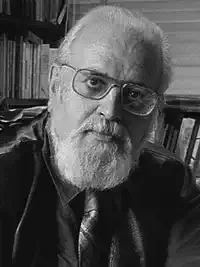
Haroldo de Campos
1929–2003
· lived 73 years
 BR
BR
BR
Haroldo de Campos was a Brazilian poet, translator, essayist, and literary critic, a central figure of concretism. His work is marked by linguistic experimentation and the pursuit of a poetry that transcended the barriers of traditional language, exploring the visuality and sonority of words. He was one of the founders of the concretist movement in Brazil and an intellectual of vast influence, with a production that spanned poetry, literary theory, and translation.
n. 1929-08-19, São Paulo · m. 2003-08-16, São Paulo
72
Views
Bio
Identification and Basic Context
Haroldo de Campos, full and unique name, was a Brazilian poet, essayist, translator, and literary critic. Born in São Paulo, he was one of the most prominent figures of concretism in Brazil.Childhood and Education
Haroldo de Campos was born into a middle-class family in São Paulo. He completed his studies in the city where he was born, showing an early great interest in literature and the arts. His intellectual formation was marked by a deep study of language, philosophy, and the artistic avant-gardes of the 20th century.Literary Career
Haroldo de Campos's literary career began with his active participation in the concretist movement, founded in 1952 along with his brother Augusto de Campos and Décio Pignatari. This movement revolutionized Brazilian poetry by proposing visual and experimental poetry. Haroldo de Campos was one of the main theorists of concretism, developing concepts such as 'poem-process' and 'transcreation', the latter a new way of thinking about literary translation. He published numerous books of poetry and essays, in addition to translating fundamental works of universal literature.Work, Style, and Literary Characteristics
Haroldo de Campos's main works include 'O Galo Pelado', 'Viva Vaia', 'A Educação dos Cinco Sentidos', and 'Galáxias'. His themes explore the relationship between man and machine, the modern city, language as form and content, and the very nature of poetry. His style is characterized by radical experimentation with form and language, the use of neologisms, the exploration of the poem's visuality, and 'transcreation', which proposes a recreation of the work in another language, going beyond mere literal translation. He was one of the pioneers of concretism, seeking a poetry that was both verbal-visual and sonorous.Cultural and Historical Context
Haroldo de Campos lived and produced during a period of intense social, political, and cultural transformations in Brazil and the world. Concretism, a movement of which he was a founder, emerged in a context of modernization and the search for a renewed artistic language, engaging with international avant-gardes. His work reflects the tensions and debates of the time, especially in the fields of arts and literary criticism.Personal Life
Haroldo de Campos had a life dedicated to study and intellectual production. He was married and had children, but his personal life was always intrinsically linked to his literary and academic activities. His relationship with his brother Augusto de Campos was fundamental to the development and consolidation of concretism.Recognition and Reception
Haroldo de Campos is widely recognized as one of the greatest poets and literary theorists of 20th-century Brazil. His work has influenced generations of poets and critics, and his concepts, such as 'transcreation', are studied internationally. He received several awards and honors throughout his career, consolidating his place in the Brazilian literary canon.Influences and Legacy
Haroldo de Campos was influenced by poets such as Oswald de Andrade and by European avant-gardes. His legacy is immense, having renewed Brazilian poetry and translation theory. His work continues to be studied and admired, and his experimental approach to language inspires new artists and thinkers.Interpretation and Critical Analysis
Haroldo de Campos's work has been the subject of numerous critical analyses that highlight its originality, theoretical rigor, and capacity for innovation in poetic language. His poems invite multiple interpretations, exploring the ambiguities and potentialities of the word.Curiosities and Lesser-Known Aspects
Haroldo de Campos was known for his erudition and tireless dedication to intellectual work. His house in São Paulo was a center of cultural effervescence, where he hosted artists and intellectuals. His ability to transpose complex works into Portuguese, such as Ezra Pound's 'Cantos', demonstrates his mastery and deep knowledge of languages and cultures.Death and Memory
Haroldo de Campos passed away in São Paulo, leaving an invaluable literary and intellectual legacy. His work continues to be published, studied, and debated, keeping alive the memory of one of Brazil's most important poets and thinkers.Poems
0No poems found
Videos
50
Comments (0)
Log in
to post a comment.
No comments yet. Be the first to comment.