
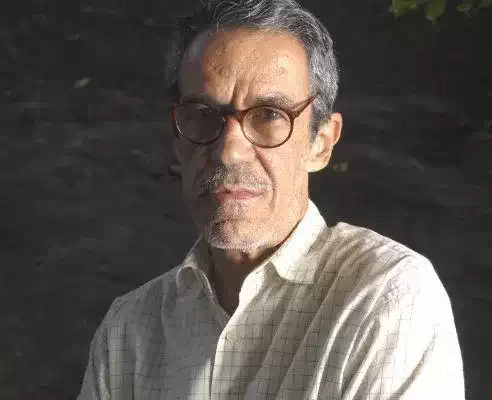
Armando Freitas Filho
 BR
BR
Armando Freitas Filho was a Brazilian poet whose work stood out for its formal experimentation and exploration of themes such as memory, time, and the human condition. His poetry is marked by dense language and a profound reflection on language and poetry itself. Throughout his career, he consolidated a unique style that dialogues with tradition while pointing towards the avant-garde. His contribution to Brazilian literature is recognized for its originality and ability to move between lyricism and metalanguage, leaving a legacy of works that continue to challenge readers and critics.
n. 1940-02-18, Rio de Janeiro · m. 2024-09-26, Lima
Bio
Identification and basic context
Armando Freitas Filho, whose full name was Armando de Freitas Filho, was a Brazilian poet, essayist, and translator. He was born in Rio de Janeiro in 1949 and died in the same city in 2017. His work is part of the context of contemporary Brazilian poetry, marked by experimentation and reflection on language itself.Childhood and education
Little is publicly known about his childhood and early education. However, his profound literary and cultural knowledge, which shines through in his work, is evident. His education appears to have been self-taught, with a vast range of readings that included classics and avant-garde authors.Literary career
Armando Freitas Filho began his literary career with the publication of poetry books that quickly gained attention for their originality and formal rigor. Throughout his career, he published several poetic and essayistic works, consolidating his presence in the Brazilian literary scene. He actively participated in literary debates and events.Work, style, and literary characteristics
Among his most significant poetic works are "A Desordem do Olhar" (1983), "O Falso Fruto" (1988), "Poemas Reunidos" (2010), and "Para que me Conheçam" (2015). His recurring themes include memory, time, the city, language, metalanguage, and the human condition. His style is characterized by imagistic density, vocabulary precision, and the exploration of poetic forms that challenge the reader, often with influences from concrete poetry and other avant-garde movements, but with an unmistakably personal voice. His poetry dialogues with both tradition and modernity, presenting a language that is both erudite and accessible, seeking to unravel the complexities of existence.Cultural and historical context
Armando Freitas Filho lived in a period of intense social and political transformations in Brazil, from the final years of the military dictatorship to the democratic period. His work subtly and intellectually reflects the concerns of his time, engaging with contemporary Brazilian cultural and literary production. He was part of a generation of poets who sought to renew poetic language.Personal life
Detailed information about his personal life is scarce in the public sphere. It is known that he dedicated a large part of his life to poetry and translation, an activity he pursued with mastery, translating authors such as Fernando Pessoa and Arthur Rimbaud. He was known for his discretion and profound intellectual rigor.Recognition and reception
Although he maintained a discreet profile, Armando Freitas Filho's work received recognition from specialized critics and other writers. His poetry is studied and admired for its complexity and innovation. He received several awards during his career, consolidating his place as one of the important poets of contemporary Brazilian literature.Influences and legacy
His work dialogues with Brazilian and universal poetic tradition, but also shows a strong influence from 20th-century avant-garde movements. Armando Freitas Filho's legacy lies in his ability to renew poetic language, exploring new forms and thematic approaches, inspiring later generations of poets to experiment with form and content.Interpretation and critical analysis
Armando Freitas Filho's poetry is often analyzed from the perspective of metalanguage and reflection on the limits of language in apprehending reality. His poems invite multiple readings, exploring the nuances of memory and the fleetingness of time, with a tone that is sometimes melancholic and sometimes ironic.Curiosities and lesser-known aspects
Armando Freitas Filho was known for his almost monastic dedication to writing and reading. His rigor with words and form was legendary among his peers. His discretion contrasted with the intensity and boldness of his poetic output.Death and memory
Armando Freitas Filho passed away in 2017, leaving behind a significant poetic body of work. His work continues to be disseminated and studied, keeping his memory and influence on Brazilian poetry alive.Poems
0No poems found
Videos
50
Comments (0)
No comments yet. Be the first to comment.