
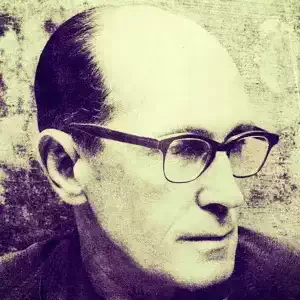
Carlos Drummond de Andrade
1902–1987
· lived 84 years
 BR
BR
BR
Carlos Drummond de Andrade was one of the most important Brazilian poets, considered one of the greatest names in Portuguese-language literature. His work, marked by irony, reflection on the human condition, lyricism, and social criticism, addressed universal themes such as love, death, time, memory, and the individual's relationship with society. Drummond left a very rich poetic legacy, characterized by his accessible yet profound language and his ability to capture the essence of everyday life.
n. 1902-10-31, Itabira · m. 1987-08-17, Rio de Janeiro
152
Views
Bio
Identification and basic context
Carlos Drummond de Andrade was born in Itabira, Minas Gerais, on October 31, 1902, and passed away in Rio de Janeiro on August 17, 1987. He is one of the most influential and celebrated poets in Brazilian literature. Coming from a family of wealthy farmers, Drummond grew up in a rural and traditional environment in Minas Gerais, but soon moved to Rio de Janeiro, where he lived most of his adult life. His work reflects both his Minas Gerais roots and his experience in the federal capital, as well as his vision of Brazil.Childhood and education
Drummond's childhood was marked by life in the countryside in Itabira, where he developed a strong connection with the land and the traditions of Minas Gerais. He was educated in boarding schools in Belo Horizonte and Nova Friburgo, where he began to engage with literature and poetry. Reading authors like Olavo Bilac and literary magazines of the time played an important role in his formation. The influence of Minas Gerais culture, with its religiosity and conservative spirit, is also present in his work.Literary career
Drummond began writing early, but his work gained national prominence with the publication of 'Alguma Poesia' in 1930, marking his entry into the Brazilian literary scene. Throughout his career, he published numerous books of poetry, prose, and chronicles, consolidating himself as one of the main poets of Brazilian Modernism. He collaborated with various newspapers and magazines, such as 'Correio da Manhã' and 'Jornal do Brasil', where he maintained chronicle columns for many years.Work, style, and literary characteristics
Drummond's work is vast and diverse, exploring themes such as love, death, time, memory, childhood, the city, politics, and the human condition. His style is marked by irony, contained lyricism, existential reflection, and social criticism. He frequently used free verse but also explored more traditional forms. Drummond's language is characterized by its clarity, musicality, and its ability to transform the everyday into poetry. Poems such as "No Meio do Caminho", "A Flor e a Náusea", "Mãos Dadas", and "Congresso" are examples of his thematic and stylistic diversity. His poetic voice transitions between the confessional lyrical self, the sharp social observer, and the poet who reflects on art and language itself.Literary characteristics
Drummond lived through a period of great transformations in Brazil, including the Vargas Era, the military dictatorship, and redemocratization. His work reflects the social and political tensions of the country, but always with a critical and detached perspective. He was one of the main representatives of the second generation of Brazilian Modernism and maintained dialogue with other important writers of his time, such as Manuel Bandeira and Cecília Meireles.
Personal life
Drummond married Dolores Dutra de Morais, with whom he had two children. His personal life, although marked by periods of introspection and melancholy, was also one of great dedication to literature. He worked as a civil servant and journalist, professions that provided him with stability to dedicate himself to writing.Recognition and reception
Drummond is widely recognized as one of the greatest Brazilian poets. He received several literary awards throughout his career, and his work is the subject of study in schools and universities, both in Brazil and abroad. His popularity transcends academia, being a poet beloved by the general public.Influences and legacy
Drummond was influenced by poets such as Fernando Pessoa, Walt Whitman, and the Symbolist poets. His legacy is incalculable for Brazilian poetry, having influenced generations of writers through his originality, depth, and his ability to portray the Brazilian soul. His work continues to be read, studied, and admired.Interpretation and critical analysis
Drummond's work has been the subject of numerous critical analyses, which highlight its thematic and stylistic complexity, his biting irony, and his ability to question reality. The relationship between the individual and the collective, the search for meaning in life, and the critique of social abuses are central points in the interpretation of his poetry.Curiosities and lesser-known aspects
Drummond was known for his discretion and humility, despite his immense fame. His passion for collecting stones and his writing routine, often carried out at night, are details that reveal a little more about his personality.Death and memory
Carlos Drummond de Andrade passed away in Rio de Janeiro, leaving behind a body of work that became a landmark in Brazilian literature. His memory is celebrated through editions of his works, academic studies, and cultural events that perpetuate his legacy.Poems
0No poems found
Quotes
1No poems found
Videos
50
Comments (0)
Log in
to post a comment.
No comments yet. Be the first to comment.