
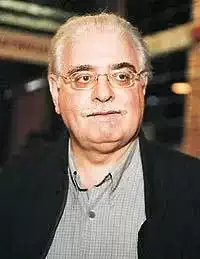
Augusto de Campos
 BR
BR
Augusto de Campos is a Brazilian poet, translator, editor, and critic, a central figure of Concrete poetry. His work, marked by visual and sonic experimentation in poetic language, revolutionized Brazilian poetry from the 1950s onwards. Alongside Haroldo de Campos and Décio Pignatari, he founded the group Noigandres, fundamental to the dissemination of Concrete poetry in Brazil and worldwide. His vast production spans poetry, essays, translations, and criticism, consolidating him as one of the most important Brazilian poets of the 20th and 21st centuries.
n. 1931-02-14, São Paulo · m. , Roma
Bio
Identification and basic context
Augusto de Campos is a Brazilian poet, translator, essayist, literary critic, and editor. He is one of the founders of Concrete poetry in Brazil. Born in the city of São Paulo, he had an intrinsic connection with the cultural and artistic development of the city and the country. He lived and produced in a context of great social, political, and technological transformations.Childhood and education
Augusto de Campos grew up in São Paulo, where he had access to a cultural and educational background that allowed him to develop his interest in arts and literature. His youth was marked by reading and immersion in various aesthetic and philosophical currents. The companionship and collaboration with his brother, Haroldo de Campos, and with Décio Pignatari were crucial for the formation of the group that would found Concrete poetry.Literary career
Augusto de Campos's literary career is inseparable from the Concrete movement, of which he was one of the main architects. From the beginning of his career, he demonstrated a strong experimental drive, seeking to break away from traditional poetic forms. He founded, along with Haroldo de Campos and Décio Pignatari, the magazine 'Noigandres,' which became the main vehicle for disseminating Concrete ideas and works. His activity as a poet, translator, and critic spanned decades, maintaining a constant search for innovation.Work, style, and literary characteristics
Augusto de Campos's work is vast and diverse, with emblematic poems such as "Ovo", "Linguagem", "Pulsar", and "Caçador de Palavras". His production stands out for its exploration of the visual and sonic dimensions of the word, breaking away from the linearity of verse and the traditional structure of the poem. He used free verse, fragmentation, the spatial arrangement of words on the page (object-poem), and the exploration of graphic and sonic resources. Themes addressed include urban daily life, technology, social criticism, love, and poetic language itself. His language is both precise and inventive, with a vocabulary that ranges from the colloquial to the erudite. Concrete poetry, the movement to which he belongs, sought a "full-bodied poetry," where the visual, spatial, and sonic integrated with the verbal.Cultural and historical context
Augusto de Campos is a central figure of Brazilian modernism, especially the second generation, which culminated in Concrete poetry. He lived and produced during a period of intense modernization in Brazil and of artistic and intellectual effervescence. His work engages with international avant-gardes, such as Futurism, Dadaism, and Surrealism, but forged a genuinely Brazilian poetic identity. Concrete poetry, led by him, proposed a radical renewal of art and literature, with a strong impact on visual arts and design.Personal life
Augusto de Campos, alongside Haroldo de Campos, formed a fundamental intellectual partnership. His dedication to poetry and literary criticism was a constant in his life. He maintained relationships with various artists and intellectuals, both in Brazil and abroad, which contributed to the dissemination of his work and Concrete poetry. His intellectual stance was always marked by radicalism and the search for new forms of expression.Recognition and reception
Augusto de Campos's recognition is vast, both in Brazil and internationally. As one of the main exponents of Concrete poetry, his work is studied in universities and recognized for its historical and aesthetic importance. He received various awards and honors throughout his career. His influence extends beyond poetry, impacting graphic design, visual arts, and music.Influences and legacy
Augusto de Campos's influences include the European avant-gardes of the early 20th century, especially Futurism and Cubism, as well as the poetry of Oswald de Andrade and the Brazilian modernist tradition. His legacy is immense: the Concrete revolution opened new paths for poetry, and his work continues to inspire generations of poets, artists, and designers through its formal daring and its profound reflection on language and art.Interpretation and critical analysis
Augusto de Campos's work is widely analyzed from the perspective of linguistic experimentation and the relationship between word and image. Critics highlight his ability to create poems that challenge traditional reading, promoting a multisensory aesthetic experience. Themes such as criticism of consumer society and information massification are frequently discussed in relation to his poems.Curiosities and lesser-known aspects
A curiosity about Augusto de Campos is his ability to navigate between avant-garde poetic creation and accessibility, reaching a wide audience with poems that, despite their structural complexity, possess a strong resonance. His activity as a translator of poets like Ezra Pound and Mallarmé is also a relevant aspect of his production.Death and memory
Augusto de Campos, still in full creative and intellectual activity, represents a living landmark in the history of Brazilian and world literature. His memory is celebrated through his vast body of work, which continues to be an object of study, admiration, and inspiration.Poems
0No poems found
Comments (0)
No comments yet. Be the first to comment.