
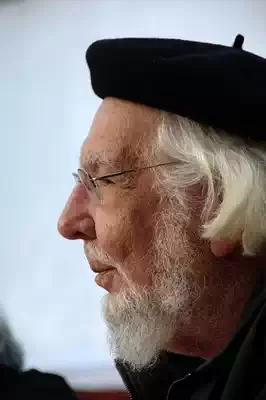
Ernesto Cardenal
 NI
NI
Ernesto Cardenal was a Nicaraguan poet, priest, theologian, and politician, a prominent figure of Liberation Theology and one of the most important poets in Latin America. His poetic work is marked by deep spirituality, social and political engagement, and accessible language that dialogues with popular culture. Cardenal dedicated his life to the struggle for social justice and artistic expression, being a fervent defender of human rights and the sovereignty of his people. His poetry is a reflection of his faith, his political convictions, and his love for Nicaragua.
n. 1925-01-20, Granada · m. 2020-03-01, Managua
Bio
Identification and basic context
Ernesto Cardenal Martínez was a Nicaraguan poet, priest, theologian, and revolutionary. Born in Granada, Nicaragua. Known worldwide for his engaged poetry and his adherence to Liberation Theology, Cardenal was a central figure in the cultural and political life of his country. His work is a testament to his Christian faith and his commitment to social justice and the transformation of his people. He served as Nicaragua's Minister of Culture after the Sandinista Revolution.Childhood and education
Ernesto Cardenal was born into an upper-middle-class family in Granada. He studied in Managua and later in the United States, where he attended Philosophy at New York University and Theology at the Gethsemani Abbey in Kentucky, under the guidance of Thomas Merton. This experience was fundamental to his spiritual and intellectual formation, influencing his views on the relationship between faith, art, and politics.Literary career
Cardenal's poetic writing began in his youth. His work evolved over time, incorporating life experiences, political engagement, and the depth of his faith. He published his first significant work, "Gũeznos," in 1932. Later, "Salmos" (1971) and "Oráculo sobre Manágua" (1973) consolidated his unique style, blending the sacred and the profane, the personal and the universal. He collaborated with various literary and cultural magazines in both Latin America and Europe.Work, style, and literary characteristics
Ernesto Cardenal's work is vast and diverse, encompassing poetry, essays, and theological reflections. His poetry highlights themes such as faith, love, revolution, nature, and Latin American identity. His style is characterized by the simplicity of language, the incorporation of elements of popular culture, and the pursuit of poetry that is both spiritual and engaged. He uses free verse, with a rhythm that evokes orality and musicality. "Salmos" is one of his most emblematic works, where Cardenal reinterprets biblical psalms in light of the Latin American reality, denouncing oppression and calling for justice.Work, style, and literary characteristics
Cultural and historical context Ernesto Cardenal lived in a period of intense social and political transformations in Latin America. His life and work are intrinsically linked to the Sandinista Revolution, which sought to overthrow the Somoza dictatorship in Nicaragua. He was one of the intellectuals who embraced Liberation Theology, a theological current that interprets the Gospel from the perspective of the poor and oppressed. His generation was marked by revolutionary ideals and the pursuit of a more just and sovereign Latin America.Work, style, and literary characteristics
Personal life Ernesto Cardenal was ordained a priest in 1965. His life was marked by a deep commitment to the poor and to the revolutionary cause. His relationship with the Catholic Church was complex; he was suspended a divinis by the Vatican in 1984 for his political involvement and for criticizing the ecclesiastical hierarchy. He maintained important friendships with other intellectuals and artists, and his life was an example of dedication to his ideals.Work, style, and literary characteristics
Recognition and reception Ernesto Cardenal received numerous awards and distinctions throughout his career, including the Reina Sofía Ibero-American Poetry Prize. His work is widely studied and admired worldwide, considered a landmark in contemporary Spanish-language poetry. Despite political controversies, his recognition as a poet and thinker remains unshakable.Work, style, and literary characteristics
Influences and legacy Cardenal's influences include mystical poets, the Bible, the Latin American literary tradition, and the social and religious currents of thought of his time. His work has influenced generations of poets and theologians, inspiring a commitment to social justice and artistic expression. His legacy is that of an intellectual who knew how to unite faith, art, and politics in defense of the poor and his people.Work, style, and literary characteristics
Interpretation and critical analysis Cardenal's poetry has been interpreted as an invitation to reflect on faith, justice, and human dignity. His work questions established powers and proposes a vision of a solidary and transformative world. Criticisms of his political actions often intertwine with the analysis of his literary work, highlighting the inseparable link between life and art in his trajectory.Work, style, and literary characteristics
Curiosities and lesser-known aspects Ernesto Cardenal was one of the founders of the Solentiname artistic community, an archipelago in Nicaragua where he promoted art and education among peasants. He was also a talented sculptor. His house in Managua became a cultural center and meeting place for intellectuals and artists.Work, style, and literary characteristics
Death and memory Ernesto Cardenal passed away on March 1, 2020, in Managua, Nicaragua, at the age of 95. His death was mourned by personalities from around the world. His vast poetic work and his legacy of struggle for social justice continue to inspire and resonate in the consciences of many.Poems
0No poems found
Videos
50
Comments (0)
No comments yet. Be the first to comment.