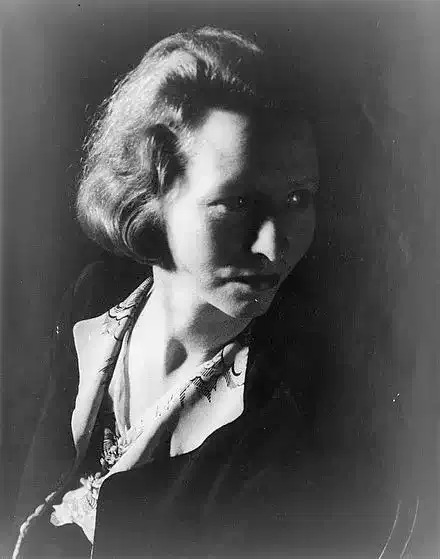
Night Is My Sister, And How Deep In Love
Night Is My Sister, And How Deep In Love
Night is my sister, and how deep in love,
How drowned in love and weedily washed ashore,
There to be fretted by the drag and shove
At the tide's edge, I lie—these things and more:
Whose arm alone between me and the sand,
Whose voice alone, whose pitiful breath brought near,
Could thaw these nostrils and unlock this hand,
She could advise you, should you care to hear.
Small chance, however, in a storm so black,
A man will leave his friendly fire and snug
For a drowned woman's sake, and bring her back
To drip and scatter shells upon the rug.
No one but Night, with tears on her dark face,
Watches beside me in this windy place.
Midnight Oil
Midnight Oil
Cut if you will, with Sleep's dull knife,
Each day to half its length, my friend,—
The years that Time take off my life,
He'll take from off the other end!
Memorial To D.C.
Memorial To D.C.
(Vassar College, 1918)
O, loveliest throat of all sweet throats,
Where now no more the music is,
With hands that wrote you little notes
I write you little elegies!
Make Bright The Arrows
Make Bright The Arrows
Make bright the arrows
Gather the shields:
Conquest narrows
The peaceful fields.
Stock well the quiver
With arrows bright:
The bowman feared
Need never fight.
Make bright the arrows,
O peaceful and wise!
Gather the shields
Against surprise.
Love Is Not All
Love Is Not All
Love is not all: it is not meat nor drink
Nor slumber nor a roof against the rain;
Nor yet a floating spar to men that sink
And rise and sink and rise and sink again;
Love can not fill the thickened lung with breath,
Nor clean the blood, nor set the fractured bone;
Yet many a man is making friends with death
Even as I speak, for lack of love alone.
It well may be that in a difficult hour,
Pinned down by pain and moaning for release,
Or nagged by want past resolution's power,
I might be driven to sell your love for peace,
Or trade the memory of this night for food.
It well may be. I do not think I would.
Lines for a Grave-Stone
Lines for a Grave-Stone
Man alive, that mournst thy lot,
Desiring what thou hast not got,
Money, beauty, love, what not;
Deeming it blesseder to be
A rotted man, than live to see
So rude a sky as covers thee;
Deeming thyself of all unblest
And wretched souls the wretchedest,
Longing to die and be at rest;
Know: that however grim the fate
Which sent thee forth to meditate
Upon my enviable state,
Here lieth one who would resign
Gladly his lot, to shoulder thine.
Give me thy coat; get into mine.
Kin To Sorrow
Kin To Sorrow
Am I kin to Sorrow,
That so oft
Falls the knocker of my door——
Neither loud nor soft,
But as long accustomed,
Under Sorrow's hand?
Marigolds around the step
And rosemary stand,
And then comes Sorrow—
And what does Sorrow care
For the rosemary
Or the marigolds there?
Am I kin to Sorrow?
Are we kin?
That so oft upon my door—
Oh, come in!
Interim
Interim
The room is full of you!—As I came in
And closed the door behind me, all at once
A something in the air, intangible,
Yet stiff with meaning, struck my senses sick!—
Sharp, unfamiliar odors have destroyed
Each other room's dear personality.
The heavy scent of damp, funereal flowers,—
The very essence, hush-distilled, of Death—
Has strangled that habitual breath of home
Whose expiration leaves all houses dead;
And wheresoe'er I look is hideous change.
Save here. Here 'twas as if a weed-choked gate
Had opened at my touch, and I had stepped
Into some long-forgot, enchanted, strange,
Sweet garden of a thousand years ago
And suddenly thought, "I have been here before!"
You are not here. I know that you are gone,
And will not ever enter here again.
And yet it seems to me, if I should speak,
Your silent step must wake across the hall;
If I should turn my head, that your sweet eyes
Would kiss me from the door.—So short a time
To teach my life its transposition to
This difficult and unaccustomed key!—
The room is as you left it; your last touch—
A thoughtless pressure, knowing not itself
As saintly—hallows now each simple thing;
Hallows and glorifies, and glows between
The dust's grey fingers like a shielded light.
There is your book, just as you laid it down,
Face to the table,—I cannot believe
That you are gone!—Just then it seemed to me
You must be here. I almost laughed to think
How like reality the dream had been;
Yet knew before I laughed, and so was still.
That book, outspread, just as you laid it down!
Perhaps you thought, "I wonder what comes next,
And whether this or this will be the end";
So rose, and left it, thinking to return.
Perhaps that chair, when you arose and passed
Out of the room, rocked silently a while
Ere it again was still. When you were gone
Forever from the room, perhaps that chair,
Stirred by your movement, rocked a little while,
Silently, to and fro...
And here are the last words your fingers wrote,
Scrawled in broad characters across a page
In this brown book I gave you. Here your hand,
Guiding your rapid pen, moved up and down.
Here with a looping knot you crossed a "t,"
And here another like it, just beyond
These two eccentric "e's." You were so small,
And wrote so brave a hand!
How strange it seems
That of all words these are the words you chose!
And yet a simple choice; you did not know
You would not write again. If you had known—
But then, it does not matter,—and indeed
If you had known there was so little time
You would have dropped your pen and come to me
And this page would be empty, and some phrase
Other than this would hold my wonder now.
Yet, since you could not know, and it befell
That these are the last words your fingers wrote,
There is a dignity some might not see
In this, "I picked the first sweet-pea to-day."
To-day! Was there an opening bud beside it
You left until to-morrow?—O my love,
The things that withered,—and you came not back
That day you filled this circle of my arms
That now is empty. (O my empty life!)
That day—that day you picked the first sweet-pea,—
And brought it in to show me! I recall
With terrible distinctness how the smell
Of your cool gardens drifted in with you.
I know, you held it up for me to see
And flushed because I looked not at the flower,
But at your face; and when behind my look
You saw such unmistakable intent
You laughed and brushed your flower against my lips.
(You were the fairest thing God ever made,
I think.) And then your hands above my heart
Drew down its stem into a fastening,
And while your head was bent I kissed your hair.
I wonder if you knew. (Beloved hands!
Somehow I cannot seem to see them still.
Somehow I cannot seem to see the dust
In your bright hair.) What is the need of Heaven
When earth can be so sweet?—If only God
Had let us love,—and show the world the way!
Strange cancellings must ink th' eternal books
When love-crossed-out will bring the answer right!
That first sweet-pea! I wonder where it is.
It seems to me I laid it down somewhere,
And yet,—I am not sure. I am not sure,
Even, if it was white or pink; for then
'Twas much like any other flower to me
Save that it was the first. I did not know
Then, that it was the last. If I had known—
But then, it does not matter. Strange how few,
After all's said and done, the things that are
Of moment.
Few indeed! When I can make
Of ten small words a rope to hang the world!
"I had you and I have you now no more."
There, there it dangles,—where's the little truth
That can for long keep footing under that
When its slack syllables tighten to a thought?
Here, let me write it down! I wish to see
Just how a thing like that will look on paper!
"I had you and I have you now no more."
O little words, how can you run so straight
Across the page, beneath the weight you bear?
How can you fall apart, whom such a theme
Has bound together, and hereafter aid
In trivial expression, that have been
So hideously dignified?—Would God
That tearing you apart would tear the thread
I strung you on! Would God—O God, my mind
Stretches asunder on this merciless rack
Of imagery! O, let me sleep a while!
Would I could sleep, and wake to find me back
In that sweet summer afternoon with you.
Summer? Tis summer still by the calendar!
How easily could God, if He so willed,
Set back the world a little turn or two!
Correct its griefs, and bring its joys again!
We were so wholly one I had not thought
That we could die apart. I had not thought
That I could move,—and you be stiff and still!
That I could speak,—and you perforce be dumb!
I think our heart-strings were, like warp and woof
In some firm fabric, woven in and out;
Your golden filaments in fair design
Across my duller fibre. And to-day
The shining strip is rent; the exquisite
Fine pattern is destroyed; part of your heart
Aches in my breast; part of my heart lies chilled
In the damp earth with you. I have been tom
In two, and suffer for the rest of me.
What is my life to me? And what am I
To life,—a ship whose star has guttered out?
A Fear that in the deep night starts awake
Perpetually, to find its senses strained
Against the taut strings of the quivering air,
Awaiting the return of some dread chord?
Dark, Dark, is all I find for metaphor;
All else were contrast,—save that contrast's wall
Is down, and all opposed things flow together
Into a vast monotony, where night
And day, and frost and thaw, and death and life,
Are synonyms. What now—what now to me
Are all the jabbering birds and foolish flowers
That clutter up the world? You were my song!
Now, let discord scream! You were my flower!
Now let the world grow weeds! For I shall not
Plant things above your grave—(the common balm
Of the conventional woe for its own wound!)
Amid sensations rendered negative
By your elimination stands to-day,
Certain, unmixed, the element of grief;
I sorrow; and I shall not mock my truth
With travesties of suffering, nor seek
To effigy its incorporeal bulk
In little wry-faced images of woe.
I cannot call you back; and I desire
No utterance of my immaterial voice.
I cannot even turn my face this way
Or that, and say, "My face is turned to you";
I know not where you are, I do not know
If Heaven hold you or if earth transmute,
Body and soul, you into earth again;
But this I know:—not for one second's space
Shall I insult my sight with visionings
Such as the credulous crowd so eager-eyed
Beholds, self-conjured, in the empty air.
Let the world wail! Let drip its easy tears!
My sorrow shall be dumb!
—What do I say?
God! God!—God pity me! Am I gone mad
That I should spit upon a rosary?
Am I become so shrunken? Would to God
I too might feel that frenzied faith whose touch
Makes temporal the most enduring grief;
Though it must walk a while, as is its wont,
With wild lamenting! Would I too might weep
Where weeps the world and hangs its piteous wreaths
For its new dead! Not Truth, but Faith, it is
That keeps the world alive. If all at once
Faith were to slacken,—that unconscious faith
Which must, I know, yet be the corner-stone
Of all believing,—birds now flying fearless
Across would drop in terror to the earth;
Fishes would drown; and the all-governing reins
Would tangle in the frantic hands of God
And the worlds gallop headlong to destruction!
O God, I see it now, and my sick brain
Staggers and swoons! How often over me
Flashes this breathlessness of sudden sight
In which I see the universe unrolled
Before me like a scroll and read thereon
Chaos and Doom, where helpless planets whirl
Dizzily round and round and round and round,
Like tops across a table, gathering speed
With every spin, to waver on the edge
One instant—looking over—and the next
To shudder and lurch forward out of sight—
* * * * * * *
Ah, I am worn out—I am wearied out—
It is too much—I am but flesh and blood,
And I must sleep. Though you were dead again,
I am but flesh and blood and I must sleep.
Journey
Journey
Ah, could I lay me down in this long grass
And close my eyes, and let the quiet wind
Blow over me—I am so tired, so tired
Of passing pleasant places! All my life,
Following Care along the dusty road,
Have I looked back at loveliness and sighed;
Yet at my hand an unrelenting hand
Tugged ever, and I passed. All my life long
Over my shoulder have I looked at peace;
And now I fain would lie in this long grass
And close my eyes.
Yet onward!
Cat birds call
Through the long afternoon, and creeks at dusk
Are guttural. Whip-poor-wills wake and cry,
Drawing the twilight close about their throats.
Only my heart makes answer. Eager vines
Go up the rocks and wait; flushed apple-trees
Pause in their dance and break the ring for me;
And bayberry, that through sweet bevies thread
Of round-faced roses, pink and petulant,
Look back and beckon ere they disappear.
Only my heart, only my heart responds.
Yet, ah, my path is sweet on either side
All through the dragging day,—sharp underfoot
And hot, and like dead mist the dry dust hangs—
But far, oh, far as passionate eye can reach,
And long, ah, long as rapturous eye can cling,
The world is mine: blue hill, still silver lake,
Broad field, bright flower, and the long white road
A gateless garden, and an open path:
My feet to follow, and my heart to hold.
If Still Your Orchards Bear
If Still Your Orchards Bear
Brother, that breathe the August air
Ten thousand years from now,
And smell—if still your orchards bear
Tart apples on the bough—
The early windfall under the tree,
And see the red fruit shine,
I cannot think your thoughts will be
Much different from mine.
Should at that moment the full moon
Step forth upon the hill,
And memories hard to bear at noon,
By moonlight harder still,
Form in the shadow of the trees, —
Things that you could not spare
And live, or so you thought, yet these
All gone, and you still there,
A man no longer what he was,
Nor yet the thing he'd planned,
The chilly apple from the grass
Warmed by your living hand—
I think you will have need of tears;
I think they will not flow;
Supposing in ten thousand years
Men ache, as they do now.