Poems List

The Fawn

The Fawn

There it was I saw what I shall never forget
And never retrieve.
Monstrous and beautiful to human eyes, hard to

believe,
He lay, yet there he lay,
Asleep on the moss, his head on his polished cleft

small ebony hoves,
The child of the doe, the dappled child of the deer.

Surely his mother had never said, "Lie here
Till I return," so spotty and plain to see
On the green moss lay he.
His eyes had opened; he considered me.


I would have given more than I care to say
To thrifty ears, might I have had him for my friend
One moment only of that forest day:


Might I have had the acceptance, not the love
Of those clear eyes;
Might I have been for him in the bough above
Or the root beneath his forest bed,
A part of the forest, seen without surprise.


Was it alarm, or was it the wind of my fear lest he


depart
That jerked him to his jointy knees,
And sent him crashing off, leaping and stumbling
On his new legs, between the stems of the white

trees?
367

The Blue Flag in the Bog

The Blue Flag in the Bog

God had called us, and we came;
Our loved Earth to ashes left;
Heaven was a neighbor's house,
Open flung to us, bereft.


Gay the lights of Heaven showed,
And 'twas God who walked ahead;
Yet I wept along the road,
Wanting my own house instead.


Wept unseen, unheeded cried,
"All you things my eyes have kissed,
Fare you well! We meet no more,
Lovely, lovely tattered mist!


Weary wings that rise and fall
All day long above the fire !"
Red with heat was every wall,
Rough with heat was every wire


"Fare you well, you little winds
That the flying embers chase!
Fare you well, you shuddering day,
With your hands before your face!


And, ah, blackened by strange blight,
Or to a false sun unfurled,
Now forevermore goodbye,
All the gardens in the world!


On the windless hills of Heaven,
That I have no wish to see,


White, eternal lilies stand,
By a lake of ebony.


But the Earth forevermore
Is a place where nothing grows,
Dawn will come, and no bud break;
Evening, and no blossom close.


Spring will come, and wander slow
Over an indifferent land,
Stand beside an empty creek,
Hold a dead seed in her hand."


God had called us, and we came,
But the blessed road I trod
Was a bitter road to me,
And at heart I questioned God.


"Though in Heaven," I said, "be all


That the heart would most desire,
Held Earth naught save souls of sinners
Worth the saving from a fire?


Withered grass,the wasted growing!
Aimless ache of laden boughs!"
Little things God had forgotten
Called me, from my burning house.


"Though in Heaven," I said, "be all
That the eye could ask to see,
All the things I ever knew
Are this blaze in back of me."


"Though in Heaven," I said, "be all
That the ear could think to lack,


All the things I ever knew
Are this roaring at my back."


It was God who walked ahead,
Like a shepherd to the fold;
In his footsteps fared the weak,
And the weary and the old,


Glad enough of gladness over,
Ready for the peace to be,
But a thing God had forgotten
Was the growing bones of me.


And I drew a bit apart,
And I lagged a bit behind,
And I thought on Peace Eternal,
Lest He look into my mind;


And I gazed upon the sky,
And I thought of Heavenly Rest,
And I slipped away like water
Through the fingers of the blest!


All their eyes were fixed on Glory,
Not a glance brushed over me;
"Alleluia ! Alleluia !"
Up the road,and I was free.


And my heart rose like a freshet,
And it swept me on before,
Giddy as a whirling stick,
Till I felt the earth once more.


All the Earth was charred and black,
Fire had swept from pole to pole;


And the bottom of the sea
Was as brittle as a bowl;


And the timbered mountain-top
Was as naked as a skull,
Nothing left, nothing left,
Of the Earth so beautiful!


"Earth," I said, "how can I leave you?"
"You are all I have," I said;
"What is left to take my mind up,
Living always, and you dead?"


"Speak!" I said, "Oh, tell me something!
Make a sign that I can see!
For a keepsake! To keep always!
Quick! Before God misses me!"


And I listened for a voice;
But my heart was all I heard;
Not a screech-owl, not a loon,
Not a tree-toad said a word.


And I waited for a sign;
Coals and cinders, nothing more;
And a little cloud of smoke
Floating on a valley floor.


And I peered into the smoke
Till it rotted, like a fog:
There, encompassed round by fire,
Stood a blue-flag in a bog!


Little flames came wading out,
Straining, straining towards its stem,


But it was so blue and tall
That it scorned to think of them!


Red and thirsty were their tongues,
As the tongues of wolves must be,
But it was so blue and tall
Oh, I laughed, I cried, to see!


All my heart became a tear,
All my soul became a tower,
Never loved I anything
As I loved that tall blue flower!


It was all the little boats
That had ever sailed the sea,


It was all the little books
That had gone to school with me;


On its roots like iron claws
Rearing up so blue and tall,
It was all the gallant Earth
With its back against a wall!


In a breath, ere I had breathed,
Oh, I laughed, I cried, to see!
I was kneeling at its side,
And it leaned its head on me!


Crumbling stones and sliding sand
Is the road to Heaven now;
Icy at my straining knees
Drags the awful under-tow;


Soon but stepping-stones of dust
Will the road to Heaven be,


Father, Son and Holy Ghost,
Reach a hand and rescue me!


"Therethere, my blue-flag flower;
Hushhushgo to sleep;
That is only God you hear,
Counting up His folded sheep!


Lullabyelullabye
That is only God that calls,
Missing me, seeking me,
Ere the road to nothing falls!


He will set His mighty feet
Firmly on the sliding sand;
Like a little frightened bird
I will creep into His hand;


I will tell Him all my grief,
I will tell Him all my sin;
He will give me half His robe
For a cloak to wrap you in.


Lullabyelullabye"
Rocks the burnt-out planet free!
Father, Son and Holy Ghost,
Reach a hand and rescue me!


Ah, the voice of love at last !
Lo, at last the face of light !
And the whole of His white robe


For a cloak against the night!


And upon my heart asleep
All the things I ever knew!


"Holds Heaven not some cranny, Lord,
For a flower so tall and blue?"


All's well and all's well!
Gay the lights of Heaven show!
In some moist and Heavenly place
We will set it out to grow.
327

The Concert

The Concert

No, I will go alone.
I will come back when it's over.
Yes, of course I love you.
No, it will not be long.
Why may you not come with me?—
You are too much my lover.
You would put yourself
Between me and song.


If I go alone,
Quiet and suavely clothed,
My body will die in its chair,
And over my head a flame,
A mind that is twice my own,
Will mark with icy mirth
The wise advance and retreat
Of armies without a country,
Storming a nameless gate,
Hurling terrible javelins down
From the shouting walls of a singing town


Where no women wait!
Armies clean of love and hate,
Marching lines of pitiless sound
Climbing hills to the sun and hurling
Golden spears to the ground!
Up the lines a silver runner
Bearing a banner whereon is scored
The milk and steel of a bloodless wound
Healed at length by the sword!


You and I have nothing to do with music.
We may not make of music a filigree frame,
Within which you and I,
Tenderly glad we came,
Sit smiling, hand in hand.


Come now, be content.
I will come back to you, I swear I will;
And you will know me still.
I shall be only a little taller
Than when I went.
382

Tavern

Tavern


I'll keep a little tavern
Below the high hill's crest,
Wherein all grey-eyed people
May set them down and rest.

There shall be plates a-plenty,
And mugs to melt the chill
Of all the grey-eyed people
Who happen up the hill.

There sound will sleep the traveller,
And dream his journey's end,
But I will rouse at midnight
The falling fire to tend.

Aye, 'tis a curious fancy—
But all the good I know
Was taught me out of two grey eyes
A long time ago.
350

The Bean-Stalk

The Bean-Stalk

Ho, Giant! This is I!
I have built me a bean-stalk into your sky!
La,—but it's lovely, up so high!


This is how I came,—I put
Here my knee, there my foot,
Up and up, from shoot to shoot—
And the blessed bean-stalk thinning
Like the mischief all the time,
Till it took me rocking, spinning,
In a dizzy, sunny circle,
Making angles with the root,
Far and out above the cackle
Of the city I was born in,
Till the little dirty city
In the light so sheer and sunny
Shone as dazzling bright and pretty
As the money that you find
In a dream of finding money—
What a wind! What a morning!—


Till the tiny, shiny city,
When I shot a glance below,
Shaken with a giddy laughter,
Sick and blissfully afraid,
Was a dew-drop on a blade,
And a pair of moments after
Was the whirling guess I made,—
And the wind was like a whip


Cracking past my icy ears,
And my hair stood out behind,
And my eyes were full of tears,
Wide-open and cold,
More tears than they could hold,
The wind was blowing so,
And my teeth were in a row,
Dry and grinning,
And I felt my foot slip,
And I scratched the wind and whined,
And I clutched the stalk and jabbered,
With my eyes shut blind,—
What a wind! What a wind!


Your broad sky, Giant,
Is the shelf of a cupboard;
I make bean-stalks, I'm
A builder, like yourself,
But bean-stalks is my trade,
I couldn't make a shelf,
Don't know how they're made,
Now, a bean-stalk is more pliant—


La, what a climb!
337

Spring

Spring


To what purpose, April, do you return again?
Beauty is not enough.
You can no longer quiet me with the redness
Of little leaves opening stickily.
I know what I know.
The sun is hot on my neck as I observe
The spikes of the crocus.
The smell of the earth is good.
It is apparent that there is no death.
But what does that signify?
Not only under ground are the brains of men
Eaten by maggots.
Life in itself
Is nothing,
An empty cup, a flight of uncarpeted stairs.
It is not enough that yearly, down this hill,
April
Comes like an idiot, babbling and strewing flowers.
407

Sorrow

Sorrow


Sorrow like a ceaseless rain

Beats upon my heart.
People twist and scream in pain,—
Dawn will find them still again;
This has neither wax nor wane,

Neither stop nor start.

People dress and go to town;

I sit in my chair.
All my thoughts are slow and brown:
Standing up or sitting down
Little matters, or what gown

Or what shoes I wear.
308

Sonnets 10: Oh, My Beloved, Have You Thought Of This

Sonnets 10: Oh, My Beloved, Have You Thought Of This

Oh, my beloved, have you thought of this:
How in the years to come unscrupulous Time,
More cruel than Death, will tear you from my kiss,
And make you old, and leave me in my prime?
How you and I, who scale together yet
A little while the sweet, immortal height
No pilgrim may remember or forget,
As sure as the world turns, some granite night
Shall lie awake and know the gracious flame
Gone out forever on the mutual stone;
And call to mind that on the day you came
I was a child, and you a hero grown?—
And the night pass, and the strange morning break
Upon our anguish for each other's sake!
264

Sonnets 12: Cherish You Then The Hope I Shall Forget

Sonnets 12: Cherish You Then The Hope I Shall Forget

Cherish you then the hope I shall forget
At length, my lord, Pieria?—put away
For your so passing sake, this mouth of clay
These mortal bones against my body set,
For all the puny fever and frail sweat
Of human love,—renounce for these, I say,
The Singing Mountain's memory, and betray
The silent lyre that hangs upon me yet?
Ah, but indeed, some day shall you awake,
Rather, from dreams of me, that at your side
So many nights, a lover and a bride,
But stern in my soul's chastity, have lain,
To walk the world forever for my sake,
And in each chamber find me gone again!
282

Sonnets 08: And You As Well Must Die, Beloved Dust

Sonnets 08: And You As Well Must Die, Beloved Dust

And you as well must die, beloved dust,
And all your beauty stand you in no stead;
This flawless, vital hand, this perfect head,
This body of flame and steel, before the gust
Of Death, or under his autumnal frost,
Shall be as any leaf, be no less dead
Than the first leaf that fell,--this wonder fled.
Altered, estranged, disintegrated, lost.
Nor shall my love avail you in your hour.
In spite of all my love, you will arise
Upon that day and wander down the air
Obscurely as the unattended flower,
It mattering not how beautiful you were,
Or how beloved above all else that dies.
254

Comments (0)

Log in to post a comment.

NoComments

Identification and basic context

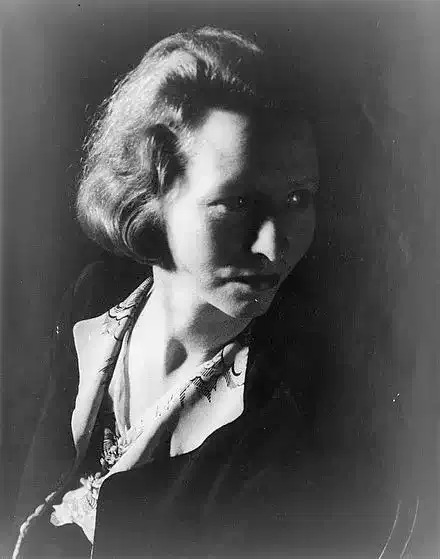
Edna St. Vincent Millay was an American poet and playwright. She was born in Rockland, Maine, United States. She primarily wrote in English. Millay became one of the most popular and influential poets of the early 20th century, often associated with the Harlem Renaissance and the Lost Generation.

Childhood and education

Millay's childhood was marked by her mother's encouragement of her artistic talents. She attended Barnard School for Girls and later Vassar College, where she began to gain recognition for her poetry. Her time at Vassar was formative, exposing her to literary circles and fostering her independent spirit.

Literary trajectory

Millay's career took off with the publication of her long narrative poem "Renascence" in 1917. She quickly became a literary sensation, known for her passionate lyrics and her defiance of convention. She published numerous collections of poetry, including "A Few Figs from Thistles" (1920), "Second April" (1921), and "The Harp-Weaver and Other Poems" (1923), for which she won the Pulitzer Prize for Poetry. She also wrote several plays.

Works, style, and literary characteristics

Major works include "Renascence" (1917), "A Few Figs from Thistles" (1920), "Second April" (1921), "The Harp-Weaver and Other Poems" (1923), and "Fatal Interview" (1931). Her poetry often explored themes of love, desire, independence, mortality, social injustice, and the passage of time. Millay was a master of traditional forms, particularly the sonnet, which she used to express intense personal emotion and sharp social commentary. Her style is characterized by its musicality, wit, emotional directness, and clarity of language. She was known for her bold, confessional voice and her unapologetic exploration of female sexuality and autonomy.

Cultural and historical context

Millay's work emerged during a period of significant social and cultural change in the United States, including the Jazz Age, the women's suffrage movement, and the Harlem Renaissance. She was a prominent figure in Greenwich Village bohemian circles and became an icon of female independence and artistic freedom.

Personal life

Millay was known for her passionate love affairs and her unconventional lifestyle. Her relationships, including her marriage to Eugen Jan Boissevain, were often sources of inspiration and sometimes turmoil. She struggled with addiction and health issues later in life.

Recognition and reception

Millay achieved immense popularity during her lifetime, becoming one of the best-selling poets in America. She won the Pulitzer Prize for Poetry in 1923. While her popularity waned somewhat in the mid-20th century, her work has seen a significant resurgence in critical appreciation in recent decades.

Influences and legacy

Millay was influenced by classical poets and the English Romantic tradition. She, in turn, influenced many later poets, particularly women writers who found inspiration in her independence and her unflinching exploration of female experience. Her work continues to be read and admired for its emotional power and its enduring relevance.

Interpretation and critical analysis

Millay's poetry is often analyzed for its feminist themes, its complex treatment of love and desire, and its engagement with social and political issues. Critics have explored her use of form to convey modern sensibility and her position within the literary landscape of her time.

Curiosities and lesser-known aspects

Millay was a charismatic performer of her own poetry and was known for her striking beauty and independent spirit, which captivated many.

Death and memory

Millay died tragically in 1950 at her home, Steepletop, in Austerlitz, New York, likely from a fall down the stairs. Her home has been preserved as a museum and literary center, ensuring her memory and work continue to be celebrated.