Poems List

The Wood Road

The Wood Road

If I were to walk this way
Hand in hand with Grief,
I should mark that maple-spray
Coming into leaf.
I should note how the old burrs
Rot upon the ground.
Yes, though Grief should know me hers
While the world goes round,
It could not if truth be said
This was lost on me:
A rock-maple showing red,
Burrs beneath a tree.
345

The True Encounter

The True Encounter

"Wolf!" cried my cunning heart
At every sheep it spied,
And roused the countryside.


"Wolf! Wolf!"—and up would start
Good neighbours, bringing spade
And pitchfork to my aid.


At length my cry was known:
Therein lay my release.
I met the wolf alone
And was devoured in peace.
464

The Spring And The Fall

The Spring And The Fall

In the spring of the year, in the spring of the year,
I walked the road beside my dear.
The trees were black where the bark was wet.
I see them yet, in the spring of the year.
He broke me a bough of the blossoming peach
That was out of the way and hard to reach.


In the fall of the year, in the fall of the year,
I walked the road beside my dear.
The rooks went up with a raucous trill.
I hear them still, in the fall of the year.
He laughed at all I dared to praise,
And broke my heart, in little ways.


Year be springing or year be falling,
The bark will drip and the birds be calling.
There's much that's fine to see and hear
In the spring of a year, in the fall of a year.
'Tis not love's going hurt my days.
But that it went in little ways.
423

The Singing-Woman From The Wood's Edge

The Singing-Woman From The Wood's Edge

What should I be but a prophet and a liar,
Whose mother was a leprechaun, whose father was a friar?
Teethed on a crucifix and cradled under water,
What should I be but the fiend's god-daughter?


And who should be my playmates but the adder and the frog,
That was got beneath a furze-bush and born in a bog?
And what should be my singing, that was christened at an altar,
But Aves and Credos and Psalms out of the Psalter?


You will see such webs on the wet grass, maybe,
As a pixie-mother weaves for her baby,
You will find such flame at the wave's weedy ebb
As flashes in the meshes of a mer-mother's web,


But there comes to birth no common spawn
From the love a a priest for a leprechaun,
And you never have seen and you never will see
Such things as the things that swaddled me!


After all's said and after all's done,
What should I be but a harlot and a nun?


In through the bushes, on any foggy day,
My Da would come a-swishing of the drops away,
With a prayer for my death and a groan for my birth,
A-mumbling of his beads for all that he was worth.


And there'd sit my Ma, with her knees beneath her chin,
A-looking in his face and a-drinking of it in,
And a-marking in the moss some funny little saying
That would mean just the opposite of all that he was praying!


He taught me the holy-talk of Vesper and of Matin,
He heard me my Greek and he heard me my Latin,
He blessed me and crossed me to keep my soul from evil,
And we watched him out of sight, and we conjured up the devil!


Oh, the things I haven't seen and the things I haven't known,
What with hedges and ditches till after I was grown,
And yanked both way by my mother and my father,
With a "Which would you better?" and a " Which would you
rather?"


With him for a sire and her for a dam,
What should I be but just what I am?
346

The Return From Town

The Return From Town

As I sat down by Saddle Stream
To bathe my dusty feet there,
A boy was standing on the bridge
Any girl would meet there.


As I went over Woody Knob
A youth was coming up the hill
Any maid would follow.


Then in I turned at my own gate,—
And nothing to be sad for—
To such a man as any WIFE
Would pass a pretty lad for.
351

The Penitent

The Penitent

I had a little Sorrow,
Born of a little Sin,
I found a room all damp with gloom
And shut us all within;
And, "Little Sorrow, weep," said I,
"And, Little Sin, pray God to die,
And I upon the floor will lie
And think how bad I've been!"


Alas for pious planning—
It mattered not a whit!
As far as gloom went in that room,
The lamp might have been lit!
My little Sorrow would not weep,
My little Sin would go to sleep—
To save my soul I could not keep
My graceless mind on it!


So I got up in anger,
And took a book I had,
And put a ribbon on my hair
To please a passing lad,
And, "One thing there's no getting by—
I've been a wicked girl," said I:
"But if I can't be sorry, why,
I might as well be glad!"
374

The Plaid Dress

The Plaid Dress

Strong sun, that bleach
The curtains of my room, can you not render
Colourless this dress I wear?—
This violent plaid
Of purple angers and red shames; the yellow stripe
Of thin but valid treacheries; the flashy green of kind deeds done
Through indolence high judgments given here in haste;
The recurring checker of the serious breach of taste?


No more uncoloured than unmade,
I fear, can be this garment that I may not doff;
Confession does not strip it off,
To send me homeward eased and bare;


All through the formal, unoffending evening, under the clean
Bright hair,
Lining the subtle gown. . .it is not seen,
But it is there.
349

The Little Ghost

The Little Ghost

I knew her for a little ghost
That in my garden walked;
The wall is high—higher than most—
And the green gate was locked.

And yet I did not think of that
Till after she was gone—
I knew her by the broad white hat,
All ruffled, she had on.

By the dear ruffles round her feet,
By her small hands that hung
In their lace mitts, austere and sweet,
Her gown's white folds among.

I watched to see if she would stay,
What she would do—and oh!
She looked as if she liked the way
I let my garden grow!

She bent above my favourite mint
With conscious garden grace,
She smiled and smiled—there was no hint
Of sadness in her face.

She held her gown on either side
To let her slippers show,
And up the walk she went with pride,
The way great ladies go.

And where the wall is built in new
And is of ivy bare
She paused—then opened and passed through
A gate that once was there.
351

The Goose-Girl

The Goose-Girl

Spring rides no horses down the hill,
But comes on foot, a goose-girl still.
And all the loveliest things there be
Come simply, so, it seems to me.
If ever I said, in grief or pride,
I tired of honest things, I lied:
And should be cursed forevermore
With Love in laces, like a whore,
And neighbours cold, and friends unsteady,
And Spring on horseback, like a lady!
370

The Death Of Autumn

The Death Of Autumn

When reeds are dead and a straw to thatch the marshes,
And feathered pampas-grass rides into the wind
Like aged warriors westward, tragic, thinned
Of half their tribe, and over the flattened rushes,
Stripped of its secret, open, stark and bleak,
Blackens afar the half-forgotten creek,—
Then leans on me the weight of the year, and crushes
My heart. I know that Beauty must ail and die,
And will be born again,—but ah, to see
Beauty stiffened, staring up at the sky!
Oh, Autumn! Autumn!—What is the Spring to me?
379

Comments (0)

Log in to post a comment.

NoComments

Identification and basic context

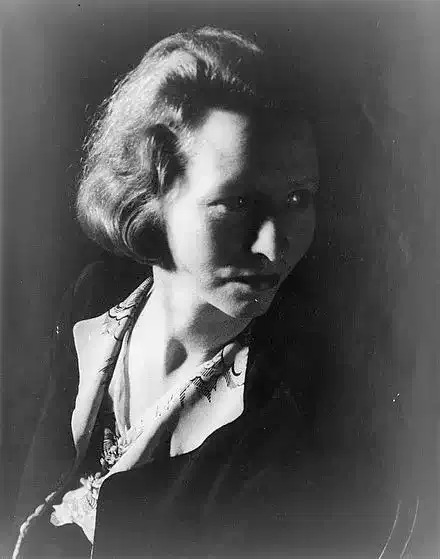
Edna St. Vincent Millay was an American poet and playwright. She was born in Rockland, Maine, United States. She primarily wrote in English. Millay became one of the most popular and influential poets of the early 20th century, often associated with the Harlem Renaissance and the Lost Generation.

Childhood and education

Millay's childhood was marked by her mother's encouragement of her artistic talents. She attended Barnard School for Girls and later Vassar College, where she began to gain recognition for her poetry. Her time at Vassar was formative, exposing her to literary circles and fostering her independent spirit.

Literary trajectory

Millay's career took off with the publication of her long narrative poem "Renascence" in 1917. She quickly became a literary sensation, known for her passionate lyrics and her defiance of convention. She published numerous collections of poetry, including "A Few Figs from Thistles" (1920), "Second April" (1921), and "The Harp-Weaver and Other Poems" (1923), for which she won the Pulitzer Prize for Poetry. She also wrote several plays.

Works, style, and literary characteristics

Major works include "Renascence" (1917), "A Few Figs from Thistles" (1920), "Second April" (1921), "The Harp-Weaver and Other Poems" (1923), and "Fatal Interview" (1931). Her poetry often explored themes of love, desire, independence, mortality, social injustice, and the passage of time. Millay was a master of traditional forms, particularly the sonnet, which she used to express intense personal emotion and sharp social commentary. Her style is characterized by its musicality, wit, emotional directness, and clarity of language. She was known for her bold, confessional voice and her unapologetic exploration of female sexuality and autonomy.

Cultural and historical context

Millay's work emerged during a period of significant social and cultural change in the United States, including the Jazz Age, the women's suffrage movement, and the Harlem Renaissance. She was a prominent figure in Greenwich Village bohemian circles and became an icon of female independence and artistic freedom.

Personal life

Millay was known for her passionate love affairs and her unconventional lifestyle. Her relationships, including her marriage to Eugen Jan Boissevain, were often sources of inspiration and sometimes turmoil. She struggled with addiction and health issues later in life.

Recognition and reception

Millay achieved immense popularity during her lifetime, becoming one of the best-selling poets in America. She won the Pulitzer Prize for Poetry in 1923. While her popularity waned somewhat in the mid-20th century, her work has seen a significant resurgence in critical appreciation in recent decades.

Influences and legacy

Millay was influenced by classical poets and the English Romantic tradition. She, in turn, influenced many later poets, particularly women writers who found inspiration in her independence and her unflinching exploration of female experience. Her work continues to be read and admired for its emotional power and its enduring relevance.

Interpretation and critical analysis

Millay's poetry is often analyzed for its feminist themes, its complex treatment of love and desire, and its engagement with social and political issues. Critics have explored her use of form to convey modern sensibility and her position within the literary landscape of her time.

Curiosities and lesser-known aspects

Millay was a charismatic performer of her own poetry and was known for her striking beauty and independent spirit, which captivated many.

Death and memory

Millay died tragically in 1950 at her home, Steepletop, in Austerlitz, New York, likely from a fall down the stairs. Her home has been preserved as a museum and literary center, ensuring her memory and work continue to be celebrated.